Chapter 7B. Signs¶
§7B.01 Design of School Signs¶
Standard
01. Except as provided in Section 2A.07, the sizes of signs and plaques to be used on conventional roadways in school areas shall be as shown in Table 7B-1.
02. The sizes in the Oversized column in Table 7B-1 shall be used on expressways in school areas.
Guidance
03. The sizes in the Oversized column should be used on roadways that have four or more lanes with posted speed limits of 40 mph or higher.
Table 7B-1. School Area Sign and Plaque Sizes
Table 7B-1. School Area Sign and Plaque Sizes
| Sign | Sign Designation | Section | Conventional Road | Minimum | Oversized |
|---|---|---|---|---|---|
| School | S1-1 | 7B.02 | 36 x 36 | 30 x 30 | 48 x 48 |
| School Bus Stop Ahead | S3-1 | 7B.04 | 36 x 36 | 30 x 30 | 48 x 48 |
| School Bus Turn Ahead | S3-2 | 7B.04 | 36 x 36 | 30 x 30 | 48 x 48 |
| Reduced School Speed Limit Ahead | S4-5, S4-5a | 7B.05 | 36 x 36 | 30 x 30 | 48 x 48 |
| School Speed Limit XX When Flashing | S5-1 | 7B.05 | 24 x 48 | — | 36 x 72 |
| End School Zone | S5-2 | 7B.02 | 24 x 30 | — | 36 x 48 |
| End School Speed Limit | S5-3 | 7B.05 | 24 x 30 | — | 36 x 48 |
| Yield (Stop) Here for School Crossing | R1-5a, R1-5c | 7B.03 | 36 x 36 | — | — |
| In-Street Ped or School Crossing | R1-6, R1-6a, R1-6b, R1-6c | 7B.03 | 12 x 36 | — | — |
| Overhead School Crossing | R1-9b, R1-9c | 7B.03 | 90 x 24 | — | — |
| Speed Limit (School Use) | R2-1 | 7B.05 | 24 x 30 | — | 36 x 48 |
| Begin Higher Fines Zone | R2-10 | 7B.06 | 24 x 30 | — | 36 x 48 |
| End Higher Fines Zone | R2-11 | 7B.06 | 24 x 30 | — | 36 x 48 |
| End Double Fines Zone | R2-11a | 7B.06 | 24 x 30 | — | 36 x 48 |
| Plaque | Sign Designation | Section | Conventional Road | Minimum | Oversized |
|---|---|---|---|---|---|
| Time of Day X:XX to X:XX AM X:XX to X:XX PM | S4-1P | 7B.06 | 24 x 12 | — | 36 x 18 |
| School | S4-3P | 7B.02, 7B.05 | 24 x 9 | — | 36 x 12 |
| When Flashing | S4-4P | 7B.05, 7B.06 | 24 x 12 | — | 36 x 18 |
| Days of Week Mon-Fri | S4-6P | 7B.05 | 24 x 12 | — | 36 x 18 |
| All Year | S4-7P | 7B.02 | 24 x 12 | — | 30 x 18 |
| Fines Higher | R2-6P | 7B.06 | 24 x 18 | — | 36 x 24 |
| Fines Double | R2-6aP | 7B.06 | 24 x 18 | — | 36 x 24 |
| $XX Fine | R2-6bP | 7B.06 | 24 x 18 | — | 36 x 24 |
| XX Feet (2-line) | W16-2P | 7B.02, 7B.03 | 24 x 18 | — | 30 x 24 |
| XX Ft (1-line) | W16-2aP | 7B.02, 7B.03 | 24 x 12 | — | 30 x 18 |
| Directional Arrow | W16-5P | 7B.02, 7B.03 | 21 x 15 | — | 30 x 21 |
| Advance Turn Arrow | W16-6P | 7B.02, 7B.03 | 21 x 15 | — | 30 x 21 |
| Downward Diagonal Arrow | W16-7P | 7B.02, 7B.03 | 21 x 15 | — | 30 x 21 |
| Ahead | W16-9P | 7B.02, 7B.03 | 24 x 12 | — | 30 x 18 |
Notes: 1. Larger sizes may be used when appropriate 2. Dimensions are shown in inches and are shown as width x height 3. Minimum sign sizes for multi-lane conventional roads shall be as shown in the Conventional Road column
Notes: 1. Larger sizes may be used when appropriate
- 2. Dimensions are shown in inches and are shown as width x height
- 3. Minimum sign sizes for multi-lane conventional roads shall be as shown in the Conventional Road column
Option
04. Signs and plaques larger than those shown in Table 7B-1 may be used (see Section 2A.07).
Standard
05. School warning signs, including the “SCHOOL” portion of the School Speed Limit (S5-1) sign and including any supplemental plaques used in association with these warning signs, shall have a fluorescent yellow-green background with a black legend and border unless otherwise provided in this Manual for a specific sign.
06. The signs used for school area traffic control shall be retroreflective or illuminated.
Support
07. Sections 2A.13 and 2A.14 contain provisions regarding the installation, placement, and location of signs.
08. Section 2A.15 contains provisions regarding the mounting heights of signs.
09. Section 2A.16 contains provisions regarding the lateral offsets of signs.
10. The “Michigan Standard Highway Signs” publication (see Section 1A.05) contains information regarding sign lettering.
Option
11. In-roadway signs for school traffic control areas may be used consistent with the requirements of Sections 2B.20 and 7B.03.
§7B.02 School Area Signs and Plaques¶
Support
Many state and local jurisdictions find it beneficial to advise road users that they are approaching a school that is adjacent to a highway, where additional care is needed, even though no school crossing is involved and the speed limit remains unchanged. Additionally, some jurisdictions designate school zones that have a unique legal standing in that fines for speeding or other moving violations within designated school zones are increased or special enforcement techniques such as photo radar systems are used. It is important and sometimes legally necessary to mark the beginning and end points of these designated school zones so that the road user is given proper notice.
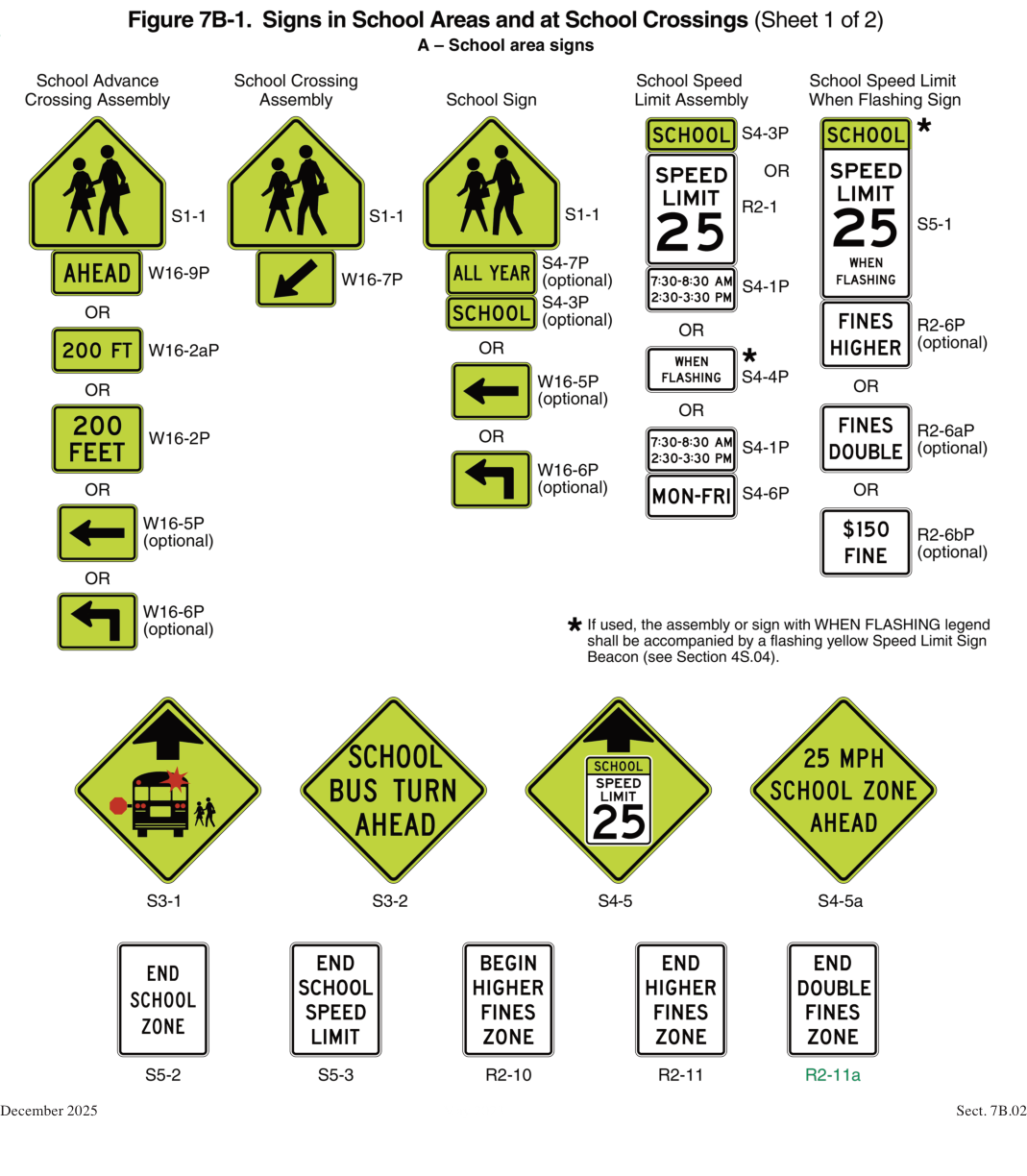
02. The School (S1-1) sign (see Figure 7B-1) has the following four applications:
- A. School Area – the S1-1 sign can be used to warn road users that they are approaching a school area that might include school buildings or grounds, a school crossing, or school related activity adjacent to the highway.
- B. School Zone – the S1-1 sign can be used to identify the location of the beginning of a designated school zone.
- C. School Advance Crossing – if combined with an AHEAD (W16-9P) plaque or an XX FEET (W16-2P or W16-2aP) plaque to comprise the School Advance Crossing assembly (see Figure 7B-1), the S1-1 sign can be used to warn road users that they are approaching a crossing where schoolchildren cross the roadway (see Section 7B.03).
- D. School Crossing – if combined with a diagonal downward-pointing arrow (W16-7P) plaque to comprise the School Crossing assembly (see Figure 7B-1), the S1-1 sign can be used to warn approaching road users of the location of a crossing where schoolchildren cross the roadway (see Section 7B.03).
Option
03. If a school area or school zone is located on a cross street in close proximity to the intersection, a School (S1-1) sign with a supplemental arrow (W16-5P or W16-6P) plaque (see Figure 7B-1) may be installed on each approach of the street or highway to warn road users making a turn onto the cross street that they will encounter a school area soon after making the turn.
Standard
04. If a school zone has been designated under State statute, a School (S1-1) sign (see Figure 7B-1) shall be installed to identify the beginning point(s) of the designated school zone (see Figure 7B-2).
Support
04A. Michigan State Statute has the following provisions on school zones.
01. MICHIGAN VEHICLE CODE (EXCERPT) Act 300 of 1949 Sec. 257.627a. "School zone" means school property on which a school building is located and the adjacent property. A school zone extends not more than 1,000 feet from the school property line in any direction. If 2 or more schools occupy the same property or adjacent properties, 1 of the following applies, as applicable: (i) If the hours of instruction at the schools are the same, then a single combined school zone shall be established. (ii) If the hours of instruction at the schools are different, overlapping school zones shall be established. History: Add. 1978, Act 42, Imd. Eff. Mar. 7, 1978 ;-- Am. 1979, Act 21, Eff. Mar. 27, 1980 ;-- Am. 1980, Act 222, Imd. Eff. July 18, 1980 ;-- Am. 1996, Act 574, Imd. Eff. Jan. 16, 1997 ;-- Am. 2000, Act 110, Imd. Eff. May 22, 2000 ;-- Am. 2005, Act 88, Imd. Eff. July 20, 2005 ;-- Am. 2016, Act 446, Imd. Eff. Jan. 5, 2017
Option
A School (S1-1) sign may be supplemented with a SCHOOL (S4-3P) plaque (see Figure 7B-1).
06. A School (S1-1) sign may be supplemented with an ALL YEAR (S4-7P) plaque (see Figure 7B-1) if the school operates on a 12-month schedule.
07. The downstream end of a designated school zone may be identified with an END SCHOOL ZONE (S5-2) sign (see Figures 7B-1 and 7B-2).
§7B.03 School Crossing Signs¶
Support
00. Michigan State Statute has the following provisions for establishing school crossings. Act 300 of 1949 Sec.257.613a. (1) Except as provided in subsections (2) and (3), the state transportation department, a county road commission, or a local authority shall establish school crossings considered necessary for the safety of schoolchildren on streets and highways under its jurisdiction. The establishment of a school crossing shall be based upon a traffic and engineering study conducted by the authority having jurisdiction, in consultation with the superintendent of the school district. (2) If considered necessary under subsection (1) or pursuant to a traffic and engineering study conducted under subsection (4), a school crossing shall be established within a safe distance from a school located on a street or highway on which the speed limit is 25 miles or more per hour. (3) Upon request of the superintendent of the school district, the following individuals shall meet at not less than 5-year intervals to consider whether a traffic and engineering study should be conducted to determine whether a school crossing is required under subsection (2): (a) The superintendent of the school district in which the school is located or his or her designee. (b) The head of the local authority having jurisdiction to maintain the road or his or her designee or, if there is no local authority, an individual designated by the director of the state transportation department. (c) The chief of police of the local unit of government in which the road is located or his or her designee or, if the local unit of government does not have a police department, the county sheriff or his or her designee. (4) If the individuals described in subsection (3) determine by unanimous vote that a traffic and engineering study should be conducted, the individuals shall notify the authority having jurisdiction to maintain the road in writing of that determination. If the authority is notified under this subsection that a traffic and engineering study should be conducted, the authority shall conduct the study. (5) Having established a school crossing, the state transportation department, county road commission, or local authority shall erect school crossing signs, in conformance with the manual of uniform traffic control devices provided for in section 608, on streets or highways under its jurisdiction. History: Add. 1978, Act 227, Imd. Eff. June 14, 1978 ;-- Am. 2004, Act 201, Imd. Eff. July 13, 2004 Popular Name: The Jasmine Miles Schoolchildren Safety Act
Standard
The School Advance Crossing assembly (see Figure 7B-1) shall consist of a School (S1-1) sign supplemented with an AHEAD (W16-9P) plaque or an XX FEET (W16-2P or W16-2aP) plaque.
02. Except as provided in Paragraph 3 of this Section, a School Advance Crossing assembly shall be used in advance (see Table 2C-3 for advance placement guidelines) of the first School Crossing assembly that is encountered in each direction as traffic approaches a school crosswalk (see Figure 7B-3).
Option
03. The School Advance Crossing assembly may be omitted (see Figure 7B-2) where a School Zone (S1-1) sign (see Section 7B.02) is installed to identify the beginning of a school zone in advance of the School Crossing assembly.
04. If a school crosswalk is located on a cross street in close proximity to an intersection, a School Advance Crossing assembly with a supplemental arrow (W16-5P or W16-6P) plaque may be installed on each approach of the street or highway to warn road users making a turn onto the cross street that they will encounter a school crosswalk soon after making the turn (see Figure 7B-3).
05. A 12-inch reduced size in-street School (S1-1) sign (see Figure 7B-1), installed in compliance with the mounting height and special mounting support requirements for an In-Street Pedestrian Crossing (R1-6 or R1-6a) sign (see Section 2B.20), may be used in advance of a school crossing to supplement the post-mounted school warning signs. A 12 x 6-inch reduced size AHEAD (W16-9P) plaque (see Figure 7B-1) may be mounted below the reduced size in-street School (S1-1) sign.
Standard
06. If used, the School Crossing assembly (see Figure 7B-1) shall be installed at the school crossing (see Figures 7B-2 and 7B-3), or as close to it as possible, and shall consist of a School (S1-1) sign supplemented with a diagonal downward-pointing arrow (W16-7P) plaque (see Section 2C.63) to show the location of the crossing.
01. The School Crossing assembly shall not be used at crossings other than those adjacent to schools and those on established school pedestrian routes.
08. The School Crossing assembly shall not be installed on an approach controlled by a STOP or a YIELD sign except as provided in Paragraphs 9 and 10 of this Section.
Option
09. The School Crossing assembly may be installed on an approach to a circular intersection controlled by a YIELD sign where the crosswalk is at least 20 feet in advance of the yield point at the entrance to a circulatory roadway.
10. At a signalized or stop-controlled intersection the School Crossing assembly may be installed on an approach to a channelized right turn lane controlled by a YIELD sign where the crosswalk is at least 20 feet in advance of the yield point.
11. A Yield Here To (Stop Here For) School Crossing (R1-5a or R1-5c) sign (see Figure 7B-4) may be used, in accordance with the provisions of Section 2B.19, in advance of a marked crosswalk that crosses an uncontrolled multi-lane approach within school zones.
12. The In-Street Pedestrian Crossing (R1-6 or R1-6a) sign (see Section 2B.20 and Figure 7B-1) or the In-Street School Crossing (R1-6b or R1-6c) sign (see Figure 7B-1) may be used, in accordance with the provisions of Section 2B.20, at school crossings on approaches that are not controlled by a traffic control signal, a pedestrian hybrid beacon, or emergency-vehicle hybrid beacon. If used at a school crossing, a 12 x 4-inch SCHOOL (S4-3P) plaque (see Figure 7B-1) may be mounted above the sign.
13. The In-Street Pedestrian Crossing (R1-6 or R1-6a) sign or In-Street School Crossing (R1-6b or R1-6c) sign may be used at intersections or midblock crossings with flashing beacons.
14. The Overhead School Crossing (R1-9b or R1-9c) sign (see Figure 7B-1) may be used, in accordance with the provisions of Section 2B.20, at school crossings on approaches that are not controlled by a traffic control signal, pedestrian hybrid beacon, or an emergency-vehicle hybrid beacon.
Standard
15. When used at an uncontrolled crossing, the In-Street or Overhead Pedestrian Crossing sign shall be used only as a supplement to a School Crossing assembly with a diagonal downward-pointing arrow (W16-7P) plaque at the crosswalk location.
Option
16. A 12-inch reduced size in-street School (S1-1) sign (see Figure 7B-1) may be used instead of the In-Street Pedestrian Crossing (R1-6 or R1-6a) or the In-Street School Crossing (R1-6b or R1-6c) sign at a school crossing on approaches that are not controlled by a traffic control signal, pedestrian hybrid beacon, or an emergency-vehicle hybrid beacon. A 12 x 6-inch reduced size diagonal downward-pointing arrow (W16-7P) plaque (see Figure 7B-1) may be mounted below the reduced size in-street School (S1-1) sign.
Standard
17. If an In-Street Pedestrian Crossing sign, an In-Street School Crossing sign, or a reduced size in-street School (S1-1) sign is placed in the roadway, the sign support shall comply with the mounting height and special mounting support requirements for an In-Street Pedestrian Crossing (R1-6 or R1-6a) sign (see Section 2B.20).
18. The In-Street Pedestrian Crossing sign, the In-Street School Crossing sign, the Overhead Pedestrian Crossing sign, and the reduced size in-street School (S1-1) sign shall not be used on approaches that are controlled by a traffic control signal, pedestrian hybrid beacon, or an emergency-vehicle hybrid beacon.
§7B.04 School Bus Stop Signs¶
Guidance
01. The School Bus Stop Ahead (S3-1) sign (see Figure 7B-1) should be installed in advance of locations where a school bus, when stopped to pick up or discharge passengers, is not visible to road users for an adequate distance and where there is no opportunity to relocate the school bus stop to provide adequate sight distance.
Option
02. The SCHOOL BUS TURN AHEAD (S3-2) sign (see Figure 7B-1) may be installed in advance of locations where a school bus turns around on a roadway at a location not visible to approaching road users for a distance as determined by the “0” column under Condition B of Table 2C-3, and where there is no opportunity to relocate the school bus turn around to provide the distance provided in Table 2C-3.
Support
03. Michigan State Statute has the following provisions for receiving and discharging pupils with buses. THE PUPIL TRANSPORTATION ACT (EXCERPT) Act 187 of 1990 Sec. 257.1855 Actuation of alternately flashing lights; procedures for receiving and discharging pupils from bus; crossing road; prohibited stops; instruction on proper school bus etiquette; reimbursement; "required to cross the roadway" explained; visibility. Sec. 55. (4) The driver of a school bus shall not stop the bus for the purpose of receiving or discharging pupils in the following instances: (a) Within 200 feet of a public or private roadway intersection unless the stop is approved by the school administrator or entity under contract with a school to provide pupil transportation services. (b) Upon a limited access highway or freeway, or upon any other highway or roadway that has been divided into 2 roadways by leaving an intervening space, a physical barrier, or clearly divided sections so constructed as to impede vehicular traffic if the pupils are required to cross the roadway. (c) Upon a roadway constructed or marked to permit 3 or more separate lanes of vehicular traffic in either direction if the pupils are required to cross the roadway. (5) The driver of a school bus when using the alternately flashing overhead red lights shall not stop the bus on any highway or roadway for the purpose of receiving or discharging pupils under the following conditions: (a) If the lawful speed limit is more than 35 miles per hour and the stopped bus is not clearly and continuously visible to approaching vehicles on that highway or roadway for at least 400 feet. When the distance from the stopped bus to the end of the highway or roadway is less than 400 feet, clear and continuous visibility must be available from the bus to the end of the highway or roadway. (b) If the lawful speed limit is 35 miles per hour or less and the stopped bus is not clearly and continuously visible to approaching vehicles on that highway or roadway, for at least 200 feet. When the distance from the stopped bus to the end of the highway or roadway is less than 200 feet, clear and continuous visibility must be available from the bus to the end of the highway or roadway. (c) Within 50 feet of an intersection if the intersection is controlled by a traffic control signal. History: 1990, Act 187, Eff. Aug. 15, 1990 ;-- Am. 1990, Act 322, Imd. Eff. Dec. 20, 1990 ;-- Am. 1991, Act 184, Imd. Eff. Dec. 27, 1991 ;-- Am. 2000, Act 49, Imd. Eff. Mar. 29, 2000 ;-- Am. 2004, Act 231, Imd. Eff. July 21, 2004 ;-- Am. 2006, Act 108, Eff. Aug. 15, 2006 ;-- Am. 2006, Act 320, Imd. Eff. July 20, 2006 ;-- Am. 2018, Act 422, Eff. Mar. 20, 2019
§7B.05 School Speed Limit Signs and Plaques¶
Standard
A School Speed Limit assembly (see Figure 7B-1) or a School Speed Limit When Flashing (S5-1) sign (see Figure 7B-1) shall be used to indicate the speed limit where a reduced school speed limit zone has been established in accordance with Section 257.627a of the “Michigan Vehicle Code.” The School Speed Limit assembly or School Speed Limit When Flashing sign shall be placed at or as near as practicable to the point where the reduced school speed limit zone begins (see Figures 7B-2 and 7B-4).
02. If a reduced school speed limit zone has been established, a School (S1-1) sign shall be installed in advance (see Table 2C-3 for advance placement guidelines) of the first School Speed Limit sign assembly or S5-1 sign that is encountered in each direction as traffic approaches the reduced school speed limit zone (see Figures 7B-2 and 7B-4).
03. Except as provided in Paragraph 4 of this Section, the downstream end of an authorized and posted reduced school speed limit zone shall be identified with an END SCHOOL SPEED LIMIT (S5-3) sign (see Figures 7B-1, 7B-2, and 7B-4).
Option
04. If a reduced school speed limit zone ends at the same point as a designated school zone (see Section 7B.02), an END SCHOOL ZONE (S5-2) sign may be used instead of an END SCHOOL SPEED LIMIT (S5-3) sign. A standard Speed Limit sign showing the speed limit for the section of highway that is downstream from the authorized and posted reduced school speed limit zone may be mounted on the same post above the END SCHOOL SPEED LIMIT (S5-3) sign or the END SCHOOL ZONE (S5-2) sign.
Guidance
05. The beginning point of a reduced school speed limit zone should be at least 200 feet in advance of the school grounds or a school crossing; however, this 200-foot distance should be increased if the reduced school speed limit is 30 mph or higher. The maximum beginning point of a reduced school speed limit zone should not be greater than 500 feet in advance of the school grounds or a school crossing.
Standard
06. The School Speed Limit assembly shall be either a static sign assembly, a blank-out sign, or a changeable message sign (see Chapter 2L).
01. The static School Speed Limit assembly shall consist of a top plaque (S4-3P) with the legend SCHOOL, a Speed Limit (R2-1) sign, and a bottom plaque (S4-1P, S4-2P, S4-4P, or S4-6P) indicating the specific periods of the day and/or days of the week that the special school speed limit is in effect (see Figure 7B-1).
08. When a School Speed Limit When Flashing (S5-1) sign or a Speed Limit (R2-1) sign with a supplemental WHEN FLASHING (S4-4P) plaque is used, a Speed Limit Sign Beacon (see Section 4S.04) shall be used to identify the periods that the school speed limit is in effect.
09. Fluorescent yellow-green pixels shall be used when the “SCHOOL” message is displayed on a changeable message sign for a school speed limit.
Option
10. Changeable message signs may use blank-out messages or other methods in order to display the school speed limit only during the periods it applies.
11. A Vehicle Speed Feedback (W13-20aP) plaque that displays the speed of approaching drivers (see Sections 2B.21 and 2C.13), that is part of a School Speed Limit assembly or a School Speed Limit When Flashing (S5-1) sign, may be used in a school speed limit zone.
Guidance
12. If used, the Vehicle Speed Feedback (W13-20aP) plaque should only be used during the time period when the school speed limit is in effect.
13. A Reduced School Speed Limit Ahead (S4-5or S4-5a) sign (see Figure 7B-1) should be used to inform road users of a reduced speed zone where the speed limit is being reduced by more than 10 mph, or where engineering judgment indicates that advance notice would be appropriate.
Standard
14. If used, the Reduced School Speed Limit Ahead sign shall be followed by a School Speed Limit sign or a School Speed Limit assembly.
15. The speed limit displayed on the Reduced School Speed Limit Ahead sign shall be identical to the speed limit displayed on the subsequent School Speed Limit sign or School Speed Limit assembly.
§7B.06 Higher Fines Zone Signs and Plaques in School Areas¶
Support
01. The signs and plaques used to inform road users of higher fines zones and their locations depend on whether the fines apply to all moving violations or only to speeding violations. Their locations also depend on whether the higher fines zone begins and/or ends at the same point as the school zone or school speed limit zone. Figures 7B-4 and 7B-5 show examples of higher fines zones signing.
Standard
02. Where increased fines are imposed for moving violations within a designated school zone as defined in Section 257.601b of the “Michigan Vehicle Code”:
- A. A BEGIN HIGHER FINES ZONE (R2-10) sign (see Figure 7B-1) or a FINES HIGHER (R2-6P), FINES DOUBLE (R2-6aP), or $XX FINE (R2-6bP) plaque (see Figure 7B-1) shall be installed as a supplement to the School Zone (S1-1) sign to identify the beginning point of the higher fines zone (see Figures 7B-4 and 7B-5); and
- B. An END HIGHER FINES ZONE (R2-11) sign (see Figure 7B-1 ), END DOUBLE FINES ZONE (R2-11a) sign (See Figure 7B-1), or an END SCHOOL ZONE (S5-2) sign (see Figure 7B-1) shall be installed at the downstream end of the zone to notify road users of the termination of the increased fines zone (see Figure 7B-5).
03. If exceeding the speed limit is the only moving violation that is subject to higher fines, a FINES HIGHER (R2-6P), FINES DOUBLE (R2-6aP), or $XX FINE (R2-6bP) plaque shall be posted with the School Speed Limit (S5-1) sign and shall not be posted beneath the School Zone (S1-1) sign (see Section 7B.05).
04. If the portion of the roadway that is subject to higher fines does not begin at the location of the School Zone (S1-1) sign, a BEGIN HIGHER FINES ZONE (R2-10) sign shall be placed at the point where the higher fines begin (see Sheet 2 of Figure 7B-5).
Option
05. If a BEGIN HIGHER FINES ZONE (R2-10) sign is used downstream of the School Zone (S1-1) sign, a FINES HIGHER (R2-6P), FINES DOUBLE (R2-6aP), or $XX FINE (R2-6bP) plaque may also be placed beneath the School Zone (S1-1) sign.
06. Where appropriate, one of the following plaques may be mounted below the sign that identifies the beginning point of the higher fines zone:
- A. A S4-1P plaque (see Figure 7B-1) specifying the times that the higher fines are in effect, or
- B. A WHEN FLASHING (S4-4P) plaque (see Figure 7B-1) if used in conjunction with a yellow flashing beacon.
Figure 7B-5. Example of Signing for a School Zone with Higher Fines for All Moving Violations (Sheet 2 of 2)
for All Moving Violations (Sheet 2 of 2) B – Higher fines zone begins after the beginning of the school zone R2-6bP (optional) R2-11a R2-6aP (optional) (optional) S4-3P (optional) Sch ool R2-11a S4-3P (optional) R2-6aP R2-6bP (optional) (optional) (optional)
Guidance
07. If other moving violations in addition to exceeding the speed limit are subject to higher fines, then the duplicate FINES HIGHER (R2-6P), FINES DOUBLE (R2-6aP), or $XX FINE (R2-6bP) plaque should be omitted from the School Speed Limit When Flashing (S5-1) sign (see Section 7B.05).
Option
08. If a higher fines zone ends at the same point as a reduced school speed limit zone, an END SCHOOL ZONE (S5-2) sign may be used instead of a combination of an END HIGHER FINES ZONE (R2-11) sign and an END SCHOOL SPEED LIMIT (S5-3) sign (see Figure 7B-5).
09. Where the higher fines zone is established by statute, the BEGIN HIGHER FINES ZONE (R2-10) sign, FINES HIGHER (R2-6P), FINES DOUBLE (R2-6aP), and $XX FINE (R2-6bP) plaques may be omitted.
§7B.07 Parking and Stopping (R7 and R8 Series) Signs¶
Option
01. Parking and stopping regulatory signs may be used to prevent parked or waiting vehicles from blocking pedestrians’ views, and drivers’ views of pedestrians, and to control vehicles as a part of the school traffic plan.
Support
02. Parking signs and other signs governing the stopping and standing of vehicles in school areas cover a wide variety of regulations. Typical examples of regulations are as follows:
- A. NO PARKING X:XX AM to X:XX PM SCHOOL DAYS ONLY
- B. NO STOPPING X:XX AM to X:XX PM SCHOOL DAYS ONLY,
- C. XX MIN LOADING X:XX AM to X:XX PM SCHOOL DAYS ONLY, and
- D. NO STANDING X:XX AM to X:XX PM SCHOOL DAYS ONLY.
03. Sections 2B.53 through 2B.55 contain information regarding the signing of parking regulations in school zone areas.