Chapter 6G. TTC Zone Regulatory Signs¶
§6G.01 Regulatory Sign Authority¶
Support
01. Regulatory signs such as those shown in Figure 6G-1 inform road users of traffic laws or regulations and indicate the applicability of legal requirements that would not otherwise be apparent.
Standard
02. Regulatory signs shall be authorized by the public agency or official having jurisdiction and shall conform with Chapter 2B.
§6G.02 Regulatory Sign Design and Size¶
Standard
01. TTC regulatory signs shall comply with the Standards for regulatory signs presented in Part 2 and in the FHWA’s “Standard Highway Signs” publication (see Section 1A.05).
02. The sizes for TTC regulatory signs shall be as shown in Table 6G-1.
§6G.03 Regulatory Sign Applications¶
Standard
01. If a TTC zone requires regulatory measures different from those existing, the existing permanent regulatory devices shall be removed or covered and superseded by the appropriate temporary regulatory signs. This change shall be made in compliance with applicable ordinances or statutes of the jurisdiction.
§6G.04 Road Closed Signs (R11-2 Series)¶
Alaska-modified
Alaska amends this section per the Alaska Traffic Manual Supplement (effective January 20, 2026). The National MUTCD text is shown above; below is Alaska's amended text, as published in the supplement (deletions removed, additions kept).
Supplement directive: - The Alaska Traffic Manual Supplement states this section for Alaska; the ATMS text below replaces the corresponding National MUTCD content (deletions removed, additions kept).
Sign (R11-101), and Lane Closed Sign (R11-102)
Guidance: 01. The ROAD CLOSED (RII-2) sign (see Figure 6G-I) or ROAD CLOSED AVALANCHE AREA (R11-101) should be used when the roadway is closed to all road users except contractors' equipment or officially authorized vehicles. The RII-2 sign or R11-101 should be accompanied by appropriate warning and detour signing.
Option: 02. STREET CLOSED (R11-2a), ROAD CLOSED AVALANCHE AREA (R11-101), BRIDGE OUT (R11-2b), or PATH CLOSED (R11-2c) signs may be substituted for Road Closed signs where applicable.
Guidance: 03. Road Closed or Road Closed Avalanche Area signs should be installed at or near the center of the roadway on or above a Type 3 Barricade that closes the roadway (see Section 6K.07).
Standard: 04. Road Closed or Road Closed Avalanche Area signs shall not be used where road user flow is maintained through the TTC zone with a reduced number of lanes on the existing roadway or where the actual closure is some distance beyond the sign.
Option: 05A. The LANE CLOSED (R11-102) sign may be posted on Type 3 barricades at cross street intersections within a lane closure where one or more through lanes of a multi-lane roadway are closed.
Guidance
01. The ROAD CLOSED (R11-2) sign (see Figure 6G-1) should be used when the roadway is closed to all road users except contractors’ equipment or officially authorized vehicles. The R11-2 sign should be accompanied by appropriate warning and detour signing.
Option
02. STREET CLOSED (R11-2a), BRIDGE OUT (R11-2b), or PATH CLOSED (R11-2c) signs may be substituted for Road Closed signs where applicable.
Guidance
03. Road Closed signs should be installed at or near the center of the roadway on or above a Type 3 Barricade that closes the roadway (see Section 6K.07).
Standard
04. Road Closed signs shall not be used where road user flow is maintained through the TTC zone with a reduced number of lanes on the existing roadway or where the actual closure is some distance beyond the sign.
§6G.05 Local Traffic Only Signs (R11-3 Series and R11-4)¶
Guidance
01. The Local Traffic Only signs (see Figure 6G-1) should be used where road users follow detours to avoid a closure some distance beyond the sign, but where local road users can use the roadway to the point of closure. These signs should be accompanied by appropriate warning and detour signing.
02. In rural applications, the Local Traffic Only sign should have the legend ROAD CLOSED XX MILES AHEAD,
Option
03. In urban areas, a ROAD (STREET) CLOSED TO THRU TRAFFIC (R11-4) sign or the legend ROAD CLOSED, LOCAL TRAFFIC ONLY may be used.
04. In urban areas, a word message that includes the name of an intersecting street name or well-known destination may be substituted for the words XX MILES AHEAD on the R11-3 sign where applicable.
05. A STREET CLOSED (R11-3a) or BRIDGE OUT (R11-3b) sign may be substituted for an R11-3 sign, where applicable.
06. The words BRIDGE OUT, BRIDGE CLOSED, or STREET CLOSED may be substituted for the words ROAD CLOSED on the R11-4 sign where applicable.
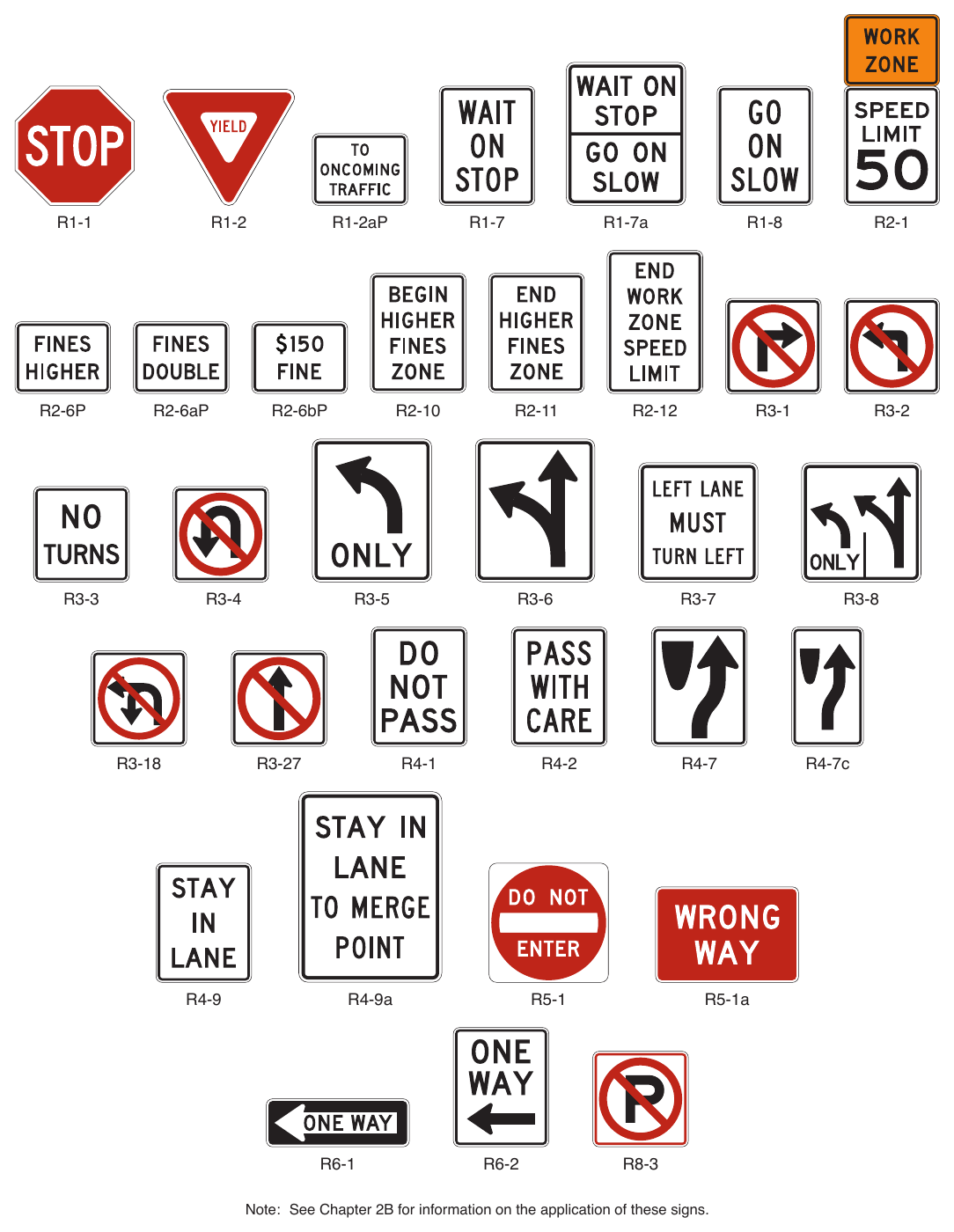
Signs shown: G20-5aP, R1-1, R1-2, R1-2aP, R1-7, R1-7a, R1-8, R2-1, R2-6P, R2-6aP, R2-6bP, R2-10, R2-11, R2-12, R3-1, R3-2, R3-3, R3-4, R3-5, R3-6, R3-7, R3-8, R3-18, R3-27, R4-1, R4-2, R4-7, R4-7c, R4-9, R4-9a, R5-1, R5-1a, R6-1, R6-2, R8-3
in Temporary Traffic Control Zones (Sheet 1 of 2) R1-2aP R1-7a G20-5aP R2-6aP R2-6bP R4-9a R4-7c R5-1a Note: See Chapter 2B for information on the application of these signs.
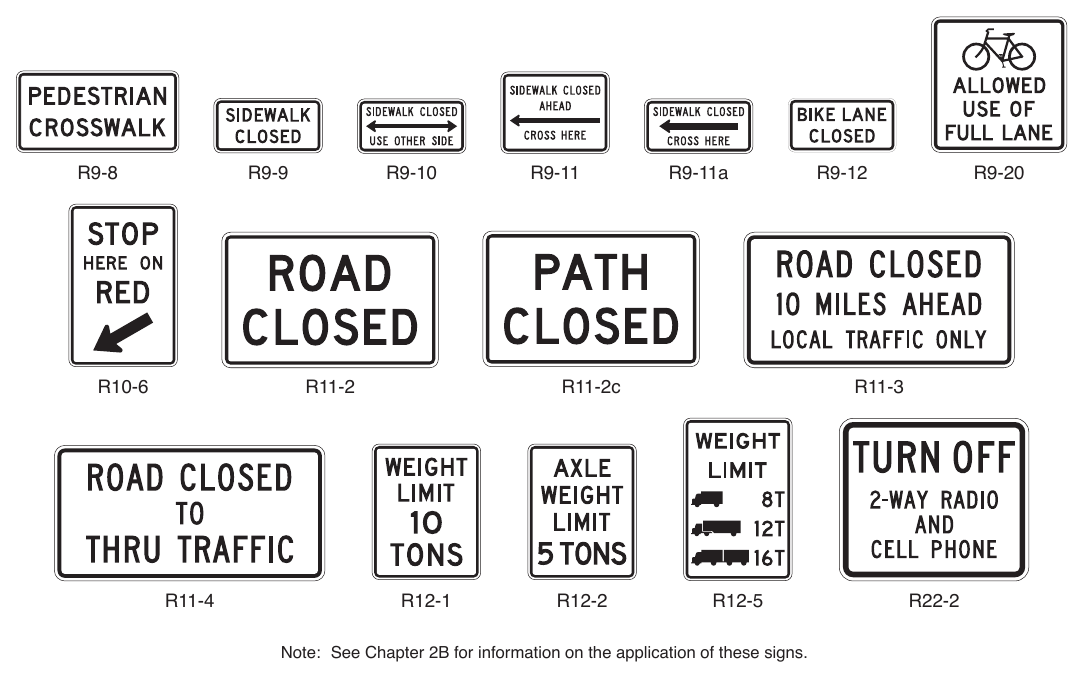
Signs shown: R9-8, R9-9, R9-10, R9-11, R9-11a, R9-12, R9-20, R10-6, R11-2, R11-2c, R11-3, R11-4, R12-1, R12-2, R12-5, R22-2
in Temporary Traffic Control Zones (Sheet 2 of 2) R9-11a R11-2c Note: See Chapter 2B for information on the application of these signs.
§6G.06 Weight Limit Signs (R12-1, R12-2, and R12-5)¶
Standard
01. A Weight Limit sign (see Figure 6G-1), which shows the gross weight or axle weight that is permitted on the roadway or bridge, shall be consistent with State or local regulations and shall not be installed without the approval of the authority having jurisdiction over the highway.
02. When weight restrictions are imposed because of the activity in a TTC zone, a marked detour shall be provided for vehicles weighing more than the posted limit.
§6G.07 STAY IN LANE Signs (R4-9 and R4-9a)¶
Option
01. A STAY IN LANE (R4-9) sign (see Figure 6G-1) may be used where a multi-lane shift has been incorporated as part of the TTC on a highway to direct road users around road work that occupies part of the roadway on a multi-lane highway.
Guidance
02. A STAY IN LANE TO MERGE POINT (R4-9a) sign (see Figure 6G-1) should be used during late merge operations (see Section 6N.19) to direct traffic to use all available lanes until the merge point is reached.
§6G.08 Work Zone and Higher Fines Signs and Plaques¶
Alaska-modified
Alaska amends this section per the Alaska Traffic Manual Supplement (effective January 20, 2026). The National MUTCD text is shown above; below is Alaska's amended text, as published in the supplement (deletions removed, additions kept).
Supplement directive: - The Alaska Traffic Manual Supplement states this section for Alaska; the ATMS text below replaces the corresponding National MUTCD content (deletions removed, additions kept).
Option: 01. A WORK ZONE (G20-5aP) plaque (see Figure 6G-l) may be mounted above a Speed Limit sign to emphasize that a reduced speed limit is in effect within a TTC zone. An END WORK ZONE SPEED LIMIT (R2-l2) sign (see Figure 6G-l) may be installed at the downstream end of the reduced speed limit zone.
Guidance: 02. A BEGIN HIGHER FINES ZONE (R2-lO) sign (see Figure 6G-l) should be installed at or near the beginning of a TTC zone where increased fines are imposed for traffic violations, and an END HIGHER FINES ZONE (R2-11) sign (see Figure 6G-l) should be installed at or near the downstream end of the TTC zone.
Option: 03. Alternate legends such as BEGIN (or END) DOUBLE FINES ZONE may also be used for the R2- 10 and R2-11 signs.
04. A FINES HIGHER, FINES DOUBLE, or $XX FINE plaque (see Section 2B.25 and Figure 6G-1) may be mounted below the Speed Limit sign if increased fines are imposed for traffic violations within the TTC zone.
05. Individual signs and plaques for work zone speed limits and higher fines may be combined into a single sign or may be displayed as an assembly of signs and plaques.
Support: 05A. The WORK ZONE BEGIN DOUBLE TRAFFIC FINES (R16-100) and END DOUBLE TRAFFIC FINES (R16-101) signs legally establish the beginning and end of double fine zones. See
13. AAC 40.010 and 17 AAC 99.010. See Section 2B.17.
Standard: 05B. On DOT&PF construction projects, the DOT&PF RTSE or the traffic control coordinator shall identify projects to receive double fine signs. On DOT&PF maintenance projects, the regional maintenance and operations chief shall make that decision. All decisions shall be made in accordance with the information given in this section.
Guidance: 05C. Double fine signs should be posted in designated double fine zones in all road construction, repair, maintenance, or utility work areas except for the following: A. Mobile operations, such as striping, grading, brush cutting, etc. B. Work on low-volume, low-speed roads. C. Pilot car operations that extend the entire length of a project. D. Work that will last less than 48 hours.
Option: 05D. Double fine signs may be omitted when work zones are shorter than 1 mile.
Standard: 05E. Within the previously described road work areas, roadway segments where one or more of the following conditions exist shall be designated double fine zones: A. Active work areas: Areas where road workers and/or machinery are presently working on or adjacent to a road.
B. Detours on new temporary roads built for that purpose; this does not include detours on existing streets. C. Sections of paved roads where pavement has been removed. D. Roads where unmatched asphalt lifts result in a vertical lip between lanes.
05F. Double fine signs shall be used only in designated double fine zones. They shall be removed or covered when work ceases and conditions B through D of this Standard subsection 05E do not exist.
05G. Double fine signs shall be confined to areas where the above conditions exist, with the following exceptions: A. If the project is 2 miles or shorter in length. B. When the above conditions exist at multiple locations separated by less than 2 miles, the locations and intervening segments shall be posted as a single double fine zone. C. Where no law enforcement exists to enforce these zones.
Support: 05H. “Work Zone Speed Limit Signs,” as used here, refer to SPEED LIMIT (R2-1) signs with a WORK ZONE (G20-5Ap) above and a FINES DOUBLE (R2-6Ap) plaques mounted below them.
Standard: 05I. The speed limit shown on Work Zone Speed Limit signs shall be either the existing limit before work began or, if a work zone speed order has been approved in accordance with DOT&PF Procedure 05.05.020, a reduced limit.
05J. Work Zone Speed Limit signs shall be posted at the beginning of every double fine zone, regardless of whether the speed limit has been reduced from the speed limit prior to implementation of temporary traffic control.
05K. The END DOUBLE TRAFFIC FINES (R16-101) sign shall be posted at the end of every double fine zone.
05L. The speed limit for the road beyond the construction zone shall be posted at the end of every double fine zone.
05M. All existing regulatory speed limit signs within the double fines zone shall be supplemented with R2-6aP plaques.
05N. When a double fine zone is longer than 2 miles, Work Zone Speed Limit signs shall be posted at spacings not greater than 2 miles within the double fines zone.
050. Signs shall be installed at major intersections within the double fine zones, using one of the following methods to warn entering drivers of double fines: A. Install work zone speed limit signs on the main street on either side of the intersection. B. Install WORK ZONE BEGIN DOUBLE TRAFFIC FINES (R16-100) signs with W1-7 Arrow Panels mounted below them on the side street(s). The use of this signing eliminates the need for ROAD WORK AHEAD (W20-100) signs.
Support: 05Q. The use of the double fines zone signs is not intended to be a reason for diminishing the number of warning signs that would normally be required in the work zone.
05R. Overuse of the double fine signs will diminish respect for, and effectiveness of, the signs. It will also result in needlessly increased fines for traffic citations.
Option
01. A WORK ZONE (G20-5aP) plaque (see Figure 6G-1) may be mounted above a Speed Limit sign to emphasize that a reduced speed limit is in effect within a TTC zone. An END WORK ZONE SPEED LIMIT (R2-12) sign (see Figure 6G-1) may be installed at the downstream end of the reduced speed limit zone.
Guidance
02. A BEGIN HIGHER FINES ZONE (R2-10) sign (see Figure 6G-1) should be installed at or near the beginning of a TTC zone where increased fines are imposed for traffic violations, and an END HIGHER FINES ZONE (R2-11) sign (see Figure 6G-1) should be installed at or near the downstream end of the TTC zone.
Table 6G-1. Temporary Traffic Control Zone Regulatory Sign and Plaque Sizes
| Sign or Plaque | Sign Designation | Section | Conventional Road | Freeway or Expressway | Minimum |
|---|---|---|---|---|---|
| Stop | R1-1 | 6G.02 | 30 x 30* | — | — |
| Stop (on Stop/Slow Paddle) | R1-1 | 6D.02 | 18 x 18 | — | — |
| Yield | R1-2 | 6G.02 | 36 x 36 x 36* | — | 30 x 30 x 30 |
| To Oncoming Traffic (plaque) | R1-2aP | 6G.02 | 36 x 30 | 48 x 36 | 24 x 18 |
| Wait on Stop | R1-7 | 6L.03 | 24 x 30 | 24 x 30 | — |
| Wait on Stop - Go on Slow | R1-7a | 6L.03 | 30 x 36 | 30 x 36 | — |
| Go on Slow | R1-8 | 6L.03 | 24 x 30 | 24 x 30 | — |
| Speed Limit | R2-1 | 6G.08 | 24 x 30* | 36 x 48 | — |
| Fines Higher (plaque) | R2-6P | 6G.08 | 24 x 18 | 36 x 24 | — |
| Fines Double (plaque) | R2-6aP | 6G.08 | 24 x 18 | 36 x 24 | — |
| $XX Fine (plaque) | R2-6bP | 6G.08 | 24 x 18 | 36 x 24 | — |
| Begin Higher Fines Zone | R2-10 | 6G.08 | 24 x 30 | 36 x 48 | — |
| End Higher Fines Zone | R2-11 | 6G.08 | 24 x 30 | 36 x 48 | — |
| End Work Zone Speed Limit | R2-12 | 6G.08 | 24 x 36 | 36 x 54 | — |
| Movement Prohibition | R3-1,2,3,4 | 6G.02 | 24 x 24* | 36 x 36 | — |
| Mandatory Movement Lane Control - Turn Only | R3-5 | 6G.02 | 30 x 36 | — | — |
| Optional Movement Lane Control - Thru and Turn | R3-6 | 6G.02 | 30 x 36 | — | — |
| Right (Left) Lane Must Turn Right (Left) | R3-7 | 6G.02 | 30 x 30* | — | — |
| Advance Intersection Lane Control (2 lanes) | R3-8 | 6G.02 | 30 x 30 | — | — |
| Movement Prohibition - No U or Left Turn | R3-18 | 6G.02 | 24 x 24* | 36 x 36 | — |
| Movement Prohibition - No Straight Through | R3-27 | 6G.02 | 24 x 24* | 36 x 36 | — |
| Do Not Pass | R4-1 | 6G.02 | 24 x 30 | 36 x 48 | — |
| Pass With Care | R4-2 | 6G.02 | 24 x 30 | 36 x 48 | — |
| Keep Right | R4-7 | 6G.02 | 24 x 30 | 36 x 48 | — |
| Narrow Keep Right | R4-7c | 6G.02 | 18 x 30 | — | — |
| Stay in Lane | R4-9 | 6G.07 | 24 x 30 | 36 x 48 | — |
| Stay In Lane To Merge Point | R4-9a | 6G.07 | 36 x 48 | 36 x 48 | — |
| Do Not Enter | R5-1 | 6G.02 | 30 x 30* | 36 x 36 | — |
| Wrong Way | R5-1a | 6G.02 | 36 x 24* | 42 x 30 | — |
| One Way | R6-1 | 6G.02 | 36 x 12* | 48 x 18 | — |
| One Way | R6-2 | 6G.02 | 24 x 30* | 36 x 48 | — |
| No Parking (symbol) | R8-3 | 6G.02 | 24 x 24* | 36 x 36 | — |
| Pedestrian Crosswalk | R9-8 | 6G.09 | 36 x 18 | — | — |
| Sidewalk Closed | R9-9 | 6G.10 | 24 x 12 | — | — |
| Sidewalk Closed, Use Other Side | R9-10 | 6G.10 | 24 x 12 | — | — |
| Sidewalk Closed Ahead, Cross Here | R9-11 | 6G.10 | 24 x 18 | — | — |
| Sidewalk Closed, Cross Here | R9-11a | 6G.10 | 24 x 12 | — | — |
| Bike Lane Closed | R9-12 | 6P.01 | 24 x 12 | — | — |
| Stop Here on Red | R10-6 | 6L.04 | 24 x 36 | — | — |
| Road Closed | R11-2, 2a, 2b, 2c | 6G.04 | 48 x 30 | — | — |
| Road Closed - Local Traffic Only | R11-3, 3a, 3b, 4 | 6G.05 | 60 x 30 | — | — |
| Weight Limit | R12-1, 2 | 6G.06 | 24 x 30 | 36 x 48 | — |
| Weight Limit | R12-5 | 6G.06 | 24 x 36 | 36 x 48 | — |
| Turn Off 2-Way Radio and Cell Phone | R22-2 | 6G.11 | 42 x 36 | 42 x 36 | — |
| Work Zone (plaque) | G20-5aP | 6G.08 | 24 x 18 | 30 x 24 | — |
* See Table 2B-1 for minimum size required for signs facing traffic on multi-lane conventional roads Notes: 1. Larger signs may be used wherever necessary for greater legibility or emphasis 2. Dimensions are shown in inches and are shown as width x height
Notes:
- 1. Larger signs may be used wherever necessary for greater legibility or emphasis
- 2. Dimensions are shown in inches and are shown as width x height
Option
03. Alternate legends such as BEGIN (or END) DOUBLE FINES ZONE may also be used for the R2-10 and R2-11 signs.
04. A FINES HIGHER, FINES DOUBLE, or $XX FINE plaque (see Section 2B.25 and Figure 6G-1) may be mounted below the Speed Limit sign if increased fines are imposed for traffic violations within the TTC zone.
05. Individual signs and plaques for work zone speed limits and higher fines may be combined into a single sign or may be displayed as an assembly of signs and plaques.
§6G.09 PEDESTRIAN CROSSWALK Sign (R9-8)¶
Option
01. The PEDESTRIAN CROSSWALK (R9-8) sign (see Figure 6G-1) may be used to indicate where a temporary crosswalk has been established.
Standard
02. If a temporary crosswalk is established, it shall be accessible to pedestrians with disabilities in accordance with Section 6C.03.
§6G.10 SIDEWALK CLOSED Signs (R9-9, R9-10, R9-11, and R9-11a)¶
Alaska-modified
Alaska amends this section per the Alaska Traffic Manual Supplement (effective January 20, 2026). The National MUTCD text is shown above; below is Alaska's amended text, as published in the supplement (deletions removed, additions kept).
Supplement directive: - The Alaska Traffic Manual Supplement states this section for Alaska; the ATMS text below replaces the corresponding National MUTCD content (deletions removed, additions kept).
Guidance: 01. SIDEWALK CLOSED signs (see Figure 6G-l) should be used where pedestrian flow is restricted. Bicyclist/ Pedestrian Detour (M4-9a) signs or Pedestrian Detour (M4-9b) signs should be used where pedestrian flow is rerouted (see Section 6I.02).
02. The SIDEWALK CLOSED (R9-9) sign should be installed at the beginning of the closed sidewalk, at the intersections preceding the closed sidewalk, and elsewhere along the closed sidewalk as needed.
03. The SIDEWALK CLOSED, (ARROW) USE OTHER SIDE (R9-l0) sign should be installed at the beginning of the restricted sidewalk when a parallel sidewalk exists on the other side of the roadway.
04. The SIDEWALK CLOSED AHEAD, (ARROW) CROSS HERE (R9-11) sign should be used to indicate to pedestrians that sidewalks beyond the sign are closed and to direct them to open crosswalks, sidewalks, or other travel paths.
05. The SIDEWALK CLOSED, (ARROW) CROSS HERE (R9-lla) sign should be installed just beyond the point to which pedestrians are being redirected.
Support: 06. These signs are typically mounted on a detectable barricade to encourage compliance and to communicate with pedestrians that the sidewalk is closed. Printed signs are not useful to many pedestrians with vision disabilities. A barrier or barricade detectable by a person with a vision disability is sufficient to indicate that a sidewalk is closed. If the barrier is continuous with detectable channelizing devices for an alternate route, accessible signing might not be necessary.
Option: 06A. The PEDESTRIAN (Arrow) (R9-100) sign may be used to direct pedestrians along pedestrian detour paths through or around work sites.
06B. The Bicycle Pedestrian (Symbol) PATHWAY (R9-101) sign may be used to direct pedestrians and bicyclists to a pathway through or around work sites.
Guidance
01. SIDEWALK CLOSED signs (see Figure 6G-1) should be used where pedestrian flow is restricted. Bicyclist/ Pedestrian Detour (M4-9a) signs or Pedestrian Detour (M4-9b) signs should be used where pedestrian flow is rerouted (see Section 6I.02).
02. The SIDEWALK CLOSED (R9-9) sign should be installed at the beginning of the closed sidewalk, at the intersections preceding the closed sidewalk, and elsewhere along the closed sidewalk as needed.
03. The SIDEWALK CLOSED, (ARROW) USE OTHER SIDE (R9-10) sign should be installed at the beginning of the restricted sidewalk when a parallel sidewalk exists on the other side of the roadway.
04. The SIDEWALK CLOSED AHEAD, (ARROW) CROSS HERE (R9-11) sign should be used to indicate to pedestrians that sidewalks beyond the sign are closed and to direct them to open crosswalks, sidewalks, or other travel paths.
05. The SIDEWALK CLOSED, (ARROW) CROSS HERE (R9-11a) sign should be installed just beyond the point to which pedestrians are being redirected.
Support
06. These signs are typically mounted on a detectable barricade to encourage compliance and to communicate with pedestrians that the sidewalk is closed. Printed signs are not useful to many pedestrians with vision disabilities. A barrier or barricade detectable by a person with a vision disability is sufficient to indicate that a sidewalk is closed. If the barrier is continuous with detectable channelizing devices for an alternate route, accessible signing might not be necessary.
§6G.11 TURN OFF 2-WAY RADIO AND CELL PHONE Sign (R22-2)¶
Standard
01. The TURN OFF 2-WAY RADIO AND CELL PHONE (R22-2) sign (see Figure 6G-1) shall be used to require road users to turn off mobile radio transmitters and cellular telephones where blasting operations occur.
Support
02. Section 6H.25 contains information about the full sequence of signs for blasting zones and the specific requirements for location of this regulatory sign.
§6G.12 Other Regulatory Signs¶
Option
01. Regulatory word message signs other than those classified and specified in this Manual and the “Standard Highways Signs” publication (see Section 1A.05) may be developed and used based on engineering judgment to aid the enforcement of other laws or regulations in TTC zones.
Guidance
02. Special regulatory signs should comply with the general requirements of color, shape, and alphabet size and series. The sign message should be brief, legible, and clear.