Chapter 7A. General¶
§7A.01 Introduction¶
Alaska-modified
Alaska amends this section per the Alaska Traffic Manual Supplement (effective January 20, 2026). The National MUTCD text is shown above; below is Alaska's amended text, as published in the supplement (deletions removed, additions kept).
Supplement directive: - The Alaska Traffic Manual Supplement states this section for Alaska; the ATMS text below replaces the corresponding National MUTCD content (deletions removed, additions kept).
Support: 01. Part 7 sets forth basic principles and prescribes standards for the design, application, installation, and maintenance of all traffic control devices (including signs, signals, and markings) and other controls (including adult crossing guards) for the special pedestrian conditions in school areas.
01A. “School,” “school zone,” “school area,” and “school district” are defined in Section 1C.02.
Support
01. Part 7 sets forth basic principles and prescribes standards for the design, application, installation, and maintenance of all traffic control devices (including signs, signals, and markings) and other controls (including adult crossing guards) for the special pedestrian conditions in school areas.
§7A.02 School Route Plans and School Crossings¶
Alaska-modified
Alaska amends this section per the Alaska Traffic Manual Supplement (effective January 20, 2026). The National MUTCD text is shown above; below is Alaska's amended text, as published in the supplement (deletions removed, additions kept).
Supplement directive: - The Alaska Traffic Manual Supplement states this section for Alaska; the ATMS text below replaces the corresponding National MUTCD content (deletions removed, additions kept).
Standard: 01A. A school route plan shall be approved by the highway authority in order for the RTSE or city traffic engineer to select the traffic control devices.
Guidance: 01. A school route plan for each school serving elementary to high school students should be prepared in order to develop uniformity in the use of school area traffic controls and to serve as the basis for a school traffic control plan for each school.
02. The school route plan, developed in a systematic manner by the school, law enforcement, and traffic officials responsible for school pedestrian safety, should consist of a map (see Figure 7A‑1) showing streets, the school, existing traffic controls, established school walk routes, and established school crossings.
03. Bicycle use as a mode of transportation, as applicable, should also be considered if students biking to and from school are not allowed to use the sidewalks along the pedestrian route.
04. Installation of school area traffic control devices and the type(s) of school area traffic control devices used, either warning or regulatory, should be related to the volume and speed of vehicular traffic, street width, and the number and age of the students using the crossing rather than just the presence of school area boundaries.
05. School area traffic control devices should be included in a school traffic control plan.
Support: 06. To establish a safer route to and from school for schoolchildren, the application of planning criterion for school walk routes might make it necessary for children to walk an indirect route to an established school crossing located where there is existing traffic control and to avoid the use of a direct crossing where there is no existing traffic control.
06A. Planning of student transportation to and from school is primarily a responsibility of the local school district.
07. The frequency of gaps in the traffic stream that are sufficient for student crossing is different at each crossing location. When the delay between the occurrences of adequate gaps becomes excessive, students might become impatient and endanger themselves by attempting to cross the street during an inadequate gap. In these instances, the creation of sufficient gaps needs to be considered to accommodate the crossing demand.
Guidance: 08. School walk routes should be planned to take advantage of existing traffic controls.
09. The following factors should be considered when determining the feasibility of requiring children to walk a longer distance to a crossing with existing traffic control: A. The availability of adequate sidewalks or other pedestrian walkways to and from the location with existing control, B. The number of students using the crossing, C. The age levels of the students using the crossing, and D. The total extra walking distance.
09A. Before designated school zones are established, a team consisting of representatives of the local school district, local government, law enforcement agency, and the highway authority should convene to discuss student transportation issues, walking routes, reduced school speed limits, and designated road crossings for students. When a school route plan has been approved by the local school district and accepted by the highway authority, the RTSE or city traffic engineer will determine the appropriate traffic control needed.
Support: 10. A School Crossing signal warrant is provided in Section 4C.06.
10A. School Zone traffic control facilitates children crossing the highway or roadway as shown on the approved school route plan and highway authority designated school zones.
10B. Planning of school sites is done using Department of Education and Early Development “Site Selection Criteria and Evaluation Handbook 2021.” Schools located within the Municipality of Anchorage (MOA) use the MOA School Area Traffic Safety Manual. Both documents aid in the development of safer school zones.
Guidance
01. A school route plan for each school serving elementary to high school students should be prepared in order to develop uniformity in the use of school area traffic controls and to serve as the basis for a school traffic control plan for each school.
02. The school route plan, developed in a systematic manner by the school, law enforcement, and traffic officials responsible for school pedestrian safety, should consist of a map (see Figure 7A-1) showing streets, the school, existing traffic controls, established school walk routes, and established school crossings.
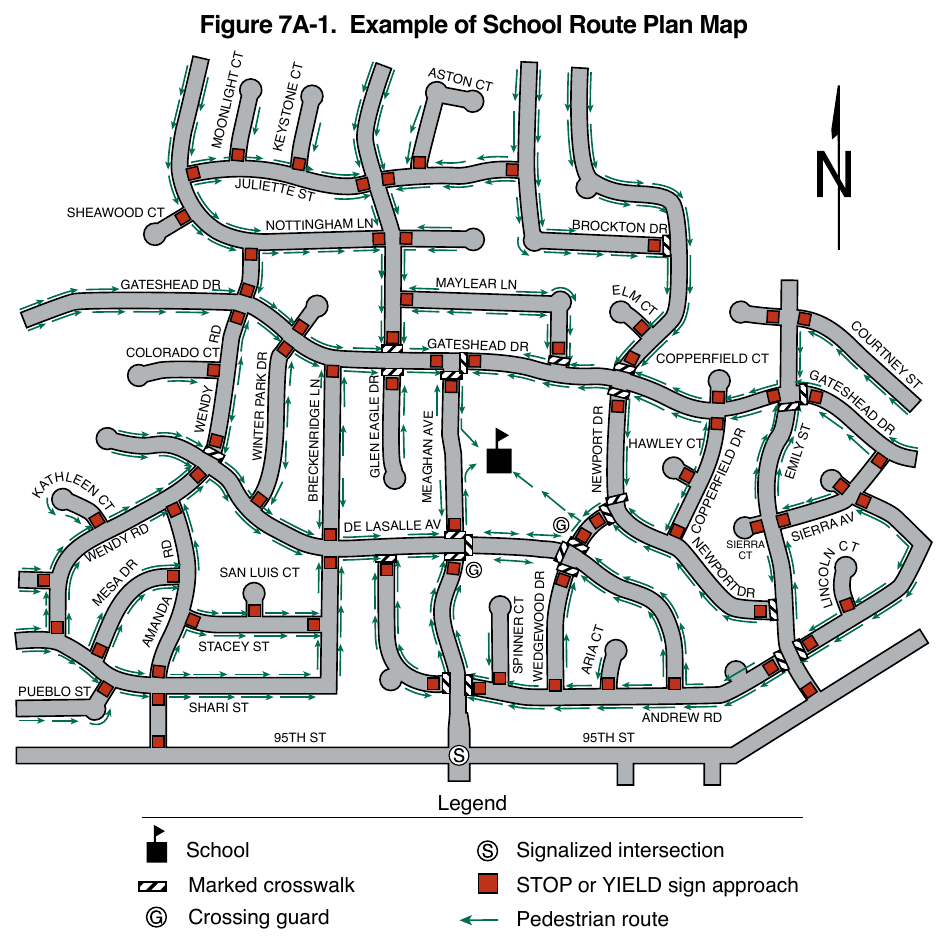
03. Bicycle use as a mode of transportation, as applicable, should also be considered if students biking to and from school are not allowed to use the sidewalks along the pedestrian route.
04. The type(s) of school area traffic control devices used, either warning or regulatory, should be related to the volume and speed of vehicular traffic, street width, and the number and age of the students using the crossing.
05. School area traffic control devices should be included in a school traffic control plan.
Support
06. To establish a safer route to and from school for schoolchildren, the application of planning criterion for school walk routes might make it necessary for children to walk an indirect route to an established school crossing located where there is existing traffic control and to avoid the use of a direct crossing where there is no existing traffic control.
07. The frequency of gaps in the traffic stream that are sufficient for student crossing is different at each crossing location. When the delay between the occurrences of adequate gaps becomes excessive, students might become impatient and endanger themselves by attempting to cross the street during an inadequate gap. In these instances, the creation of sufficient gaps needs to be considered to accommodate the crossing demand.
Guidance
08. School walk routes should be planned to take advantage of existing traffic controls.
09. The following factors should be considered when determining the feasibility of requiring children to walk a longer distance to a crossing with existing traffic control:
- A. The availability of adequate sidewalks or other pedestrian walkways to and from the location with existing control,
- B. The number of students using the crossing,
- C. The age levels of the students using the crossing, and
- D. The total extra walking distance.
Support
10. A School Crossing signal warrant is provided in Section 4C.06.