Chapter 6I. TTC Zone Guide Signs¶
§6I.01 Guide Signs – General¶
Support
01. Guide signs along highways provide road users with information to help them along their way through the TTC zone. The design of guide signs is presented in Part 2.
Guidance
02. The following guide signs should be used in TTC zones as needed:
- A. Standard route markings where temporary route changes are necessary,
- B. Directional signs and street name signs, and
- C. Special guide signs relating to the condition or work being done.
Standard
03. (DE Revision) If additional temporary guide signs are used in TTC zones, they shall have a black legend and border on a fluorescent orange background.
Support
03A. (DE Revision) The fluorescent version of orange provides higher conspicuity than standard orange, especially during twilight.
Option
04. Guide signs used in TTC incident management situations may have a black legend and border on a fluorescent pink background.
05. (DE Revision) When temporary directional signs and temporary street name signs are used in conjunction with detour routing, these signs may have a black legend and border on a fluorescent orange background.
06. When permanent directional signs or permanent street name signs are used in conjunction with detour signing, they may have a white legend on a green background (see Sections 2D.35 and 2D.45).
Standard
07. (DE Revision) The sizes for TTC guide signs shall be as shown in Table 6I-1.
§6I.02 Detour Signs and Plaques (M4-8P, M4-8a, M4-8bP, M4-9, M4-9-DE, M4-9-DE1, M4‑9a, M4‑9b, M4‑9c, and M4‑10)¶
Standard
01. Each detour shall be adequately marked with standard temporary route signs and destination signs.
Option
02. Detour signs in TTC incident management situations may have a black legend and border on a fluorescent pink background.
03. The Detour Arrow (M4-10) sign (see Figure 6I-1) may be used where a detour route has been established.
04. The DETOUR (M4-8P) plaque (see Figure 6I-1) may be mounted at the top of a route sign assembly to mark a temporary route that detours from a highway, bypasses a section closed by a TTC zone, and rejoins the highway beyond the TTC zone.
04A. (DE Revision) Special detour signs (see Figure 6P-20) may be used on roadways that intersect closed roadways to advise motorists of a corresponding detour.
Table 6I-1. Temporary Traffic Control Zone Guide Sign and Plaque Sizes (Delaware Revision)
| Sign or Plaque | Sign Designation | Section | Conventional Road | Freeway or Expressway | Minimum |
|---|---|---|---|---|---|
| Exit Open | E5-2 | 6H.12 | 48 x 36 | 48 x 36 | — |
| Exit Closed | E5-2a | 6H.12 | 48 x 36 | 48 x 36 | — |
| Exit Only | E5-3 | 6H.13 | 48 x 36 | 48 x 36 | — |
| Detour | M4-8P | 6I.02 | 30 x 15 | 30 x 15 | — |
| End Detour | M4-8a | 6I.02 | 24 x 18 | 24 x 18 | — |
| End (plaque) | M4-8bP | 6I.02 | 24 x 12 | 24 x 12 | — |
| Detour | M4-9 | 6I.02 | 30 x 24 | 48 x 36 | — |
| Detour (Through) | M4-9-DE | 6I.02 | 30 x 24 | 48 x 36 | — |
| Detour (U-turn) | M4-9-DE1 | 6I.02 | 30 x 24 | 48 x 36 | — |
| Bike/Pedestrian Detour | M4-9a | 6I.02 | 30 x 24 | — | — |
| Pedestrian Detour | M4-9b | 6I.02 | 30 x 24 | — | — |
| Bike Detour (with arrow) | M4-9c | 6I.02 | 30 x 24 | — | — |
| Detour | M4-10 | 6I.02 | 48 x 18 | — | — |
Notes: 1. Larger signs may be used wherever necessary for greater legibility or emphasis 2. Dimensions are shown in inches and are shown as width x height
(Delaware Revision) Notes:
- 1. Larger signs may be used wherever necessary for greater legibility or emphasis
- 2. Dimensions are shown in inches and are shown as width x height
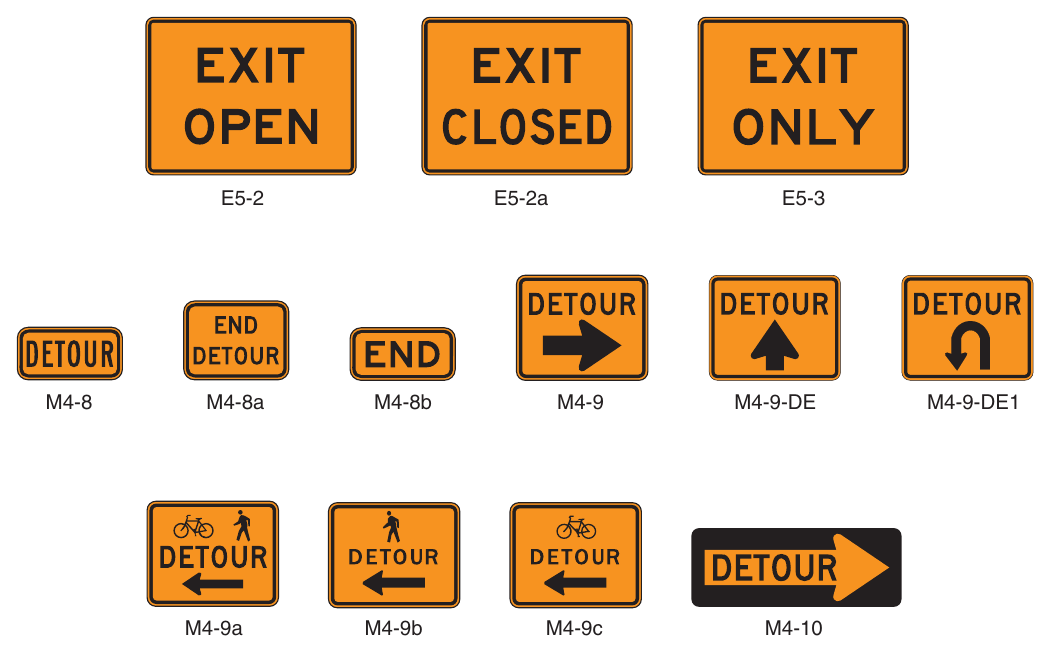
Signs shown: E5-2, E5-2a, E5-3, M4-8, M4-8a, M4-8b, M4-9, M4-9a, M4-9b, M4-9c, M4-10
(Delaware Revision) M4-8b
Guidance
04B. (DE Revision) Special detour sign legends should have a minimum letter height of 6 inches on all two-lane roadways and on multi-lane roadways with a posted speed limit of 40 miles per hour or less. Special detour sign legends should have a minimum letter height of 8 inches on multi-lane roadways with a posted speed limit of 45 miles per hour or greater.
05. The Detour Arrow (M4-10), sign should normally be mounted just below the ROAD CLOSED (R11-2, R11-3a, or R11-4) sign. The Detour Arrow sign should include a horizontal arrow pointed to the right or left as required.
06. (DE Revision) The DETOUR (M4-9), DETOUR Through Arrow (M4-9-DE), or the DETOUR U-turn Arrow (M4-9-DE1) sign (see Figure 6I-1) should be used for unnumbered highways, for emergency situations, for periods of short durations, or where, over relatively short distances, road users are guided along the detour and back to the desired highway without route signs.
07. A Street Name sign should be placed above, or the street name should be incorporated into, a DETOUR (M4-9) sign to indicate the name of the street being detoured.
Option
08. The END DETOUR (M4-8a) sign or the END (M4-8bP) plaque (see Figure 6I-1) may be used to indicate that the detour has ended.
08A. (DE Revision) The DETOUR (M4-9), DETOUR Through Arrow (M4-9-DE), or the DETOUR U-turn Arrow (M4-9-DE1) sign (see Figure 6I-1) may be used for detours of numbered highways or ramps to or from numbered roadways for short duration closures. Short duration may be considered as one day/night for freeways and expressways and up to three days/nights for all other numbered highways.
Guidance
09. When the END DETOUR sign is used on a numbered highway, the sign should be mounted above a route sign after the downstream end of the detour.
10. The Pedestrian/Bicyclist Detour (M4-9a) sign (see Figure 6I-1) should be used where a pedestrian/bicyclist detour route has been established because of the closing of a pedestrian/bicycle facility to through traffic.
Standard
11. If used, the Pedestrian/Bicyclist Detour sign shall have an arrow pointing in the appropriate direction.
Option
12. The arrow on a Pedestrian/Bicyclist Detour sign may be on the sign face or on a supplemental plaque.
13. The Pedestrian Detour (M4-9b) sign or Bicyclist Detour (M4-9c) sign (see Figure 6I-1) may be used where a pedestrian or a bicyclist detour route (not both) has been established because of the closing of the pedestrian or bicycle facility to through traffic.
§6I.03 EXIT CLOSED Panel¶
Guidance
01. (DE Revision) When an exit ramp is closed, an EXIT CLOSED sign panel with a black legend and border on a fluorescent orange background should be placed diagonally across the interchange/intersection guide signs.
02. (DE Revision) If used, the EXIT CLOSED sign should be placed diagonally across the interchange/ intersection guide signs starting from the bottom left corner of the guide sign to the upper right corner of the guide sign.
03. (DE Revision) If used, the legend of the EXIT CLOSED sign should be sized appropriately based on the size of the interchange/intersection guide sign to which the EXIT CLOSED sign is to be affixed, but no less than 8 inches in height.