Chapter 1B. Legal Requirements for Traffic Control Devices¶
§1B.01 National and State Standard¶
Standard
01. The Manual on Uniform Traffic Control Devices for Streets and Highways (MUTCD) is incorporated by reference in 23 Code of Federal Regulations (CFR), Part 655, Subpart F and shall be recognized as the national standard for all traffic control devices installed on any street, highway, bikeway, or site roadway open to public travel (see definition in Section 1C.02) in accordance with 23 U.S.C. 109(d) and 402(a).
02. In accordance with 23 CFR 655.603(a), the MUTCD shall apply to all of the following types of facilities:
- A. Any street, roadway, or bikeway open to public travel, either publicly or privately owned; (See FHWA Known Errors 01/24/2025)
- B. Streets and roadways on sites that are off the public right-of-way that are open to public travel without full-time access restrictions. Examples include roadways within shopping centers, office parks, airports, sports arenas, other similar business and/or recreation facilities, governmental office complexes, schools, universities, recreational parks, and other similar publicly-owned complexes and/or recreation facilities. The above-described examples of streets and roadways are referred to in this Manual as site roadways open to public travel;
- C. Publicly-owned toll roads, including those under the jurisdiction of a public agency, public authority, or public-private partnership;
- D. Privately-owned toll roads where the public is allowed to travel without access restriction. This includes gated toll roads or roadways where the general public is able to pay to access the facility; and
- E. Grade crossings of publicly-owned roadways with railroads or light rail transit. The MUTCD shall not apply to the following types of facilities:
- A. Roadways within private gated properties where access to the general public is restricted at all times;
- B. Grade crossings of privately-owned roadways with railroads; and
- C. Parking areas, including the driving aisles within those parking areas, that are either publicly or privately owned. (See FHWA Known Errors 01/24/2025)
Support
The policies and procedures of the Federal Highway Administration (FHWA) to obtain basic uniformity of traffic control devices are as described in 23 CFR 655, Subpart F. The Texas Manual on Uniform Traffic Control Devices (TMUTCD) is incorporated by reference in Texas Administrative Code, Title 43, Section 25.1 to govern standards and specifications for all traffic control devices to be erected and maintained upon any street, highway, bikeway, public facility, or private property open to public travel within this state, including those under local jurisdiction.
§1B.02 Texas Adoption and Conformance¶
The National MUTCD became effective on January 18, 2024. As required by 23 CFR 655.603(b) (1) and (3), Texas adopted this TMUTCD within two years and in substantial conformance with the National MUTCD.
Standard
01. States or other Federal agencies that have their own MUTCDs or Supplements shall revise these MUTCDs or Supplements to be in substantial conformance with changes to the National MUTCD within 2 years of the effective date of the Final Rule for the changes [23 CFR 655.603(b)(3)]. Substantial conformance of such State or other Federal agency MUTCDs or Supplements shall be as defined in 23 CFR 655.603(b)(1).
03. For the purposes of Paragraph 2 of this Section, policies, directives, specifications, standard drawings, or similar documents that are issued by an agency and that change or modify Standard, Guidance, or Option provisions in this Manual shall be considered as supplements to the TMUTCD and shall also be revised to be in substantial conformance with the National MUTCD.
04. This Manual is adopted by the Texas Transportation Commission under the authority of Texas Transportation Code Section 544.001: “Section 544.001. Adoption of Sign Manual for State Highways - The Texas Transportation Commission shall adopt a manual and specifications for a uniform system of traffic-control devices consistent with this chapter that correlates with and to the extent possible conforms to the system approved by the American Association of State Highway and Transportation Officials.”
Support
05. The Texas Transportation Code, Section 544.006 states that a person may not place, maintain, or display on or in view of a highway an unauthorized sign, signal, marking or device and the authority with jurisdiction over the highway is authorized to remove such unauthorized sign, signal, marking, or device without notice.
§1B.03 Compliance of Devices¶
Standard
01. The U.S. Secretary of Transportation, under authority granted by the Highway Safety Act of 1966, decreed that traffic control devices on all streets and highways open to public travel in accordance with 23 U.S.C. 109(d) and 402(a) in each State shall be in substantial conformance with the Standards issued or endorsed by the FHWA.
Support
02. 23 CFR 655.603 also requires traffic control devices on all streets, highways, bikeways, and site roadways open to public travel in each State be in substantial conformance with standards issued or endorsed by the Federal Highway Administrator.
Standard
03. Texas Transportation Code, Section 544.002 requires that the traffic control devices be placed and maintained as provided in this Manual.
04. After the effective date of a new edition of the TMUTCD or a revision thereto, new or reconstructed devices installed shall comply with the new edition or revision, as required by 23 CFR 655.603.
05. In cases involving Federal-aid projects for new construction, reconstruction, resurfacing, restoration, or rehabilitation of a facility to which this Manual applies, the traffic control devices installed (temporary or permanent) shall comply with the most recent edition of the TMUTCD before that highway is opened or re-opened to the public for unrestricted travel [23 CFR 655.603(d)(2) and (d)(3)].
06. Unless a particular device is no longer serviceable (see definition in Section 1C.02), non-compliant devices on existing highways and bikeways shall be brought into compliance with the current edition of the TMUTCD as part of the systematic upgrading of substandard traffic control devices (and installation of new required traffic control devices) required pursuant to the Highway Safety Program, 23 U.S.C. §402(a).
Support
07. The FHWA has the authority to establish other target compliance dates for implementation of particular changes to the TMUTCD [23 CFR 655.603(d)(1)].
Standard
08. The target compliance dates established by the FHWA shall be as shown in Table 1B-1.
09. Design, application, and placement of traffic control devices other than those adopted in this Manual shall be prohibited unless the provisions of Sections 1B.04 through 1B.08 are followed regarding official interpretations, experiments, changes to the TMUTCD, and interim approvals granted by the FHWA.
Support
10. Many of the provisions in this Manual that are explicitly prohibitive have been included to address practices that have been shown to be ineffective, unsafe, or inconsistent with uniformity. A provision of mandatory or recommended practice represents the accepted and established practice that promotes uniformity and consistency. The absence of a provision in this Manual that explicitly prohibits a particular practice, use, design, application, operation, or other aspect of a traffic control device does not, in itself, constitute acceptability or permission to use the device in a manner not provided for in this Manual.
Guidance
11. Agencies should contact TxDOT when considering employing a practice or application that is not explicitly addressed in this Manual to ensure continued compliance with the provisions in this Manual.
Support
12. The FHWA reviews and interprets the provisions in this Manual for agencies on an as-needed basis, which can lead to the issuance of official interpretations (see Section 1B.04), or interim approvals (see Section 1B.07).
Standard
13. A non-compliant traffic control device that is being replaced or refurbished because it is damaged, missing, or no longer serviceable (see definition in Section 1C.02) for any reason shall be replaced with a compliant device, except as provided for in Paragraph 14 of this Section.
Option
14. A non-compliant traffic control device may be replaced in kind when engineering judgment indicates it is more appropriate because:
- A. One compliant device in the midst of a series of adjacent non-compliant devices would be confusing to road users, and/or
- B. The schedule for replacement of the whole series of non-compliant devices will result in achieving timely compliance with the TMUTCD.
Table 1B-1. Target Compliance Dates Established by the FHWA
| TMUTCD Section(s) | Subject Area | Specific Provision | Compliance Date |
|---|---|---|---|
| 2B.64 | Weight Limit Signs | Paragraph 6 - requirement for additional Weight Limit sign with the advisory distance or directional legend in advance of applicable section of highway or structure | January 18, 2029 |
| 2C.25 | Low Clearance Signs (W12-2) | Paragraph 1 - Required posting of the Low Clearance Advance (W12-2) sign in advance of the structure | January 18, 2029 |
| 2C.25 | Low Clearance Signs (W12-2a, W12-2b) | Paragraph 18 - Recommended posting of Low Clearance Overhead (W12-2a or 12-2b) signs on an arch or other structure under which the clearance varies greatly | January 18, 2029 |
| 3A.05 | Maintaining Minimum Retroreflectivity | Implementation and continued use of a method that is designed to maintain retroreflectivity of longitudinal pavement markings (see Paragraph 1 of Section 3A.05) | September 6, 2026 |
| 8B.16 | High-Profile Grade Crossings | Paragraphs 3 and 7 - Recommended installation of Low Ground Clearance and/or Vehicle Exclusion signs and detour signs for vehicles with low ground clearances that might hang up on high-profile grade crossings at locations with a known history | January 18, 2029 |
| 8D.09 through 8D.12 | Highway Traffic Signals at or Near Grade Crossings | Assessment and determination of appropriate treatment to achieve compliance (preemption, movement prohibition, pre-signals, queue cutter signals) | January 18, 2034 |
§1B.04 Interpretations¶
Support
01. The FHWA and TxDOT issue authoritative interpretations of this Manual when necessary to provide clarity in response to unique situations for device application or general requests for clarification of a provision.
02. An interpretation includes a consideration of the application and operation of standard traffic control devices, the official meanings of standard traffic control devices, or the variations from standard device designs and design requirements.
Guidance
03. Requests for an interpretation of this Manual should contain the following information:
- A. A concise statement of the interpretation being sought;
- B. A description of the condition that provoked the need for an interpretation;
- C. Any illustration that would be helpful to understand the request; and
- D. Any supporting research data that is pertinent to the item to be interpreted.
Support
04. Section 1B.08 contains information on submitting a request for interpretation.
§1B.05 Experimentation¶
Support
01. Requests for experimentation (see Section 1B.08) include consideration of field deployment for the purpose of testing or evaluating a new traffic control device, its application or manner of use, or a provision not specifically described in this Manual.
Standard
02. A traffic control device or application that does not comply with the provisions of this Manual shall not be used on any street, highway, bikeway, or site roadway open to public travel (see definition in Section 1C.02) without first receiving official approval to experiment from the FHWA’s Office of Transportation Operations and TxDOT.
Support
03. A request for permission to experiment (see Section 1B.08) will be considered only when submitted by the public agency or toll facility authority responsible for the operation of the road or street on which the experiment is to take place. For a site roadway open to public travel, the request will be considered only if it is submitted by the private owner or official having jurisdiction.
04. A request for experimentation with a novel device or application across multiple jurisdictions as a single experiment with a common hypothesis, evaluation plan, and evaluation team will be considered when submitted jointly by all the authorities responsible for operation of the roads or streets on which the experiment is to take place. Similarly, a request to add experimental sites to an experimentation approved for another jurisdiction will be considered when submitted jointly by the all the authorities for operation of the roads or streets on which the experiment is then to take place.
05. Manufacturers or inventors of novel devices are encouraged to engage the services of a qualified traffic engineer or other professional who is versed in traffic control devices. Early engagement during the concept and development processes will help ensure the efficacy of the device with regard to human factors, operational, safety, and other considerations prior to an agency requesting experimentation.
06. In some cases, an off-roadway closed-course or laboratory study might be required before a request for experimentation can be considered. The purpose of such a study is to determine whether testing the experimental device or application in an open-road setting could result in an undue safety risk.
Guidance
07. Before requesting permission to experiment with a new device or application, an owner of a site roadway open to public travel should first check for any laws, regulations, and/or directives covering the application of the TMUTCD that might apply.
Option
08. An agency may request a preliminary assessment of the viability of a potential request for experimentation by submitting an abstract that briefly describes the experimental concept.
Support
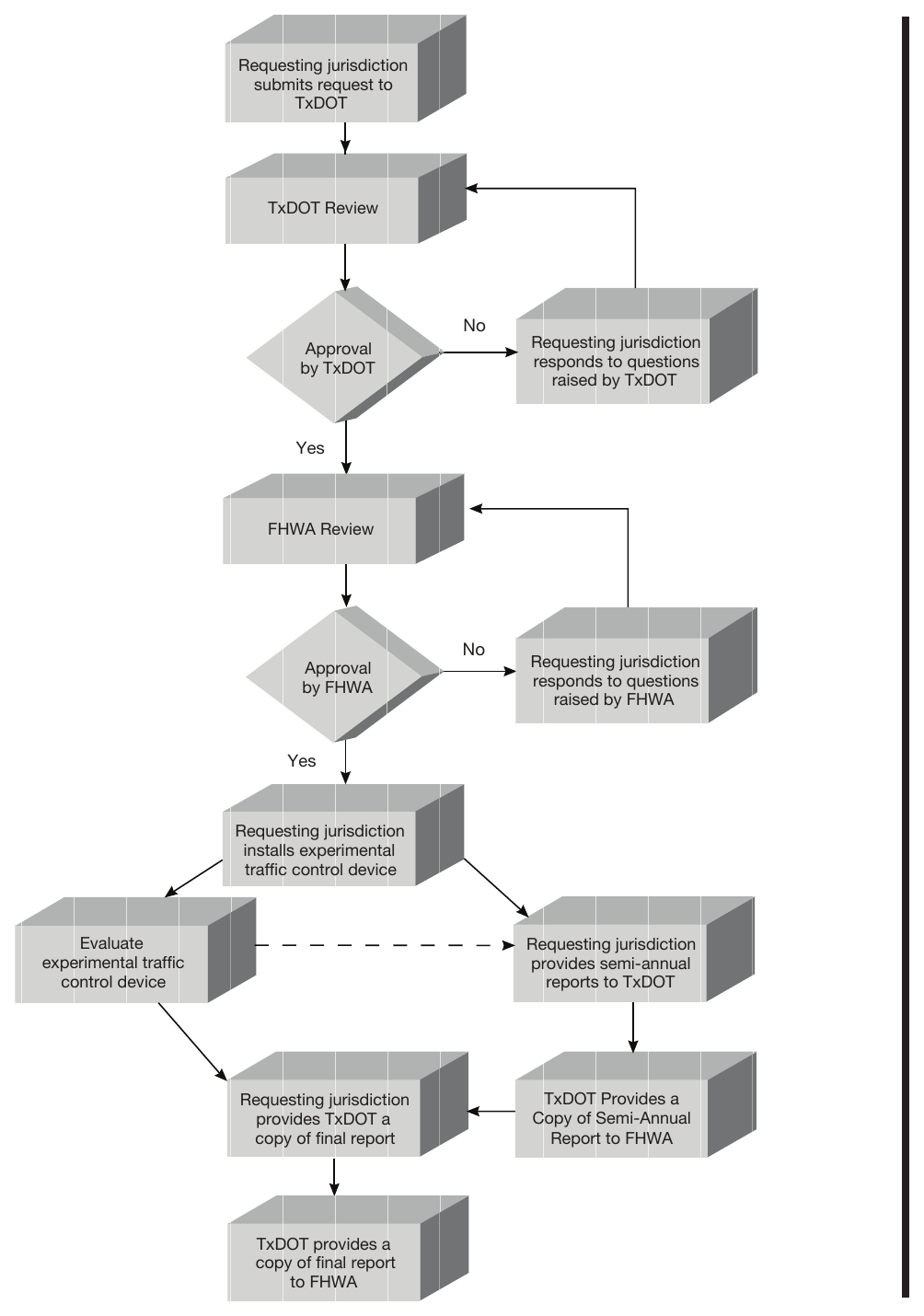
09. A diagram indicating the process for requesting and conducting experimentations with traffic control devices is shown in Figure 1B-1.
Standard
10. The request for permission to experiment shall contain the following:
- A. A statement indicating the nature of the problem and a hypothesis establishing the premise of the experiment.
- B. A description of the proposed change to the traffic control device or application of the traffic control device, including the manner in which it deviates from the provisions of this Manual, and how it is expected to be an improvement over existing provisions.
- C. Illustrations that would help to explain the traffic control device or use of the traffic control device.
- D. Any supporting data explaining how the traffic control device was developed, including if it has been tested, in what ways it was found to be adequate or inadequate, and how this choice of device or application was derived.
- E. Comparison of the proposed device to other compliant devices or treatments, either individually or in combination, that address the same condition, if applicable.
- F. A legally-binding statement that the experimental device or application is in the public domain, in accordance with Paragraph 16 of this Section.
- G. The time period and location(s) of the experiment.
- H. Control sites for comparison purposes or justification for not using control sites.
- I. A detailed research and evaluation plan that provides for close monitoring of the experimentation, throughout all stages of its field implementation. The evaluation plan shall include an appropriate evaluation methodology, such as before and after analysis, or other appropriate methodology as well as quantitative data describing the performance of the experimental device.
- J. An agreement to provide semi-annual progress reports for the duration of the experimentation, in accordance with the schedule provided in Paragraph 12 of this Section, and an agreement to provide a report of the final results of the experimentation to the FHWA’s Office of Transportation Operations within 3 months following completion of the experimentation (see Paragraph 14 of this Section). The FHWA’s Office of Transportation Operations or TxDOT shall have the right to terminate approval of an agency’s experiment if reports are not received in accordance with this schedule.
- K. An agreement to restore the site of the experiment to a condition that complies with the provisions of this Manual within 3 months following the end of the time period of the experiment. This agreement shall also provide that the agency sponsoring the experimentation will terminate the experimentation at any time that it determines that safety concerns are directly or indirectly attributable to the experimentation and the agency shall provide timely notification to the FHWA’s Office of Transportation Operations and TxDOT. The FHWA’s Office of Transportation Operations or TxDOT shall have the right to terminate approval of the experimentation at any time if there is an indication of safety or operational concerns, or if the terms of the approval are not being adhered to. If, as a result of the experimentation, a request is made that this Manual be changed to include the device or application being experimented with, the FHWA’s Office of Transportation Operations will determine whether the device or application can be permitted to remain in place until an official rulemaking action has occurred.
11. Where an item in Paragraph 10 of this Section is determined to not be applicable to the type of experiment, device, or application, the request shall provide sufficient explanation.
12. The required semi-annual progress reports shall be submitted throughout the course of an approved experiment in accordance with the following schedule:
- A. No later than August 1st for the preceding period of January through June;
- B. No later than February 1st for the preceding period of July through December; and
- C. The Texas Department of Transportation, Traffic Safety Division shall be copied on any semi-annual reports and final reports. (See Section 1B.08)
13. The experimenting agency shall submit a semi-annual progress report for any approved experiment even if no work was performed during the previous reporting period. Failure to submit two consecutive progress reports shall result in termination of the experiment and shall constitute rescission of the FHWA’s approval to the experimenting agency, requiring restoration of the site(s) to a condition that complies with the provisions of this Manual within 3 months.
14. The experimenting agency shall submit a final report within 3 months of the conclusion of an approved experiment. If a final report is not received by the FHWA’s Office of Transportation Operations, and the experimenting agency fails to notify the FHWA of any mitigating circumstances within 6 months of the end of the approved experimentation period, then the experiment shall be considered terminated and shall constitute rescission of the FHWA’s approval to the experimenting agency, requiring restoration of the site(s) to a condition that complies with the provisions of this Manual within 3 months.
Support
15. Under certain circumstances the FHWA Office of Transportation Operations might allow an experimental device or device application that has been shown to be effective and without safety concerns to remain in use after the experiment has ended. This typically would occur if the device or application is actively being considered for interim approval under the provisions of Section 1B.07.
Standard
16. A request for experimentation that involves a new traffic control device or a new application of an existing traffic control device shall include from the agency conducting the experiment, the manufacturer and/or developer of the device, and the supplier of the device, a legally-binding statement certifying that the traffic control device is not protected by a patent, trademark, or copyright in accordance with Section 1D.06, and that the traffic control device is in the public domain and can be used freely in traffic control device design and application without infringement or claim of trade secret misappropriation. The legally-binding statement shall also state that the agency conducting the experiment, the manufacturer and/or developer of the device, and the supplier of the device are aware that if patent, trademark, or copyright protection is established in the future for the device or application, such action will result in its removal from the TMUTCD, cancellation of its interim approval, or cancellation of the authorization for experimentation.
Support
17. For the purpose of the Standard in Paragraph 16 of this Section, traffic control device refers to those aspects of a sign, signal, marking or other device which regulates, warns, or guides traffic. The limitation on patent, trademark, or copyright protection does not include the legal protection of individual elements of such devices. For example, manufacturing methods, assembly methods, or individual components of such devices can be protected, whereas the traffic control device cannot be subject to protection so long as it remains in this Manual. As a further example, an internal circuit board for an electronic traffic control device can be legally protected, but the electronic traffic control device itself or its operational function cannot be legally protected by any of the above forms of intellectual property rights.
§1B.06 Changes to the MUTCD¶
Support
01. Continuing advances in technology and approaches to traffic safety will produce changes in the highway, vehicle, and road-user proficiency; therefore, portions of the system of traffic control devices in this Manual will require updating. It is important to have a procedure for recognizing these developments and for introducing new ideas and modifications into the system.
02. A change includes consideration of a new device to replace a present standard device, an additional device to be added to the list of standard devices, or a revision to a traffic control device application or placement criteria.
Guidance
03. Requests for a change to this Manual (see Section 1B.08) should contain the following information:
- A. A statement indicating what change is proposed;
- B. Any illustration that would be helpful to understand the request; and
- C. Any supporting research data that is pertinent to the item to be reviewed.
Support
04. Requests for a change to this Manual will be evaluated to consider the potential safety and operational benefits of the requested change and be considered for inclusion in the future rulemaking to issue a new edition or revision of the Manual. A diagram indicating the process for incorporating new traffic control devices into this Manual is shown in Figure 1B-2. (See FHWA Known Errors 01/24/2025)
NO See Figure 1B-1 FHWA notifies requesting party (if any) Accepted for Federal rulemaking? Interim approval? * FHWA issues Interim Approval with technical conditions for use, and posts on MUTCD website FHWA develops device provisions for inclusion in the next Notice of Proposed Amendments FHWA publishes Notice of Proposed Amendments in Federal Register Docket comment period Jurisdictions apply for and receive Interim Approval reviews comments Jurisdictions deploy devices under Interim Approval conditions FHWA prepares Final Rule FHWA publishes Final Rule No action required Final Rule different from Interim Approval? State manuals must be in substantial conformance with the National MUTCD within 2 years as specified in 23 CFR 655.603(a) Jurisdictions comply with Final Rule provisions for device *A change request to allow the use of a new traffic control device is considered for Interim Approval when FHWA determines that the change will have a substantial national safety or operational benefit and that it would not be in the public interest to wait the intervening time period before the device could otherwise be officially incorporated into the MUTCD through rulemaking.
§1B.07 Interim Approvals¶
Support
01. Interim approval allows for provisional use, pending official rulemaking, of a new traffic control device, a revision to the application or manner of use of an existing traffic control device, or a provision not specifically described in this Manual.
02. The FHWA issues an interim approval by official memorandum signed by the Associate Administrator for Operations and posts this memorandum on the MUTCD Web site.
03. Interim approval allows for the optional use of a traffic control device or application and does not create a new mandate or recommendation for its use. Interim approval includes conditions that jurisdictions, toll facility operators, or owners of site roadways open to public travel agree to comply with in order to use the traffic control device or application until an official rulemaking action has occurred.
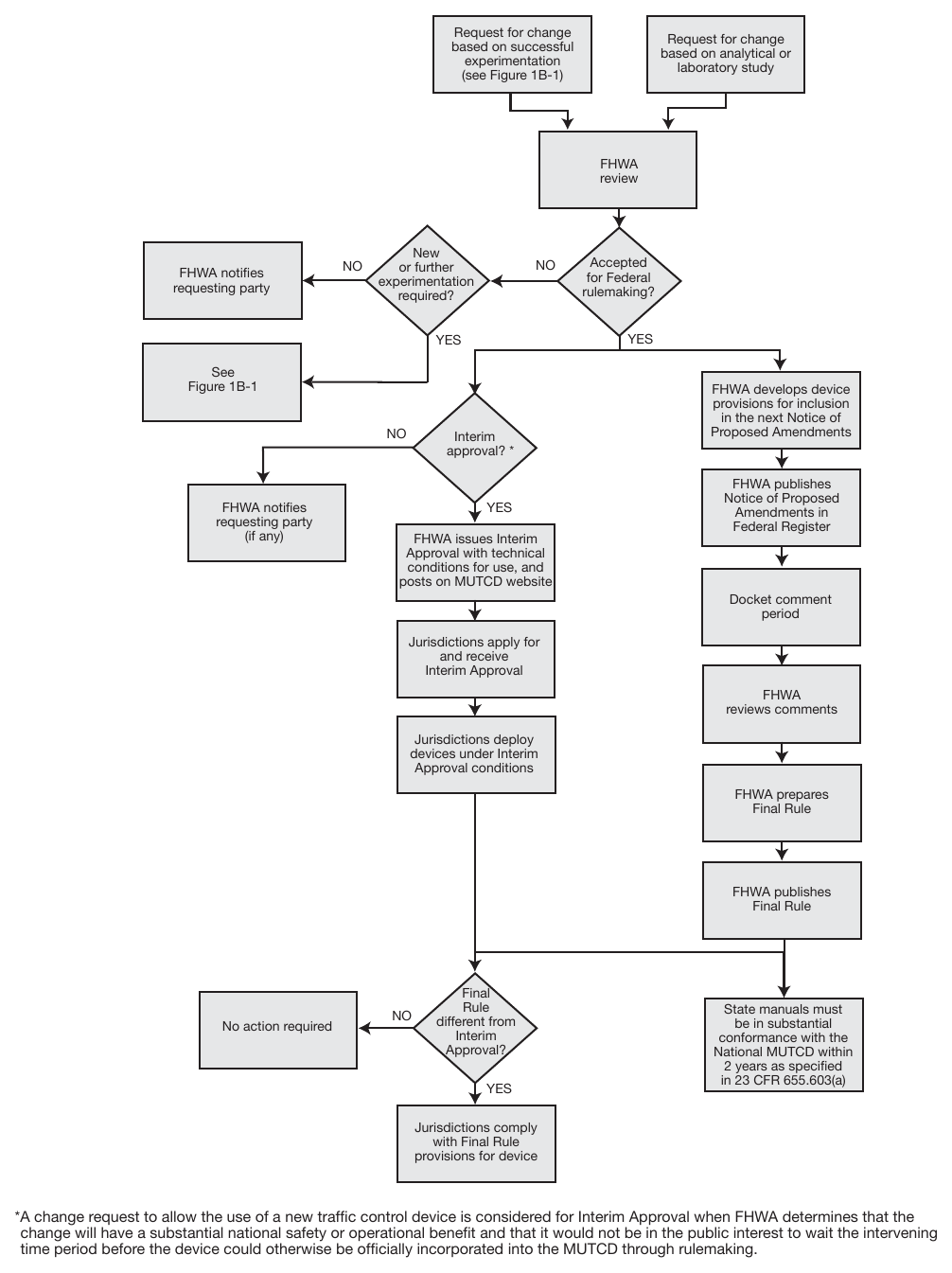
04. The issuance by FHWA of an interim approval might result in the traffic control device or application being proposed for adoption in the next scheduled rulemaking process to issue a new edition or revision of this Manual. If the device or application under interim approval is not proposed in the next rulemaking for a new edition or revision, then a statement of the status of the interim approval, whether it is to be rescinded or remain in effect, will be included in the Federal Register notice for the rulemaking.
05. Interim approval is considered based on the results of experimentation, and/or results of analytical or laboratory studies with a traffic control device or application that analytically demonstrates a device effectively communicates its intended meaning. Interim approval considerations include an assessment of relative risks, benefits, costs, impacts, and other factors.
06. Section 1B.08 contains information on submitting a request for interim approval.
07. Interim approval is ordinarily considered only after published authoritative research and experimentation sufficiently demonstrate that the device or application provides a significant safety or operational improvement. Individual experiments by various jurisdictions, without a research report on the overall findings of the experimental device or application, will not ordinarily qualify for issuance of an interim approval.
08. Interim approval ordinarily is not considered based solely on non-U.S. experience with a new traffic control device or application. Differences in regulations, enforcement and penalties, and driver licensing requirements, among other factors, can result in dissimilar road-user behavior. Additionally, due to variations in conventions for traffic control device design, a non-U.S. traffic control device concept might need to be adapted to U.S. criteria to ensure consistency with the provisions and principles of this Manual. However, documented nonU.S. experience can be considered in the development of requests for experimentation (see Section 1B.05) and within the evaluation plan for traffic control device research.
Standard
09. A jurisdiction, toll facility operator, or owner of a site roadway open to public travel that desires to use a traffic control device or application for which FHWA has issued an interim approval shall request permission from TxDOT. TxDOT will then forward the request to FHWA. Permission from FHWA shall be received prior to applying the device or application.
10. The request to place a traffic control device or application under an existing interim approval shall contain the following:
- A. A description of where the device or application will be used, such as a list of specific locations or highway segments or types of situations, or a statement of the intent to use the device or application jurisdiction-wide;
- B. An agreement to abide by the specific conditions for use of the device or application as contained in the FHWA’s interim approval memorandum;
- C. An agreement to maintain and continually update a list of locations where the device or application has been installed; and
- D. An agreement to:
- 1. Restore the site(s) of the interim approval to a condition that complies with the provisions in this Manual within 3 months following the issuance of a final rule on this traffic control device or application; and
- 2. Terminate use of the device or application installed under the interim approval at any time that it determines that safety concerns are directly or indirectly attributable to the device or application. The FHWA’s Office of Transportation Operations shall have the right to terminate the interim approval at any time if there is an indication of safety, operational, or other concerns.
Option
11. TxDOT may submit a request for permission to use a device or application under an existing interim approval for all jurisdictions in Texas, as long as the request contains the information required in Paragraph 10 of this Section. (See FHWA Known Errors 01/24/2025)
Standard
12. A jurisdiction, toll facility operator, or owner of a site roadway open to public travel that elects to use a device or application under a statewide interim approval shall inform TxDOT of its use of the device or application.
13. Under a statewide interim approval, the respective jurisdictions, toll facility operators, and owners of site roadways open to public travel shall maintain and continually update a record of all locations on their roads where the device or application is implemented (see Item C of Paragraph 9 of this Section) and shall furnish this information to TxDOT. (See FHWA Known Errors 01/24/2025)
§1B.08 Requesting Official Interpretations, Experiments, Changes to the TMUTCD, or Interim Approvals¶
Guidance
01. A local jurisdiction, toll facility operator, or owner of a site roadway open to public travel that is requesting permission to experiment or permission to use a device or application under an existing interim approval should first check for any Texas laws, regulations, and/or directives covering the application of the TMUTCD provisions that might apply.
Standard
Requests for an interpretation, permission to experiment, a change to the TMUTCD, granting of an interim approval, or permission to use an existing interim approval shall be submitted to the Texas Department of Transportation, Traffic Safety Division, 125 E. 11th Street, Austin, Texas 78701. If the request is an issue TxDOT can and has the authority to address, TxDOT will reply with an official response. If the request requires FHWA input, it will be forwarded to FHWA’s MUTCD team in the Office of Transportation Operations for an official response.