2K. Tourist-Oriented Directional Signs¶
§2K.01 Purpose and Application¶
Support
01. Tourist-oriented directional signs are post-mounted guide sign assemblies with one or more signs that display the business identification of and directional information for generic eligible business, service, and activity facilities.
Standard
02. A facility shall be eligible for tourist-oriented directional signs only if it derives its major portion of income or visitors during the normal business season from road users not residing in the area of the facility.
Option
03. Tourist-oriented directional signs may include businesses involved with seasonal agricultural products.
Standard
04. The use of tourist-oriented directional signs shall be limited to rural highways (see definition in Section 1C.02). Tourist-oriented directional signs shall not be installed on conventional roads in urban or urbanized areas or on freeway or expressway main roadways or ramps.
04a. The tourist-oriented information and specific service information signs shall be separate installations.
Support
04b. Refer to the SHC, Division 1, Chapter 1.5, Article 3, § 229.285.
Option
05. Tourist-oriented directional signs may be used in conjunction with General Service signs (see Section 2I.02).
Support
06. Section 2K.07 contains information on the adoption of a State policy for States that elect to use tourist-oriented directional signs.
Standard
07. Refer to SHC, Division 1, Chapter 1.5 for administration, standards, eligibility, and fees concerning the tourist-oriented directional signs. Refer to Section 1A.05 for information regarding these publications.
§2K.02 Design¶
Standard
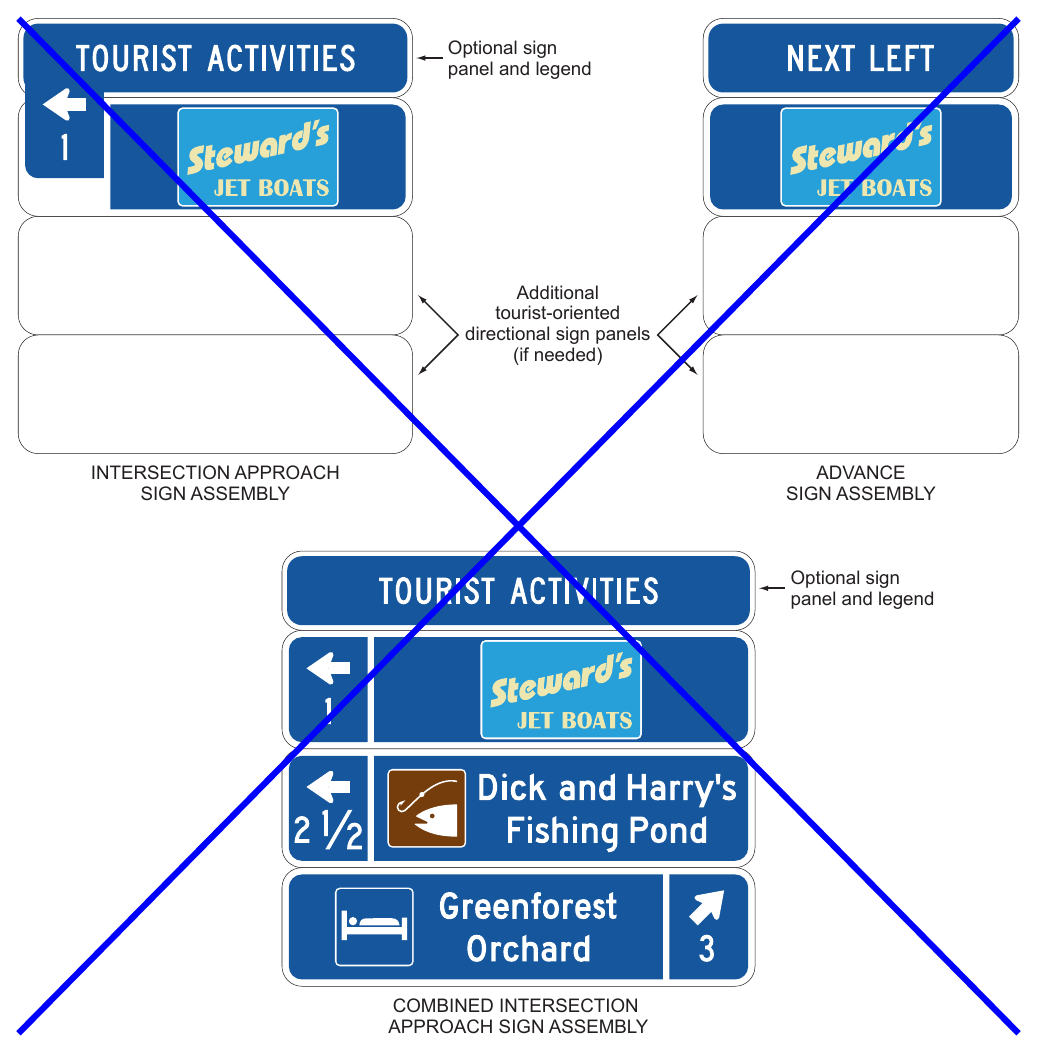
01. Tourist-oriented directional sign assemblies shall have one or more to three signs (see Figure 2K-1 2K-1(CA)) for the purpose of displaying the generic business identification of and directional information for eligible facilities. Except as provided in Paragraph 7 of this Section, each sign shall be rectangular in shape and shall have a white legend and border on a blue background.
02. The content of the legend on each sign shall be limited to the generic identification and directional information for no more than one eligible business, service, or activity facility. The legends shall not include promotional advertising or gambling activities.
Guidance
03. Each sign should have a maximum of two lines of legend including no more than one symbol (see Paragraph 4 of this Section), a separate directional arrow, and the distance to the facility displayed beneath the arrow. Arrows pointing to the left or up should be at the extreme left of the sign panel. Arrows pointing to the right should be at the extreme right of the sign panel. Symbols, when used, should be to the left of the word legend or business identification sign panel (see Paragraphs 6 and 9 of this Section).
Option
04. The General Service sign symbols (see Section 2I.02) and the symbols for recreational and cultural interest area signs (see Chapter 2M) may be used on tourist-oriented directional signs.
05. Based on engineering judgment, the hours of operation may be displayed on the sign.
06. Business identification sign panels (see Section 2J.03) for specific businesses, services, and activities may be used in place of word legends on tourist-oriented direction signs.
Standard
06a. The tourist-oriented directional signs shall not identify particular business or services by name, but rather shall be generic and identify only the type or nature of the business or service available.
Support
Refer to the SHC, Division 1, Chapter 1.5, Article 3, § 229.285.
Standard
07. When used, recreational and cultural interest area symbols shall be white on a brown background.
08. When used, symbols shall be an appropriate size (see Section 2K.04).
09. When used, business identification sign panels shall not exceed 24 inches in width and 15 inches in height. Logos resembling official traffic control devices shall not be permitted.
Option
10. The word message TOURIST ACTIVITIES may be displayed at the top of the tourist-oriented directional sign assembly.
Support
10a. The TOURIST ACTIVITIES word message unnecessarily increases the height of the sign.
Standard
11. The TOURIST ACTIVITIES word message shall have a white legend in all upper-case letters and a white border on a blue background. If used, it shall be placed above and in addition to the directional signs.
Support
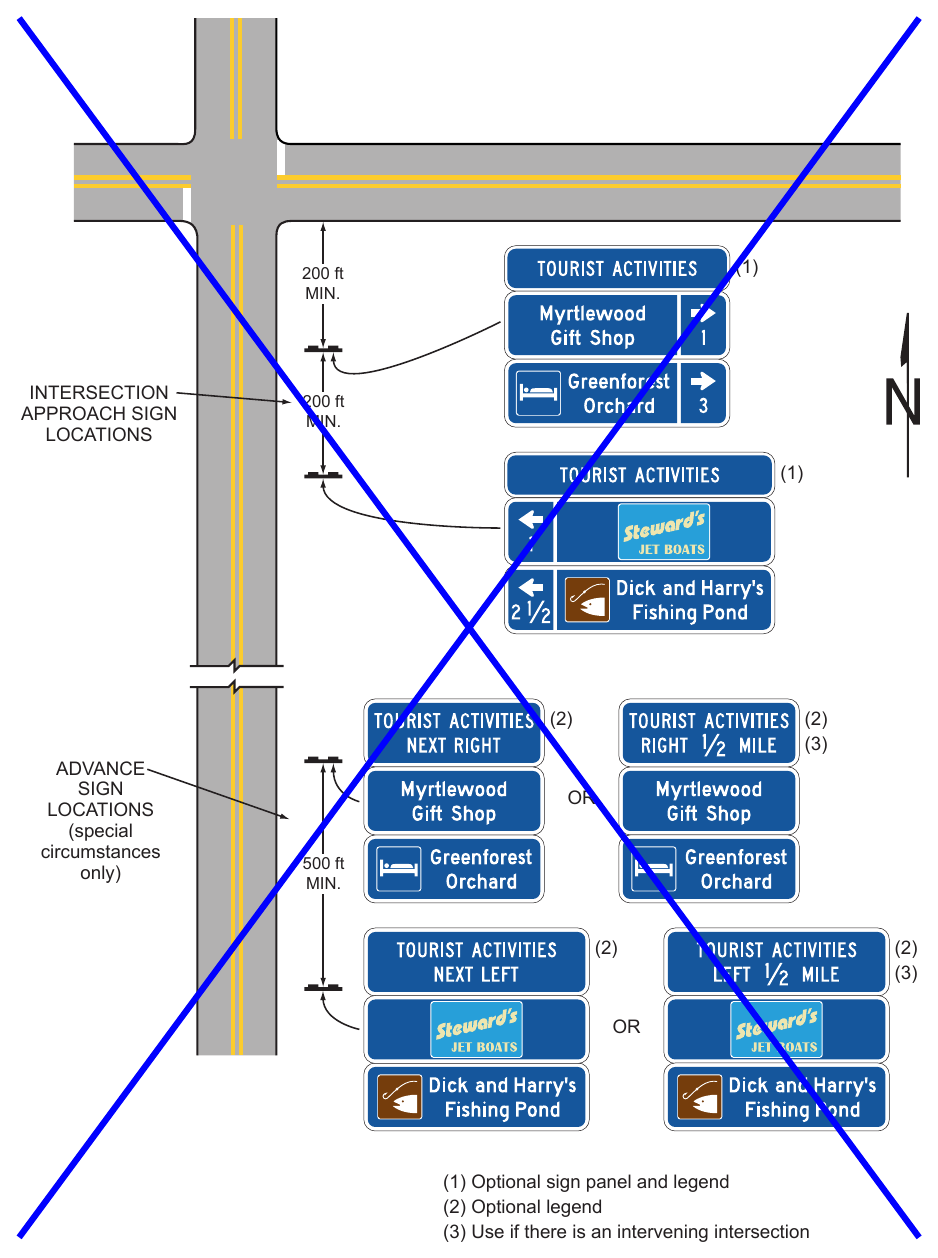
12. Examples of tourist-oriented directional signs are shown in Figures 2K-1 and 2K-2 2K-1(CA).
§2K.03 Style and Size of Lettering¶
Guidance
01. All letters and numbers on tourist-oriented directional signs, except on the business identification sign panels, should be upper-case and at least 6 inches in height. Any legend on a business identification sign panel should be proportional to the size of the business identification sign panel.
Standard
02. Design standards for letters, numerals, and spacing shall be as provided in the “Standard Highway Signs” publication (see Section 1A.05).
03. Figure 2K-1(CA) and the Caltrans’ California Sign Specifications for Tourist Oriented Directional signs shall be used for arrangement and size of tourist-oriented directional signs. A single sign arrangement is used in California for touristoriented directional signs.
§2K.04 Arrangement and Size of Signs¶
Standard
The total height of the tourist-oriented directional signs in a sign assembly shall be limited to a maximum of 6 feet excluding the mounting height measured vertically from the bottom of the sign assembly to the elevation of the near edge of the roadway. Additional height shall be allowed to accommodate the addition of the optional TOURIST ACTIVITIES message provided in Section 2K.02 and the action messages provided in Section 2K.05.
Guidance
02. The number of intersection approach sign assemblies (one sign assembly for tourist-oriented destinations to the left, one for destinations to the right, and one for destinations straight ahead) installed in advance of an intersection should not exceed three.
Standard
02a. The number of signs installed in each assembly should shall not exceed three.
Support
02b. Refer to the SHC, Division 1, Chapter 1.5, Article 3, § 229.28.
Guidance
02c. The signs for right-turn, left-turn, and straight-through destinations should be on separate sign assemblies. Signs for facilities in the straight-through direction should be considered only when there are signs for destinations in either the left or right direction.
03. If it has been determined to be appropriate to combine the left-turn and right-turn destination signs on a single sign assembly, the left-turn destination signs should be above the right-turn destination signs (see Figure 2K-1). When there are multiple destinations in the same direction, they should be in order based on their distance from the intersection. Except as provided in Paragraph 5 of this Section, a straight-through sign should not be combined in a sign assembly
01. displaying left-turn and/or right-turn destinations. The signs should not exceed the size necessary to accommodate two lines of legend without crowding. Symbols on a directional sign should not exceed the height of two lines of a word legend. All directional signs and other parts of the sign assembly should be the same width, which should not exceed 6 feet.
Standard
05. At intersection approaches where three or fewer facilities are displayed, the left-turn, right-turn, and straight-through destination sign panels may shall be combined on the same sign assembly.
06. Figure 2K-1(CA) and the Caltrans’ California Sign Specifications for Tourist Oriented Directional (SG44-1A(CA) and SG44-2A(CA)) signs shall be used for arrangement and size of tourist-oriented directional signs. A single sign arrangement is used in California for tourist-oriented directional signs.
§2K.05 Advance Signs¶
Guidance
01. Advance signs should be limited to those situations where sight distance, intersection vehicle maneuvers, or other vehicle operating characteristics require advance notification of the destinations and their directions.
02. The design of the advance sign should be identical to the design of the intersection approach sign. However, the directional arrows and distances to the destinations should be omitted and the action messages NEXT RIGHT, NEXT LEFT, or AHEAD should be placed on the sign above the business identification signs. The action messages should have the same letter height as the other word messages on the directional signs (see Figures 2K-1 and 2K-2).
Standard
03. The action message signs shall have a white legend in all upper-case letters and a white border on a blue background.
Option
04. The legend RIGHT ½ MILE or LEFT ½ MILE may be used on advance sign assemblies when there are intervening minor roads.
05. The height required to add the directional word messages recommended for the advance sign assembly may be added to the maximum sign height of 6 feet.
Guidance
06. The optional TOURIST ACTIVITIES message, when used on an advance sign assembly, and the action message should be combined on a single sign with TOURIST ACTIVITIES as the top line and the action message as the bottom line (see Figure 2K-2).
Support
07. Advance signs are not used in California for tourist-oriented directional signs.
§2K.06 Sign Locations¶
Guidance
01. If used, the intersection approach signs should be located at least 200 feet in advance of the intersection. Sign assemblies should be spaced at least 200 feet apart and at least 200 feet from other traffic control devices.
02. If used, advance signs should be located approximately ½ mile from the intersection with 500 feet between these sign assemblies. In the direction of travel, the order of advance sign placement should be to show the destinations to the left first, then destinations to the right, and last, the destinations straight ahead (see Figure 2K-2).
Support
02a. Advance signs are not used in California for tourist-oriented directional signs.
Guidance
03. Position, height, and lateral offset of sign assemblies should be governed by Chapter 2A except as permitted in this Section.
Option
04. Tourist-oriented directional signs may be placed farther from the edge of the road than other traffic control signs.
Standard
05. The location of other traffic control devices shall take precedence over the location of tourist- oriented directional signs.
§2K.07 State Policy¶
Standard
01. To be eligible for tourist-oriented directional signing, facilities shall comply with applicable State and Federal laws concerning the provisions of public accommodations without regard to race, religion, color, age, sex, or national origin, and with laws concerning the licensing and approval of service facilities. Each State that elects to use tourist-oriented directional signs shall adopt a policy that complies with these provisions.
Guidance
02. The State policy should include:
- A. A definition of tourist-oriented business, service, and activity facilities.
- B. Eligibility criteria for signs for facilities.
- C. Provision for covering signs during off seasons for facilities operated on a seasonal basis.
- D. Provisions for signs to facilities that are not located on the crossroad when such facilities are eligible for signs.
- E. A definition of the immediate area in compliance with the provisions of Paragraph 2 of Section 2K.01.
- F. Maximum distances to eligible facilities. The maximum distance should be 5 miles.
- G. Provision for information centers (plazas) when the number of eligible sign applicants exceeds the maximum permissible number of sign panel installations.
- H. Provision for limiting the number of signs when there are more applicants than the maximum number of signs permitted.
- I. Criteria for use at intersections on expressways.
- J. Provisions for controlling or excluding those businesses which have illegal signs as defined by the Highway Beautification Act of 1965 (23 U.S.C. 131).
- K. Provisions for States to charge fees to cover the cost of signs through a permit system.
- L. A definition of the conditions under which the time of operation is displayed.
- M. Provisions for determining if advance signs will be permitted, and the circumstances under which they will be installed.
Option
03. The Tourist Oriented Directional signs may be placed at qualifying conventional rural highway intersections.
Support
04. These qualifying intersections are described in Chapter 1.5 of the SHC.
05. Refer to the SHC, Division 1, Chapter 1.5 for administration, standards, eligibility, and fees concerning the tourist-oriented directional signs. Refer to Section 1A.05 for information regarding these publications.
(if needed) Optional sign panel and legend
.png)
Signs shown: SG44-1A(CA), SG44-2A(CA)
8 ft - 2 in.
06. SG44-2A(CA)
(1) Optional sign panel and legend (2) Optional legend (3) Use if there is an intervening intersection
Table 2K-101(CA). California Tourist-Oriented Directional Sign Sizes
| Sign or Plaque | Sign Designation | Section | Conventional Road | ||||||||
|---|---|---|---|---|---|---|---|---|---|---|---|
| Tourist-Oriented Directional Sign (TODS) | SG44-1A(CA) | 2K.04 | VARS x 18 | ||||||||
| Tourist-Oriented Directional Sign (TODS) | SG44-2A(CA) | 2K.04 | VARS x 18 | ||||||||