7C. Markings¶
§7C.01 Crosswalk Markings¶
Standard
When transverse crosswalk lines are used, they shall be solid white or yellow, marking both edges of the crosswalk, except as noted in the Option. Refer to CVC § 21368. They shall be not less than 12 inches nor greater than 24 inches in width.
Guidance
00b. If transverse crosswalk lines are used to mark a crosswalk, the gap between the lines should not be less than 6 feet. If diagonal or longitudinal lines are used without transverse lines to mark a crosswalk, the crosswalk width should not be less than 6 feet.
00c. Crosswalk lines on both sides of the crosswalk should extend across the full width of pavement or to the edge of the intersecting crosswalk to discourage diagonal walking between crosswalks.
01. Crosswalks should be marked at all intersections on established routes to a school where there is substantial conflict between motorists, bicyclists, and student movements; where students are encouraged to cross between intersections; where students would not otherwise recognize the proper place to cross; or where motorists or bicyclists might not expect students to cross (see Figure 7A-1).
02. An engineering study considering the factors described in Section 3C.02 should be performed before a marked crosswalk is installed at a location away from a traffic control signal or an approach controlled by a STOP or YIELD sign.
03. Because non-intersection school crossings are generally unexpected by the road user, warning signs (see Section 7B.03) should be installed for all marked school crosswalks at non-intersection locations. Adequate visibility of students by approaching motorists and of approaching motorists by students should be provided by parking prohibitions or other appropriate measures.
Support
04. Section 3C.03 contains provisions regarding the placement and design of crosswalks, and Section 3B.19 contains provisions regarding the placement and design of the stop lines and yield lines that are associated with them. Provisions regarding the curb markings that can be used to establish parking regulations on the approaches to crosswalks are contained in Section 3B.18.
Support
05. Examples of school area signing, markings, flashing beacons and overhead school signs are shown in Figures 7B-2(CA) and Figures 7B-101(CA) through 7B-104(CA).
06. Refer to CVC § 21368 for crosswalks near schools.
Standard
07. Whenever a marked pedestrian crosswalk has been established in a roadway contiguous to a school building or school grounds, it shall be yellow. If any one of the crosswalks is required to be yellow at an intersection, then all other marked pedestrian crosswalks at that intersection shall also be yellow. Refer to CVC 21368.
Option
08. A marked pedestrian crosswalk may be yellow if the nearest point of the crosswalk is not more than 600 feet from a school building or school grounds. Refer to CVC § 21368.
09. A marked pedestrian crosswalk may be yellow if the nearest point of the crosswalk is not more than 2800 feet from a school building or school grounds and there are no intervening crosswalks other than those contiguous to the school grounds, and it appears that the facts and circumstances require special marking for the protection and safety of persons attending the school. Refer to CVC § 21368.
Guidance
10. Diagonal or longitudinal markings should be used when a crosswalk is marked at an uncontrolled crossing location. The diagonal or longitudinal lines should be 12 to 24 inches wide and spaced 12 to 60 inches apart. The spacing design should avoid the wheel paths.
Option
11. For added visibility, the area of a crosswalk may be marked with white or yellow diagonal lines at a 45-degree angle to the line of the crosswalk or with white or yellow longitudinal lines parallel to traffic flow. Refer to CVC § 21368. When diagonal or longitudinal lines are used to mark a crosswalk, the transverse crosswalk lines may be omitted.
§7C.02 Pavement Word, Symbol, and Arrow Markings¶
Option
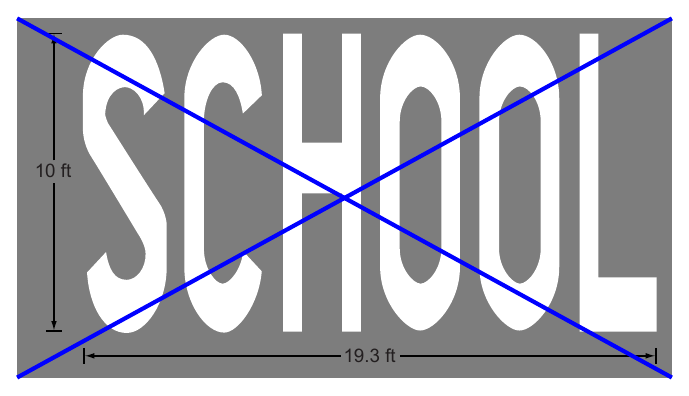
01. If used, the SCHOOL word marking may extend to the width of two approach lanes (see Figure 7C- 1).
Guidance
02. If the two-lane SCHOOL word marking is used, the letters should be 10 feet or more in height.
Support
03. Section 3B.20 contains provisions regarding other word, symbol, and arrow pavement markings that can be used to guide, warn, or regulate traffic.
Standard
04. If used, the SCHOOL pavement marking shown in Figure 7C-101(CA) shall be used and it shall be restricted to a single lane.
Guidance
05. On State highways, all letters, numerals, and symbols should be in accordance with Caltrans’ Standard Plans publication. See Section 1A.05 for more information regarding this publication.
Standard
06. The SLOW SCHOOL XING marking shall be used in accordance with the provisions of CVC § 21368 in advance of all yellow school crosswalks (see Figure 7C-101(CA)). They shall not be used where the crossing is controlled by stop signs, traffic signals, or yield signs. They shall be yellow, with the word XING at least 100 feet in advance of the school crosswalk.
Option
07. The SCHOOL XING marking and crosswalks may be used at remote locations outside of the school zone.
Support
08. Remote crosswalk locations are locations near schools, which are not included in CVC § 21368 criteria. Also refer to Section
Standard
09. If the SCHOOL XING marking and crosswalks are used at remote locations outside of the school zone, they shall not be yellow (Refer to CVC § 21368), but white.
Guidance
10. The SCHOOL XING marking should be used in advance of all white school crosswalks.
Option
11. The SCHOOL marking may be used with the School Assemblies A(CA) or C(CA), except at locations where SLOW SCHOOL XING markings are required.
Standard
12. If the SCHOOL marking is used with the School Assemblies A(CA) or C(CA) (See Section 7B.02 and 7B.05), it shall be yellow.
Guidance
13. If used, the SCHOOL marking should be located adjacent to the School Assemblies A(CA) or C(CA) (See Section 7B.02 and
Support
14. Refer to Section 3C.03 for more details on SCHOOL marking.
.png)
Note: See Section 7C.02 for SLOW SCHOOL XING marking.