2L. Changeable Message Signs¶
§2L.01 Description of Changeable Message Signs¶
Support
01. A changeable message sign (CMS) is a traffic control device that is capable of displaying one or more alternative messages. Some CMS have a blank mode when no message is displayed, while others display multiple messages with only one of the messages displayed at a time (such as OPEN/CLOSED signs at weigh stations).
02. The provisions in this Chapter apply to both permanent (fixed) and portable changeable message signs with electronic displays or the electronic display portion of an otherwise conventional static sign. Additional provisions that only apply to portable changeable message signs (PCMS) can be found in Section 6L.05. The provisions in this Chapter generally do not apply to CMS with non-electronic displays that are changed either manually or electromechanically, such as a hinged-panel, rotating-drum, or back-lit curtain or scroll CMS.
03. The CMS is a traffic control device at all times regardless of the type of message being displayed. Accordingly, the limitations on design, format, and manner of display of a message conveyed on a conventional sign apply to CMS regardless of the type of message being displayed at any given time. Some of the general provisions regarding traffic control devices are reiterated in this Chapter. However, this Chapter is not an independent or stand-alone reference for CMS. Users of CMS are expected to consult the other chapters in this Manual for criteria on how to develop effective messages that comply with this Manual and that meet the expectancy and limitations of the road user. In this regard, the engineering processes applied to decisions about whether to use a particular sign, for example, are no different for the decisions about the type and content of the message under consideration for display on a CMS. The other limited-use messages allowed on CMS as provided for in this Chapter likewise fall under the same MUTCD provisions as the primary-use traffic operation regulatory, warning, and guidance messages except as stated otherwise in this Chapter.
04. CMS messaging can be subject to habituation, a phenomenon by which repeated exposure to a stimulus results in diminished response. CMS habituation can occur through repeated exposure to messages, especially those messages that might not be perceived as having relevance to the road user, resulting in diminished responsiveness of the road user to that message. Because messages can be changed or extinguished, the effectiveness of CMS is tied more to the messages displayed thereon, the frequency of displayed messages, and the relevance to the road user, rather than to the installation of the signs themselves.
Guidance
05. Changeable message signs should be used judiciously to avoid habituation and preserve their effectiveness during the display of real-time messages about traffic conditions or traffic advisories.
Standard
06. The design of legends for non-electronic display CMS shall comply with the provisions of Chapters 2A through 2K, 2M, and 2N of this Manual. Other CMS shall comply with the design and application principles established in this Chapter, Chapter 2A, and provisions elsewhere in this Manual for specific signs.
07. No items other than inventory or maintenance-related information (see Section 2A.04) shall be displayed on the front or back of a CMS or portable CMS. Names or logos of the manufacturer, brand, or model shall not be displayed on a CMS or portable CMS, either in the message display itself or on the exterior housing.
Guidance
08. Blank-out signs that display only single-phase, predetermined electronic-display legends that are limited by their composition and arrangement of pixels or other illuminated forms in a fixed arrangement (such as a blank-out sign indicating a part-time turn prohibition, a blank-out or changeable lane-use sign, or a changeable OPEN/CLOSED sign for a weigh station) should comply with the provisions of the applicable Section for the specific type of sign, provided that the letter forms, symbols, and other legend elements are duplicates of the conventional messages as detailed in the “Standard Highway Signs” publication (see Section 1A.05). Because such a sign is effectively an illuminated version of a conventional sign, the size of its legend elements, the overall size of the sign, and the placement of the sign should comply with the applicable provisions for the conventional version of the sign.
§2L.02 Applications of Changeable Message Signs¶
Standard
01. CMS shall display only traffic operational, regulatory, warning, and guidance information except as otherwise provided in this Chapter. Advertising or other messages not related to traffic control shall not be displayed on a CMS or on its supports or other equipment.
Option
02. CMS may display traffic safety campaign messages (see Section 2L.07), transportation-related messages, emergency homeland security messages, and America’s Missing: Broadcast Emergency Response (AMBER) alert messages, all as provided for in this Chapter.
03. Transportation-related messages for the purpose of improving traffic conditions, such as those providing information on alternative means of transportation, electronic toll collection, or carpooling may be displayed to remind or inform drivers of relevant options or opportunities for transportation.
Support
04. Messages regarding broader transportation items not related to improving traffic conditions, such as reminders of driver’s license or vehicle registration renewal, vehicle recall information, and vehicle maintenance, do not meet the purpose of a transportation-related message.
05. Examples of transportation-related messages include “STADIUM EVENT SUNDAY, DELAYS NOON TO 4 PM” and “OZONE ALERT—USE TRANSIT.”
Guidance
06. A CMS should not be used to display a transportation-related message if doing so could adversely affect respect for the sign. “CONGESTION AHEAD” or other overly simplistic or vague messages should not be displayed alone. These messages should be supplemented with a message on the location or distance to the congestion or incident, delay and travel time, alternative route, or other similar messages.
07. CMS should not be used in place of conventional signs for conditions that do not change, except for blank-out type signs used to display regulatory, warning, and guidance information that routinely reoccurs, but only on a part-time basis. Similarly, when only certain elements of a message on a non-changeable sign are subject to change, only those elements of the sign should be in an electronic display, for example the prices shown on the R3-48 and R3-48a signs (see Figure 2G-18).
Support
08. The purpose of CMS is to provide real-time traffic regulatory, warning, or guidance messages as follows:
- A. Incident management and route diversion;
- B. Warning of adverse roadway travel conditions due to weather;
- C. Special event applications associated with traffic control or conditions;
- D. Lane, ramp, and roadway control;
- E. Priced or other types of managed lanes;
- F. Travel times;
- G. Warning situations;
- H. Traffic regulations;
- I. Speed control or warning;
- J. Variable destination guidance;
- K. Supporting temporary traffic control; or
- L. Active Traffic Management.
09. CMS provide significant flexibility and capability in communicating many types of real-time traffic control messages to road users. While their intended purpose is the display of traffic regulatory, warning, or guidance information, other limited uses are also allowed under certain conditions, as provided in this Chapter. Their integrity as an official traffic control device rests significantly on their judicious use and proper messaging format and content, regardless of the message type being displayed.
Standard
10. State and local highway agencies that have permanently-installed (fixed) or positioned (portable) CMS shall issue and maintain a policy regarding the use and display of all types of messages to be used on their CMS. The policy shall define the types of messages that will be allowed, the priority of messages, the proper syntax of messages, the timing of messages, and other important messaging elements to ensure messages displayed meet the basic principles that govern the design and use of traffic control devices in general (see Section 1D.01) and traffic signs in particular as provided for in this Manual.
Guidance
State and local agencies that use CMS, but do not have permanently-installed (fixed) or positioned (portable) signs, should develop and establish a policy as discussed in Paragraph 10 of this Section.
12. When CMS are used at multiple locations to address a specific situation, the message displays should be consistent along the roadway corridor and adjacent corridors, which might necessitate coordination among different operating agencies.
13. AMBER alerts (see Paragraph 2 of this Section), when displayed, should not preempt messages related to traffic or travel conditions. AMBER alert messages should be kept as brief as possible and, when possible, direct road users to another source, such as broadcast or highway advisory radio, for detailed information about the alert.
Standard
14. Types of “alert” messages other than AMBER alerts that are unrelated to traffic or travel conditions shall not be displayed on CMS.
15. The format of CMS displays shall not be of a type that could be considered similar to advertising or promotional displays.
Support
16. In times of a declared state of emergency, it might be appropriate to display messages related to evacuation, homeland security, or emergency information. Traffic patterns, movement, or other situations might be atypical due to the emergency, necessitating unique messaging not specifically related to traffic conditions.
Standard
17. Homeland security and emergency messages shall only be displayed in declared states of emergency when there is an imminent threat to the general population. Generic security or personal safety messages shall not be displayed when there is no context of a declared state of emergency or known imminent national security threat. Homeland security and emergency messages shall not be promotional or advisory in nature, including the message design, layout, or manner of display.
Guidance
18. Homeland Security and emergency messages should undergo significant levels of scrutiny prior to being approved for broadcast to ensure accuracy and consistency with emergency conditions. These messages should be designed to convey a clear and simple meaning in a similar format to traffic control messages.
Support
19. Section 2B.21 contains information regarding the design of CMS that are used to display variable speed limits that change based on ambient or operational conditions on the variable Speed Limit (R2-1) sign.
20. Section 2C.13 contains information regarding the design of CMS that are used to display the speed at which approaching vehicles are traveling on the Vehicle Speed Feedback (W13-20 and W13-20aP) sign and plaque.
21. Section 2H.04 contains information regarding the design of CMS that are used to display variable speeds for traffic signal progression on the Traffic Signal Speed (I1-1) sign.
22. Section 5B.01 contains provisions for LEDs used in electronic-display signs to accommodate driving automation systems. Caltrans’ Policy regarding the use of CMS for AMBER alert messages on State Highways
Support
23. A primary mission of Caltrans is the safe and orderly movement of traffic. It is the policy of Caltrans to display only real-time information that conveys current traffic safety and congestion information on CMS.
Standard
24. An exception to Caltrans policy on the use of CMS shall be made only for AMBER Alerts. Only credible real-time information, where it is crucial to the safety of the victim to disseminate the information to the public in the near term, shall be displayed on these CMS.
Support
25. Law enforcement activates an AMBER Alert when circumstances meet the following criteria: the person is confirmed missing; the law enforcement agency believes the person has been kidnapped; the agency believes the missing person is under threat of serious bodily harm or death.
Standard
26. The California Highway Patrol (CHP) shall consult with the investigating agency prior to requesting any CMS activation.
11. Caltrans shall only respond to AMBER alert requests from the CHP. Caltrans’ District Traffic Management Center (TMC) staff and local CHP staff shall jointly agree upon the most appropriate CMS message content(s). The TMC staff shall also consult with CHP staff regarding the length of time to display messages (initially 2-3 hours), and extent of roadway system to display the messages (i.e. radius and/or directions and specific routes).
Guidance
27. TMC personnel should discuss with CHP the limitations on message content, the number of signs that can be deployed within a given time period, conflicts with other necessary sign messages etc.
Support
28. There is a concern that messages that are too general in describing vehicles might result in inappropriate vigilantism. The preferred response is to display a radio frequency (thus referring the public elsewhere for details) – Caltrans’ Highway Advisory Radios (HAR) or appropriate commercial radio. Alternatively, a license plate number (or partial number) might be displayed along with a vehicle description. The display of any contact phone number is not allowed.
29. Nothing in this policy suggests a requirement to pre-empt true road users safety messages, e.g. unexpected “end of queue” motorist alerts, severe weather advisories (fog, smoke), road closure and detour information etc.
Option
30. It may be necessary to turn off an AMBER alert message that creates a traffic hazard.
Support
31. This policy primarily applies to the use of fixed CMS. Should the use of portable CMS be necessary and appropriate at a specific location(s); Caltrans can expect CHP assistance with portable CMS deployment as needed.
Guidance
32. The TMCs should notify Caltrans’ HQ Communications Center when responding to an AMBER alert request. The TMCs should monitor and save traffic data to determine if unintended consequences of displaying such a message occurred on the highway.
Standard
33. A joint debriefing of Caltrans and CHP staff shall follow every event.
34. In all cases, messages shall maintain the credibility of the CMS.
§2L.03 Legibility and Visibility of Changeable Message Signs¶
Support
01. The maximum distance at which a driver can first correctly identify letters and words on a sign is called the legibility distance of the sign. Legibility distance is affected by the characteristics of the sign design and the visual capabilities of drivers. Visual capabilities, and thus legibility distances, vary among drivers.
02. For the more common types of CMS, the longest measured legibility distances on sunny days occur during mid-day when the sun is overhead. Legibility distances are much shorter when the sun is behind the sign face, when the sun is on the horizon and shining on the sign face, or at night.
03. Visibility is the characteristic that enables a CMS to be seen. Visibility is associated with the point where the CMS is first detected, whereas legibility is the point where the message on the CMS can be read. Environmental conditions such as rain, fog, and snow impact the visibility of CMS and can reduce the available legibility distances. During these conditions, there might not be enough viewing time for drivers to read the message.
Guidance
04. CMS used on roadways with speed limits of 55 mph or higher should be visible from ½ mile under both day and night conditions. The message should be designed to be legible from a minimum distance of 600 feet for nighttime conditions and 800 feet for normal daylight conditions. When environmental conditions that reduce visibility and legibility are present, or when the legibility distances stated in the previous sentences in this paragraph cannot be practically achieved, messages composed of fewer units of information should be used and consideration should be given to limiting the message to a single phase (see Section 2L.05 for information regarding the lengths of messages displayed on CMS).
05. The electronic display of standardized regulatory and warning signs used individually or as part of the legend for a larger sign should meet the size and legend requirements for those specific signs in Chapters 2B and 2C.
§2L.04 Design Characteristics of Messages¶
Standard
01. Except as provided in Paragraph 2 of this Section, messages shall not include animation, flashing, dissolving, exploding, scrolling, or other dynamic display elements.
02. When a portable CMS is used as an arrow board that uses a flashing or sequential display for a lane or shoulder closure, the display and operation shall be considered that of an arrow board and shall comply with the provisions of Sections 6L.05 and 6L.06.
Guidance
03. In developing messages for display on CMS, the provisions of Section 1D.01 should be consulted for the principles of an effective traffic control device.
Standard
04. All message displays on CMS, whether for traffic operational, regulatory, warning, or guidance information, or for the other allowable message types as defined in this Chapter, shall follow the same design and display principles found in this Manual used for other traffic control signs, except as provided elsewhere in this Chapter.
Guidance
05. Except in the case of a limited-legend CMS (such as a blank-out or a part-time regulatory sign display) that is used in place of a conventional regulatory sign or an activated blank-out warning sign that supplements a conventional warning sign at a separate location, the signs should be used as a supplement to and not as a substitute for conventional signs and markings unless otherwise provided for in this Manual.
Support
06. When CMS are overused for messages not directly associated with real-time driving conditions, road users might pay less attention to the sign, thereby limiting their effectiveness as traffic control devices.
Guidance
07. Warning Beacons (see Section 4S.03) should not be installed on CMS, rather CMS should be used predominately to display messages that are critical to real-time travel conditions. CMS word messages should be limited to no more than three lines, with no more than 20 characters per line.
08. The spacing between characters in a word should be between 25 and 40 percent of the letter height. The spacing between words in a message should be between 75 and 100 percent of the letter height. Spacing between the message lines should be between 50 and 75 percent of the letter height. Table 2L-1 contains information for spacing between characters, words, and lines of text.
09. Except as otherwise provided in this Manual, word messages on CMS should be composed of all upper-case letters. The minimum letter height should be 18 inches for CMS on roadways with speed limits of 45 mph or higher. The minimum letter height should be 12 inches for CMS on roadways with speed limits of less than 45 mph. When a message is composed of two phases and higher informational load (see Section 2L.05), the letter height should be 18 inches, regardless of the speed limit, to optimize legibility distance and available viewing time.
Option
10. CMS used to replicate a conventional sign may use the character size of the conventional sign being replicated.
Support
11. Using letter heights of more than 18 inches will not result in proportional increases in legibility distance.
Guidance
12. The width-to-height ratio of the sign characters should be between 0.7 and 1.0. The stroke width-to- height ratio should be 0.2.
Support
13. The width-to-height ratio is commonly accomplished using a minimum font matrix density of five pixels wide by seven pixels high.
Standard
14. CMS shall automatically adjust their brightness under varying light conditions to maintain legibility.
Guidance
15. The luminance design of a CMS should meet industry criteria for daytime and nighttime conditions. Luminance contrast design should be between 8 and 12 for all conditions.
Support
16. CMS maintenance and replacement practices might need to account for the reduction of LED luminance and luminance contrast that occurs naturally over time and might substantially impact legibility.
Guidance
17. Contrast orientation of CMS should always be positive, that is, with luminous characters on a dark or less-luminous background.
Support
18. Legibility distances for negative-contrast CMS are likely to be at least 25 percent shorter than those of positivecontrast messages. In addition, the increased light emitted by negative-contrast CMS has not been shown to improve detection distances and might visually overwhelm the darker characters of the sign legend.
Standard
19. The colors used for the legends and backgrounds on CMS shall be as provided in Table 2A-2 and Table 2A-2(CA).
20. Except as provided for in Paragraph 21 of this Section, if a black background is used, the color used for the legend on a CMS shall match the background color that would be used on a standard sign for that type of legend as specified in Table 2A-2 and Table 2A-2(CA).
Option
21. CMS that use only yellow or amber LEDs may display a yellow or amber legend that does not match the background color used on a standard sign for that type of legend as specified in Table 2A-2 and Table 2A-2(CA).
Standard
22. If a green background is used for a guide message on a CMS or if a blue background is used for a motorist services message on a CMS, the background color shall be provided by green or blue lighted pixels such that the entire CMS would be lighted, not just the white legend.
Support
23. Some CMS that employ newer technologies have the capability to display a near duplicate of a standard sign or other sign legend using standard symbols, the Standard Alphabets and letter forms, route shields, and other typical sign legend elements with no apparent loss of resolution or recognition to the road user when compared with a conventional version of the same sign legend. Such signs are of the full-matrix type and can typically display full-color legends. Figure 2L-1 shows comparative examples of the effects of varying pixel densities on legend form.
Guidance
24. If used, the CMS described in Paragraph 23 of this Section should not display symbols or route shields unless they can do so in the appropriate legend and background color combinations. Where an LED matrix is used to form the changeable legend, signs with pixel spacing greater than 20 millimeters should display only word legends and no symbols or route shields.
25. For a single-phase message where the Standard Alphabets and other legend elements of standard designs are used, the lettering style, size, and line spacing should comply with the applicable provisions for the type of message displayed as provided elsewhere in this Manual. For two-phase messages, larger legend heights should be used as described previously in this Section because of the need for such messages to be legible at a greater distance. Regardless of the number of phases, the CMS should comply with the legibility and visibility provisions of Section 2L.03.
§2L.05 Message Length and Units of Information¶
Guidance
The maximum length of a message should be dictated by the number of units of information contained in the message, in addition to the size of the CMS. A unit of information, which is a single answer to a single question that a driver can use to make a decision, should not be more than four words.
Support
02. In order to illustrate the concept of units of information, Table 2L-2 shows an example message that is comprised of four units of information.
03. The maximum allowable number of units of information in a CMS message is based on the principles described in this Section, the current highway operating speed, the legibility characteristics of the CMS, and the lighting conditions.
Standard
04. Each message shall consist of no more than two phases. A phase shall consist of no more than three lines of text. Each phase shall be understood by itself, and the meaning of the entire message shall be the same, regardless of the sequence in which the phases are read. Each line of legend shall be centered on the sign. Except for signs located on toll plaza structures or other facilities with a similar booth-lane arrangement, if more than one CMS is
01. visible to road users, then only one sign shall display a sequential message at any given time.
Option
05. A legend on a CMS that replicates a legend on a conventional sign that would not normally be center justified may be left justified or right justified as appropriate, such as a travel time or a variable rate toll display.
Standard
06. Abbreviations displayed on CMS shall comply with the provisions of Section 1D.08.
Guidance
07. When designing and displaying messages on CMS, the following principles should be used:
- A. The minimum time that an individual phase is displayed should be based on 1 second per word or 2 seconds per unit of information, whichever produces a lesser value. The display time for a phase should never be less than 2 seconds.
- B. The maximum cycle time of a two-phase message should be 8 seconds.
- C. The duration between the display of two phases should not exceed 0.3 seconds.
- D. No more than three units of information should be displayed in a message phase.
- E. No more than four units of information should be in a message when the traffic operating speeds are 35 mph or more.
- F. No more than five units of information should be in a message when the traffic operating speeds are less than 35 mph.
- G. Only one unit of information should appear on each line of the CMS.
Support
08. Table 2L-2 provides an example of the number of units of information in a message. Option:
09. A unit of information consisting of more than one word may be displayed on more than one line. An additional CMS at a downstream location may be used for the purpose of allowing the entire message to be read twice.
10. If more than two phases would be needed to display the necessary information, additional CMS may be used to display this information as a series of two distinct, independent messages with a maximum of two phases at each location, in accordance with the provisions of Paragraph 4 of this Section.
Support
11. Tables 2L-3 and 2L-4 provide examples of message construction for CMS. Each example shows the message content, layout, and phasing for a potential message and an improved message. The improved message for each example has been optimized for recognition, comprehension, and effectiveness.
§2L.06 Travel Time Messages¶
Support
01. Travel times provide road users useful information about the level of congestion on segments of highways where motorists experience frequent incidents that slow traffic. Travel times are only helpful to the road user if they have a general understanding of the length of the road segment the travel time is related to so that they can compare that to the time it takes them to travel a similar distance on a highway without congestion. However, travel time messages require road users to read and process a significant amount of information and careful consideration is needed to ensure the overall message is not overloading the motorist.
Guidance
02. Travel times should be tied to the distance to a particular destination or junction so that road users can estimate the level of congestion based on the time to travel that distance. When travel times are displayed on CMS, such as during peak traffic conditions, the message should comply with the provisions of Sections 2E.49 and 2E.50. If both a travel time and a distance are displayed, the sign should display only one destination. A distance displayed as part of a travel time message should be rounded to the nearest whole mile.
Option
03. When comparative travel time displays are used providing travel times on different routes to one destination, distances to that destination may be eliminated.
04. A reference-location-based exit number (see Section 2E.22) may be displayed in lieu of a destination name or junction thereby providing the necessary distance information to the road user. If reference-location- based exit numbers are displayed, then up to two travel times may be displayed provided that the distance to the exit is not also displayed.
§2L.07 Traffic Safety Campaign Messages¶
Support
01. An allowable ancillary use of CMS is the display of traffic safety messages in conjunction with a traffic safety campaign that includes other forms of media as the primary communication and education mechanism.
Standard
02. Traffic control messages shall have priority over traffic safety campaign messages.
Guidance
03. When a CMS is used to display a traffic safety campaign, the message should be simple, direct, brief, legible, and clear (see Section 1D.01). Traffic safety campaign messages should be relevant to the road user on the roadway on which the message is displayed. For example, messages regarding school bus stop safety should not be displayed on freeways where school bus stops are not found.
04. A CMS should not be used to display a traffic safety campaign message if doing so could adversely affect respect for the sign. Messages with obscure or secondary meanings, such as those with popular culture references, unconventional sign legend syntax, or that are intended to be humorous, should not be used as they might be misunderstood or understood only by a limited segment of road users and require greater time to process and understand. Similarly, slogan-type messages and the display of statistical information should not be used.
05. The broad traffic safety campaign marketing message should be appropriately shortened or otherwise modified to comply with the provisions of Section 2L.05 when a traffic safety campaign message is displayed on a CMS.
06. Traffic safety campaign messages should emphasize the applicable regulation or warning and should reference any penalties associated with violations of the regulation. Traffic safety campaigns using CMS should include coordinated enforcement efforts where penalties or enforcement type warnings are part of the message displayed on the CMS.
07. Traffic safety campaign messages should not be displayed on CMS unless they are part of an active, coordinated safety campaign that uses other media forms as the primary means of outreach. For consistency on a national level, traffic safety campaigns should be coordinated with those on the National Highway Transportation Safety Administration’s annual communications calendar.
Support
08. Examples of traffic safety campaign messages include “UNBUCKLED SEAT BELTS FINE + POINTS” and “IMPAIRED DRIVERS LOSE LICENSE + JAIL.”
§2L.08 Permanently-Located (Fixed) Changeable Message Signs¶
Support
01. Careful consideration of CMS installation location is important to having a safe and effective message, taking into account several factors. CMS message length and complexity will vary and often include two-phase displays, all of which might require longer glance times by motorists than would be required for conventional sign messages.
02. Permanently-located (Fixed) CMS (FCMS) are generally used on higher-speed, multi-lane facilities with high traffic volumes where more time might be required to properly respond to a message, such as by changing lanes or reducing speed. It also is common for other signs to be in the same vicinity of the desired location for a permanently-located (Fixed) CMS (FCMS) raising the concern of overloading road users with information.
Guidance
03. A CMS that is used in place of a conventional sign (such as a blank-out or variable legend regulatory sign) should be located in accordance with the provisions of Chapter 2A and the provisions for the conventional sign it replaces.
04. Permanently-located (Fixed) CMS (FCMS) should:
- A. Be located sufficiently upstream of known bottlenecks and high crash locations to enable road users to select an alternate route or take other appropriate action in response to a recurring condition.
- B. Be located sufficiently upstream of major diversion decision points, such as interchanges, to provide adequate distance over which road users can change lanes to reach one destination or the other.
- C. Not be located within an interchange except for toll plazas or managed lanes.
- D. Not be positioned at locations where the information load on drivers is already high because of guide signs and other types of information.
- E. Not be located in areas where drivers frequently perform lane-changing maneuvers in response to guide sign information, or because of merging or weaving conditions.
Support
Many of the factors in locating permanently-located (Fixed) CMS (FCMS) apply to PCMS. Information regarding the design and application of PCMS in temporary traffic control zones is contained in Section 6L.05.
§2L.101(CA) Extinguishable Message Signs¶
Support
01. Extinguishable message signs are designed to have one or more messages that can be displayed or deleted as required. Such a sign can be changed manually, by remote control, or by automatic controls that can “sense” the conditions that require special sign messages.
02. It is recognized that due to technological limitations, many extinguishable message signs cannot conform to the exact sign shape, color, and dimensions specified in these standards. Nevertheless, it is essential that extinguishable message signs ascribe to the principles established in this California MUTCD, and to the extent practicable, with the design and applications prescribed herein.
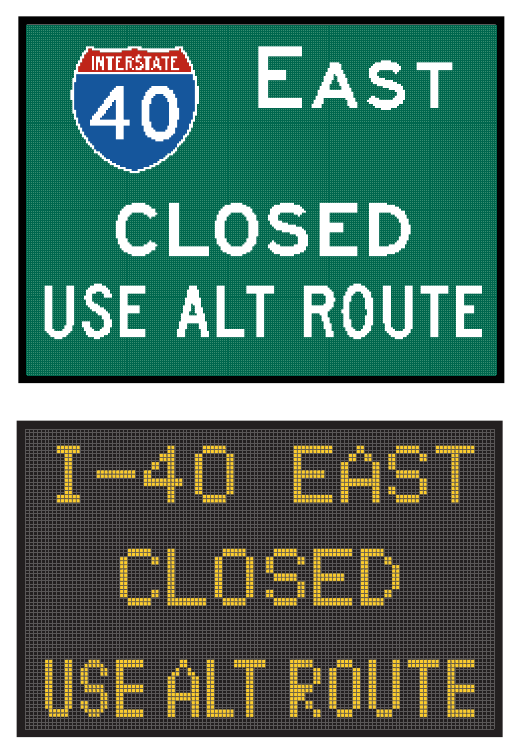
Color full-matrix CMS with pixel pitches of 20 millimeters or less are typically capable of displaying legends nearly identical to conventional sign legends, including route shields and symbols as provided in the MUTCD. CMS with insufficient pixel density, typically with pixel pitches greater than 20 millimeters – whether full color or monochrome – are generally not capable of adequately displaying conventional sign legends with sufficient clarity and should only display monochrome word messages. Notes:
- 1. Pixel pitch is the distance from the center of a pixel to the center of an adjacent pixel.
- 2. The pixel pitch is described in Metric units because sign manufacturers only use Metric units.
Table 2L-1. Spacing between Message Characters,
| Height of Letters Used on CMS | Spacing between Characters in Words | Horizontal Spacing between Words | Vertical Spacing between Lines of Text |
|---|---|---|---|
| 12 | 3-5 | 9 - 12 | 6-9 |
| 18 | 4½-7 | 13 ½ - 18 | 9 - 13 ½ |
Table 2L-2. Example of Units of Information
| Question | Answer | Number of Information Units |
|---|---|---|
| What happened? | MAJOR CRASH | 1 |
| Where? | AT EXIT 12 | 1 |
| Who is the | Drivers heading TO NEW YORK | 1 |
| advisory for? | ||
| What is advised? | USE ROUTE 46 | 1 |
Table 2L-3. Examples of Message Construction for CMS
| Example Phase Potential Message Improved Message Comments | ||||
|---|---|---|---|---|
| 1 | 1 2 | EXIT 10 CLOSED USE EXIT 12 | EXIT 10 CLOSED USE EXIT 12 | Diversionary message: Each message phase should convey a complete thought independent of the other message phase. The entire message should also make sense regardless of which phase is read first. |
| 2 | 1 2 | ROADWORK AHEAD CAUTION CAUTION CAUTION | ROAD WORK AHEAD FINES DOUBLE | Advance warning message: Condensing ROAD and WORK into single word is not necessary since sign width will accommodate the conventional 2-word message. A general CAUTION message is not specific enough to be actionable by the road user. Message should not be repeated to fill sign. Phase 2 of the improved message can be eliminated without any loss of meaning to Phase 1. |
| 3 | 1 2 | RIGHT LANE CLOSED 1 MILE | RIGHT LANE CLOSED 1 MILE N/A Single-Phase Message | Advance warning message: Use of single phase message reduces time necessary to read and glances away from the road. Second phase does not provide a complete message. |
| 4 | 1 2 | RT LN CLSD 1 MI N/A Single-Phase Message | RIGHT LANE CLOSED 1 MILE N/A Single-Phase Message | Advance warning message: Less common abbreviations (see Table 1D-2) are not warranted when the sign can accommodate the full message. Abbreviations in Table 1D-2 should be limited only to portable CMS where the number of characters per line is limited. |
| 5 | 1 2 | 9TH AVENUE SOUTHWEST KEEP RIGHT N/A Single-Phase Message | 9TH AVE SW KEEP RIGHT N/A Single-Phase Message | Directional message: Conventional abbreviations for street name descriptors (see Table 2D-3) are used for consistency with standard signs to improve recognition and reduce the apparent amount of legend. |
| 6 | 1 2 | EXPWY CONGESTED USE 101 FOR AIRPORT N/A Single-Phase Message | US 19 CONGESTED AIRPORT USE EXIT 101 | Diversionary message: Lack of Expressway route number is vague to unfamiliar road user. Adding exit number for diversion route simplifies message. Diversion message is stated in reverse order and requires more words as a result. |
| 7 | 1 2 | TRAVEL TIME TO I-89 13 MINUTES TRAVEL TIME TO I-89 12 MILES | I-89 JCT 12 MILES 13 MINS N/A Single-Phase Message | Travel time information: TRAVEL TIME legend is extraneous and out of context for the distance message. Changing only one line of legend between phases compromises recognition of the message. |
| 8 | 1 2 | SEAT BELTS SAVE LIVES N/A Single-Phase Message | STATE LAW FASTEN SEAT BELTS N/A Single-Phase Message | Safety campaign regulatory message: Slogan-type message does not convey the legal requirement. As an alternative, the STATE LAW legend could be eliminated and the fine for violations displayed on a second phase to convey the regulatory nature of the message. |
| 9 | 1 2 | DONT TEXT JUST DRIVE IT CAN WAIT | NO HAND-HELD PHONE BY DRIVER $250 FINE AND POINTS | Regulatory message. Slogan-type message does not convey the legal requirement. Phase 2 of the improved message can be eliminated without any loss of meaning to Phase 1. |
Note: Examples shown are for single-color CMS with pixel spacing greater than 20 mm and use all upper-case lettering. Multi-color, full- matrix CMS with pixel spacing of 20 mm or less should use upper- and lower-case lettering where appropriate and proper legend and background colors.
Note: Examples shown are for single-color CMS with pixel spacing greater than 20 mm and use all upper-case lettering. Multi-color, full- matrix CMS with pixel spacing of 20 mm or less should use upper- and lower-case lettering where appropriate and proper legend and background colors.
Table 2L-4. Examples of Message Construction for Portable CMS*
| Example | Phase | Potential Message | Improved Message | Comments |
|---|---|---|---|---|
| 1 | 1 2 | EXIT 10 CLOSED USE EXIT 12 | EXIT 10 CLOSED USE EXIT 12 | Diversionary message: Each phase conveys a complete thought. |
| 2 | 1 2 | ROADWORK AHEAD CAUTION CAUTION CAUTION | ROAD WORK AHEAD FINES DOUBLE | Advance warning message: Condensing ROAD and WORK into a single word is unnecessary because the sign width will accommodate the conventional 2-word phrase. A general CAUTION message is not specific enough to be useful to the road user. Message should not be repeated to fill the sign. Phase 2 of the improved message can be eliminated without any loss of meaning to Phase 1. |
| 3 | 1 2 | RIGHT LANE CLOSED 1 MILE | RIGHT LN CLOSED 1 MILE N/A Single-Phase Message | Advance warning message: Separation of the message into 2 phases is unnecessary. Second phase does not provide a complete message. |
| 4 | 1 2 | RT LN CLSD 1 MI N/A Single-Phase Message | RIGHT LN CLOSED 1 MILE N/A Single-Phase Message | Advance warning message: Less common abbreviations (see Table 1D-2) are not warranted when the sign can accommodate the full message. |
| 5 | 1 2 | 9TH AVENUE SW KEEP RIGHT | 9 AVE SW KEEP RIGHT N/A Single-Phase Message | Directional message: Conventional abbreviations for street name descriptors (see Table 2D-3) are used for consistency with standard signs to improve recognition and reduce the apparent amount of legend. |
| 6 ** | 1 2 | ROAD WORK NEXT 3 MILES | ROADWORK NEXT 3 MILE N/A Single-Phase Message | Advance warning message: Condensing ROAD and WORK into single word (see Table 1D-2) accommodates a single-phase message. |
| 7 | 1 2 | SEAT BELTS SAVE LIVES | FASTEN SEAT BELTS STATE LAW | Safety campaign regulatory message: Slogan-type message does not convey the legal requirement. As an alternative, the STATE LAW legend could be eliminated and the fine for violations displayed on a second phase to convey the regulatory nature of the message. Phase 2 of the improved message can be eliminated without any loss of meaning to Phase 1. |
| 8 | 1 2 | DONT TEXT JUST DRIVE | NO HAND- HELD PHONE BY DRIVER | Regulatory message: Slogan-type message does not convey the legal requirement. |
* Examples shown are for a portable CMS where the display width is generally limited to 8 characters per line of legend.
** Refer to FHWA’s List of Known Errors for error in row. Refer to Section 1A.04 for more details.