3I. Channelizing Devices Used for Emphasis of Pavement Marking Patterns¶
§3I.01 Channelizing Devices¶
Option
01. Channelizing devices (see Sections 6K.01 through 6K.07 and Figure 6K-1) such as cones, tubular markers, vertical panels, lane separators, drums, and barricades may be used for general traffic control purposes such as adding emphasis to reversible lane delineation, channelizing lines, islands, pedestrian facilities, or bicycle facilities. Channelizing devices may also be used along a center line to preclude turns or along lane lines to preclude lane changing, as determined by engineering judgment.
Support
01a. In California, cones and drums are used for temporary traffic control, not as permanent channelizing devices.
02. Although they are not considered to be traffic control devices, raised islands (see Chapter 3J) are also sometimes used to channelize traffic.
Standard
03. Except for color, the design of channelizing devices, including, but not limited to, retroreflectivity, minimum dimensions, and mounting height, shall comply with the provisions of Chapter 6K.
04. Except as provided in Paragraph 5 of this Section, the color of channelizing devices used outside of temporary traffic control zones shall be the same color as the pavement marking that they supplement, or for which they are substituted, in accordance with Section 3A.03.
Option
05. The color of channelizing devices used to emphasize pavement marking patterns outside of temporary traffic control zones may be orange provided that the application of the orange-colored channelizing device is not permanent.
Support
06. Emergency incidents and planned special events are the most common temporary traffic control zones that would justify orange channelizing devices to emphasize standard pavement marking colors. These events do not necessitate police officers or other authorized personnel to obtain and deploy channelizing devices that match the color of the existing pavement marking.
Standard
07. For nighttime use, channelizing devices shall be retroreflective (as described in Part 6) or internally illuminated. On channelizing devices used outside of temporary traffic control zones, retroreflective sheeting or bands shall be white if the devices separate traffic flows in the same direction and shall be yellow if the devices separate traffic flows in the opposite direction or are placed along the left-hand edge line of a one-way roadway or ramp.
Support
08. Channelizers are flexible retroreflective devices for installation within the roadway to discourage road users from crossing a line or area of the roadway. Unlike delineators, which indicate the roadway alignment, channelizers are intended to provide additional guidance and/or restriction to traffic by supplementing pavement markings and delineation.
Option
09. Channelizers may be used for additional emphasis to discourage median crossings at traffic islands and at lane separations.
Standard
10. The design of a channelizer shall be as shown in Figure 3I-101(CA).
11. The retroreflective unit used on channelizers shall be a minimum of 3 x 12 inches. The 3 x 24 inch minimum retroreflective unit shall be visible at 1000 feet at night under illumination of legal high beam headlights, by persons with vision of or corrected to 20/20.
12. The post shall be flexible with a 2 ¼ inch minimum width, except that the portion containing the retroreflective unit shall be a minimum width of 3 inches. The post shall be a minimum height of 36 inches above the pavement.
13. Channelizer posts used for temporary traffic control shall be orange with white reflectors. Refer to Section 6H.101(CA).
Option
14. At locations where speeds are 40 mph or less a minimum post height of 28 inch may be used.
Support
15. Since channelizers require closer spacing, their post size requirements differ from those of delineators.
16. There are two basic types of channelizers: one attaches to the pavement and the other attaches to an anchoring device imbedded in the pavement. Both the base and anchor systems are designed to permit replacement of the channelizer post. Refer to Figure 3I-101(CA).
Guidance
17. Channelizers should be placed a minimum of 2 feet from the traffic line, away from traffic, to allow for future maintenance of the line.
Option
18. Space limitations may dictate exceptions to this criterion. At certain locations, placement directly on the traffic line may be required.
Support
19. Spacing of the channelizers depends on the type of facility where they are to be used, the speed and volume of traffic, and the alignment to be channelized. Spacing which results in a visual fence/barrier effect is a key factor in channelizer installation.
Guidance
20. The maximum post spacing should be 100 feet on carpool lanes where channelizers are used primarily to delineate the separation between the carpool lane and the main facility.
21. In locations where a relatively high number of violations occur, the post spacing should be 25 feet.
Option
22. Where barrier violations are relatively minimal, a post spacing of 50 feet may be adequate. However, spacing in excess of 50 feet is of negligible value as a deterrent to intentional barrier violations.
23. Post spacing closer than 25 feet may be considered on lower speed roads, urban streets and at specific locations such as traffic islands.
§3I.02 Tubular Markers¶
Standard
01. Tubular markers for permanent installations shall be a minimum of 28 inches in height and shall be a minimum of 2 inches wide facing road users.
Guidance
02. Tubular markers should be affixed to the pavement or other surface either directly or by means of an attachment system that is affixed to the pavement or other surface. Tubular markers should normally be spaced no greater than N as cited in Section 3B.14.
Option
03. Other spacing may be used based on engineering judgment. Support:
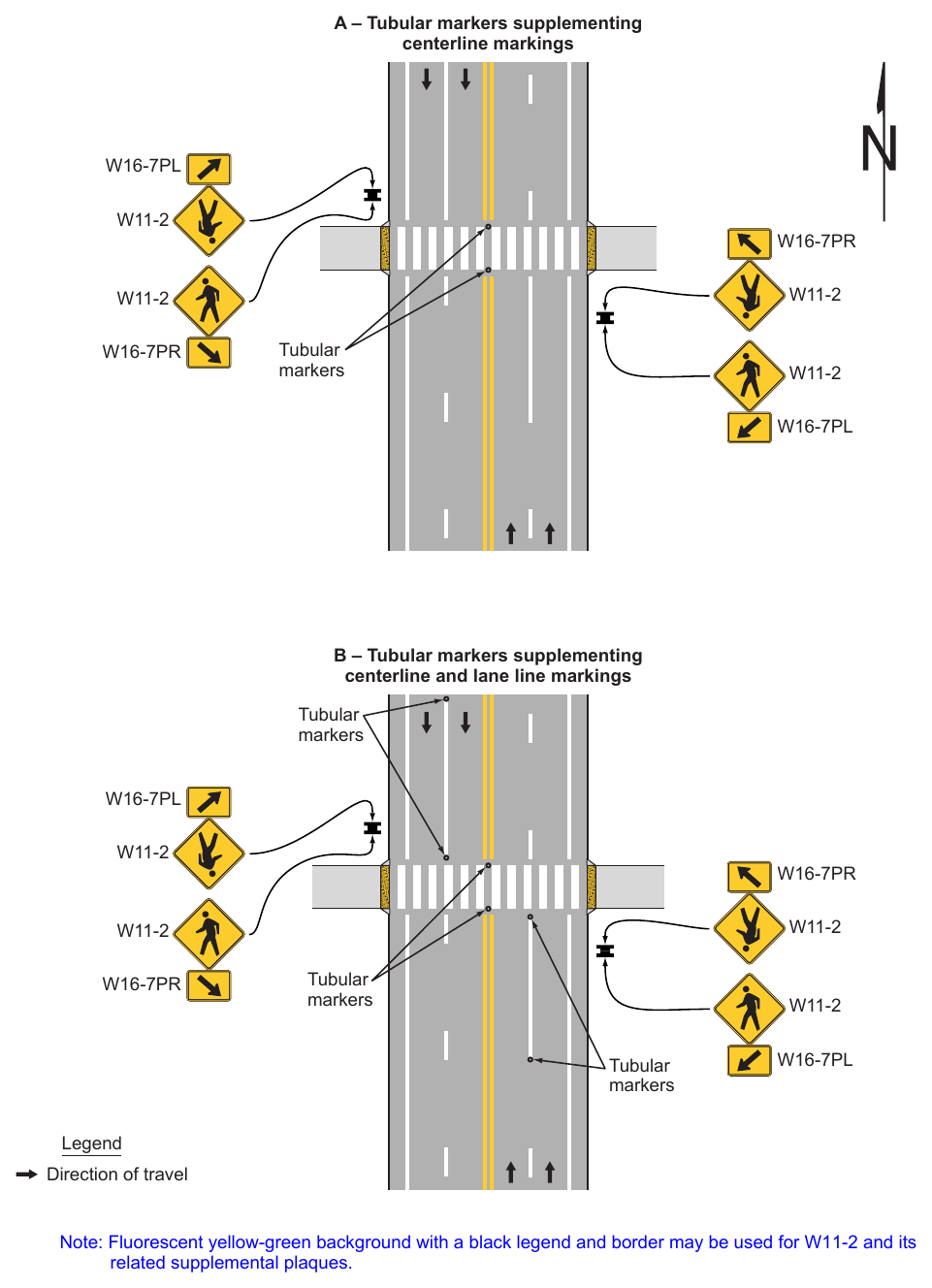
04. Tubular markers are sometimes used to provide additional emphasis or improve lane discipline in advance of an unsignalized crosswalk (see Figure 3I-1).
Guidance
05. When tubular markers are used to supplement a R1-6 series sign (see Section 2B.20) that is either on the center line, lane line, or median island, they should not be used on the same pavement marking line where the R1-6 series sign is installed.
Support
06. Section 6K.04 contains information for temporary installations of tubular markers.
Signs shown: W11-2
in Advance of an Unsignalized Crosswalk (Sheet 1 of 2) A – Tubular markers supplementing centerline markings Tubular markers B – Tubular markers supplementing centerline and lane line markings Tubular markers Tubular markers Tubular markers Legend Direction of travel Note: Fluorescent yellow-green background with a black legend and border may be used for W11-2 and its related supplemental plaques.
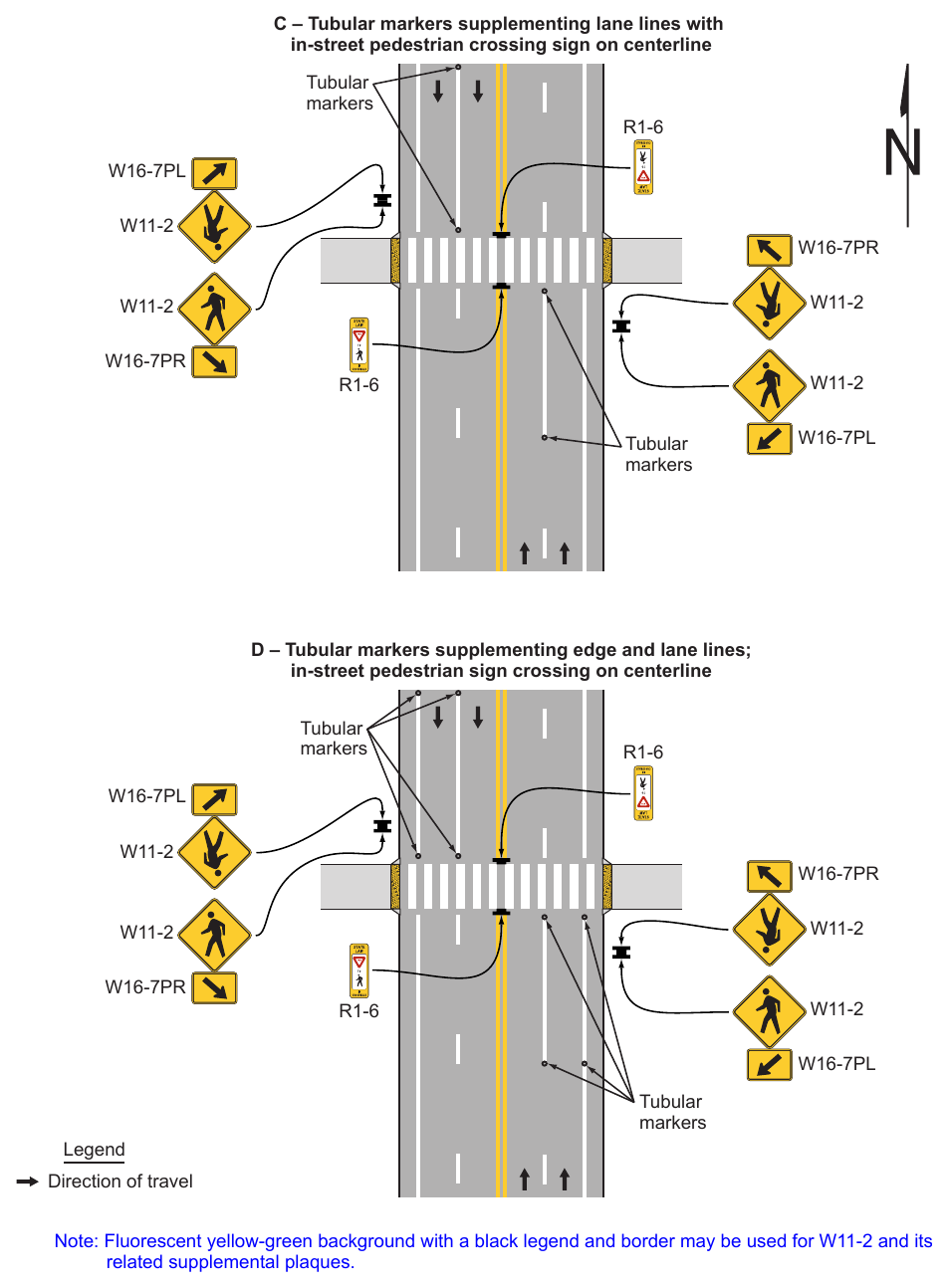
in Advance of an Unsignalized Crosswalk (Sheet 2 of 2) C – Tubular markers supplementing lane lines with in-street pedestrian crossing sign on centerline Tubular markers Tubular markers D – Tubular markers supplementing edge and lane lines; in-street pedestrian sign crossing on centerline Tubular markers Tubular markers Legend Direction of travel Note: Fluorescent yellow-green background with a black legend and border may be used for W11-2 and its related supplemental plaques.
.png)
3 in. min. 1.5 in. max. 3 ft 4 in. max. 2 in. max. min. 3 in. x 12 in. Retroreflector 2.25 in. min. Flexible Post Rigid Base Flexible Base 18 in. min.