3G. Delineators¶
§3G.01 General¶
Support
01. Delineators are particularly beneficial at locations where the alignment might be confusing or unexpected, such as at lane-reduction transitions and curves. Delineators are effective guidance devices at night and during adverse weather. An important advantage of delineators in certain locations is that they remain visible when the roadway is wet or covered by snow.
02. Delineators are considered guidance devices to help road users navigate the roadway alignment, rather than warning devices.
Option
03. Delineators may be used on long continuous sections of highway or through short stretches where there are changes in horizontal alignment.
§3G.02 Design¶
Standard
01. Delineators shall consist of retroreflective devices that are capable of clearly retroreflecting light under normal atmospheric conditions from a distance of 1,000 feet when illuminated by the high beams of standard automobile lights. They shall be mounted on crashworthy (see definition in Section 1C.02) supports.
02. Retroreflective elements for delineators shall have a minimum vertical and horizontal dimension of 3 inches, or a minimum diameter dimension of 3 inches when circular.
Support
03. Within a series of delineators along a roadway, delineators for a given direction of travel at a specific location are referred to as single delineators if they have one retroreflective element for that direction, double delineators if they have two identical retroreflective elements for that direction mounted together, or vertically-elongated delineators if they have a single retroreflective element with an elongated vertical dimension to approximate the vertical dimension of two separate single delineators.
Option
04. A vertically-elongated delineator of appropriate size may be used in place of a double delineator.
Support
05. There are two classes of delineator posts and several types of retroreflectorization as shown in Figure 3G-101(CA).
§3G.03 Application¶
Standard
01. The color of delineators shall comply with the color of edge lines stipulated in Sections 3A.03 and 3B.09.
02. A series of single delineators shall be provided on the right-hand side of freeways and expressways and on at least one side of interchange ramps, except when either Condition A or Condition B is met, as follows:
- A. On tangent sections of freeways and expressways when both of the following conditions are met:
- 1. Raised pavement markers are used continuously on lane lines throughout all curves and on all tangents to supplement pavement markings, and
- 2. Roadside delineators are used to lead into all curves, or
- B. On sections of roadways where continuous lighting is in operation between interchanges.
Option
03. Delineators may be provided on other classes of roads.
04. A series of single delineators may be provided on the left-hand side of roadways.
05. Chevron Alignment (W1-8) signs may be used instead of or in addition to standard delineators, as provided in Section 2C.08.
Standard
06. Delineators on the left-hand side of a two-way roadway shall be white (see Figure 3G-1).
Guidance
07. A series of single delineators should be provided on the outside of curves on interchange ramps.
08. Where median crossovers are provided for official or emergency use on divided highways and where these crossovers are to be marked with pavement markings, a double yellow delineator should be placed on the left-hand side of the through roadway on the far side of the crossover for each roadway.
09. Double or vertically-elongated delineators should be installed at approximately 100-foot intervals along acceleration and deceleration lanes.
10. A series of delineators should be used wherever guardrail or other longitudinal barriers are present along a roadway or ramp.
Option
11. Red delineators may be used on the reverse side of any delineator where it would be viewed by a road user traveling in the wrong direction on that particular ramp or roadway.
Guidance
12. Except as provided in Paragraph 13 of Section 3B.12, delineators of the appropriate color should be used to indicate a lane-reduction transition where either an outside or inside lane merges into an adjacent lane.
13. When used for lane-reduction transitions, the delineators should be installed adjacent to the lane or lanes reduced for the full length of the transition and should be so placed and spaced to show the reduction (see Section 3B.12 and Figure
14. On a highway with continuous delineation on either or both sides, delineators should be carried through transitions.
Standard
15. When used on a truck escape ramp, delineators shall be red.
Guidance
16. Red delineators should be placed on both sides of truck escape ramps.
Option
17. Where delineation is required within a paved area, surface mounted channelizers may be used. Refer to Section 3I.01.
Support
18. Examples of the use of delineators are shown in Figure 3G-101(CA). Color exceptions are shown in Figure 3G-103(CA) and 3G104(CA).
19. Following are typical delineators and their uses:
- A. Type E - White Retroreflector (2 Sided). For use on the left or right of 2-lane 2-way streets and highways when it is desirable to have a reflector on the front and one on the back of the delineator facing the opposite direction of traffic.
- B. Type F - White Retroreflector (1 Sided). For use on the right of freeways and expressways. They may also be used on 2lane 2-way streets and highways when the Type E is not needed.
- C. Type G - Yellow Retroreflector (1 Sided). For use on the left of divided highways and 2-lane highway intersections as shown in Figure 3G-102(CA).
- D. Type J - Red Retroreflector (1 Sided). For placement on both sides of Truck Escape Ramps as shown in Figure 3G103(CA).
20. As shown in Figure 3G-102(CA) and Figure 3G-104(CA), Type K(CA), Type P(CA), and Type R(CA) Object Markers are used along with delineators. Refer to Figure 2C-17(CA) for object marker details.
21. Bikeway separator posts are a type of delineator used as vertical elements to define Class IV bikeways. Refer to the FHWA “Separated Bike Lane Planning and Design Guide” for information on the design of bikeway separator posts. Refer to Sections 9E.07 and 9E.17.
§3G.04 Placement and Spacing¶
Guidance
01. Except as provided in Paragraph 2 of this Section, delineators should be mounted at a height, measured vertically from the bottom of the lowest retroreflective device to the elevation of the near edge of the roadway, of approximately 4 feet.
Option
02. When mounted on the face of or on top of guardrails or other longitudinal barriers, delineators may be mounted at a lower elevation than the normal delineator height recommended in Paragraph 1 of this Section.
Guidance
Delineators should be placed 2 to 8 6 feet outside the outer edge of the shoulder, or if appropriate, in line with the roadside barrier that is 8 feet or less outside the outer edge of the shoulder.
04. Delineators should be placed at a constant distance from the edge of the roadway, except that where an obstruction intrudes into the space between the pavement edge and the extension of the line of the delineators, the delineators should be transitioned to be in line with or inside the innermost edge of the obstruction. If the obstruction is a guardrail or other longitudinal barrier, the delineators should be transitioned to be just behind, directly above (in line with), or on the innermost edge of the guardrail or longitudinal barrier.
05. Delineators should not present a vertical or horizontal clearance obstacle for pedestrians.
06. Delineators should be spaced 200 to 530 feet apart on mainline tangent sections. Delineators should be spaced 100 to 200 feet apart on ramp tangent sections.
Option
07. On a highway with continuous delineation on either or both sides, the spacing between a series of delineators may be closer.
08. When uniform spacing is interrupted by such features as driveways and intersections, delineators which would ordinarily be located within the features may be relocated in either direction for a distance not exceeding ¼ of the uniform spacing. Delineators still falling within such features may be eliminated.
09. Delineators may be transitioned in advance of a lane transition or obstruction as a guide for oncoming traffic.
Guidance
10. The spacing of delineators should be adjusted on approaches to and throughout horizontal curves so that several delineators are always simultaneously visible to the road user. The approximate spacing shown in Table 3G-1 should be used.
11. The spacing between red delineators that are placed on both sides of a truck escape ramp should not exceed 50 feet for a distance that is sufficient to identify the ramp entrance. The spacing between red delineators that are placed beyond the ramp entrance should be such that adequate guidance is provided based on the length and design of the escape ramp.
Option
12. When needed for special conditions, delineators of the appropriate color may be mounted in a closely- spaced manner on the face of or on top of guardrails or other longitudinal barriers to form a continuous or nearly-continuous “ribbon” of delineation.
Support
13. Examples of delineator installations are shown in Figure 3G-1.
Guidance
14. If used on the State Highway System, delineators should be placed as follows:
- A. On the outsides of highway curves of 3000 feet radius or less (including medians in divided highways), freeway exit and entrance ramps and connectors. Exception to this is where a median barrier is delineated as shown in the Median Barrier Delineation Detail in Figure 3G-105(CA). Delineator spacing on curves is shown in Figure 3G-1 and Table 3G-1.
- B. On the right of tangent sections of freeway entrance and exit ramps, collector roads, freeway connectors and lane reduction transition sections at 200 feet spacing.
- C. On embankments higher than 10 feet and with side slopes steeper than 4:1. The spacing of tangent sections is approximately 525 feet. For spacing on curves, refer to Figure 3G-1 and Table 3G-1.
- D. On approaches to narrow bridges as shown in Figure 3G-104(CA).
- E. On tangent sections of rural State highways where there are no reflective pavement markers, such as in snow areas. Delineator spacing is approximately 525 feet.
- F. On all new guardrail or bridge rail installations, or when maintenance is required on existing guardrail or bridge rail, within 12 feet of the edge of traveled way and curves of 3000 feet radius or less. The spacing on tangent sections is approximately 525 feet. For spacing on curves, refer to Figure 3G-1 and Table 3G-1.
Option
15. Delineators may also be placed as follows:
- A. At intersections, road approaches, and median openings, as shown in Figure 3G-102(CA).
- B. On sections of highway with non-standard shoulder width.
03. If the exit gore at an interchange is not illuminated or is partially illuminated, delineators may be placed as shown in Figure 3G102(CA) per the following details:
- A. Type F - White Retroreflectors (1 Sided) on the right side, beginning at a distance > 5S from the theoretical gore point at 100 feet spacing.
- B. Type G - Yellow Retroreflectors (1 Sided) on the left side of the exit at 10 feet spacing and then shifting to 100 feet spacing.
- C. Type F - White Retroreflectors (1 Sided) on the right side of the mainline, downstream of the exit at 10 feet spacing.
Support
17. Refer to Table 3G-1 for formula to calculate value of S.
§3G.101(CA) Emergency Passageway Marker¶
Support
01. Except for emergency passageways in median barriers, median openings are not allowed on freeways.
Guidance
02. Where freeway median passageways are provided for emergency vehicles, delineation for the crossover should be as follows:
- A. At a point, 1/5 mile in advance of the crossover, one Class 1 Delineator, with a yellow post and two 3 x 12 inch white retroreflectors stacked vertically (24 inch of white retroreflectance), should be placed on the left side of the through roadway facing approaching traffic.
- B. At a point, 1/10 mile in advance of the crossover, one Class 1 Delineator, with a yellow post and two 3 x 12 inch yellow retroreflectors stacked vertically, should be placed on the left side as in A.
- C. At the far side of the crossover, one Class 1 Delineator, with a yellow post and one 3 x 12 inch white retroreflector over one 3 x 12 inch yellow retroreflector stacked vertically, should be placed on the left side as in A.
§3G.102(CA) Narrow Bridge Signing and Marking¶
Support
01. The placement of warning signs, object markers, delineators, and edge lines at narrow bridges is dependent upon the width of the bridge and approach roadway.
Standard
02. Narrow bridge signing and marking shall conform to the details shown in Figure 3G-104(CA).
§3G.103(CA) Median Barrier Delineation¶
Guidance
01. Median barriers should be delineated when the clearance between the barrier and the edge of traveled way is less than 8 feet.
02. In general, when delineated, it should be with an approved median barrier marker, the same color as the left edge line. They should be placed on top of the barrier at 48 foot centers.
03. Markers placed on the sides of barriers, near the splash zone, should be avoided because of the tendency to collect dirt which reduces their effectiveness. Refer to Figure 3G-105(CA).
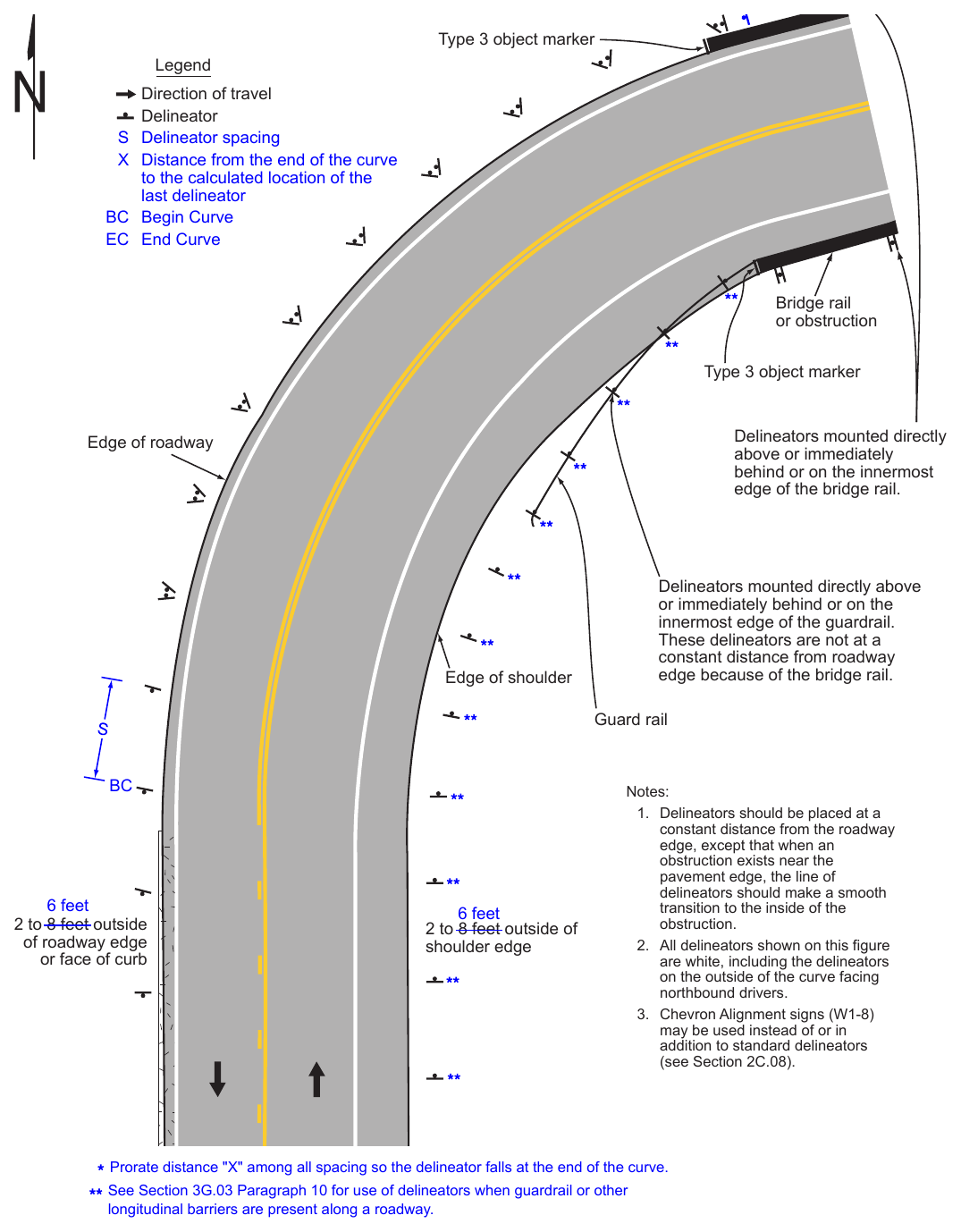
- 1. Delineators should be placed at a constant distance from the roadway edge, except that when an obstruction exists near the pavement edge, the line of delineators should make a smooth transition to the inside of the obstruction.
- 2. All delineators shown on this figure are white, including the delineators on the outside of the curve facing northbound drivers.
- 3. Chevron Alignment signs (W1-8) may be used instead of or in addition to standard delineators (see Section 2C.08). Prorate distance "X" among all spacing so the delineator falls at the end of the curve. See Section 3G.03 Paragraph 10 for use of delineators when guardrail or other longitudinal barriers are present along a roadway.
.png)
18 in. min. Delineator 12 ft Maximum Edge of Traveled Way Paved Shoulder 2 ft min. 2 ft - 6 ft Target Plate Optional Plate 8 in. x 24 in. 2.25 in. Minimum 2.25 in. Minimum 2.25 in. Minimum 12 in. Class 1 Delineator - 3 in. ± square of retroreflective sheeting. Class 2 Delineator - 3 in. ± acrylic cube-corner retroreflective element. Notes:
- 1. Class 1 (Flexible Post) Delineators are standard on State highways, except for certain locations, e.g., snow or protected areas behind guardrail, etc. Refer to Section 3G.03 for post color.
- 2. Class 1 (Flexible Post) Delineators used in construction or maintenance zones shall be orange with white retroreflective sheeting. However, if the delineators are to remain in place as a permanent roadway feature after the construction or maintenance period, refer to Section 3G.03 for post color and retroreflective sheeting color.
- 3. The Type of Retroreflective Element and Class of Post is designated as E-1, F-2, etc.
-sheet1.png)
- 1. For typical Delineators, see Figure 3G-101(CA).
- 2. For Delineator spacing on curves, see Figure 3G-1.
- 2. To be used if the exit gore can not be negotiated in a reasonably safe manner. Refer to Section 2C.72. F ft sp a 10 ft spacing
-sheet2.png)
at Intersections, Islands, Ramps, and Connectors (Sheet 2 of 2)
.png)
(See Notes 3, 5, 6) W30cP(CA) W7-4 (Optional) Gravel Bed Type 'J' Delineator (See Note 1) (See Note 2) (See Note 2) White Line 100 ft White Edgeline Type 'F' Delineator (See Note 4) W7-4b W7-4b W7-4b F Type F Delineator J Type J Delineator Direction of Travel Notes:
- 1. Place Type 'J' Delineators at 50 ft centers. Refer to Figure 3G-101(CA).
- 2. Place NO STOPPING ANY TIME, R26A(S)(CA) signs at 250 ft centers.
- 3. Additional RUNAWAY TRUCK RAMP 1 MILE and RUNAWAY TRUCK RAMP 1/2 MILE, W7-4 signs may also be placed in the median on a one-way roadway.
- 4. Place three Type 'F' Delineators at 500 ft centers, preceding and following the Runaway Truck Ramp. Refer to Figure 3G-101(CA).
- 5. Additional advance RUNAWAY TRUCK RAMP (2 MILES, 3 MILES, etc.) W7-4 signs may be added as necessary.
- 6. Overhead signs may be substituted for ground mounted signs.
- 7. Refer to Figure 3A-101(CA) through Figure 3A-114(CA) for widths and patterns of longitudinal lines. CASE 1: Bridge Widths - 24 ft to 28 ft and width of the approach roadbed (including paved shoulders), exceeds bridge width W5-2 (See Note 2) AP CA Type P (OM-3R) Guardrail CA Type P (OM-3L) Guardrail NARROW BRIDGE
.png)
(One-Way and Two-Way Roadways) Edge Line Edge Line CA Type P (OM-3R) Guardrail CA Type P (OM-3L) Guardrail 50:1 Edge Line Taper 2 ft Edge Line Delineators at 50 ft spacing CASE 3: Bridge Widths - Less than 16 ft 50 ft CA Type P (OM-3R) Guardrail CA Type P (OM-3L) Guardrail Edge of Paved Shoulder 50:1 Edge Line Taper 50 ft CASE 2: Bridge Widths - 16 ft to less than 24 ft and width of the approach (See Note 2) roadbed (including paved shoulders), exceeds bridge width 2 ft Edge Line Delineators at 50 ft spacing Edge of Paved Shoulder CA Type P Object Marker. Refer to Figure 2C-17(CA). AP Advance Placement Distance. Refer to Section 2C.04. Delineators (Type "F" for One-Way Roadways and Type "E" for Two-Way Roadways). Refer to Figure 3G-101(CA). Notes:
- 1. The Edge Line shall be continued across all bridges on State highways.
- 2. The NARROW BRIDGE (W5-2) sign should be erected on the right and in the median on a one-way roadway.
- 3. Delineators shall be continued across the bridge in Cases 2 and 3.
.png)
Note: Median Barrier Marker should be the same color as the left edge line.
Table 3G-1. Approximate Spacing for Delineators on Horizontal Curves
| Radius (R) of Curve | Approximate Spacing (S) on Curve |
|---|---|
| 50 feet | 20 feet |
| 115 feet | 25 feet |
| 180 feet | 35 feet |
| 250 feet | 40 feet |
| 300 feet | 50 feet 4 0 feet |
| 400 feet | 55 feet 40 feet |
| 500 feet | 65 feet 40 feet |
| 600 feet | 70 feet 40 feet |
| 700 feet | 75 feet |
| 800 feet | 80 feet |
| 900 feet | 85 feet |
| 1,000 feet | 90 feet |
Notes: 1. Spacing for specific radii may be interpolated from table. 2. The minimum spacing should be 20 feet. 3. The spacing on curves should not exceed 300 feet. 4. In advance of or beyond a curve, and proceeding away from the end of the curve, the spacing of the first delineator is 2S, the second 3S, and the third 6S, but not to exceed 300 feet. 5. S refers to the delineator spacing for specific radii computed from the formula S=3√R-50. 6. The distances for S shown in the table above were rounded to the nearest 5 feet.
Notes: 1. Spacing for specific radii may be interpolated from table.
- 2. The minimum spacing should be 20 feet.
- 3. The spacing on curves should not exceed 300 feet.
- 4. In advance of or beyond a curve, and proceeding away from the end of the curve, the spacing of the first delineator is 2S, the second 3S, and the third 6S, but not to exceed 300 feet.
- 5. S refers to the delineator spacing for specific radii computed from the formula S=3√R-50.
- 6. The distances for S shown in the table above were rounded to the nearest 5 feet.