6G. TTC Zone Regulatory Signs¶
§6G.01 Regulatory Sign Authority¶
Support
01. Regulatory signs such as those shown in Figure 6G-1 inform road users of traffic laws or regulations and indicate the applicability of legal requirements that would not otherwise be apparent.
Standard
02. Regulatory signs shall be authorized by the public agency or official having jurisdiction and shall conform with Chapter 2B.
Support
03. Some of the California regulatory signs used in TTC zones are shown in Figure 6G-1(CA) and Table 6G-1(CA).
§6G.02 Regulatory Sign Design and Size¶
Standard
01. TTC regulatory signs shall comply with the Standards for regulatory signs presented in Part 2 and in the FHWA’s “Standard Highway Signs” publication (see Section 1A.05).
02. The sizes for TTC regulatory signs shall be as shown in Table 6G-1.
§6G.03 Regulatory Sign Applications¶
Standard
If a TTC zone requires regulatory measures different from those existing, the existing permanent regulatory devices shall be removed or covered and superseded by the appropriate temporary regulatory signs. This change shall be made in compliance with applicable ordinances or statutes of the jurisdiction.
§6G.04 Road Closed Signs (R11-2 Series)¶
Guidance
01. The ROAD CLOSED (R11-2) sign (see Figure 6G-1) should be used when the roadway is closed to all road users except contractors’ equipment or officially authorized vehicles. The R11-2 sign should be accompanied by appropriate warning and detour signing.
Option
02. STREET CLOSED (R11-2a), BRIDGE OUT (R11-2b), or PATH CLOSED (R11-2c) signs may be substituted for Road Closed signs where applicable.
Guidance
03. Road Closed signs should be installed at or near the center of the roadway on or above a Type 3 Barricade that closes the roadway (see Section 6K.07).
Standard
04. Road Closed signs shall not be used where road user flow is maintained through the TTC zone with a reduced number of lanes on the existing roadway or where the actual closure is some distance beyond the sign.
§6G.05 Local Traffic Only Signs (R11-3 Series and R11-4)¶
Guidance
01. The Local Traffic Only signs (see Figure 6G-1) should be used where road user flow detours to avoid a closure some distance beyond the sign, but where local road users can use the roadway to the point of closure. These signs should be accompanied by appropriate warning and detour signing.
Support
01a. Refer to FHWA’s List of Known Errors for errors in Paragraph 1. Refer to Section 1A.04 for more details.
02. In rural applications, the Local Traffic Only sign should have the legend ROAD CLOSED XX MILES AHEAD,
Option
03. In urban areas, a ROAD (STREET) CLOSED TO THRU TRAFFIC (R11-4) sign or the legend ROAD CLOSED, LOCAL TRAFFIC ONLY may be used. In urban areas, a word message that includes the name of an intersecting street name or well-known destination may be substituted for the words XX MILES AHEAD on the R11-3 sign where applicable.
05. A STREET CLOSED (R11-3a) or BRIDGE OUT (R11-3b) sign may be substituted for a R11-3 sign, where applicable.
06. The words BRIDGE OUT, BRIDGE CLOSED, or STREET CLOSED may be substituted for the words ROAD CLOSED on the R11-4 sign where applicable.
07. The word RAMP may be substituted for ROAD or STREET where applicable.
§6G.06 Weight Limit Signs (R12-1, R12-2, and R12-5)¶
Standard
01. A Weight Limit sign (see Figure 6G-1), which shows the gross weight or axle weight that is permitted on the roadway or bridge, shall be consistent with State or local regulations and shall not be installed without the approval of the authority having jurisdiction over the highway.
02. When weight restrictions are imposed because of the activity in a TTC zone, a marked detour shall be provided for vehicles weighing more than the posted limit.
§6G.07 STAY IN LANE Signs (R4-9 and R4-9a)¶
Option
01. A STAY IN LANE (R4-9) sign (see Figure 6G-1) may be used where a multi-lane shift has been incorporated as part of the TTC on a highway to direct road users around road work that occupies part of the roadway on a multi-lane highway.
Guidance
02. A STAY IN LANE TO MERGE POINT (R4-9a) sign (see Figure 6G-1) should be used during late merge operations (see Section 6N.19) to direct traffic to use all available lanes until the merge point is reached.
§6G.08 Work Zone and Higher Fines Signs and Plaques¶
Option
01. A WORK ZONE (G20-5aP) plaque (see Figure 6G-1) may be mounted above a Speed Limit sign to emphasize that a reduced speed limit is in effect within a TTC zone. An END WORK ZONE SPEED LIMIT (R2-12) sign (see Figure 6G-1) may be installed at the downstream end of the reduced speed limit zone.
Guidance
02. A BEGIN HIGHER DOUBLE FINES ZONE (R2-10) sign (see Figure 6G-1) should be installed at or near the beginning of a TTC zone where increased fines are imposed for traffic violations, and an END HIGHER DOUBLE FINES ZONE (R2-11) sign (see Figure 6G-1) should be installed at or near the downstream end of the TTC zone.
Option
03. Alternate legends such as BEGIN (or END) DOUBLE FINES ZONE may also be used for the R2-10 and R2-11 signs.
04. A FINES HIGHER, FINES DOUBLE, or $XX FINE plaque (see Section 2B.25 and Figure 6G-1) may be mounted below the Speed Limit sign if increased fines are imposed for traffic violations within the TTC zone.
05. Individual signs and plaques for work zone speed limits and higher fines may be combined into a single sign or may be displayed as an assembly of signs and plaques.
06. The TRAFFIC FINES DOUBLED IN CONSTRUCTION ZONES (C40(CA)) and TRAFFIC FINES DOUBLED IN WORK ZONES (C40A(CA)) (see Figure 6G-1(CA)) signs may be placed approximately 500 feet in advance of the first required TTC sign(s). The placement of the C40(CA) and C40A(CA) signs is at the discretion of the responsible person(s) in charge of the work zone.
Support
07. Refer to CVC § 42009 for fines for offenses committed in highway construction or maintenance area. In California, as per CVC only doubling of the fines is allowed, not higher fines of other denominations.
Guidance
08. The C40A(CA) sign is intended to be manufactured as a fabric sign and should be used on a short term (daily) basis only. Longer term situations should use the C40(CA) sign.
Support
09. CVC § 22362 applies to "When Workers are Present" condition and signs need to be covered or removed when no work is in progress. However, per CVC 21367, agency can "...regulate the movement of traffic...whenever the traffic would endanger the safety of workers or the work would interfere with or endanger the movement of traffic through the area." If obstructions would be present throughout the project duration the signs would not need to be covered or removed. This would also apply to situations where the construction work changes the highway configuration, curvature or elevation, making it necessary to post reduced speed limits.
Option
10. The Speed Limit (R2-1) sign with a WORK ZONE (G20-5aP) plaque mounted above it may be used for the protection of workers during working hours to reduce speed limit within a TTC zone.
Standard
11. The R2-1 sign with G20-5aP plaque mounted above it shall only be used in conjunction with appropriate advance warning signs.
12. The R2-1 signs with G20-5aP plaques mounted above them shall be removed or covered promptly when no longer applicable.
Support
13. The R2-1 sign with G20-5aP mounted above it is authorized for use by CVC § 22362. This section provides authority to post a speed limit of not less than 25 mph at locations where employees of any contractor, or of the agency in charge of the job, are engaged in work upon the roadway.
14. Posting unrealistically low speed limits will result in loss of sign credibility and a high violation rate.
Guidance
15. Before using a R2-1 sign with G20-5aP plaque mounted above it, work zone conditions should be analyzed to determine what maximum speed limit would be appropriate for that particular location.
16. The R2-1 sign with G20-5aP plaque mounted above it should be placed within 400 feet of the zone where workers are on the roadway or so nearly adjacent as to be endangered by traffic.
Option
17. The R2-1 sign with G20-5aP plaque mounted above it may be provided by the agency having jurisdiction over the street or road.
Guidance
18. The R2-1 sign with G20-5aP plaque mounted above it should be posted a maximum distance of 400 feet in advance of where, and when workers are present; and the Speed Reduction (W3-5) sign or Speed Zone Ahead (R2-4(CA)) sign informs road users of the reduced speed limit TTC zone.
19. As the TTC zone activities change, signs should be moved as appropriate.
§6G.09 PEDESTRIAN CROSSWALK Sign (R9-8)¶
Option
01. The PEDESTRIAN CROSSWALK (R9-8) sign (see Figure 6G-1) may be used to indicate where a temporary crosswalk has been established.
Standard
02. If a temporary crosswalk is established, it shall be accessible to pedestrians with disabilities in accordance with Section 6C.03.
§6G.10 SIDEWALK CLOSED Signs (R9-9, R9-10, R9-11, and R9-11a)¶
Guidance
SIDEWALK CLOSED signs (see Figure 6G-1) should be used where pedestrian flow is restricted. Bicyclist/Pedestrian Detour (M4-9a) signs or Pedestrian Detour (M4-9b) signs should be used where pedestrian flow is rerouted (see Section 6I.02).
02. The SIDEWALK CLOSED (R9-9) sign should be installed at the beginning of the closed sidewalk, at the intersections preceding the closed sidewalk, and elsewhere along the closed sidewalk as needed.
03. The SIDEWALK CLOSED, (ARROW) USE OTHER SIDE (R9-10) sign should be installed at the beginning of the restricted sidewalk when a parallel sidewalk exists on the other side of the roadway.
04. The SIDEWALK CLOSED AHEAD, (ARROW) CROSS HERE (R9-11) sign should be used to indicate to pedestrians that sidewalks beyond the sign are closed and to direct them to open crosswalks, sidewalks, or other travel paths.
01. The SIDEWALK CLOSED, (ARROW) CROSS HERE (R9-11a) sign should be installed just beyond the point to which pedestrians are being redirected.
Support
06. These signs are typically mounted on a detectable barricade to encourage compliance and to communicate with pedestrians that the sidewalk is closed. Printed signs are not useful to many pedestrians with vision disabilities. A barrier or barricade detectable by a person with a vision disability is sufficient to indicate that a sidewalk is closed. If the barrier is continuous with detectable channelizing devices for an alternate route, accessible signing might not be necessary.
§6G.11 TURN OFF 2-WAY RADIO AND CELL PHONE Sign (R22-2)¶
Standard
01. The TURN OFF 2-WAY RADIO AND CELL PHONE (R22-2) sign (see Figure 6G-1) shall be used to require road users to turn off mobile radio transmitters and cellular telephones where blasting operations occur.
Support
02. Section 6H.25 contains information about the full sequence of signs for blasting zones and the specific requirements for location of this regulatory sign.
§6G.12 Other Regulatory Signs¶
Option
01. Regulatory word message signs other than those classified and specified in this Manual and the “Standard Highways Signs” publication (see Section 1A.05) may be developed and used based on engineering judgment to aid the enforcement of other laws or regulations in TTC zones.
Guidance
02. Special regulatory signs should comply with the general requirements of color, shape, and alphabet size and series. The sign message should be brief, legible, and clear.
§6G.101(CA) RAMP CLOSED (C2(CA)) and RAMP CLOSED, USE RAMP AT __ (SC7(CA)) Signs¶
Standard
01. The RAMP CLOSED (C2(CA)) sign (refer to Figure 6G-1(CA)) shall be installed at the entrance of an on-ramp or off-ramp that is closed to all road users.
Option
02. The RAMP CLOSED, USE RAMP AT __ (SC7(CA)) sign may be used in lieu of the RAMP CLOSED (C2(CA)) sign.
Guidance
03. The RAMP CLOSED AHEAD (C19(CA)) sign (refer to Figure 6H-1(CA)) should be used in advance of the point where an onramp or off-ramp is closed to all road users.
Option
04. The USE NEXT EXIT (C38(CA)) sign may be used with the RAMP CLOSED (C2(CA)) sign on freeways if the next exit provides access to destinations from the closed ramp.
Guidance
05. The Day – Specific hours (SC6-3P(CA)) plaque should be installed below the RAMP CLOSED (C2(CA)) sign to notify motorists when a freeway or expressway on-ramp or off-ramp is temporarily closed for no more than one day.
06. The Multiple Days – Specific Hours (SC6-4P(CA)) plaque should be installed below the RAMP CLOSED (C2(CA)) sign to notify motorists when a freeway or expressway on-ramp or off-ramp is temporarily closed for multiple consecutive days.
07. The RAMP CLOSED assembly should be removed when the ramp is reopened to traffic.
Standard
08. The SC6-3P(CA) and SC6-4P(CA) plaques (refer to Figure 6I-1(CA)) shall display the correct day of the week, month, calendar date, and times during which the ramp is closed.
Option
09. For extended ramp closures, a PCMS may be used in advance of the ramp to supplement the RAMP CLOSED assembly for the duration of the closure.
Option
10. The RAMP CLOSED, USE RAMP AT ___ (SC7(CA)) sign may be used in lieu of the combination of the RAMP CLOSED (C2(CA)) sign and USE NEXT EXIT (C38(CA)) sign as shown on Caltrans’ Standard Plan T-14 to inform motorists of a closed entrance or exit ramp and to provide an alternate route. See Section 1A.05 for information regarding this publication.
Guidance
11. The ___ EXIT – RAMP CLOSED (SC8(CA)) sign should be used to inform motorists of a closed exit ramp.
Standard
12. If used, the SC8(CA) sign shall be placed on the right shoulder, upstream of the preceding exit ramp.
Guidance
13. The EXIT with Arrow (SC18(CA)) sign should be used to inform motorists of the direction to follow for a freeway exit within a work zone.
§6G.102(CA) MOVE OVER OR SLOW WHEN AMBER LIGHTS FLASHING Sign (R111(CA))¶
01. On Freeways, lane and/or shoulder closures, incident management, and for short duration work, MOVE OVER OR SLOW WHEN AMBER LIGHTS FLASHING (R111(CA)) sign (refer to Figure 6G-1(CA)) may be temporarily displayed on the back of a work vehicle to warn and regulate road users to move over and/or slow when passing work vehicles displaying a flashing amber warning light within or adjacent to the highway.
§6G.103(CA) Moving Lane Closure Signs (W23-1 and SC10(CA), SC11(CA), SC13(CA), SC15(CA))¶
Standard
01. On State highways, the following signs (see Figures 6H-1 and 6G-1(CA)) shall be used as shown in Caltrans’ Standard Plans T15, T16 and T17 for moving lane closures. See Section 1A.05 for information regarding this publication.
- A. LANE CLOSED AHEAD or ROAD WORK AHEAD (SC10(CA)).
- B. LANE CLOSED (SC11(CA)).
- C. SLOW TRAFFIC AHEAD (W23-1).
- D. DO NOT PASS (SC13(CA)).
- E. CAUTION (SC15(CA)).
02. The Moving Lane Closure signs shall have a black legend on either a white or an orange background.
03. If used, the SC10(CA) sign and a Type II arrow board shall be mounted on the designated sign vehicle.
04. The SC11(CA) sign and a Type II arrow board shall be mounted on the designated sign vehicle.
05. If used, the W23-1 sign shall be mounted on the rear of the designated sign vehicle.
06. The SC13(CA) sign shall be mounted on the rear and/or the front of the designated sign vehicle.
07. If used, the SC15(CA) sign shall be mounted on the front of the designated sign vehicle.
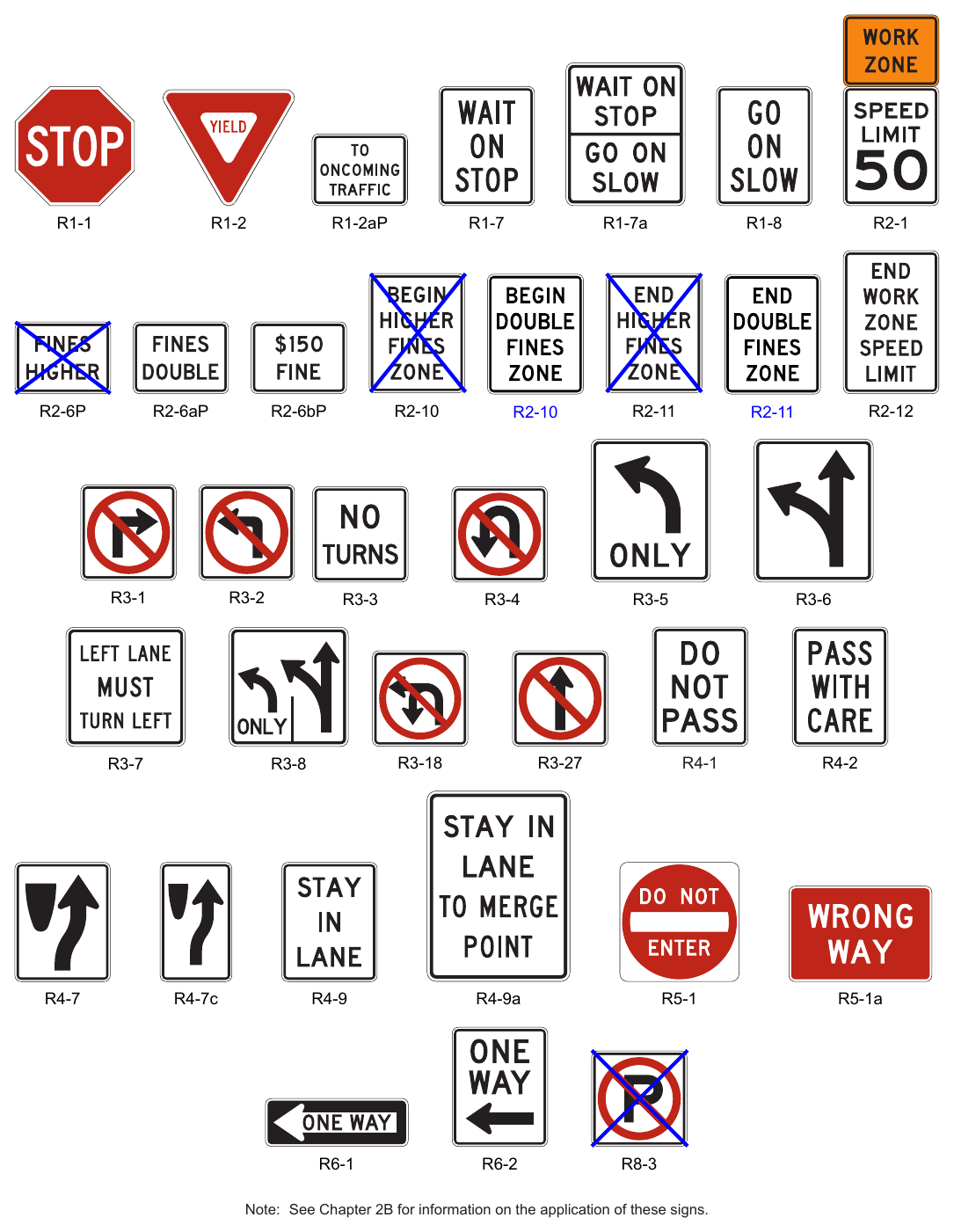
Signs shown: G20-5aP, R1-1, R1-2, R1-2aP, R1-7, R1-7a, R1-8, R2-1, R2-6P, R2-6aP, R2-6bP, R2-10, R2-11, R2-12, R3-1, R3-2, R3-3, R3-4, R3-5, R3-6, R3-7, R3-8, R3-18, R3-27, R4-1, R4-2, R4-7, R4-7c, R4-9, R4-9a, R5-1, R5-1a, R6-1, R6-2, R8-3
in Temporary Traffic Control Zones (Sheet 1 of 2) R2-6aP R2-6bP R1-2aP R1-7a R4-7c R4-9a G20-5aP R5-1a Note: See Chapter 2B for information on the application of these signs.
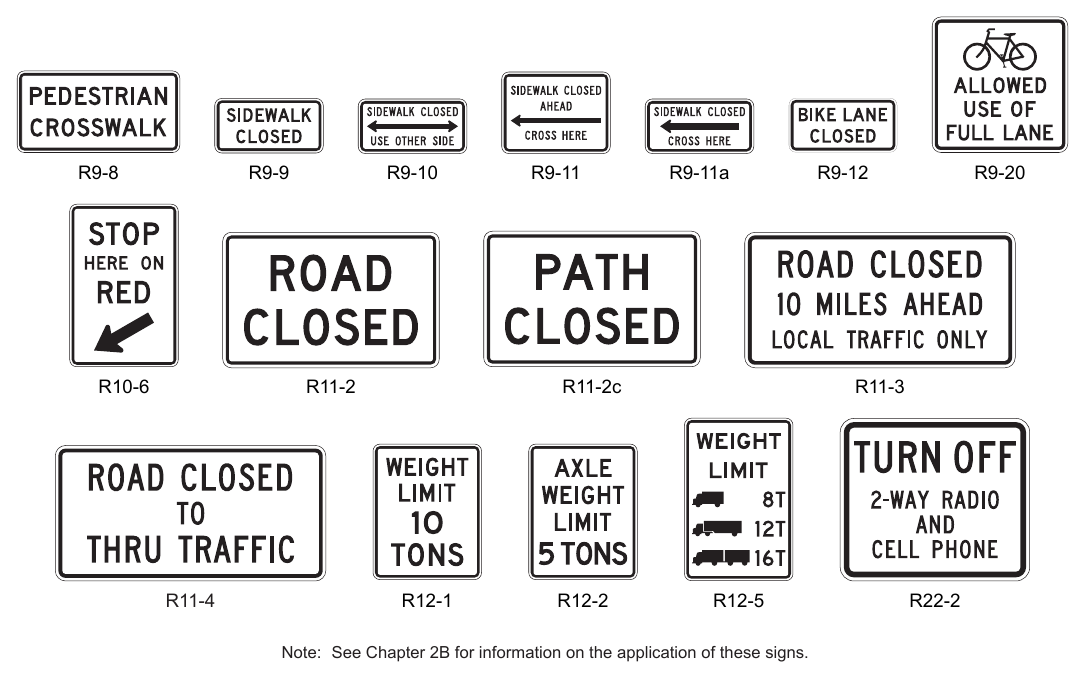
Signs shown: R9-8, R9-9, R9-10, R9-11, R9-11a, R9-12, R9-20, R10-6, R11-2, R11-2c, R11-3, R11-4, R12-1, R12-2, R12-5, R22-2
in Temporary Traffic Control Zones (Sheet 2 of 2) R9-11a R11-2c Note: See Chapter 2B for information on the application of these signs.
.png)
Table 6G-1. Temporary Traffic Control Zone Regulatory Sign and Plaque Sizes
| Sign or Plaque | Sign Designation | Section | Conventional Road | Freeway or Expressway | Minimum |
|---|---|---|---|---|---|
| Stop | R1-1 | 6G.02 | 30 x 30* | — | — |
| Stop (on Stop/Slow Paddle) | R1-1 | 6D.02 | 18 x 18 | — | — |
| Yield | R1-2 | 6G.02 | 36 x 36 x 36* | — | 30 x 30 x 30 |
| To Oncoming Traffic (plaque) | R1-2aP | 6G.02 | 36 x 30 | 48 x 36 | 24 x 18 |
| Wait on Stop | R1-7 | 6L.03 | 24 x 30 | 24 x 30 | — |
| Wait on Stop - Go on Slow | R1-7a | 6G.03 ** | 30 x 36 | 30 x 36 | — |
| Go on Slow | R1-8 | 6L.03 | 24 x 30 | 24 x 30 | — |
| Speed Limit | R2-1 | 6G.08 | 24 x 30* | 36 x 48 | — |
| Fines Higher (plaque) | — | ||||
| R2-6P | 6G.08 | 24 x 18 | 36 x 24 | ||
| Fines Double (plaque) | R2-6aP | 6G.08 | 24 x 18 | 36 x 24 | — |
| $XX Fine (plaque) | R2-6bP | 6G.08 | 24 x 18 | 36 x 24 | — |
| Double Begin Higher Fines Zone | R2-10 | 6G.08 | 24 x 30 | 36 x 48 | — |
| Double End Higher Fines Zone | R2-11 | 6G.08 | 24 x 30 | 36 x 48 | — |
| End Work Zone Speed Limit | R2-12 | 6G.08 | 24 x 36 | 36 x 54 | — |
| Movement Prohibition | R3-1,2,3,4 | 6G.02 | 24 x 24* | 36 x 36 | — |
| Mandatory Movement Lane Control - Turn Only | R3-5 | 6G.02 | 30 x 36 | — | — |
| Optional Movement Lane Control - Thru and Turn | R3-6 | 6G.02 | 30 x 36 | — | — |
| Right (Left) Lane Must Turn Right (Left) | R3-7 | 6G.02 | 30 x 30* | — | — |
| Advance Intersection Lane Control (2 lanes) | R3-8 | 6G.02 | 30 x 30 | — | — |
| Movement Prohibition - No U or Left Turn | R3-18 | 6G.02 | 24 x 24* | 36 x 36 | — |
| Movement Prohibition - No Straight Through | R3-27 | 6G.02 | 24 x 24* | 36 x 36 | — |
| Do Not Pass | R4-1 | 6G.02 | 24 x 30 | 36 x 48 | — |
| Pass With Care | R4-2 | 6G.02 | 24 x 30 | 36 x 48 | — |
| Keep Right | R4-7 | 6G.02 | 24 x 30 | 36 x 48 | — |
| Narrow Keep Right | R4-7c | 6G.02 | 18 x 30 | — | — |
| Stay in Lane | R4-9 | 6G.07 | 24 x 30 | 36 x 48 | — |
| Stay In Lane To Merge Point | R4-9a | 6G.07 | 36 x 48 | 36 x 48 | — |
| Do Not Enter | R5-1 | 6G.02 | 30 x 30* | 36 x 36 | — |
| Wrong Way | R5-1a | 6G.02 | 36 x 24* | 42 x 30 | — |
| One Way | R6-1 | 6G.02 | 36 x 12* | 48 x 18 | — |
| One Way | R6-2 | 6G.02 | 24 x 30* | 36 x 48 | — |
| — | |||||
| No Parking (symbol) | R8-3 | 6G.02 | 24 x 24* | 36 x 36 | |
| Pedestrian Crosswalk | R9-8 | 6G.09 | 36 x 18 | — | — |
| Sidewalk Closed | R9-9 | 6G.10 | 24 x 12 | — | — |
| Sidewalk Closed, Use Other Side | R9-10 | 6G.10 | 24 x 12 | — | — |
| Sidewalk Closed Ahead, Cross Here | R9-11 | 6G.10 | 24 x 18 | — | — |
| Sidewalk Closed, Cross Here | R9-11a | 6G.10 | 24 x 12 | — | — |
| Bike Lane Closed | R9-12 | 6P.01 | 24 x 12 | — | — |
| Stop Here on Red | R10-6 | 6L.04 | 24 x 36 | — | — |
| Road Closed | R11-2, 2a, 2b, 2c | 6G.04 | 48 x 30 | — | — |
| Road Closed - Local Traffic Only | R11-3, 3a, 3b, 4 | 6G.05 | 60 x 30 | — | — |
| Weight Limit | R12-1, 2 | 6G.06 | 24 x 30 | 36 x 48 | — |
| Weight Limit | R12-5 | 6G.06 | 24 x 36 | 36 x 48 | — |
| Turn Off 2-Way Radio and Cell Phone | R22-2 | 6G.11 | 42 x 36 | 42 x 36 | — |
| Work Zone (plaque) | G20-5aP | 6G.08 | 24 x 18 | 30 x 24 | — |
* See Table 2B-1 for minimum size required for signs facing traffic on multi-lane conventional roads
** Refer to FHWA’s List of Known Errors for error in the Section reference for the R1-7a sign. Refer to Section 1A.04 for more details.
Notes: 1. Larger signs may be used wherever necessary for greater legibility or emphasis 2. Dimensions are shown in inches and are shown as width x height
(Also see C2(CA) Sign Size) Notes:
- 1. Larger signs may be used wherever necessary for greater legibility or emphasis
- 2. Dimensions are shown in inches and are shown as width x height
Table 6G-1(CA). California Temporary Traffic Control Zone Regulatory Sign and Plaque Sizes
| Sign or Plaque | Sign Designation | Section | Conventional Road (Minimum) | Expressway | Freeway | Oversized |
|---|---|---|---|---|---|---|
| RAMP CLOSED | C2(CA) | 6G.101(CA) | 48 x 30 | 48 x 30 | 48 x 30 | --- |
| TRAFFIC CONTROL-WAIT AND FOLLOW PILOT CAR | C37(CA) | 6E.04 | 36 x 42 | 36 x 42 | --- | --- |
| TRAFFIC FINES DOUBLE IN | C40(CA) | 6G.08 | 36 x 36 | 48 x 48 | 48 x 48 | --- |
| CONSTRUCTION ZONES | ||||||
| MOVE OVER OR SLOW WHEN AMBER LIGHTS FLASHING | R111(CA) | 6G.102(CA) | 54 x 18 | 54 x 18 | 54 x 18 | --- |
| PILOT CAR DO NOT PASS | R115(CA) | 6E.04 | 36 x 18 | 36 x 18 | --- | --- |
| RAMP CLOSED, USE RAMP AT___ | SC7(CA) | 6G.101(CA) | 84 x 42 | 84 x 42 | 84 x 42 | --- |
| LANE CLOSED AHEAD or ROAD WORK | SC10(CA) | 6G.103(CA) | 48 x 30 | 66 x 36 | 66 x 36 | --- |
| AHEAD | ||||||
| LANE CLOSED | SC11(CA) | 6G.103(CA) | 42 x 30 | 54 x 42 | 54 x 42 | --- |
| DO NOT PASS | SC13(CA) | 6G.103(CA) | 42 x 30 | 54 x 42 | 54 x 42 | --- |
| CAUTION | SC15(CA) | 6G.103(CA) | 42 x 18 | 54 x 24 | 54 x 24 | --- |
| DOUBLE FINE ZONE | SR54(CA) | 2B.25 | 30 x 30 | 42 x 42 | 42x 42 | --- |
--84 x 42