2F. Toll Road Signs¶
Chapter 2F. TOLL ROAD SIGNS¶
§2F.01 Scope¶
Support
01. Toll highways are typically limited-access freeway or expressway facilities. A portion of or an entire route might be a toll highway, or a bridge, tunnel, or other crossing point might be the only toll portion of a highway at which a toll is collected. A toll highway might be a conventional road. The general signing requirements for toll roads will depend on the type of facility and access (freeway, expressway, or conventional road). The provisions of Chapters 2D and 2E will generally apply for guide signs along the toll facility that direct road users within and off the facility where exit points and geometric configurations are not dependent specifically on the collection of tolls. The aspect of tolling and the presence of toll plazas or collection points necessitate additional considerations in the typical signing needs. The notification of the collection of tolls in advance of and at entry points to the toll highway also necessitates additional modifications to the typical signing.
02. The scope of this Section applies to a route or facility on which all lanes are tolled. Chapter 2G contains provisions for the signing of managed lanes within an otherwise non-toll facility that employ tolling or pricing as an operational strategy to manage congestion levels.
Standard
03. Except where specifically provided in this Chapter, the provisions of other Chapters in Part 2 shall apply to toll roads.
§2F.02 Sizes of Toll Road Signs and Electronic Toll Collection (ETC) System Pictographs¶
Standard
01. Except as provided in Section 2A.07, the minimum sizes of toll road signs that have standardized designs shall be as shown in Table 2F-1.
Support
02. Section 2A.07 contains information regarding the applicability of the various columns in Table 2F-1.
Option
03. Signs larger than those shown in Table 2F-1 may be used (see Section 2A.07).
Standard
04. The ETC system pictograph (see Section 2A.04) shall be of a size that makes it a prominent feature of the sign legend as necessary for conspicuity for those road users with registered ETC accounts seeking such direction, as well as for those road users who do not have ETC accounts so that it is clear to them to avoid such direction when applicable.
Guidance
05. Except as provided in Paragraph 6 of this Section, an ETC pictograph that is in the shape of a horizontally-oriented rectangle should have a minimum height of 1.5 times the upper-case letter height of the principal legend on the sign. The width of an ETC pictograph in the shape of a horizontal rectangle should be between approximately 2 and 3 times the height of the pictograph.
06. When the pictograph is the principal legend on the sign, such as for advance guide signs for open-road tolling lanes (see Section 2F.15), the minimum height of a horizontally-oriented rectangular ETC pictograph should be consistent with that of a route shield prescribed for the particular application and type of sign.
07. For ETC pictographs whose shape is square, circular, or otherwise similar in height and width, or is a vertically-oriented rectangle, the same basic principles for conspicuity and placement should be followed. ETC pictographs whose shape is not in that of a horizontally-oriented rectangle should be suitably sized to facilitate conspicuity as described in Paragraph 4 of this Section and should be of a similar approximate area as the horizontally-oriented rectangular pictographs designed in accordance with the height and width as provided in Paragraph 5 of this Section.
§2F.03 Use of Color on Toll Signs¶
Standard
01. Use of the color purple on any sign shall comply with the provisions of Sections 1D.05 and 2A.06. Except as provided in Sections 2F.05 and 2F.16, purple as a background color shall be used only when the information associated with the appropriate ETC account is displayed on that portion of the sign. The background color of the remaining portion of such signs shall comply with the provisions of Sections 1D.05 and 2A.06 as appropriate for a regulatory, warning, or guide sign. Purple shall not be used as a background color to display a destination, action message, or other legend that is not a display of the requirement for all vehicles to have a registered ETC account.
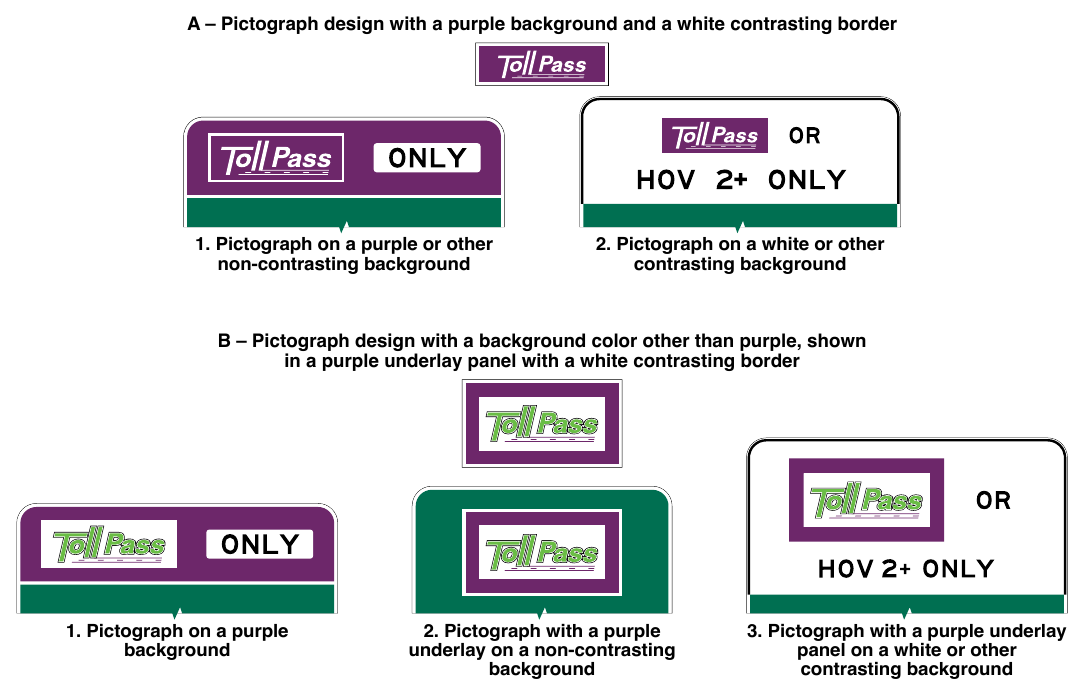
02. If only vehicles with registered ETC accounts are allowed to use a highway lane, a toll plaza lane, an open-road tolling lane, or all lanes of a toll highway or connection, the guide signs for such lanes or highways shall incorporate the pictograph (see Section 2A.04) adopted by the toll facility’s ETC payment system and the regulatory message ONLY. Except for ETC pictographs whose predominant background color is purple, if incorporated within the green background of a guide sign, the ETC pictograph shall be on a white rectangular or square panel set on a purple underlay panel with a white border. For rectangular ETC pictographs whose predominant background color is purple, a white border shall be used at the outer edges of the purple rectangle to provide contrast between the pictograph and the sign background color.
03. If an ETC pictograph is used on a separate plaque in a route sign assembly (see Section 2F.05) or on a header panel within a guide sign, the plaque or the header panel shall have a purple background with a white border and the ETC pictograph shall have a white border to provide contrast between the pictograph and the background of the plaque or header panel.
04. Purple underlay panels for ETC pictographs or purple backgrounds for plaques and header panels shall only be used in the manner described in Paragraphs 1 through 3 of this Section to convey the requirement of a registered ETC account on signs for lanes reserved exclusively for vehicles with such an account and on directional signs to an ETC Account-Only facility from a non-toll facility or from a toll facility that accepts multiple payment forms.
Table 2F-1. Toll Road Sign and Plaque Minimum Sizes
| Sign or Plaque | Sign Designation | Section | Conventional Road | Expressway | Freeway | Minimum | Oversized | |
|---|---|---|---|---|---|---|---|---|
| Single Lane | Multi-Lane | |||||||
| Toll Rate | R3-28 | 2F.04 | — | — | 114 x 48 | 114 x 48 | — | — |
| Pay Toll (plaque) | R3-29P | 2F.04 | — | — | 24 x 18 | 24 x 18 | — | — |
| Take Ticket (plaque) | R3-30P | 2F.04 | — | — | 24 x 18 | 24 x 18 | — | — |
| ETC Account-Only | R3-31 | 2F.05 | 24 x 24 | 24 x 24 | 36 x 36 | 36 x 36 | 24 x 24 | 36 x 36 |
| No Cash (plaque) | R3-32P | 2F.05 | 24 x 12 | 24 x 12 | 36 x 18 | 36 x 18 | 24 x 12 | 36 x 18 |
| Pay Toll XX Miles Cars (price) | W9-6 | 2F.06 | 96 x 66 | 96 x 66 | 96 x 66 | 96 x 66 | — | — |
| Stop Ahead Pay Toll Cars (price) | W9-6a | 2F.08 | 114 x 66 | 114 x 66 | 114 x 66 | 114 x 66 | — | — |
| Pay Toll XX Miles Cars (price) (plaque) | W9-6bP | 2F.07 | 312* x 30 | 312* x 30 | 312* x 30 | 312* x 30 | — | — |
| Stop Ahead Pay Toll (plaque) | W9-6cP | 2F.09 | 264* x 30 | 264* x 30 | 264* x 30 | 264* x 30 | — | — |
| Stop Ahead Pay Toll (plaque) | W9-6dP | 2F.09 | 114 x 48 | 114 x 48 | 114 x 48 | 114 x 48 | — | — |
| Take Ticket XX Miles | W9-6e | 2F.06 | 114 x 48 | 114 x 48 | 114 x 48 | 114 x 48 | — | — |
| Stop Ahead Take Ticket | W9-6f | 2F.08 | 114 x 48 | 114 x 48 | 114 x 48 | 114 x 48 | — | — |
| Take Ticket XX Miles (plaque) | W9-6gP | 2F.07 | 216 x 30 | 216 x 30 | 216 x 30 | 216 x 30 | — | — |
| Stop Ahead Take Ticket (plaque) | W9-6hP | 2F.09 | 282 x 30 | 282 x 30 | 282 x 30 | 282 x 30 | — | — |
| Last Exit Before Toll (1-line) (plaque) | W16-16P | 2F.10 | — | — | 252* x 36 | 252* x 36 | — | — |
| Last Exit Before Toll (2-line) (plaque) | W16-16aP | 2F.10 | — | — | 144 x 54 | 144 x 54 | — | — |
| Toll (plaque) | W16-17P | 2F.11 | 24 x 12 | 24 x 12 | 36 x 18 | 36 x 18 | 24 x 12 | 36 x 18 |
| Toll Collector Symbol Panel | M4-17 | 2F.12 | — | — | 48 x 48 | 48 x 48 | — | — |
| Exact Change Symbol Panel | M4-18 | 2F.12 | — | — | 48 x 48 | 48 x 48 | — | — |
* The width shown represents the minimum dimension. The width shall be increased as appropriate to match the width of the guide sign.
Notes: 1. Larger signs may be used when appropriate 2. Dimensions are shown as width x height, in inches
Notes: 1. Larger signs may be used when appropriate
- 2. Dimensions are shown as width x height, in inches
Support
05. Figure 2F-1 shows examples of ETC account pictographs, their use with various background colors, and modifications involving underlay panels.
06. Section 2F.02 contains provisions regarding the size of pictographs for ETC accounts.
- 1. Pictograph on a purple or other non-contrasting background
- 2. Pictograph on a white or other contrasting background B – Pictograph design with a background color other than purple, shown in a purple underlay panel with a white contrasting border
- 1. Pictograph on a purple background
- 2. Pictograph with a purple underlay on a non-contrasting background
- 3. Pictograph with a purple underlay panel on a white or other contrasting background
REGULATORY SIGNS¶
§2F.04 Regulatory Signs for Toll Plazas¶
Support
01. Toll plaza operations often include lane-specific restrictions on vehicle type, forms of payment accepted, and speed limits or required stops. Vehicles are typically required to come to a stop to pay the toll or receive a toll ticket in the attended and exact change or automatic lanes. Electronic toll collection (ETC) lanes with favorable geometrics typically allow vehicles to move through the toll plaza without stopping, but usually within a set regulatory speed limit or advisory speed. In some ETC lanes and in most lanes that accommodate non-ETC vehicles, a stop might be required while the ETC payment is processed because of geometric or other conditions.
Guidance
02. Regulatory signs applicable only to a particular lane or lanes should be located in a position that makes their lane applicability clear to road users approaching the toll plaza.
03. Regulatory signs, or regulatory panels within guide signs, indicating restrictions on vehicle type and forms of toll payment accepted at a specific toll plaza lane should be installed over the applicable lane either on the toll plaza canopy or on a separate structure immediately in advance of the canopy located in a manner such that each sign is clearly related to an individual toll lane.
Support
04. Section 2F.12 contains information regarding the incorporation of regulatory messages into guide signs for toll plazas.
05. Section 2F.16 contains information regarding the design and use of toll plaza canopy signs.
Guidance
06. One or more Speed Limit (R2-1) signs (see Section 2B.21) should be installed in the locations provided in Paragraph 8 of this Section for an ETC-Only lane at a toll plaza in which an enforceable regulatory speed limit is established for a lane in which it is intended that vehicles move through the toll plaza without stopping while toll payments requiring stops occur in other lanes at the toll plaza. The speed limit displayed on the signs should be based on an engineering study taking into account the geometry of the toll plaza and the lanes, as well as other appropriate safety and operational factors.
07. A Speed Limit (R2-1) sign should not be installed for a toll plaza lane that is controlled by a STOP (R1-1) sign or where a stop is required.
08. Where speed limit signs are installed over a toll plaza lane on the toll plaza canopy, on the approach end of the toll booth island, on the toll booth itself, or on a vertical element of the canopy structure, then down arrows or diagonally downward-pointing directional arrows should be used to supplement the speed limit signs if there is a need to clarify the applicability of a sign to a specific lane or to improve compliance.
Standard
09. A STOP (R1-1) sign shall not be installed for a toll plaza lane that is operated as an ETC-Only lane and that is designed for tolls to be collected while vehicles continue moving.
Option
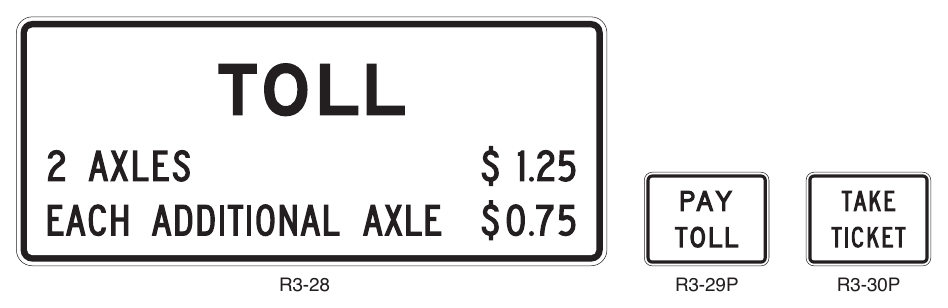
10. A STOP (R1-1) sign may be installed to require all vehicles to come to a complete stop to pay a toll in an attended or exact change lane, even if that lane is also available for optional use by vehicles with registered ETC accounts. A PAY TOLL (R3-29P) or TAKE TICKET (R3-30P) plaque (see Figure 2F-2), as appropriate to the operation, may be installed directly under the STOP (R1-1) sign for a toll plaza lane, if needed.
11. The mounting height of the STOP sign and any supplemental plaque may be less than the normal mounting height requirements if constrained by the physical features of the toll island or toll plaza.
12. The lateral offset of a STOP or other regulatory sign located within a toll plaza island may be reduced to a minimum of 1 foot from the face of the toll island or raised barrier to the nearest edge of the sign.
Guidance
13. If used, a STOP (R1-1) sign for a toll plaza cash payment lane should be located in a longitudinal position as near as practical to the point where a vehicle is expected to stop to pay the toll or take a ticket.
Option
14. A Toll Rate (R3-28) sign (see Figure 2F-2) may be installed in advance of the toll plaza to indicate the toll applicable to the various vehicle types.
Guidance
15. If used, the Toll Rate (R3-28) sign should be located between the toll plaza and the first advance sign informing road users of the toll plaza.
16. The R3-28 sign should not contain more than three lines of legend. Each line that shows a toll amount should display only a single toll amount.
Option
17. Additional toll rate information exceeding three lines of legend may be displayed on the toll booth adjacent to the payment window of an attended lane or the payment receptacle of an exact change or automatic lane where it is visible to a road user who has stopped to pay the toll, but is not visible to approaching road users who have not yet entered the toll lane.
§2F.05 Electronic Toll Collection (ETC) Account-Only Regulatory Sign and Plaque (R3-31 and R3-32P)¶
Standard
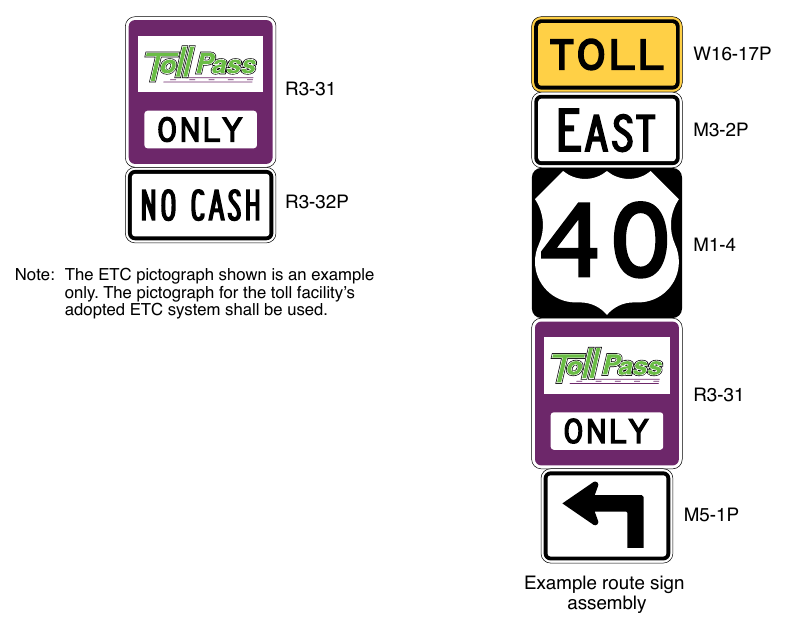
01. In any route sign assembly providing directions to a toll facility, or to a tolled segment of a highway, where electronic toll collection (ETC) is the only payment method accepted and all vehicles are required to have a registered ETC account, the ETC Account-Only (R3-31) sign (see Figure 2F-3) shall be mounted directly below the route sign of the numbered or named toll facility. The R3-31 sign shall have a white border and purple background and incorporate the pictograph adopted by the toll facility’s ETC payment system and the word ONLY in black letters on a white panel set on the purple background of the sign.
Option
02. The NO CASH (R3-32P) plaque (see Figure 2F-3) with a black legend and border on a white background may be mounted directly below the R3-31 sign in a Directional or other sign assembly.
Note: The ETC pictograph shown is an example only. The pictograph for the toll facility’s adopted ETC system shall be used. Example route sign assembly
WARNING SIGNS¶
§2F.06 Pay Toll and Take Ticket Advance Warning Signs (W9-6 and W9-6e)¶
Standard
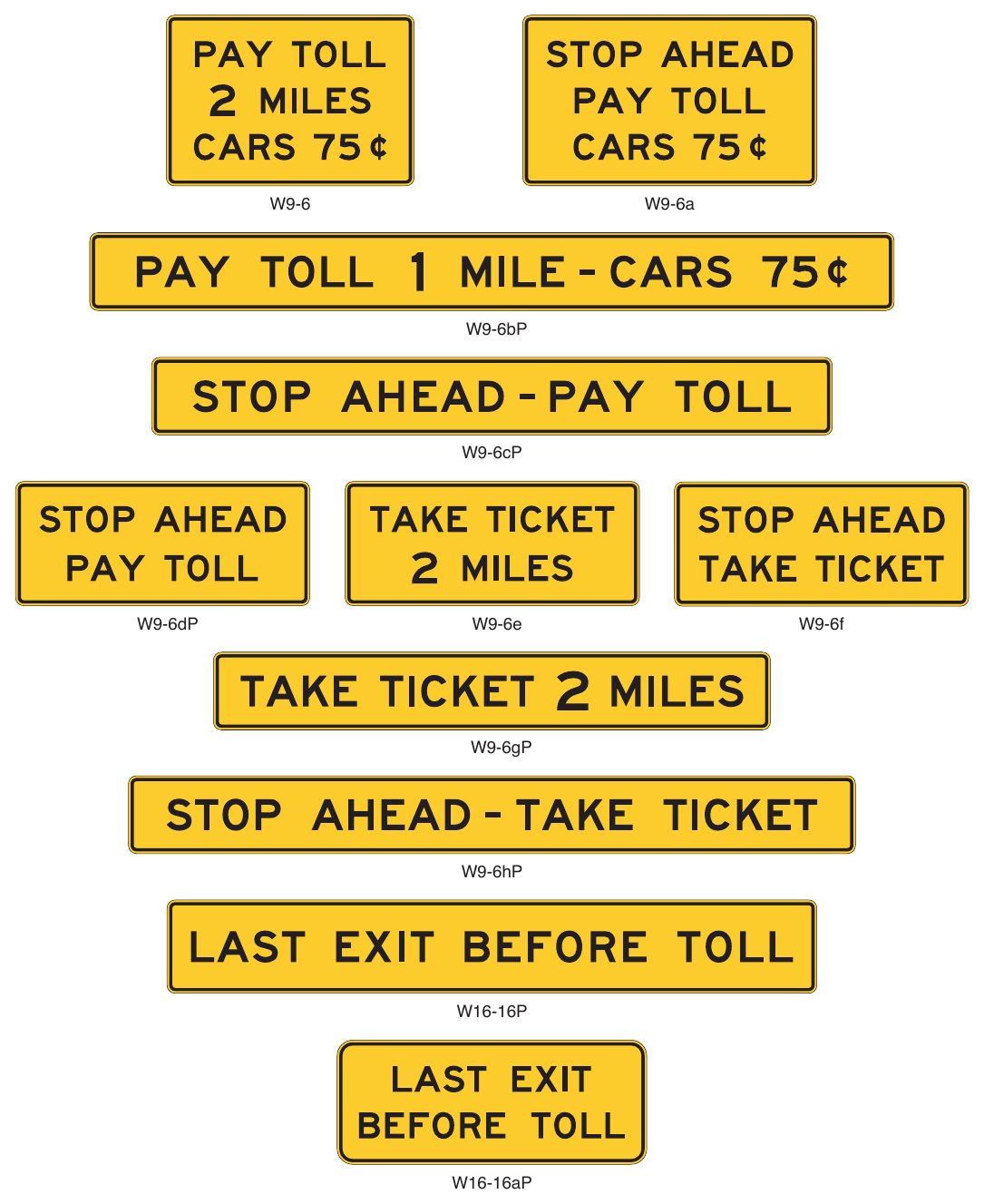
01. The Pay Toll (W9-6) and Take Ticket (W9-6e) Advance Warning signs shall display the distance to the toll plaza and, except for toll-ticket facilities, the toll for passenger or 2-axle vehicles (see Figure 2F-4). Where the toll for passenger or 2-axle vehicles is variable by time of day, a changeable message element shall be incorporated into the W9-6 sign to display the toll in effect.
Guidance
02. The Pay Toll Advance Warning (W9-6) sign should be installed at approximately 1 mile and ½ mile in advance of mainline toll plazas at which some or all lanes are required to come to a stop to pay a toll (see Sections 2F.14 and 2F.15).
03. The Take Ticket Advance Warning (W9-6e) sign should be installed at approximately 1 mile and ½ mile in advance of mainline toll plazas at which some or all lanes are required to come to a stop to take a toll ticket (see Sections 2F.14 and 2F.15).
04. The Pay Toll and Take Ticket Advance Warning signs should be mounted overhead.
Option
05. If there is insufficient space for the W9-6 or W9-6e sign at the 1-mile or ½-mile advance location, the Pay Toll or Take Ticket Advance Warning (W9-6bP or W9-6gP) plaque (see Section 2F.07) may be installed at those advance locations above the appropriate guide sign(s) that relate to toll payment types.
06. An additional W9-6 or W9-6e sign may be installed approximately 2 miles in advance of a mainline toll plaza. This sign may be either mounted overhead or post-mounted.
07. If the visibility of a ramp toll plaza at which some or all lanes are required to come to a stop to pay a toll or take a ticket is limited, the W9-6 or W9-6e sign may also be installed in advance of the ramp toll plaza.
§2F.07 Pay Toll and Take Ticket Advance Warning Plaques (W9-6bP, W9-6dP, and W9-6gP)¶
Option
01. The Pay Toll or Take Ticket Advance Warning (W9-6bP and W9-6gP) plaques (see Figure 2F-4) may be installed above the appropriate guide sign(s) relating to toll payment types at the 1-mile and/or ½-mile advance locations on the approach to a toll plaza if there is insufficient space for the W9-6 or W9-6e sign (see Section 2F.06) at those advance locations.
Standard
02. The W9-6bP and W9-6gP plaques shall display the distance to the toll plaza and, except for toll-ticket facilities, the toll for passenger or 2-axle vehicles. Where the toll for passenger or 2-axle vehicles is variable by time of day, a changeable message element shall be incorporated into the W9-6bP plaque to display the toll in effect.
Option
03. The distance to the toll plaza may be omitted from the W9-6bP and W9-6gP plaques if the distance is displayed on the guide sign that the plaque accompanies.
04. The Pay Toll (W9-6dP) plaque may be used if the toll information is displayed on the guide sign that the plaque accompanies.
05. The toll for passenger or 2-axle vehicles may be omitted from the W9-6bP plaque if the toll information is displayed on the guide sign that the plaque accompanies.
§2F.08 Stop Ahead Pay Toll and Stop Ahead Take Ticket Warning Signs (W9-6a and W9-6f)¶
Standard
01. The Stop Ahead Pay Toll (W9-6a) warning sign (see Figure 2F-4) shall display the toll for passenger or 2-axle vehicles. Where the toll for passenger or 2-axle vehicles is variable by time of day, a changeable message element shall be incorporated into the W9-6a sign to display the toll in effect.
Guidance
02. The Stop Ahead Pay Toll (W9-6a) sign should be installed downstream from the W9-6 sign that is ½ mile in advance of a mainline toll plaza where some or all of the lanes are required to come to a stop to pay a toll (see Sections 2F.14 and 2F.15).
Signs shown: W9-6, W9-6a, W9-6bP, W9-6cP, W9-6dP, W9-6e, W9-6f, W9-6gP, W9-6hP, W16-16P, W16-16aP
03. The Stop Ahead Take Ticket (W9-6f) warning sign (see Figure 2F-4) should be installed downstream from the W9-6e sign that is ½ mile in advance of a mainline toll plaza where some or all of the lanes are required to come to a stop to take a toll ticket (see Sections 2F.14 and 2F.15).
04. The W9-6a and W9-6f signs should be mounted overhead. The location of the overhead sign should coincide with the approximate location where the mainline lanes begin to widen on the approach to the toll plaza lanes.
05. Where open-road tolling is used in addition to a toll plaza at a particular location, the W9-6a or W9-6f sign should be located such that the message is clearly related to the lanes that access the toll plaza and not to the open-road tolling lanes.
Option
06. If there is insufficient space for the W9-6a or W9-6f sign at the recommended location, the Stop Ahead Pay Toll (W9-6cP) or the Stop Ahead Take Ticket (W9-6hP) plaque (see Section 2F.09) may be installed at that location above the appropriate guide sign that relates to toll payment types.
07. If the visibility of a ramp toll plaza at which some or all lanes are required to come to a stop to pay a toll or take a ticket is limited, the W9-6a or W9-6f sign may also be installed in advance of the ramp toll plaza.
§2F.09 Stop Ahead Pay Toll and Stop Ahead Take Ticket Warning Plaques (W9- 6cP and W9-6hP)¶
Option
01. The Stop Ahead Pay Toll (W9-6cP) warning plaque (see Figure 2F-4) may be installed above the appropriate guide sign at the location specified for the Stop Ahead Pay Toll (W9-6a) sign (see Section 2F.08) if there is insufficient space for the W9-6a sign at that location and the toll information is displayed on the guide sign that the plaque accompanies.
02. The Stop Ahead Take Ticket (W9-6hP) warning plaque (see Figure 2F-4) may be installed above the appropriate guide sign at the location specified for the Take Ticket (W9-6f) sign (see Section 2F.08) if there is insufficient space for the W9-6f sign at that location.
§2F.10 LAST EXIT BEFORE TOLL Warning Plaques (W16-16P and W16-16aP)¶
Guidance
01. The LAST EXIT BEFORE TOLL (W16-16P or W16-16aP) warning plaque (see Figure 2F-4) should be used to notify road users of the last exit from a highway before it becomes a facility on which toll payments are required. The plaque should be installed above the appropriate guide signs for the exit (see Sections 2E.23 and 2E.25), but below the Exit Number or LEFT plaque if used.
§2F.11 TOLL Warning Plaque (W16-17P)¶
Standard
01. The TOLL (W16-17P) warning plaque (see Figure 2F-3) shall have a black legend and border on a yellow background and shall be mounted directly above the route sign of a numbered toll highway or, if used, above the cardinal direction and alternative route auxiliary signs, in any route sign assembly providing direction to a toll highway or to a segment of a highway on which the payment of a toll is required.
GUIDE SIGNS¶
§2F.12 Toll Facility and Toll Plaza Guide Signs – General¶
Support
01. Toll plazas are used on many toll highways, bridges, and tunnels for collection of tolls from road users. Electronic toll collection and/or open-road tolling might also be used on such facilities, either in addition to or in place of collecting toll payments at toll plazas.
02. Chapter 2G contains information regarding signs for preferential and managed lanes that are applicable to toll roads.
03. Chapter 3E contains information regarding pavement markings for certain toll plaza applications.
Standard
04. Directional assemblies for entrances to a toll highway, or to a road leading directly to a toll highway with no opportunity to exit before paying or being charged a toll, shall clearly indicate that the facility is a toll facility. Except where the State Toll Route sign (see Paragraph 8 of this Section) is used, the TOLL (W16-17P) warning plaque (see Section 2F.11) shall be used above the route sign of a numbered toll facility in any route sign assembly that provides directions to the toll route from another highway (see Figure 2F-5).
05. Except where the State Toll Route sign (see Paragraph 8 of this Section) is used and on Exit Gore signs or destination guide (D1 series) signs, a rectangular panel with the black legend TOLL on a yellow background shall be incorporated into the guide signs leading road users to a tolled highway (see Figures 2F-6 through 2F-8).
06. Guide signs for toll highways, toll plazas, and tolled or priced managed lanes (see Chapter 2G) shall have white legends and borders on green backgrounds, except as specifically provided by Sections 2F.12 through 2F.16.
Option
07. A State Toll Route sign (see Paragraph 8 of this Section) may be used in lieu of the State Route (M1-5) sign in combination with the TOLL (W16-17P) warning plaque or the TOLL panel (see Paragraphs 10 and 11 of this Section).
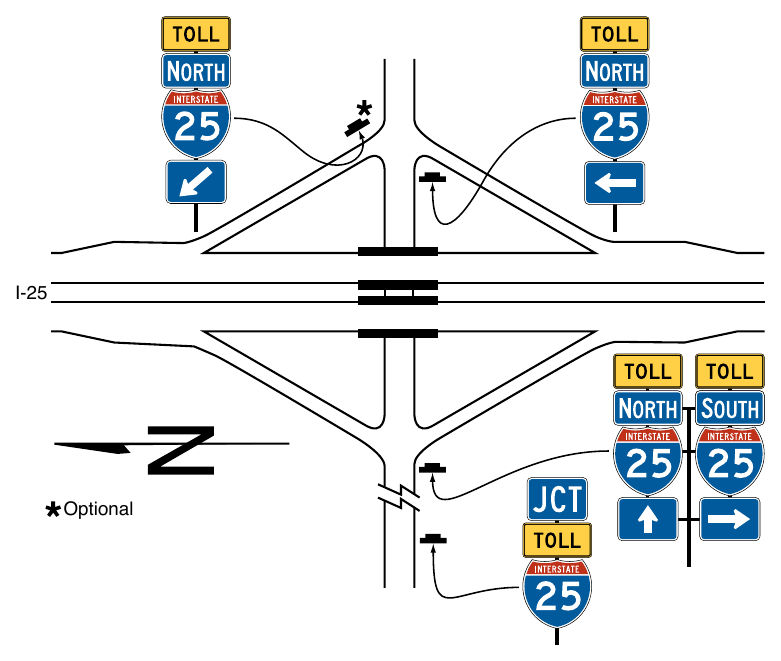
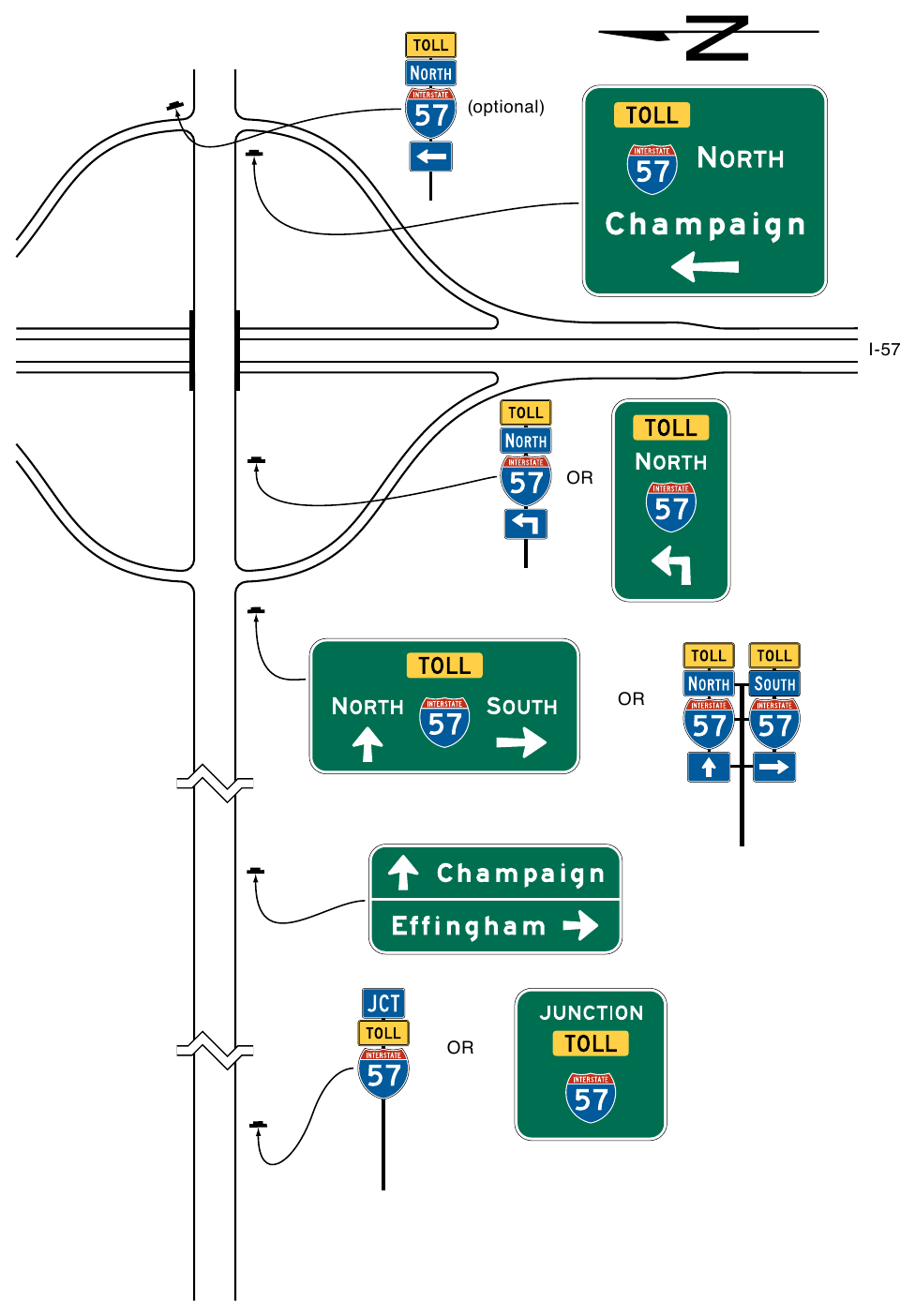
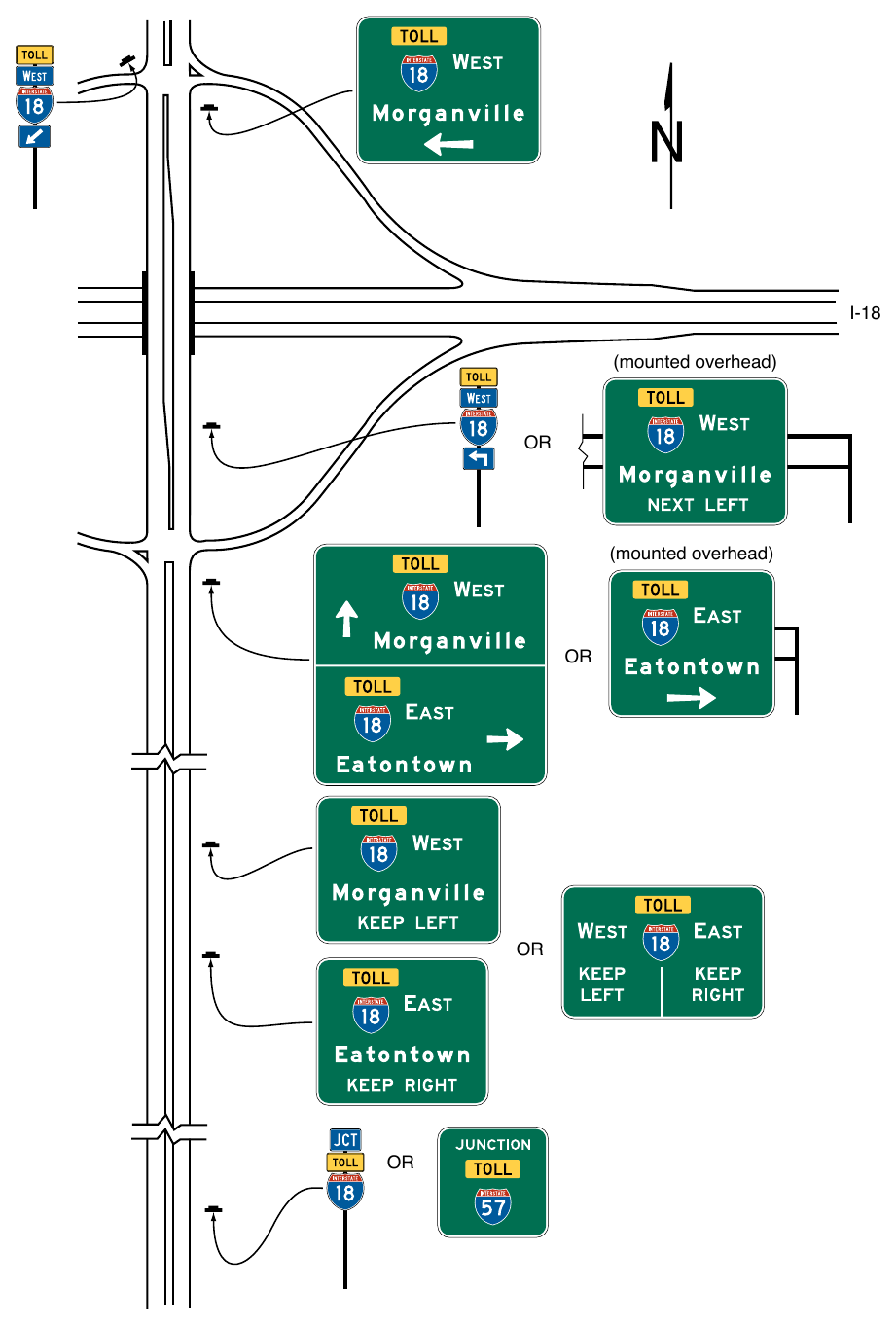
(mounted overhead)
Signs shown: W16-17P
connection provided in the vicinity) (an alternate non-toll entrance is provided in the vicinity) Note: The ETC pictographs shown are examples only. The pictograph for the toll facility’s adopted ETC system shall be used.
Standard
A State Toll Route sign shall incorporate into its design the word TOLL using the same letter height, legend, background colors, and overall plaque dimensions specified for the W16-17P warning plaque.
09. The Interstate, Off-Interstate, and U.S. Route signs shall not be modified for tolled facilities.
Option
10. Where conditions do not accommodate separate signs, or where it is important to associate a particular regulatory or warning message with specific guidance information, regulatory and/or warning messages may be combined with guide signs for toll plazas using plaques, header panels, or rectangular regulatory or warning panels incorporated within the guide signs, as long as the proper legend and background colors are preserved.
Standard
11. When regulatory messages are incorporated within a guide sign, they shall be on a rectangular panel with a black legend on a white background. When warning messages are incorporated within a guide sign, they shall be on a rectangular panel with a black legend on a yellow background.
Guidance
12. Guide signs for toll plazas should be designed in accordance with the general principles of guide signs and the specific provisions of Chapter 2E.
13. Signs for toll plazas should systematically provide road users with advance and toll plaza lane-specific information regarding:
- A. The amount of the toll, the types of payment accepted, and the type(s) of registered ETC accounts accepted for payment;
- B. Which lane or lanes are required or allowed to be used for each available payment type; and
- C. Restrictions on the use of a toll plaza lane or lanes by certain types of vehicles (such as cars only or no trucks).
Standard
14. Signs for attended lanes at toll plazas shall incorporate the Toll Collector (M4-17) symbol panel (see Figure 2F-9).
Option
15. Signs for attended lanes at toll plazas may also display word legends, such as FULL SERVICE, CASH, CHANGE, or RECEIPTS (see Figure 2F-9), to supplement the required symbol panel when lanes have different services available through them.
Standard
16. Signs for Exact Change lanes at toll plazas shall incorporate the Exact Change (M4-18) symbol panel and, except for ticketed systems, display the amount of the toll for passenger vehicles (see Figure 2F-9).
Option
17. Signs for Exact Change lanes at toll plazas may include an appropriate word legend, such as EXACT CHANGE (see Figure 2F-9), to supplement the required symbol panel.
Standard
18. When used, the M4-17 and M4-18 symbol panels shall be used only as panels within guide signs. The M4-17 and M4-18 symbols or panels shall not be used as an independent sign or within a sign assembly.
19. If only vehicles with registered ETC accounts are allowed to use a toll plaza lane, the signs for such lanes shall incorporate the pictograph adopted by the toll facility’s ETC payment system and the regulatory message ONLY (see Figures 2F-1 and 2F-8 through 2F-11). The use, size, and placement of the ETC pictograph shall comply with the provisions of Sections 2F.02 and 2F.03.
20. An Overhead Arrow-per-Lane guide sign (see Figure 2F-10) shall be used in advance of a location where the mainline lanes split to separate traffic entering Open-Road ETC lanes from lanes entering a toll plaza where other methods of payment are accepted and an option lane is provided at the split (see Figure 2F-11). An Overhead Arrow-per-Lane guide sign shall not be used if there is no option lane at the split.
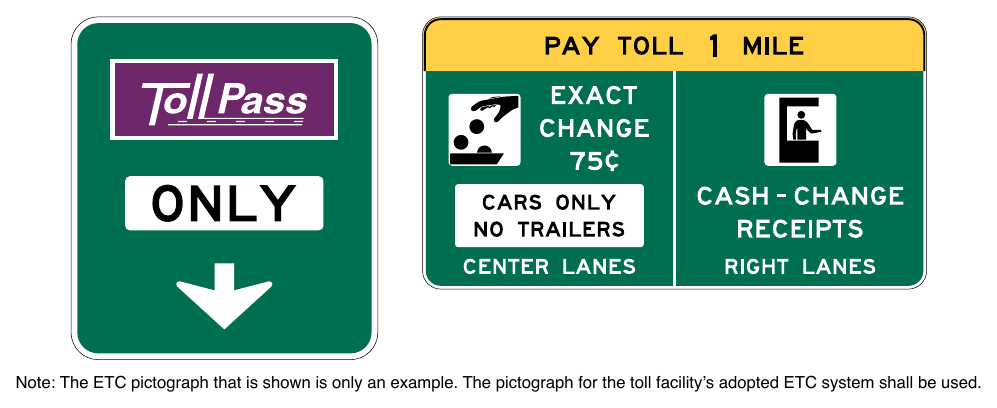
Note: The ETC pictograph that is shown is only an example. The pictograph for the toll facility’s adopted ETC system shall be used.
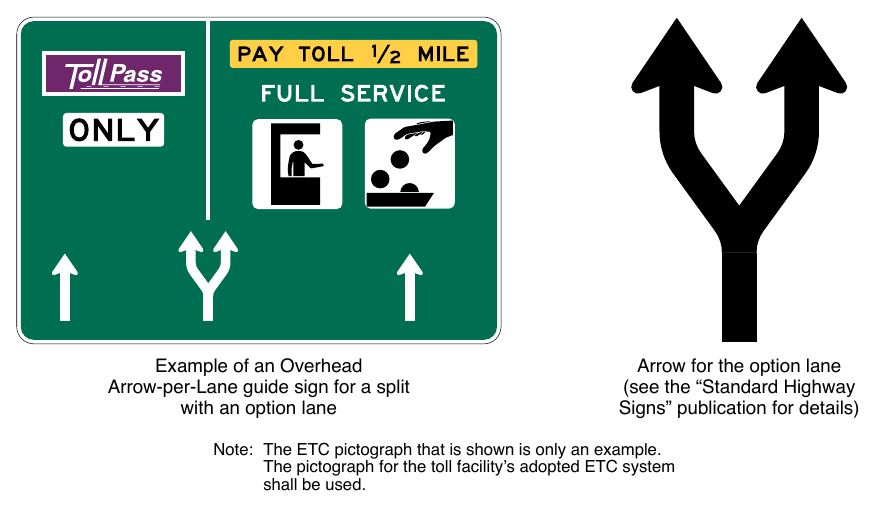
Note: The ETC pictograph that is shown is only an example. The pictograph for the toll facility’s adopted ETC system shall be used.
Option
21. The ETC payment system’s pictograph, without a purple underlay or purple header panel, may be used on signs for Exact Change or attended lanes at toll plazas to indicate that vehicles with registered ETC accounts may also use those lanes.
§2F.13 Electronic Toll Collection (ETC) Signs – General¶
Support
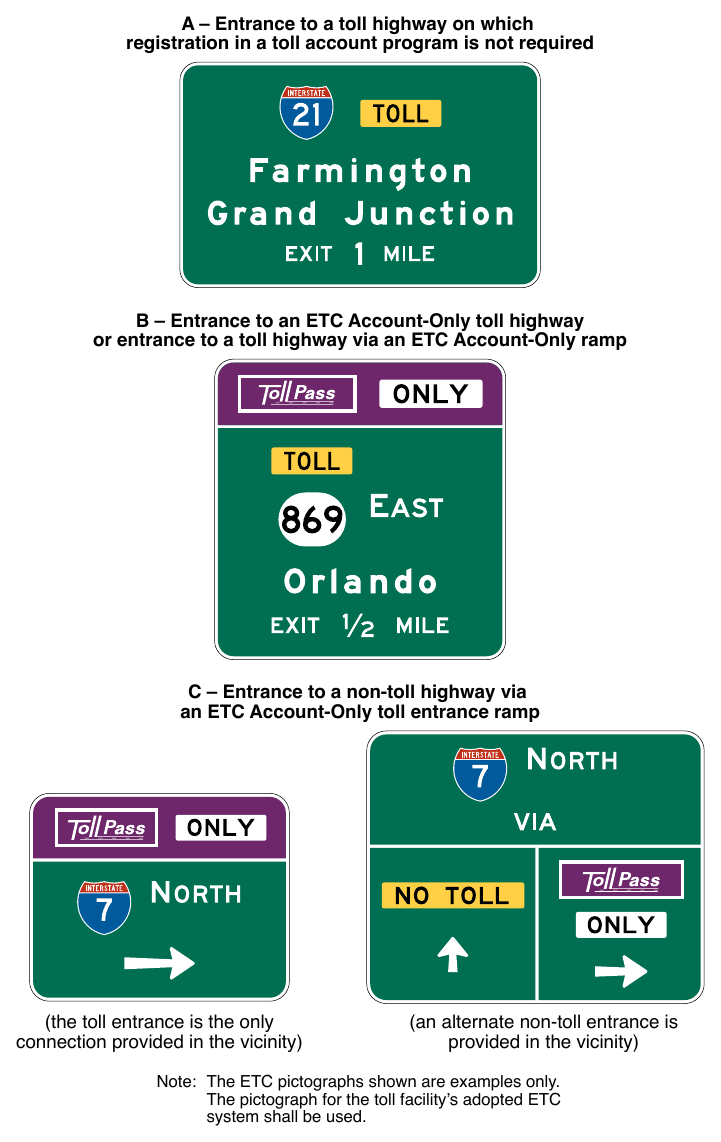
01. Figure 2F-8 shows examples of guide signs for entrances to various types of toll highways and for ETC Account-Only entrances to non-toll highways.
Standard
02. Signing for entrances to toll highways where ETC is employed only through license plate character recognition such that road users are not required to establish a toll account or register their vehicle equipment shall comply with the provisions of Paragraphs 4 and 5 of Section 2F.12.
Support
03. Figure 2F-12 shows examples of guide signs for the entrance to a toll highway on which tolls are collected electronically only and registration in a toll-account program is not required.
Standard
04. If only vehicles with registered ETC accounts are allowed to use a toll highway, the guide signs for entrances to such facilities shall incorporate the pictograph adopted by the toll facility’s ETC payment system and the regulatory message ONLY (see Figures 2F-1 and 2F-8 through 2F-12). The use, size, and placement of the ETC pictograph and the use and color of the background and underlay panel shall comply with the provisions of Sections 2F.02 and 2F.03.
Support
05. Sections 2F.05, 2F.11, and 2F.17 contain additional provisions regarding signs for toll highways that only accept ETC payments.
06. Sections 2G.16 through 2G.19 contain additional provisions regarding signs for priced managed lanes that only accept ETC payments.
07. Figure 2F-13 shows an example of guide signs for alternative toll and non-toll ramp connections to a non-toll highway (see Section 2F.18).
08. Many different ETC payment systems are used by the various toll facility operators. Some of these systems accept payment from other systems’ accounts.
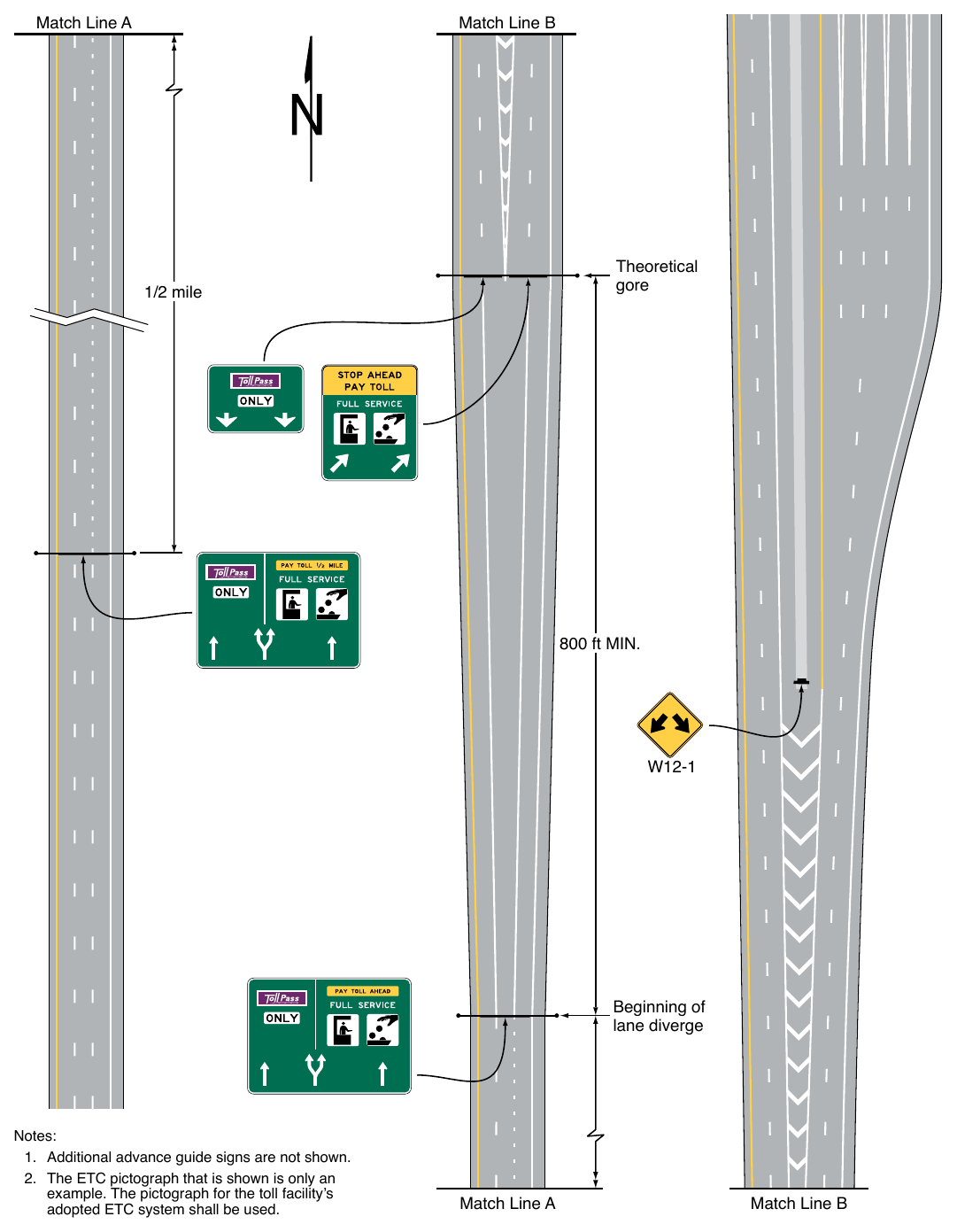
Signs shown: W12-1
- 1. Additional advance guide signs are not shown.
- 2. The ETC pictograph that is shown is only an example. The pictograph for the toll facility’s adopted ETC system shall be used. Match Line A Match Line B
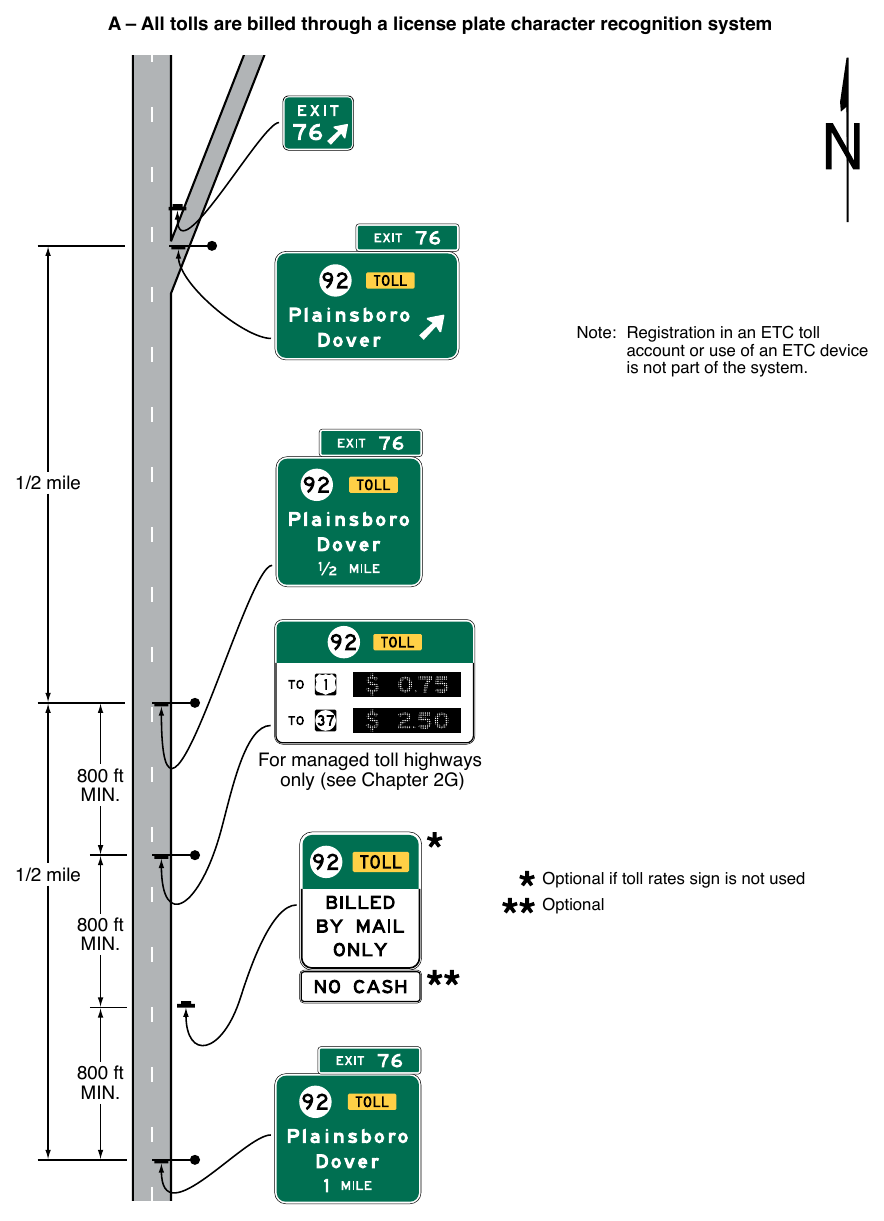
on which Tolls are Collected Electronically Only (Sheet 1 of 3) A – All tolls are billed through a license plate character recognition system Note: Registration in an ETC toll account or use of an ETC device is not part of the system. 1/2 mile 800 ft 1/2 mile 800 ft For managed toll highways only (see Chapter 2G) Optional if toll rates sign is not used Optional 800 ft
Option
09. Where a facility will accept payments from other systems’ accounts in addition to its primary ETC-account payment system, such information may be displayed on a separate information sign near the entrances to such a facility or in advance of a toll plaza or open-road tolling lanes, as space allows between primary signs.
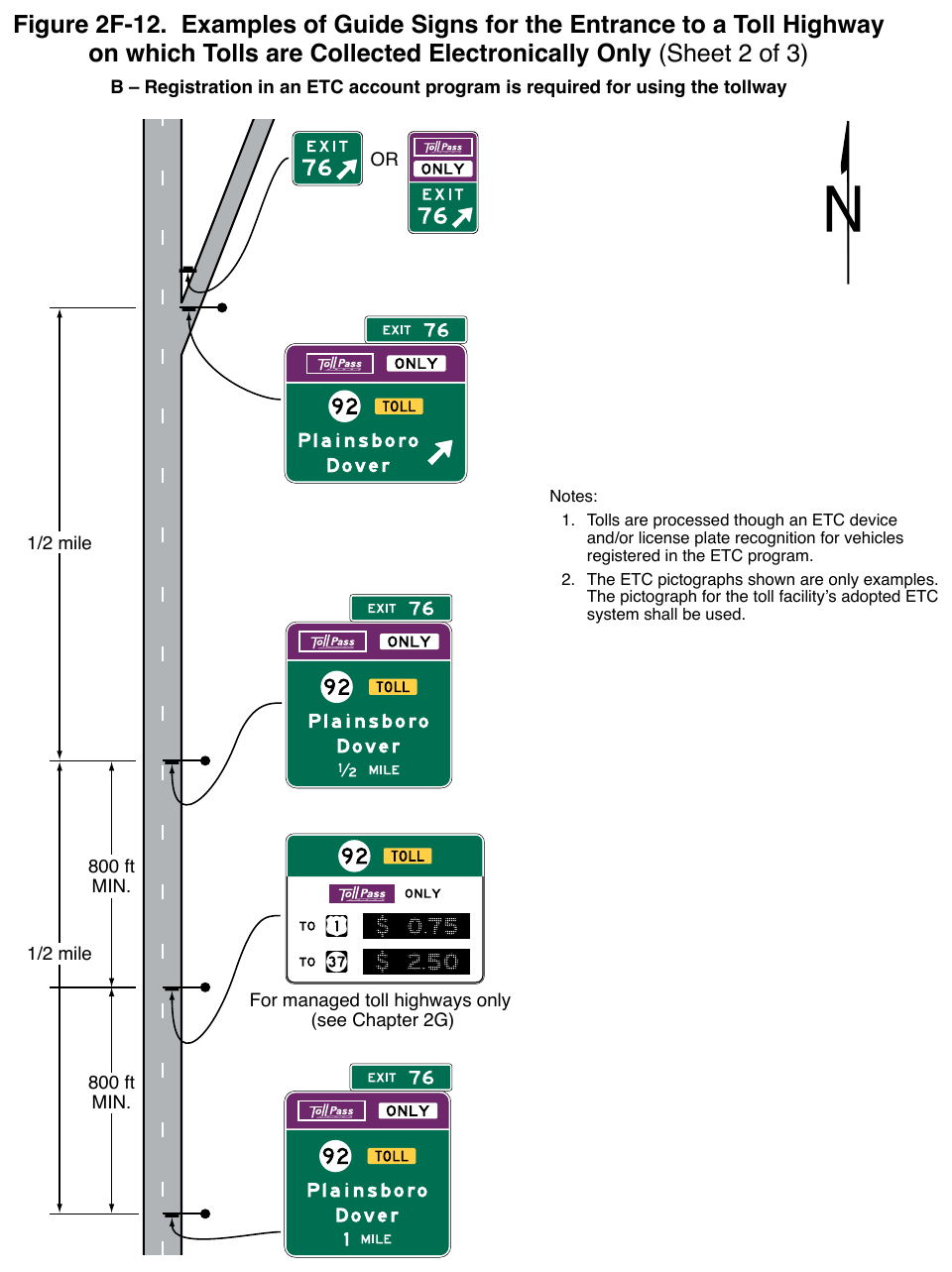
on which Tolls are Collected Electronically Only (Sheet 2 of 3) B – Registration in an ETC account program is required for using the tollway Notes:
- 1. Tolls are processed though an ETC device and/or license plate recognition for vehicles registered in the ETC program.
- 2. The ETC pictographs shown are only examples. The pictograph for the toll facility’s adopted ETC system shall be used. 1/2 mile 800 ft MIN. 1/2 mile For managed toll highways only (see Chapter 2G) 800 ft MIN.
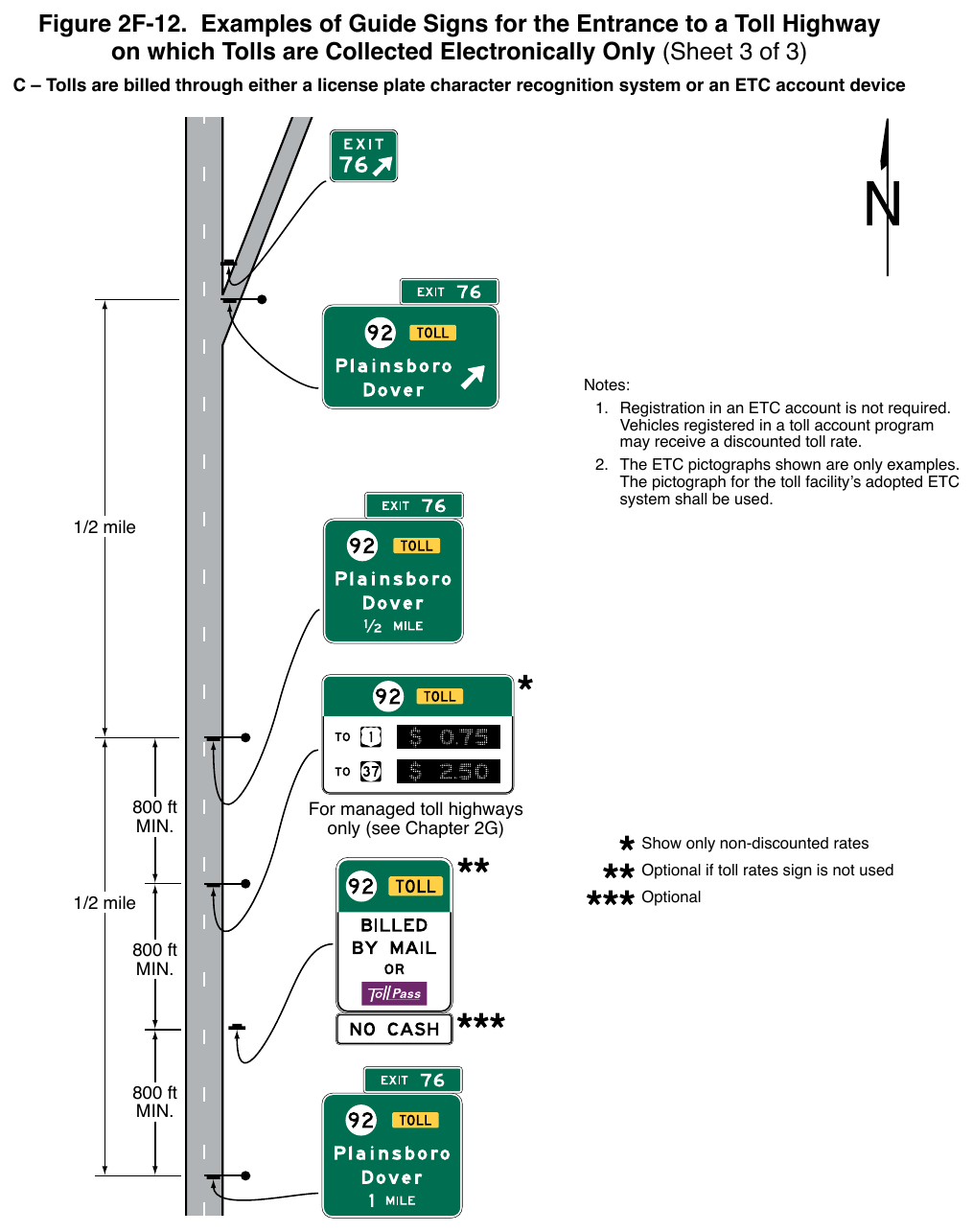
on which Tolls are Collected Electronically Only (Sheet 3 of 3) C – Tolls are billed through either a license plate character recognition system or an ETC account device Notes:
- 1. Registration in an ETC account is not required. Vehicles registered in a toll account program may receive a discounted toll rate.
- 2. The ETC pictographs shown are only examples. The pictograph for the toll facility’s adopted ETC system shall be used. 1/2 mile 800 ft MIN. For managed toll highways only (see Chapter 2G) Show only non-discounted rates Optional if toll rates sign is not used 1/2 mile Optional 800 ft MIN. 800 ft MIN.
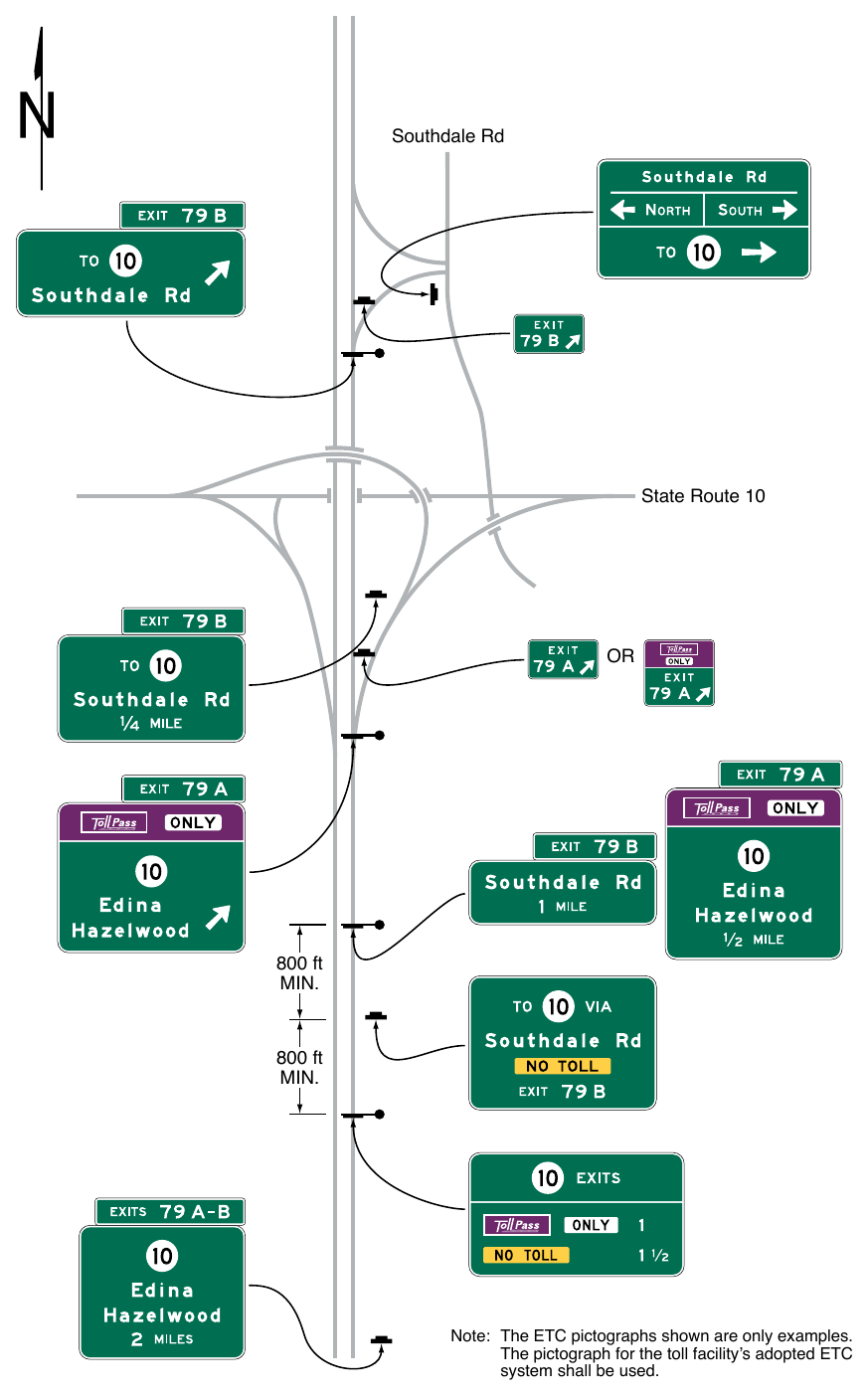
Note: The ETC pictographs shown are only examples. The pictograph for the toll facility’s adopted ETC system shall be used.
§2F.14 Advance Signs for Conventional Toll Plazas¶
Guidance
01. For conventional toll plazas (those without a divergence onto a separate alignment from mainline-aligned open-road tolling or ETC-Only lanes), one or more sets of overhead advance guide signs complying with the provisions of this Section should be provided. The advance guide signs for multi-lane toll plazas should provide information regarding which lanes to use for all of the toll payment methods accepted at the toll plaza. These signs should include toll plaza lane numbers (if used), or action messages or lane-use information such as LEFT LANE(S), CENTER LANE(S), RIGHT LANE(S), or down arrows over the approximate center of each applicable lane. These signs should also incorporate regulatory messages indicating any restrictions or prohibitions on the use of the lanes associated with the various types of payment methods by certain types of vehicles. For mainline toll plazas, these signs should be at least ½ mile in advance of the toll plaza, and farther if practical.
02. Additional guide signs with lane information for the toll payment types should be provided between approximately ¼ mile and 800 feet in advance of the toll plaza at a location that avoids or minimizes obstruction of toll plaza canopy signs (see Section 2F.16) and lane-use control signals.
03. The number, mounting, and/or spacing of sets of advance signs for approaches to toll plazas on ramps, toll bridges, or tunnels, to accommodate a limited distance to the plaza from an intersection or from the start of the approach road to the bridge or tunnel, should be based on an engineering study or engineering judgment.
Support
04. Figure 2F-14 shows examples of advance signs for a conventional toll plaza.
§2F.15 Advance Signs for Toll Plazas on Diverging Alignments from Open-Road ETC Account-Only Lanes¶
Support
01. Open-Road ETC lanes are sometimes located on the normal mainline alignment while the lanes for other toll payment methods are located at a toll plaza on a separate alignment (see Figure 2F-15). Since road users paying cash tolls must diverge from the mainline alignment, similar to a movement for an exit, it is important that the guide signs in advance of and at the point of divergence clearly indicate the required lane use and/or movements.
Guidance
02. For toll plazas located on a separate alignment that diverges from mainline-aligned Open-Road ETC lanes where vehicles are required to have a registered ETC account to use the Open-Road Tolling lanes, overhead advance signs should be provided at approximately 1 mile and ½ mile in advance of the divergence point. Both the 1-mile and ½-mile advance signs should include:
- A. The ETC (pictograph) Account-Only guide sign (see Figures 2F-9 and 2F-15) with a down arrow over the approximate center of each lane that will become an Open-Road ETC lane;
- B. For the lane or lanes which will diverge to a toll plaza, guide signs conforming to the provisions of Section 2F.12, indicating which lane or lanes will diverge to the toll plaza for the various cash toll payment methods; and
- C. Regulatory signs, plaques, or panels within the guide signs, indicating any restrictions or prohibitions of certain types of vehicles from toll plaza lanes associated with the various types of payment methods.
03. At or near the theoretical gore of the divergence point, an additional set of overhead guide signs should be provided and should include:
- A. The ETC (pictograph) Account-Only guide sign (see Figures 2F-9 and 2F-15) with a down arrow over the approximate center of each Open-Road ETC lane;
- B. Guide signs conforming to the provisions of Section 2F.12 and 2F.13, with diagonally upward-pointing directional arrow(s) over the approximate center of each lane indicating the direction of the divergence, and providing lane information for all types of payment methods accepted at the toll plaza; and
- C. Regulatory signs, plaques, or panels within the guide signs, indicating any restrictions or prohibitions on the use of the toll plaza lanes associated with the various types of payment methods by certain types of vehicles.
04. Approximately 800 feet in advance of the toll plaza at a location that avoids or minimizes any obstruction of the toll plaza canopy signs (see Section 2F.16) and lane-use control signals, an additional set of overhead advance signs with lane information for the toll payment types should be provided.
Standard
05. The use of down and directional arrows on the signs at the locations described in Paragraphs 2 through 4 of this Section shall comply with the provisions of Section 2D.08.
Support
06. Figure 2F-15 shows an example of advance signs for toll plazas on a diverging alignment from Open-Road ETC Account-Only Lanes.
07. Section 4R.02 contains information regarding the use of lane-use control signals for Open-Road ETC lanes for temporary lane closure purposes.
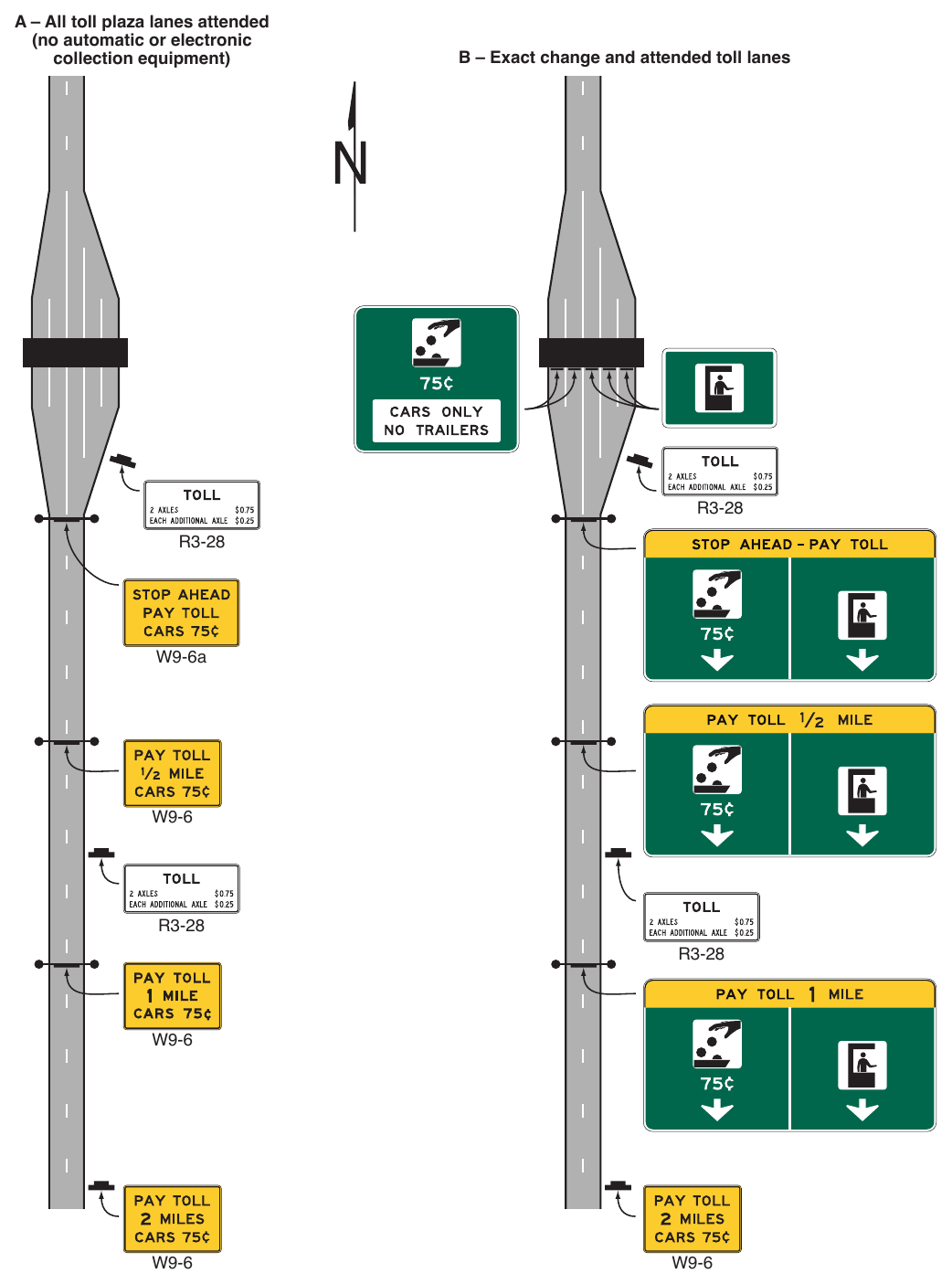
(no automatic or electronic collection equipment) B – Exact change and attended toll lanes W9-6a
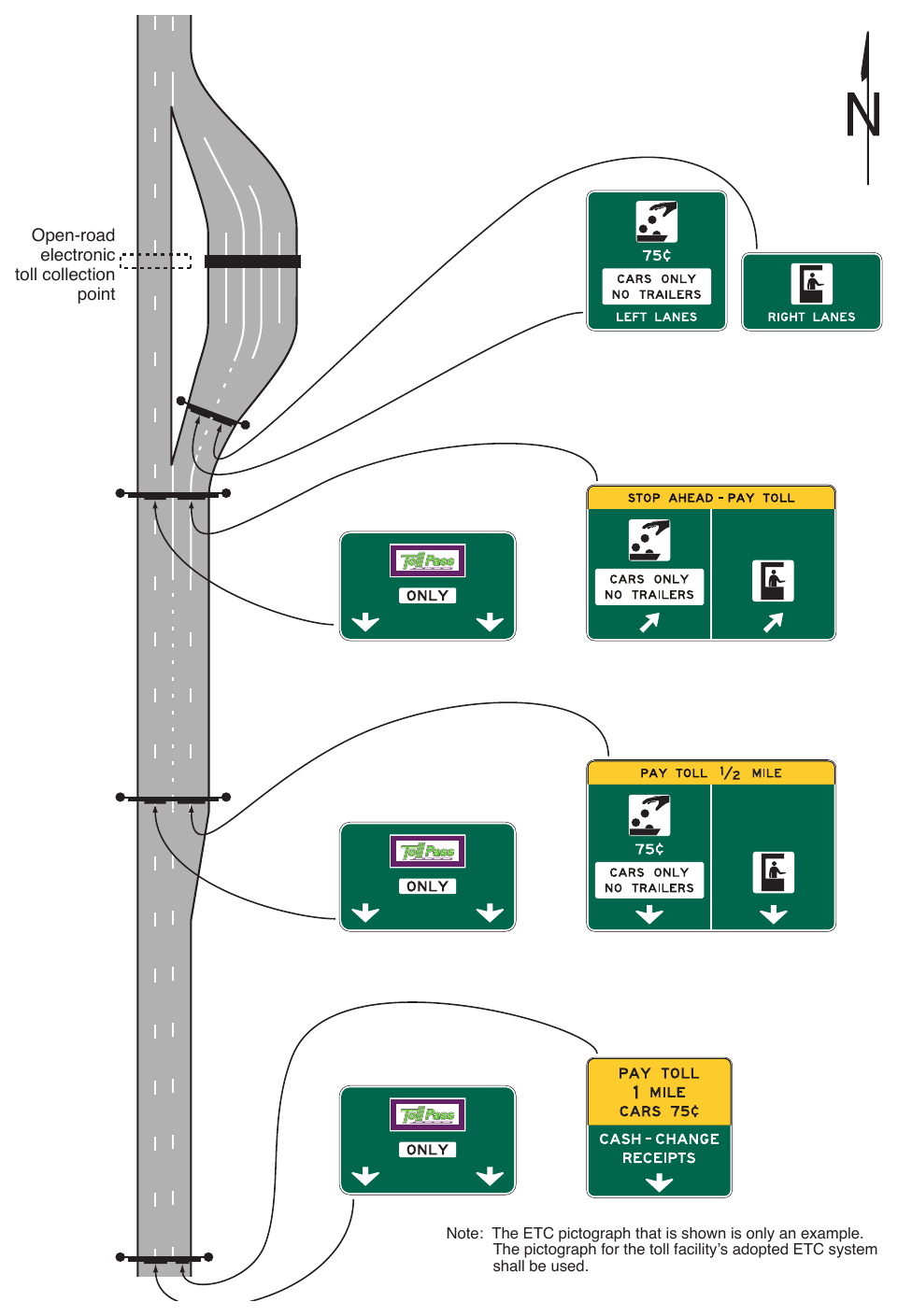
Note: The ETC pictograph that is shown is only an example. The pictograph for the toll facility’s adopted ETC system shall be used.
§2F.16 Toll Plaza Canopy Signs¶
Standard
01. A sign complying with the provisions of Section 2F.12 shall be provided above the approximate center of each lane that is not an Open-Road ETC lane, mounted on or suspended from the toll plaza canopy, or on a separate structure immediately in advance of the plaza located such that each sign is clearly related to an individual toll lane, indicating the payment type(s) accepted in the lane and any restrictions or prohibitions of certain types of vehicles that apply to the lane. Except for toll-ticket systems, the toll for passenger or 2-axle vehicles shall be included on the canopy sign or on a separate sign mounted on the upstream side of the tollbooth.
02. The background color of a canopy sign for an ETC Account-Only toll plaza lane shall be purple (see Figure 2F-16).
Option
03. Where vehicles are required to have a registered ETC account to use the lane, one or two flashing yellow beacons (see Section 4R.03) may supplement a canopy sign over an ETC Account-Only lane to call special attention to the location of the ETC Account-Only lane within the plaza.
04. The canopy sign for an ETC Account-Only toll plaza lane in which a regulatory speed limit is not posted and in which vehicles are not required to stop may display an advisory speed within a horizontal rectangular panel with a black legend and yellow background within the bottom portion of the canopy sign.
Standard
05. Flashing beacons supplementing a canopy sign over an ETC Account-Only lane shall be mounted directly above or alongside the sign in a manner that is separated from any lane-use control signals for that lane (see Figure 2F-16).
06. For multi-lane toll plazas, lane-use control signals (see Section 4R.02) shall be provided above the approximate center of each toll plaza lane that is not an Open-Road ETC lane to indicate the open or closed status of each lane. Lane-use control signals shall not be used to call attention to a lane for a specific toll payment type such as ETC Account-Only lanes.
Support
07. Part 6 contains information regarding the closing of a lane for temporary traffic control purposes.
08. Figure 2F-16 shows examples of toll plaza canopy signs.
§2F.17 Guide Signs for Entrances to Electronic Toll Collection (ETC) Only Facilities¶
Support
01. Some toll highways, bridges, and tunnels are restricted to use only by vehicles with a specific registered ETC account, referred to as ETC Account-Only facilities. Other facilities collect tolls electronically using license plate character recognition in which the registered vehicle owner is then billed by postal mail and registration in an ETC account program is not required but could be an optional payment method. These facilities are commonly referred to as All-Electronic Tolling (AET) or Cashless Tolling.
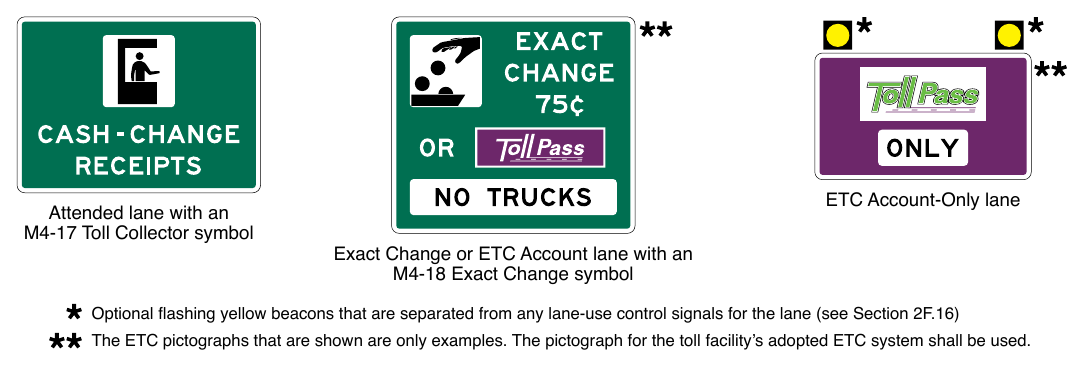
Optional flashing yellow beacons that are separated from any lane-use control signals for the lane (see Section 2F.16) The ETC pictographs that are shown are only examples. The pictograph for the toll facility’s adopted ETC system shall be used.
Standard
Guide signs for facilities that only collect tolls electronically shall comply with the applicable provisions of Chapter 2E and Section 2F.13.
03. Guide signs for the entrance ramps to ETC Account-Only facilities shall incorporate the pictograph of the toll facility’s primary ETC payment system and the word ONLY in a header panel or plaque designed in accordance with the provisions of Section 2F.13 (see Figure 2F-8).
Option
04. A separate information sign displaying the route number, the TOLL warning panel (see Section 2F.11), and the legend NO CASH may be located within the sequence of the Advance guide signs on the approach to the entrance to an ETC Account-Only facility.
05. Exit Gore signs for entrance ramps to such ETC Account-Only facilities may incorporate the pictograph of the toll facility’s ETC payment system and the word ONLY in a header panel or plaque designed in accordance with the provisions of Section 2F.13 (see Figure 2F-13 and Drawing B in Figure 2F-12).
06. If more than one ETC account program is accepted for toll payments on an ETC Account-Only facility, the additional accepted ETC account program pictographs may be displayed on a separate informational guide sign with the legend, ALSO ACCEPTED, within the sequence of advance guide signs for the entrance to the facility.
Support
07. Section 2F.05 contains information regarding ETC Account-Only signs and plaques for use with route signs in route sign assemblies.
Standard
08. Where vehicles are not required to have a registered ETC account to use an ETC-Only facility, guide signs for the facility shall comply with the applicable provisions of Chapter 2E and specifically with the applicable provisions of Section 2F.13.
09. Advance and Exit Direction guide signs for the entrances to facilities that do not require registration in an ETC toll account program shall not display a pictograph of an accepted ETC payment system or use purple as a background color on any portion of the signs.
10. Information on accepted toll payment methods for a facility that does not require registration in an ETC toll account program shall only be provided on a separate informational guide sign, if used, that displays one of the following legends (see Drawing C in Figure 2F-12):
- A. TOLL BILLED BY MAIL ONLY, if there is no alternative payment method; or
- B. TOLL BILLED BY MAIL OR [ETC Account Pictograph], if the facility also accepts payments from registered users of an ETC account program.
Option
11. If there is more than one ETC toll account program accepted, all ETC account program pictographs of the accepted ETC accounts may be displayed on the separate informational guide sign below the TOLL BILLED BY MAIL OR legend. A plaque with the legend NO CASH may be added below the signs described in Paragraph 10 of this Section.
Guidance
12. The signs described in Paragraph 10 of this Section should be located within the sequence of Advance Guide signs for the entrance to the facility and/or at a location along the facility itself (see Drawing C in Figure 2F-12).
Option
13. If the ETC-Only facility also accepts payments from multiple ETC account programs, but does not require registration in the primary ETC account program associated with the facility in order to use the facility, then the pictographs of the other accepted ETC account programs may be displayed on the separate information sign beneath the legend TOLL BILLED BY MAIL and the word OR.
14. If, in addition to a toll, a nominal surcharge (not a fine, penalty, or violation) is assessed road users not registered in the toll account program, or registered toll account users are assessed a discounted toll, such information may be displayed on a separate information sign on the approach to the entrance to the facility.
§2F.18 Guide Signs for ETC-Only Entrance Ramps to Non-Toll Highways¶
Support
01. In some cases, access to or from a non-toll route might be provided by a ramp on which a toll is charged in order to manage congestion, limit access, or for other reasons. The toll ramp might be provided as an alternative to or in lieu of a ramp providing similar access without charging a toll. Figures 2F-8 and 2F-13 show examples of guide signs for a ramp on which a toll is charged to enter a non-toll route.
Standard
02. Guide signs for ETC-Only Entrance Ramps to non-toll highways shall comply with the provisions of Section 2F.17.
Option
03. A NO TOLL panel with a black legend and a yellow background may be included on the top section of the Exit Gore sign for an exit that provides access to the facility without charging a toll.
§2F.19 ETC Account Program Information Signs¶
Standard
01. Except as provided in Paragraph 2 of this Section, signs that inform road users of telephone numbers, Internet addresses, including domain names and uniform resource locators (URLs), or e-mail addresses for enrolling in an ETC account program of a toll facility or managed lane, obtaining an ETC transponder, and/or obtaining ETC account program information shall only be installed in rest areas, parking areas, or similar roadside facilities where the signs are viewed only by pedestrians or occupants of parked vehicles.
Option
02. ETC account program information signs displaying telephone numbers that have no more than four characters may be installed on roadways in locations where they will not obscure the road user’s view of higher priority traffic control devices and that are removed from key decision points where the road user’s view is more appropriately focused on other traffic control devices, roadway geometry, or traffic conditions, including exit and entrance ramps, intersections, toll plazas, temporary traffic control zones, and areas of limited sight distance.