Chapter 3C. Crosswalk Markings¶
§3C.01 General¶
Support
01. Crosswalk markings provide guidance for pedestrians who are crossing roadways by defining and delineating paths on approaches to and within signalized intersections, and on approaches to other intersections where traffic stops.
02. In conjunction with signs and other measures, crosswalk markings help to alert road users of a designated pedestrian crossing point across roadways at locations that are not controlled by traffic control signals or STOP or YIELD signs.
03. At non-intersection locations, crosswalk markings legally establish the crosswalk.
04. Detectable warning surfaces mark boundaries between pedestrian and vehicular ways where there is no raised curb. Detectable warning surfaces are typically installed where curb ramps are constructed at the junction of sidewalks and the roadway or shoulder, for marked and unmarked crosswalks. Detectable warning surfaces contrast visually with adjacent walking surfaces, either light-on-dark, or dark-on-light. The U.S. Department of Justice 2010 ADA Standards for Accessible Design, September 15, 2010, 28 CFR 35 and 36, Americans with Disabilities Act of 1990 contains specifications for the design of detectable warning surfaces.
§3C.02 Application of Crosswalk Markings¶
Guidance
01. At locations controlled by traffic control signals, crosswalk markings should be installed.
Option
02. Crosswalk markings may be omitted if engineering judgment indicates they are not needed to direct pedestrians to the proper crossing path(s).
Guidance
03. On approaches controlled by STOP or YIELD signs, crosswalk markings should be installed where engineering judgment indicates they are needed to direct pedestrians to the proper crossing path(s).
04. At uncontrolled approaches, an engineering study should be performed before a marked crosswalk is installed. The following criteria should be considered:
- A. Total number of approach lanes,
- B. The presence of a median,
- C. The distance from adjacent signalized intersections or other controlled crossings,
- D. Projected pedestrian and bicyclist volumes,
- E. Pedestrian and bicyclist paths of travel,
- F. Pedestrian ages and abilities,
- G. Pedestrian and bicyclist delays,
- H. Location or frequency of public transit stops,
- I. Average daily traffic (ADT),
- J. Speed limit or the 85th-percentile speed,
- K. The horizontal and vertical geometry of the crossing location,
- L. The possible consolidation of multiple crossing points,
- M. The availability of street lighting, and
- N. Other appropriate factors.
Standard
05. Crosswalk markings shall be provided at legally established crosswalks at non-intersection locations.
Guidance
06. The installation of other traffic control devices and other measures designed to reduce traffic speeds, shorten crossing distances, enhance driver awareness of the crossing, and/or provide active warning of pedestrian presence, should be considered in addition to a new marked crosswalk and signs across an uncontrolled approach to an intersection or midblock crossing location where any of the following conditions exist:
- A. The roadway has four or more lanes of travel without a raised median or pedestrian refuge island and an ADT of 12,000 vehicles per day or greater; or
- B. The roadway has four or more lanes of travel with a raised median or pedestrian refuge island and an ADT of 15,000 vehicles per day or greater, or
- C. The posted speed limit is 40 mph or greater, or
- D. A crash study reveals that multiple-threat crashes are the predominant crash type on a multi-lane approach, or
- E. When adequate visibility cannot be provided by parking prohibitions.
Support
07. Chapter 4J contains information on pedestrian hybrid beacons.
08. Chapter 4L contains information on rectangular rapid flashing beacons.
09. Section 4S.03 contains information regarding Warning Beacons to provide active warning of a pedestrian’s presence.
10. Section 4U.02 contains information regarding In-Roadway Warning Lights at crosswalks.
11. Chapter 7C contains information on school crosswalks.
12. Chapter 7D contains information regarding school crossing supervision.
13. Section 9E.13 contains information on crosswalk markings for shared-use path crossings.
§3C.03 Design of Crosswalk Markings¶
Support
01. Section 3B.19 contains information regarding placement of stop line markings and yield line markings near crosswalk markings.
02. Crosswalk markings are classified as either transverse line or high-visibility. Transverse crosswalk markings consist of two transverse lines. High-visibility markings consist of longitudinal lines parallel to traffic flow with or without transverse lines. Figure 3C-1 presents crosswalk marking designs.
Standard
03. Crosswalk markings shall be white. When used, transverse lines shall not be less than 6 inches or greater than 24 inches in width.
Support
04. The allowable upper limit approaching 24 inches for the width of the transverse lines is normally applied where no stop or yield line is used in advance of the crosswalk or when approach speeds exceed 35 miles per hour.
Standard
05. Except as provided in Paragraph 6 of this Section, the minimum width of a marked crosswalk shall be 6 feet.
06. At a non-intersection crosswalk where the posted speed limit is 40 mph or greater, the minimum width of the crosswalk shall be 8 feet.
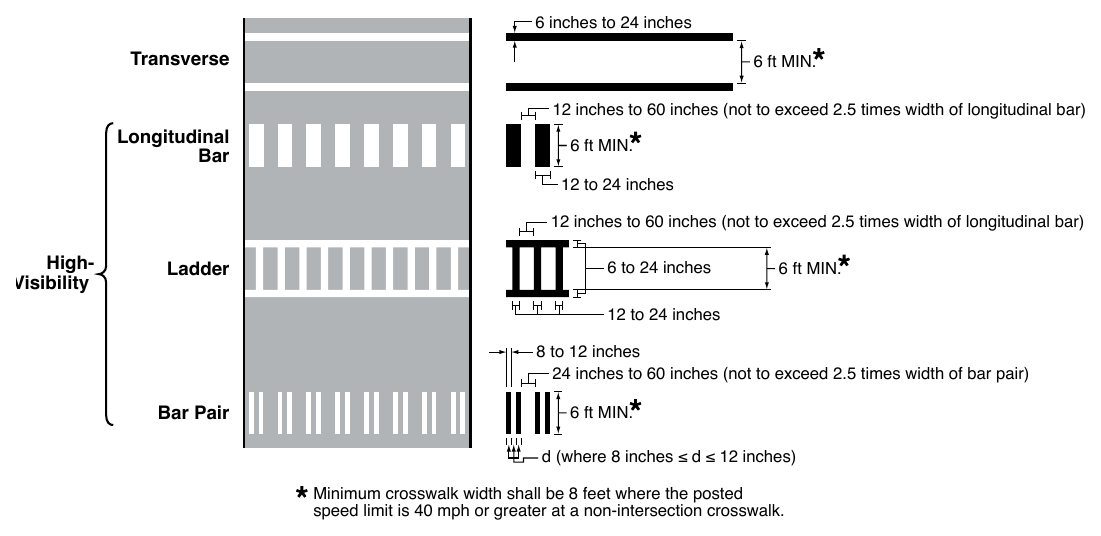
6 ft MIN. 12 inches to 60 inches (not to exceed 2.5 times width of longitudinal bar) Longitudinal Bar 6 ft MIN. 12 to 24 inches 12 inches to 60 inches (not to exceed 2.5 times width of longitudinal bar) High-visibility Ladder 6 to 24 inches 6 ft MIN. 12 to 24 inches 8 to 12 inches 24 inches to 60 inches (not to exceed 2.5 times width of bar pair) Bar Pair 6 ft MIN. d (where 8 inches ≤ d ≤ 12 inches) Minimum crosswalk width shall be 8 feet where the posted speed limit is 40 mph or greater at a non-intersection crosswalk.
Guidance
07. High-visibility crosswalk markings (such as shown in Figure 3C-1) and warning signs (see Section 2C.55) should be installed for all crosswalks at non-intersection locations.
08. Added visibility should be provided by parking prohibitions on the approach to marked crosswalks at nonintersection locations.
Standard
09. At marked crosswalk locations where curb ramps are provided, crosswalk markings shall be located so that the curb ramps are within the extension of the crosswalk markings.
Guidance
10. Crosswalk marking designs should extend across the full width of pavement or to the edge of the intersecting crosswalk to discourage diagonal walking between crosswalks.
Support
11. Provisions for aesthetic treatments for the interior portion of a legally-established crosswalk are contained in Section 3H.03.
Standard
12. If paving materials are used to function as the white transverse lines to establish a marked crosswalk, white additives shall be part of the mixture to produce a white surface. The white paving materials shall be retroreflective.
§3C.04 Transverse Line Crosswalks¶
Guidance
01. Transverse line crosswalk markings should be limited to locations controlled by traffic control signals or on approaches controlled by STOP or YIELD signs.
Support
02. Transverse line crosswalk marking design consists of two parallel transverse lines (see Figure 3C-1).
03. Transverse line crosswalk markings can provide benefits to crosswalk operations including:
- A. Define where the channelization of pedestrians or other non-motorized users is necessary to facilitate crossing the roadway.
- B. Alert motorists to the location of where pedestrians and other non-motorized users might be expected when crossing the roadway.
- C. Emphasize a crosswalk at a controlled intersection.
- D. Fulfill a legal need to mark the crosswalk.
§3C.05 High-Visibility Crosswalks¶
Option
01. High-visibility crosswalk markings may be used where additional conspicuity is desired for a crosswalk over transverse line crosswalk markings.
Support
02. High-visibility crosswalk markings include the longitudinal bar, ladder, and bar pair designs (see Figure 3C-1).
03. High-visibility crosswalk markings can provide benefits to crosswalk operations including:
- A. Providing greater detection distances for the approaching motorist.
- B. Emphasizing a crosswalk where substantial numbers of pedestrians cross without any other traffic control device.
- C. Emphasizing a crosswalk at an uncontrolled approach.
- D. Emphasizing the location where a high number of conflicts between turning motorists and users of the crosswalk are expected.
- E. Improving visibility of the crosswalk location for otherwise difficult-to-detect pedestrians or other non-motorized users of the crosswalk.
- F. Emphasizing a school crossing.
Standard
04. The minimum number of individual longitudinal elements to establish a high-visibility crosswalk shall be three. For the bar pair crosswalk design (see Section 3C.08), a coupling set of two longitudinal bars shall be considered to be one individual longitudinal element.
Guidance
05. The dimensions of the individual longitudinal element and the lateral spacing between subsequent individual longitudinal elements for a high-visibility crosswalk should be uniform when establishing the crosswalk.
06. The dimensions of the individual longitudinal element and the lateral spacing between subsequent individual longitudinal elements for a high-visibility crosswalk should be uniform when establishing separate crosswalks on multiple approaches to the same intersection and on both sides of a median refuge if one is present.
07. The individual longitudinal elements of a high-visibility crosswalk should be angled such that they are parallel to the travel path of approaching traffic.
Option
08. The lateral spacing between longitudinal elements may be staggered to avoid wheel paths, center lines, and lane lines.
§3C.06 Longitudinal Bar Crosswalks¶
Support
01. The longitudinal bar crosswalk marking design (see Figure 3C-1) provides for improved detection and recognition over the transverse line crosswalk for people with low vision and cognitive impairments.
Standard
02. The width of an individual longitudinal bar shall not be less than 12 inches or greater than 24 inches.
03. The lateral spacing between subsequent longitudinal bars shall not be less than 12 inches or greater than 60 inches. The lateral spacing of the longitudinal bars shall not exceed 2.5 times the width of a longitudinal bar.
§3C.07 Ladder Crosswalks¶
Support
01. Ladder crosswalks (see Figure 3C-1) implement a design where longitudinal bars are used in the interior portion of the crosswalk between the transverse lines that define the limits of the crosswalk.
02. The ladder crosswalk marking design provides for improved detection and recognition over the transverse crosswalk for people with low vision and cognitive impairments.
03. Since the longitudinal component of the ladder crosswalk marking design is similar to the benefits provided by the longitudinal bar crosswalk design, the ladder crosswalk design is normally used to discourage or prohibit diagonal walking between crosswalks.
Standard
04. The transverse lines used to establish the limits of the ladder crosswalk shall not be less than 6 inches or greater than 24 inches in width.
05. The width of an individual interior longitudinal bar shall not be less than 12 inches or greater than 24 inches.
06. The lateral spacing between subsequent interior longitudinal bars shall not be less than 12 inches or greater than 60 inches. The lateral spacing of the interior longitudinal bars shall not exceed 2.5 times the width of an interior longitudinal bar.
Option
07. Where it might be necessary to alleviate a distortion due to perspective (foreshortening) caused by approaching roadway geometry that curves or to accommodate low approach angles of the approaching motorists, the interior longitudinal bars may be rotated up to 45 degrees to the transverse lines to remain parallel to approaching traffic.
§3C.08 Bar Pair Crosswalks¶
Support
01. Bar pair crosswalks (see Figure 3C-1) can provide the same benefits as other high-visibility crosswalk designs with the opportunity for less maintenance.
02. Bar pair crosswalks can be useful in locations that are susceptible to slip and fall incidents exacerbated by extreme or inclement weather, or in locations where high motorcycle or bicycle use is expected, in order to maximize wheel traction with the road surface.
Standard
03. The width of an individual longitudinal bar that establishes one-half of the bar pair shall not be less than 8 inches or greater than 12 inches. The lateral spacing between successive individual longitudinal bars within the same bar pair shall be equal to the width of one longitudinal bar.
04. The lateral spacing between subsequent longitudinal bar pairs shall not be less than 24 inches or greater than 60 inches, or 2.5 times the width of the total width of a bar pair.
05. Longitudinal bar pair crosswalks shall not be installed with accompanying transverse lines.
§3C.09 Crosswalk Markings at Circular Intersections¶
Standard
01. Crosswalk markings shall not be provided to or from the central island of a roundabout.
Guidance
02. If pedestrian facilities are provided, crosswalks should be marked across roundabout entrances and exits to indicate where pedestrians are intended to cross.
03. On an approach to a circular intersection controlled by a YIELD sign and at uncontrolled exits, crosswalks should be a minimum of 20 feet from the edge of the circulatory roadway.
Support
04. Chapter 3D provides figures that illustrate examples of crosswalk markings for roundabouts.
§3C.10 Crosswalks for Exclusive Pedestrian Phases that Permit Diagonal Crossings¶
Option
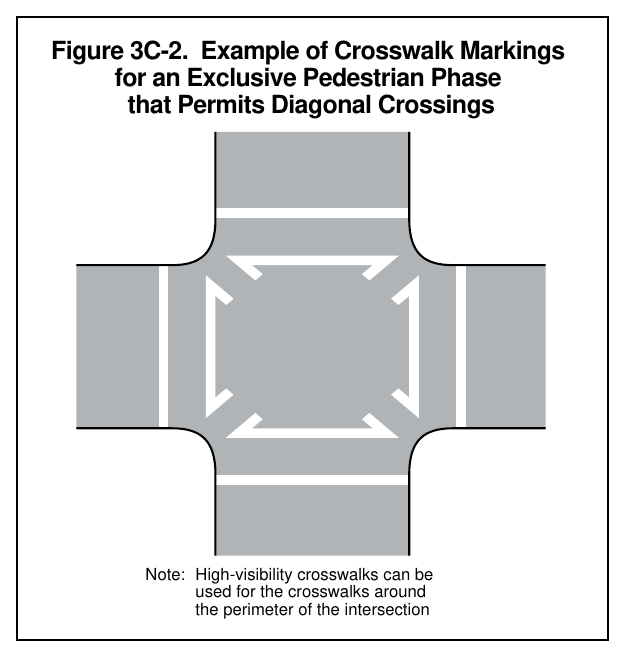
01. When an exclusive pedestrian phase that permits diagonal crossing of an intersection is provided at a traffic control signal, a marking as shown in Figure 3C-2 may be used for the crosswalk.
Guidance
02. The segments of the crosswalk marking that facilitate the diagonal crossing should not use high-visibility crosswalk markings.
§3C.11 Crosswalks at Diamond Interchanges with a Transposed Alignment Crossroad¶
Support
01. Diamond interchanges with a transposed alignment crossroad, also known as double-crossover diamond interchanges or diverging diamond interchanges, include directional crossovers on either side of the interchange that transpose the crossroad which results in vehicles traveling on the left-hand side of the street or highway between the crossover intersections. The potential for altered travel paths for pedestrians and the associated, unique, operational aspects such as traffic approaching from unexpected directions and unfamiliar signal phasing schemes are important considerations.
Guidance
02. If pedestrian facilities are provided, pedestrian crossing movements of the crossroads at a diamond interchange with a transposed alignment crossroad should be marked at the crossover intersections where motor vehicle traffic becomes transposed.
03. If pedestrian facilities are provided, crosswalks should be marked across ramp terminals at diamond interchanges with a transposed alignment crossroad to indicate where pedestrians are intended to cross.
04. Crosswalks across ramps at diamond interchanges with a transposed alignment crossroad with yield controlled vehicle movements should be located a minimum of 20 feet from the edge of an intersecting ramp.
Support
05. Section 3B.31 contains information on markings, such as edge lines, lane lines, and lane-use arrows, for diamond interchanges with a transposed alignment crossroad.
06. Figure 3B-29 shows an example of pedestrian crossing locations at a diamond interchange with a transposed alignment crossroad.
§3C.12 Pedestrian Islands and Medians¶
Support
01. Raised islands or raised medians of sufficient width that are placed in the center area of a street or highway can serve as a place of refuge for pedestrians who are attempting to cross at a midblock or intersection location. Center islands or medians allow pedestrians to find an adequate gap in one direction of traffic at a time, as the pedestrians are able to stop, if necessary, in the center island or median area and wait for an adequate gap in the other direction of traffic before crossing the second half of the street or highway. The U.S. Department of Justice 2010 ADA Standards for Accessible Design, September 15, 2010, 28 CFR 35 and 36, Americans with Disabilities Act of 1990 contains specifications for the design of detectable warning surfaces and provides technical requirements that can be used to determine the minimum width for accessible refuge islands.