Chapter 9B. Regulatory Signs¶
§9B.01 STOP and YIELD Signs (R1-1 and R1-2)¶
Standard
01. STOP (R1-1) signs (see Figure 9B-1) shall be installed on bicycle facilities at points where bicyclists are required to stop.
02. YIELD (R1-2) signs (see Figure 9B-1) shall be installed on bicycle facilities at points where bicyclists have an adequate view of conflicting traffic as they approach the sign, and where bicyclists are required to yield the right-of-way to that conflicting traffic.
03. A STOP sign or a YIELD sign shall not be installed in conjunction with a bicycle signal face (see Chapter 4H).
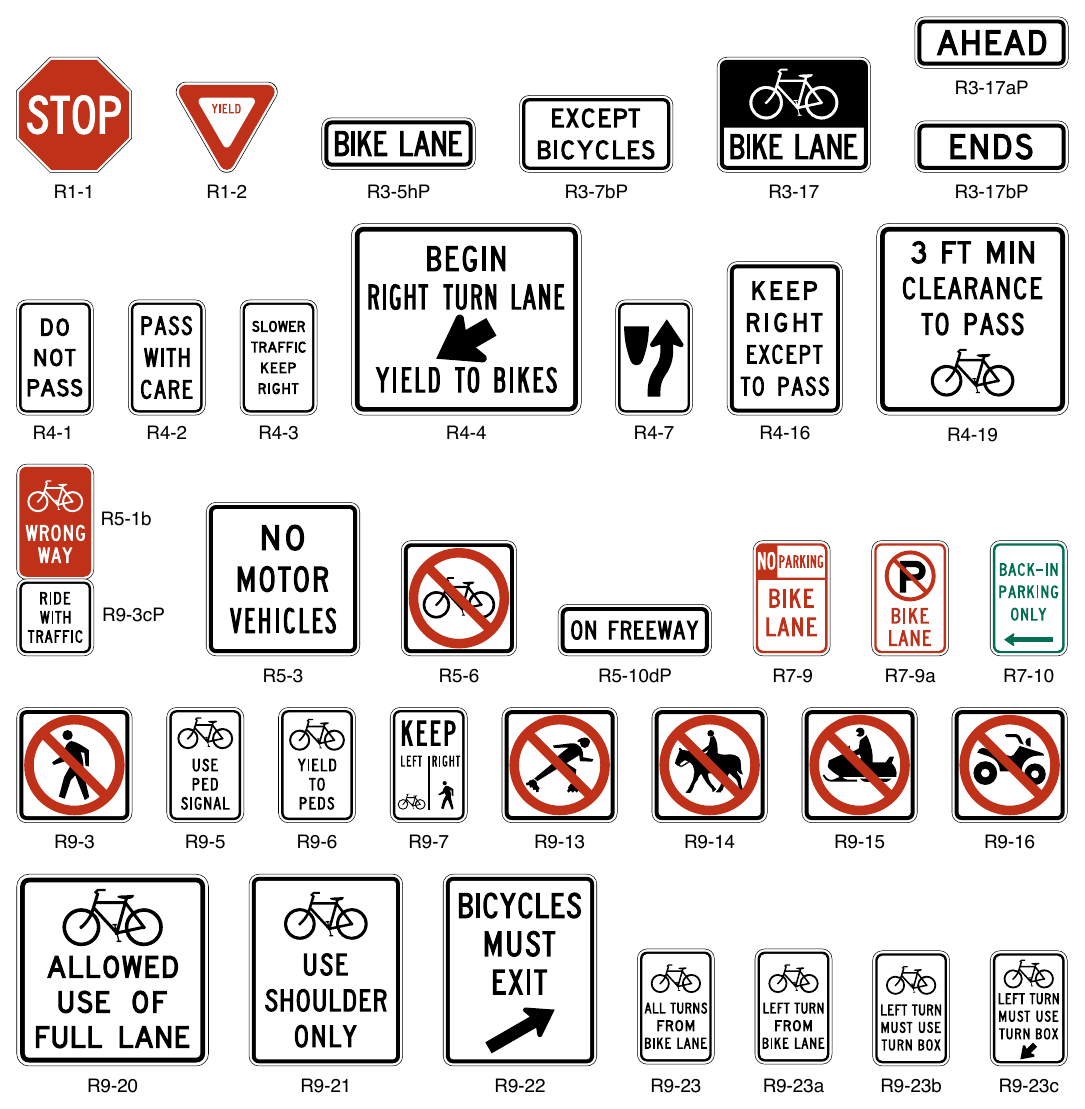
Signs shown: R3-17aP, R1-1, R1-2, R3-5hP, R3-7bP, R3-17, R3-17bP, R4-1, R4-2, R4-3, R4-4, R4-7, R4-16, R4-19, R5-1b, R9-3cP, R5-3, R5-6, R5-10dP, R7-9, R7-9a, R7-10, R9-3, R9-5, R9-6, R9-7, R9-13, R9-14, R9-15, R9-16, R9-20, R9-21, R9-22, R9-23, R9-23a, R9-23b, R9-23c
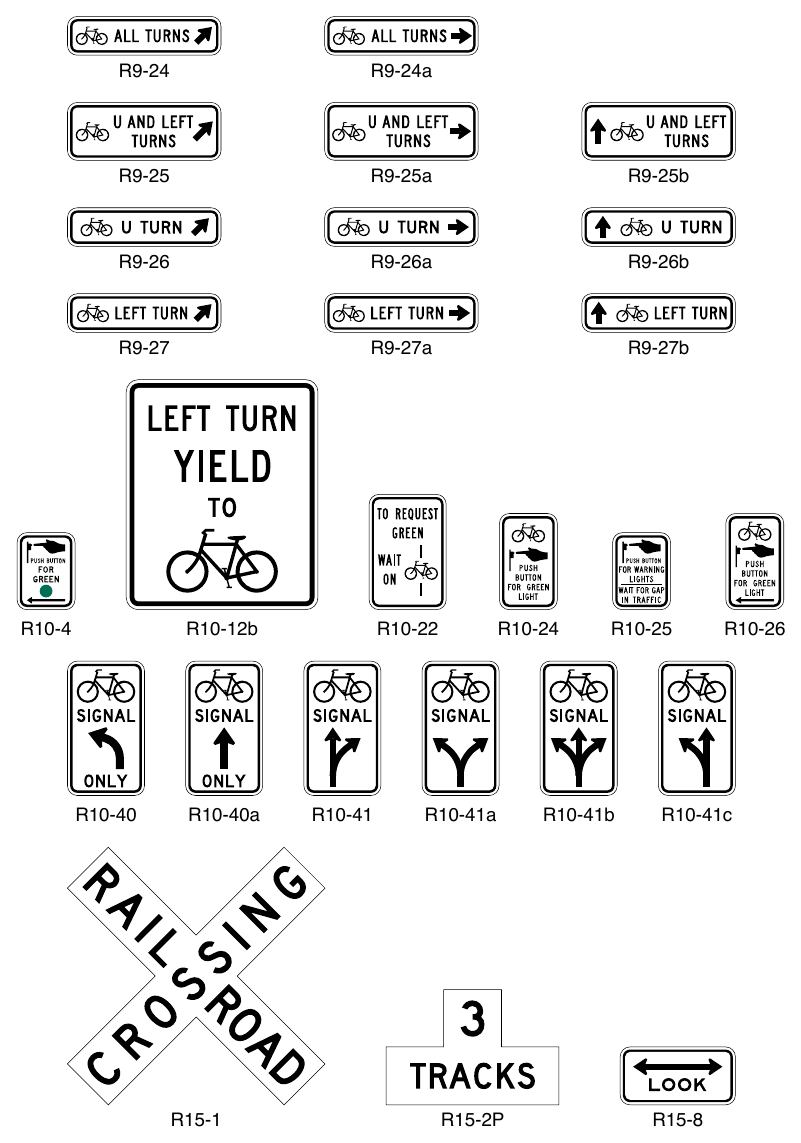
Signs shown: R9-24, R9-24a, R9-25, R9-25a, R9-25b, R9-26, R9-26a, R9-26b, R9-27, R9-27a, R9-27b, R10-4, R10-12b, R10-22, R10-24, R10-25, R10-26, R10-40, R10-40a, R10-41, R10-41a, R10-41b, R10-41c, R15-1, R15-2P, R15-8
Option
04. Larger signs may be used on shared-use paths and separated bikeways for added emphasis.
Guidance
05. Where conditions require shared-use path users or bicyclists on separated bikeways, but not roadway users, to stop or yield, the STOP or YIELD sign should be placed or shielded so that it is not readily visible to roadway users.
06. When the placement of STOP or YIELD signs is being considered, the priority at a shared-use path/roadway intersection should be assigned with consideration of the following:
- A. Relative speeds of shared-use path and roadway users,
- B. Relative volumes of shared-use path and roadway traffic, and
- C. Relative importance of shared-use path and roadway.
07. Speed should not be the sole factor used to determine priority, as it is sometimes appropriate to give priority to a high-volume shared-use path that crosses a low-volume street, or to a regional shared-use path that crosses a minor collector street.
08. When priority is assigned (see Sections 2B.06 and 2B.08), the least-restrictive control that is appropriate should be placed on the lower-priority approaches. STOP signs should not be used where YIELD signs would provide adequate control.
§9B.02 EXCEPT BICYCLES Regulatory Plaque (R3-7bP)¶
Support
01. There are circumstances where it might be appropriate to exempt bicyclists from regulatory restrictions applied to other traffic.
Guidance
02. Where an engineering study or engineering judgment demonstrates that it is appropriate to exempt bicyclists from the provisions of a regulatory sign, the EXCEPT BICYCLES (R3-7bP) regulatory plaque (see Figure 9B-1) should be used.
Support
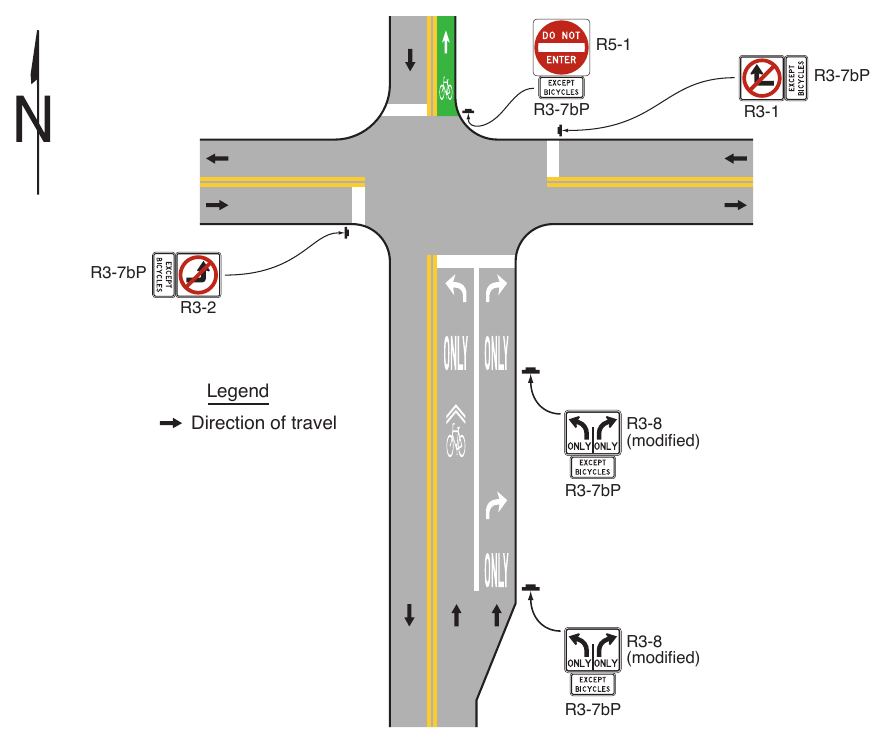
03. Figure 9B-2 shows examples of how the EXCEPT BICYCLES (R3-7bP) regulatory plaque can be applied.
04. Section 9C.05 contains information regarding the EXCEPT BICYCLES warning plaque when applicable to a warning sign.
Standard
05. The EXCEPT BICYCLES regulatory plaque shall not be used to exempt bicyclists from the legal requirement of a STOP or YIELD sign, Yield Here to Pedestrians Signs, Stop Here for Pedestrians Signs, or a traffic signal indication.
06. Where a regulatory sign, such as the No Left Turn (R3-2) sign (see Section 2B.26), is installed on the same post or mounting as a STOP sign or YIELD sign, the EXCEPT BICYCLES regulatory plaque shall not be installed in conjunction with the regulatory sign on that post or mounting that includes the STOP sign or YIELD sign.
07. The EXCEPT BICYCLES regulatory plaque shall be placed below the regulatory sign that it supplements.
§9B.03 Advance Intersection Lane Control Signs (R3-8 Series) for Bicycle Lanes¶
Option
01. Advance Intersection Lane Control (R3-8 series) signs (see Section 2B.30) may display the arrangement of a conventional or buffer-separated bicycle lane in relation to other lanes in the same direction that are present on a roadway approach to an intersection.
Support
02. The number and combination of permissible movements by both the motor vehicle and the bicycle on the same approach to an intersection might be practically limited by the amount of information that can be legibly displayed on signs or in signing sequences and still be readily comprehended by road users. The excessive display of all movements by more than one mode can result in unwieldy signs that are difficult to locate and install.
Guidance
03. On an approach to an intersection with complex geometry that can include multiple through lanes and multiple turn lanes and also includes a bicycle lane, consideration should be given to displaying all allowable movements on separate signs, such as using Mandatory Movement Lane Control (R3-5) signs (see Section 2B.28) for the through lanes and Mandatory Movement Lane Control (R3-7) signs (see Section 2B.28) for the turn lanes, and guide signs for bicycle routes (see Section 9D.02 through 9D.07) and Bicycle Route Sign auxiliary plaques (see Section 9D.08) for the bicycle movement.
Standard
04. The portion of the sign face for the bicycle lane shall be limited to the relationship of the bicycle lane to the other lanes on the roadway approach to the intersection. The portion of the sign face for the bicycle lane shall not be modified to display specific, supplementary information about the bicycle lane such as bicycle lane extensions, contiguous buffer spaces, or other ancillary bicycle operations such as two-stage turn boxes or bicycle boxes.
05. Counter-flow bicycle lanes shall not be displayed on Advance Intersection Lane Control signs.
06. The shared-lane marking symbol shall not be displayed on Advance Intersection Lane Control signs.
07. Shared-use paths shall not be displayed on Advance Intersection Lane Control signs.
08. Advance Intersection Lane Control signs that display the bicycle lane shall use a contrasting white legend on a black background for the bicycle lane (see Figure 2B-4). The portion of the display for the bicycle lane shall not use the color green on the sign face in an attempt to be consistent with the greencolored pavement that might be present on the intersection approach.
§9B.04 Bicycle Lane Signs and Plaques (R3-17, R3-5hP, R3-17aP, and R3-17bP)¶
Standard
01. The Bike Lane (R3-17) sign and the BIKE LANE (R3-5hP), AHEAD (R3-17aP), and ENDS (R3-17bP) plaques (see Figure 9B-1) shall be used only in conjunction with marked bicycle lanes as described in Sections 9E.01, 9E.06, and 9E.07.
Guidance
02. If used, Bicycle Lane signs and plaques should be located at the beginning of the bicycle lane and in advance of the downstream end of the bicycle lane.
Option
03. Additional Bicycle Lane signs and plaques may be used at periodic intervals along the bicycle lane as determined by engineering judgment based on the operating speed of bicycle and other traffic, block length, distances from adjacent intersections, and other considerations.
Support
04. Section 2B.33 contains information for the application of BEGIN and END plaques.
05. Section 9B.03 contains information on displaying the bicycle lane on Advance Intersection Lane Control signs.
Option
06. Where two or more movements from a bicycle lane are allowed, or where the emphasis of allowed bicycle movements is needed, an Optional Movement Lane Control sign (see Section 2B.29) may be supplemented with a BIKE LANE (R3-5hP) plaque above the Optional Movement Lane Control sign.
07. Where bicycle lanes are located between travel lanes on intersection approaches or where only a single bicycle movement is allowed from a certain bicycle lane, a Mandatory Movement Lane Control sign (see Section 2B.28) may be supplemented with a BIKE LANE plaque to require a bicyclist in a particular bicycle lane at an intersection to stay in the same lane and proceed straight through the intersection, or to indicate a required turn from a particular bicycle lane.
§9B.05 BEGIN RIGHT TURN LANE YIELD TO BIKES Sign (R4-4)¶
Option
01. Where motor vehicles entering a mandatory right-turn lane must weave across bicyclists in bicycle lanes, the BEGIN RIGHT TURN LANE YIELD TO BIKES (R4-4) sign (see Figure 9B-1) may be used to inform both the motorist and the bicyclist of this weaving maneuver (see Figures 9E-3 and 9E-4).
Guidance
02. The R4-4 sign should not be used when bicyclists need to move left because of a right-turn lane drop situation.
§9B.06 Bicycle Wrong Way Sign and RIDE WITH TRAFFIC Plaque (R5-1b and R9-3cP)¶
Option
01. The Bicycle WRONG WAY (R5-1b) sign and RIDE WITH TRAFFIC (R9-3cP) plaque (see Figure 9B-1) may be placed facing wrong-way bicyclists, such as on the left-hand side of a roadway.
02. This sign and plaque may be mounted back-to-back with other signs to minimize visibility to other traffic.
Guidance
03. The RIDE WITH TRAFFIC plaque should be used only in conjunction with the Bicycle WRONG WAY sign, and should be mounted directly below the Bicycle WRONG WAY sign.
§9B.07 NO MOTOR VEHICLES Sign (R5-3)¶
Option
The NO MOTOR VEHICLES (R5-3) sign (see Figure 9B-1) may be installed at the entrance to a shared-use path.
§9B.08 Selective Exclusion Signs¶
Option
01. Selective Exclusion signs (see Figure 9B-1) may be installed at the entrance to a roadway or facility to notify road or facility users that designated types of traffic are excluded from using the roadway or facility.
Support
02. Typical exclusion messages include:
- A. No Bicycles (R5-6);
- B. No Pedestrians (R9-3);
- C. No Skaters (R9-13);
- D. No Equestrians (R9-14);
- E. No Snowmobiles (R9-15); and
- F. No All-Terrain Vehicles (R9-16).
Option
03. Where bicyclists, pedestrians, and motor-driven cycles are all prohibited, the R5-10a word message sign (see Section 2B.45) may be used.
§9B.09 No Parking Bike Lane Signs (R7-9 and R7-9a)¶
Standard
If the installation of signs is necessary to restrict parking, standing, or stopping in a bicycle lane, appropriate signs as described in Sections 2B.53 through 2B.55, or the No Parking Bike Lane (R7-9 or R7-9a) signs (see Figure 9B-1) shall be installed.
§9B.10 Back-In Parking Sign (R7-10)¶
Option
01. The Back-In Parking (R7-10) sign (see Section 2B.52 and Figure 9B-1) may be used where back-in parking is required by motor vehicles in the presence of a bicycle lane or movement.
Support
02. Angled back-in curb parking is commonly applied on streets where a bicycle lane is present so that the scanning behavior of a motorist associated with the back-in angle parking task, both entering and exiting the parking space, would place a bicyclist in a bicycle lane in a more direct view of the motor vehicle operator.
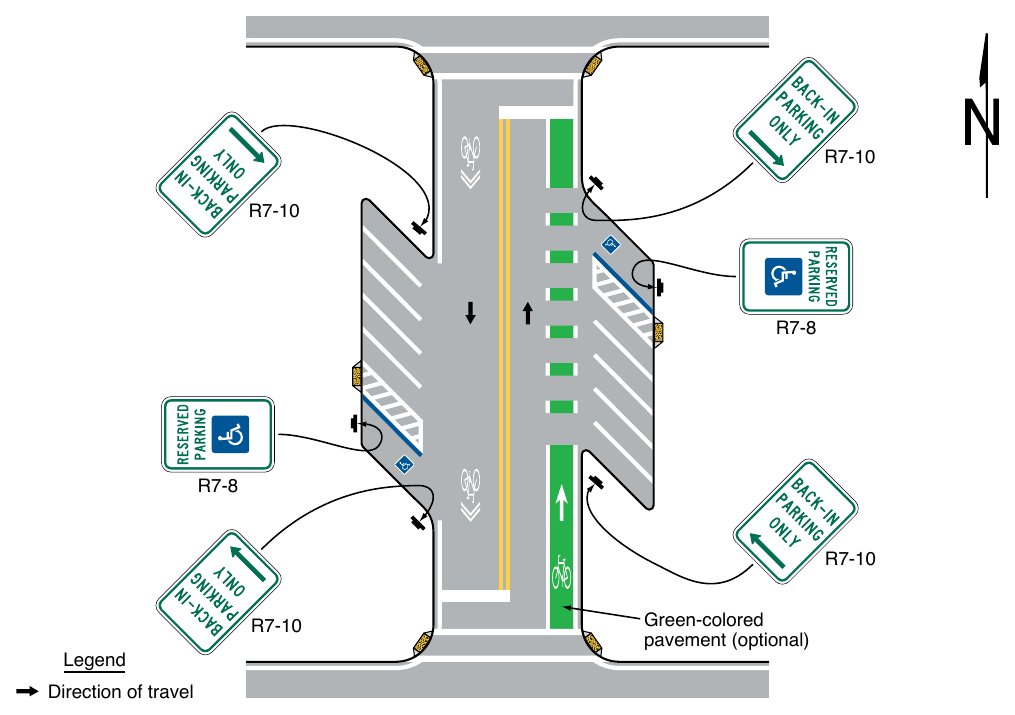
03. Figure 9B-3 shows an example of the use of back-in parking signs in conjunction with bicycle lanes.
§9B.11 Bicycles Use Ped Signal Sign (R9-5)¶
Option
01. The Bicycles Use Ped Signal (R9-5) sign (see Figure 9B-1) may be used where the crossing of a street by bicyclists is controlled by pedestrian signal indications.
02. In order to remind drivers who are making turns to yield to or stop for pedestrians or bicyclists, a Turning Vehicles Yield to Pedestrians (R10-15) sign, Turning Vehicles Stop for Pedestrians (R10-15a) sign (see Section 2B.59), or Left Turn Yield to Bicycles (R10-12b) sign (see Section 9B.21) may be used.
Guidance
03. If used, the R9-5 sign should be installed in the vicinity of where bicyclists will be crossing the street.
pavement (optional) Direction of travel
§9B.12 Bicycles Yield to Peds Sign (R9-6)¶
Option
01. The Bicycles Yield to Peds (R9-6) sign (see Figure 9B-1) may be used at locations where a bicyclist is required to cross or share a facility used by pedestrians and is required to yield to the pedestrians.
Standard
02. Where the Bicycles Yield to Peds sign is supported by a yield line pavement marking (see Section 3B.19) to establish the yielding point, the sign and the pavement marking shall be installed adjacent to each other.
03. The Bicycles Yield to Peds sign shall not be used in bicycle corridors to establish a programmatic regulation where no yielding point exists.
04. The Bicycles Yield to Peds sign shall not be used in conjunction with a STOP or YIELD sign, Yield Here to Pedestrians Sign, or a Stop Here for Pedestrians Sign.
§9B.13 Shared-Use Path Restriction Sign (R9-7)¶
Option
01. The Shared-Use Path Restriction (R9-7) sign (see Figure 9B-1) may be installed to supplement a solid white pavement marking line (see Section 9E.13) on facilities that are to be shared by pedestrians and bicyclists in order to provide a separate designated pavement area for each mode of travel. The symbols may be transposed as appropriate.
Guidance
02. If two-way operation is allowed on the facility for pedestrians and/or bicyclists, the designated pavement area that is provided for each two-way mode of travel should be wide enough to accommodate both directions of travel for that mode.
§9B.14 Bicycles Allowed Use of Full Lane Sign (R9-20)¶
Support
01. The Uniform Vehicle Code (UVC) defines a “substandard width lane” as a “lane that is too narrow for a bicycle and a vehicle to travel safely side by side within the same lane.”
Option
02. The Bicycles Allowed Use of Full Lane (R9-20) sign (see Figure 9B-1) may be used on roadways where no bicycle lanes or adjacent shoulders usable by bicycles are present and where travel lanes are too narrow for bicycles and motor vehicles to operate side-by-side.
03. The Bicycles Allowed Use of Full Lane sign may be used in locations where it is important to inform road users that bicyclists might occupy the travel lane.
04. Section 9E.09 describes a shared-lane marking that may be used in addition to or instead of the Bicycles Allowed Use of Full Lane sign to inform road users that bicyclists might occupy the travel lane.
§9B.15 Bicycle Passing Clearance Sign (R4-19)¶
Option
01. The Bicycle Passing Clearance (R4-19) sign (see Figure 9B-1) may be used in jurisdictions that have defined in law or ordinance a specific clearance to be provided by motor vehicles when they pass bicycles.
02. The specific clearance displayed on the Bicycle Passing Clearance (R4-19) sign may be adjusted to reflect the applicable law or ordinance.
Standard
03. The Bicycle Passing Clearance (R4-19) sign shall not be used in jurisdictions that do not have a specific passing clearance to be provided by motor vehicles passing bicycles, as defined in law or ordinance.
Guidance
04. The Bicycle Passing Clearance (R4-19) sign should not be used on roadways with bicycle lanes or with shoulders usable for bicycle travel.
§9B.16 Bicycles Use Shoulder Only Sign (R9-21)¶
Option
01. The Bicycles Use Shoulder Only (R9-21) sign (see Figure 9B-1) may be used to designate locations on a freeway or expressway where bicycles are allowed, but must remain on an available and usable shoulder.
Guidance
02. The Bicycles Use Shoulder Only sign should be limited to use on freeways and expressways.
03. The Bicycles Use Shoulder Only sign should be placed adjacent to the entrance ramp or entrance to the freeway at or near the location where the full-width shoulder resumes beyond the entrance ramp taper.
§9B.17 Signing for Bicycles on Freeways and Expressways¶
Standard
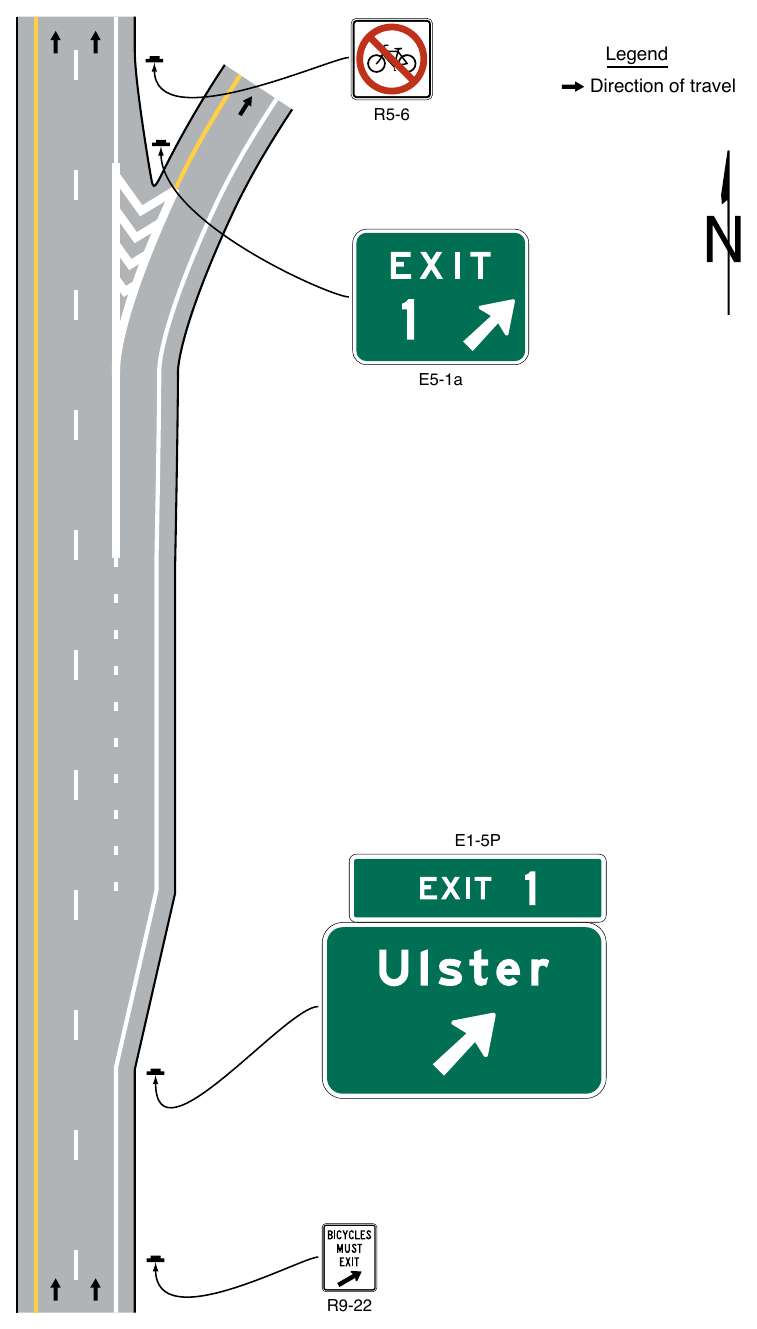
01. The Bicycles Must Exit (R9-22) sign (see Figure 9B-1) shall be used in advance of a location where a freeway or expressway becomes prohibited to bicycle travel, and shall be placed in advance of the intersection or exit ramp prior to the prohibited segment of roadway (see Figure 9B-4).
Option
02. The Bicycles Must Exit sign may be used below a post-mounted Exit Direction sign.
Standard
03. If the Bicycles Must Exit sign is used, a No Bicycles (R5-6) sign (see Figure 9B-1) shall be placed downstream from the intersection or exit ramp departure point where the prohibited segment of freeway or expressway begins. The No Bicycles sign shall not be placed below the Exit Gore sign.
Option
04. The ON FREEWAY (R5-10dP) plaque (see Figure 9B-1) may be used with an appropriate Selective Exclusion sign to indicate a prohibition along ramps leading to an adjacent or parallel freeway.
Support
05. Section 2B.45 contains information on regulatory signing for prohibiting bicycles from using particular roadways or facilities.
§9B.18 Two-Stage Bicycle Turn Box Regulatory Signing (R9-23 Series)¶
Support
01. Where two-stage bicycle turn boxes are provided in an intersection, the design of an approach to that intersection will determine whether the use of a two-stage bicycle turn box is required by bicycles to facilitate a turn.
02. Situations in which a two-stage bicycle turn box might be necessary to facilitate turns include, but are not limited to, those in which:
- A. A separated bicycle facility is provided where upstream access to a lane used to facilitate turns by motor vehicle traffic is physically inaccessible to bicycles;
- B. Left turns are prohibited from the left-most lane, or right turns are prohibited from the right-most lane, at an intersection; or
- C. Locations where physical or operational conditions make it impracticable or unsafe for a bicyclist to merge and make the appropriate turn as would any other vehicle.
Standard
03. Where bicycles are required to use a two-stage bicycle turn box (see Figure 9B-5), the Two-Stage Bicycle Turn Box regulatory sign series (see Figure 9B-5) shall be used.
04. Where bicycles are required to use a two-stage bicycle turn box, the Bicycles All Turns from Bike Lane (R9-23) or Bicycle Left Turn from Bike Lane (R9-23a) advance regulatory sign shall be mounted in advance of the intersection, and at least one Bicycle Turn Must Use Turn Box (R9-23b or R9-23c) sign shall be used at the intersection.
05. Where used, the Bicycle Turn Must Use Turn Box (R9-23b) sign shall be mounted at the near side of the intersection.
06. Where used, the Bicycle Turn Must Use Turn Box location (R9-23c) sign shall be mounted at the far side of the intersection.
Option
07. Where use of a two-stage bicycle turn box is optional, the Two-Stage Bicycle Turn Box guide sign series (see Section 9D.13) may be used to provide directional information.
08. If used, an appropriately sized Street Name (D3-1) sign (see Section 2D.45) may be installed below the All Turns from Bike Lane sign or Left Turn from Bike Lane sign to identify the crossroad where the turn box will be available.
Support
09. Section 9E.11 contains information regarding pavement markings and turning restrictions for two-stage turn boxes.
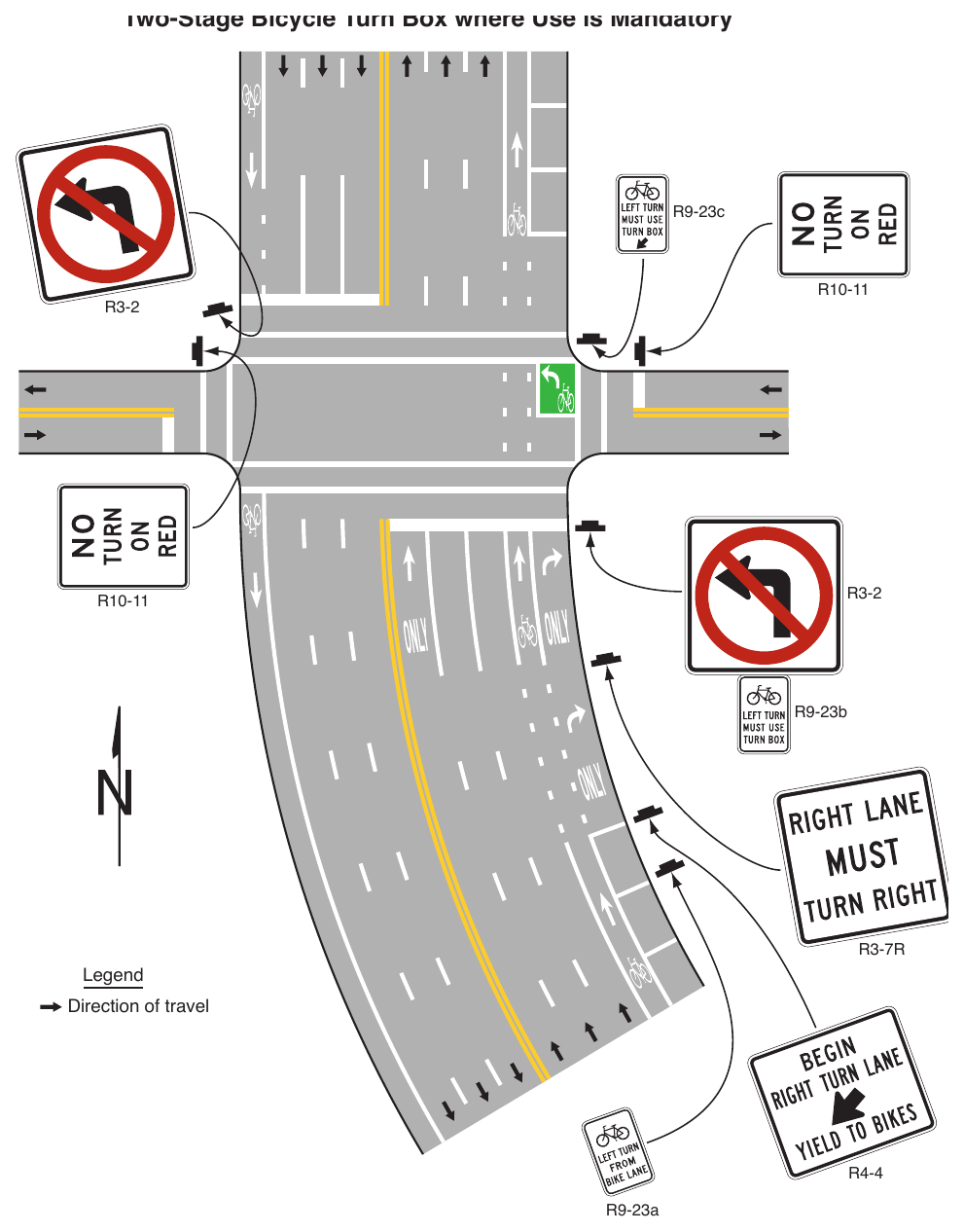
Signs shown: R9-23c, R10-11, R3-2, R9-23b, R3-7R, R4-4, R9-23a
§9B.19 Bicycle Jughandle Signs (R9-24, R9-25, R9-26, and R9-27 Series)¶
Support
01. Bicycle jughandle turns allow bicycles to use the traffic control provided for the crossroad for facilitating a left turn, right turn, or U-turn.
Option
02. The R9-23 sign (see Figure 9B-1) may be used in advance of where bicyclists are required to use the bicycle jughandle turn in order to facilitate all turns.
03. The R9-24 series sign (see Figure 9B-1) may be used where bicyclists are required to use the bicycle jughandle turn in order to facilitate all turns.
04. The R9-25 series sign (see Figure 9B-1) may be used where bicyclists are required to use a bicycle jughandle turn to facilitate U-turns and left turns and where right-turning bicyclists are exempted or the right turn is not available or possible (see Figure 9B-6).
05. The R9-26 series sign (see Figure 9B-1) may be used where bicyclists are required to use a jughandle to facilitate U-turns and where left-turning and right-turning bicyclists are exempted or the left turn or right turn is not available or possible.
06. The R9-27 series sign (see Figure 9B-1) may be used where bicyclists are required to use a jughandle to facilitate left turns and where U-turning and right-turning bicyclists are exempted or the U-turn or right turn is not available or possible.
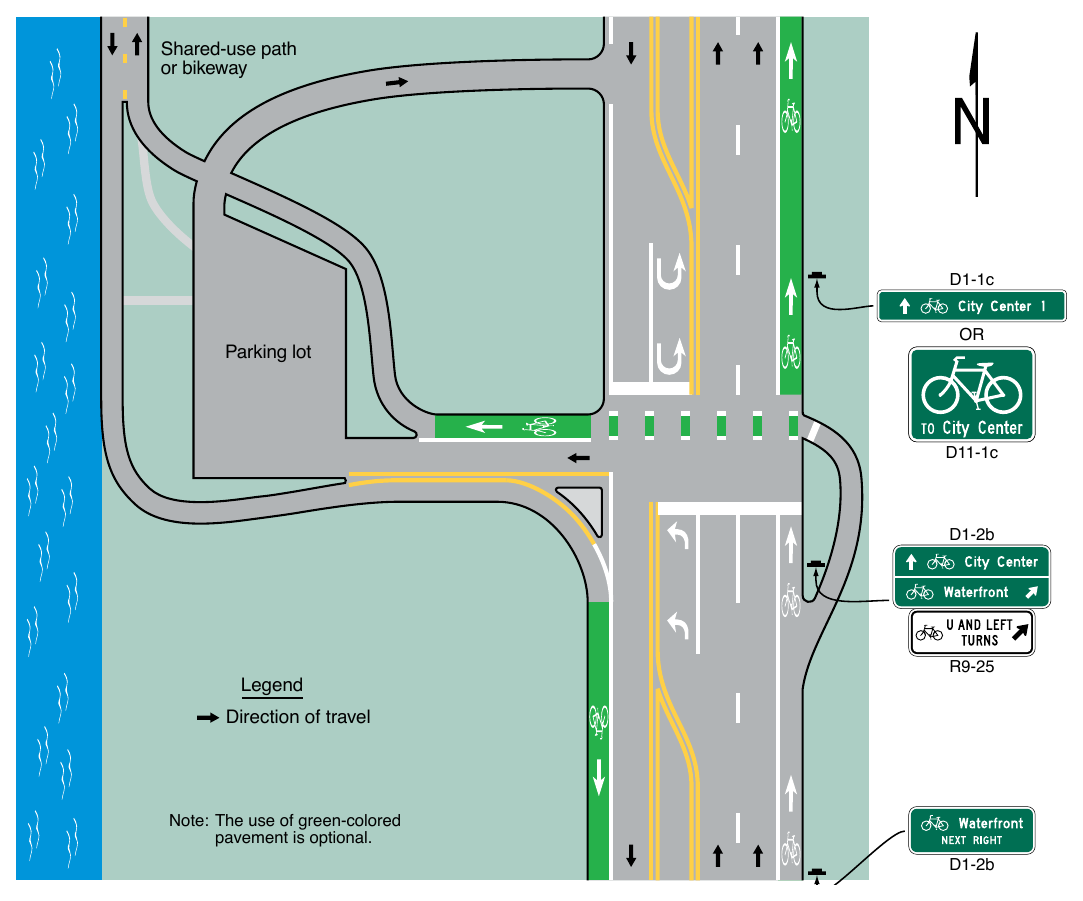
07. Note: The use of green-colored pavement is optional. D1-2b A Bicycle Jughandle sign may be used to indicate a jughandle turn initially made by a left turn for a bicycle lane on the left-hand side of a one-way street or for a counter-flow bicycle lane. The legend RIGHT may be substituted for the legend LEFT on Bicycle Jughandle signs to represent bicycle facilities on the left-hand side of the roadway where facilitating a right turn would be applicable.
Guidance
08. Applications of Bicycle Jughandle signs should be limited to brief independent alignments either through physical separation or islands formed by pavement markings. Bicycle Jughandle signs should not be used for a turning movement facilitated by a two-stage turn box (see Section 9B.18).
Support
09. Bicycle Jughandle signs are designed to be mounted below guide signs.
10. Section 9D.01 contains information regarding the use of Bicycle Destination signs that can be used for jughandles.
§9B.20 Bicycle Actuation Signs (R10-4, R10-22, R10-24, R10-25, and R10-26)¶
Option
01. Where bicycles are not controlled by pedestrian signal indications, the R10-4, R10-24, or R10-26 sign (see Section 2B.58) may be used.
Guidance
02. If used, the R10-4, R10-24, or R10-26 signs (see Figure 9B-1) should be installed in the vicinity of where bicycles will be crossing the street.
Option
03. If bicycles are crossing a roadway where In-Roadway Warning Lights (see Section 4U.02) or other warning lights or beacons have been provided, the R10-25 (see Figure 9B-1) sign may be used.
04. The Bicycle Detector (R10-22) sign (see Figure 9B-1) may be installed at signalized intersections where pavement markings are used to indicate the location where a bicycle is to be positioned to actuate the signal (see Section 9E.15).
Guidance
05. If the Bicycle Detector sign is installed, it should be placed at the roadside adjacent to the marking to emphasize the location of the marking.
§9B.21 Left Turn Yield to Bicycles Sign (R10-12b)¶
Option
01. The Left Turn Yield to Bicycles (R10-12b) sign (see Figure 9B-1) may be used to emphasize the requirement for motorists to yield to bicyclists in situations where the motorist is turning across a bicycle movement that may be unexpected in direction, location, or some other quality that would be inconsistent with the typical bicycle lane.
Support
02. Section 2B.59 contains provisions on the placement and use of regulatory Traffic Signal signs.
§9B.22 Bicycle Signal Signs (R10-40, R10-40a, R10-41, R10-41a, R10-41b, and R10-41c)¶
Support
01. The purposes of the Bicycle Signal signs (see Figure 9B-1) are to inform road users that the signal indications in the bicycle signal face are intended only for bicyclists, and to inform bicyclists which specific bicycle movements are controlled by the bicycle signal face.
02. Section 4H.03 contains information on signs that are used in conjunction with bicycle signal faces.
Standard
03. The Bicycle Signal – Mandatory Movement (R10-40 or R10-40a) sign or the Bicycle Signal – Optional Movement (R10-41. R10-41a, R10-41b, or R10-41c) sign shall require bicycles to turn, shall permit turns where such turns would otherwise not be allowed, shall require a bicycle to stay in the same lane and proceed straight through an intersection, or shall indicate allowed movements when a GREEN BICYCLE signal indication is displayed on a bicycle signal face.
§9B.23 LOOK Sign (R15-8)¶
Option
01. At railroad or LRT grade crossings with shared-use paths or separated bikeways, the LOOK (R15-8) sign (see Figure 9B-1) may be mounted on the Crossbuck support below the Crossbuck (R15-1) sign or any other signs, or on a separate post in the immediate vicinity of the grade crossing on the railroad or LRT right-of-way.
Guidance
02. A LOOK sign should not be mounted on a Crossbuck Assembly that has a YIELD or STOP sign mounted on the same support as the Crossbuck.
§9B.24 Other Regulatory Signs¶
Option
01. Other regulatory signs described in Chapters 2B and 8B may be installed on bicycle facilities as appropriate.