Chapter 6F. Temporary Traffic Control Zone Signs – General¶
§6F.01 General Characteristics of TTC Zone Signs¶
Support
01. TTC zone signs convey both general and specific messages by means of words, symbols, and/or arrows and have the same three categories as all road user signs: regulatory, warning, and guide.
Option
02. Where the color orange is required, the fluorescent orange color may also be used.
Support
03. The fluorescent version of orange provides higher conspicuity than standard orange, especially during twilight.
Option
04. Standard orange flags, flashing beacons, and/or flashing warning lights may be used in conjunction with signs.
Standard
05. When standard orange flags, flashing beacons, and/or flashing warning lights are used in conjunction with a sign, they shall not block the sign face.
06. Except as provided in Section 2A.07, the sizes for TTC signs and plaques shall be as shown in Tables 6G-1, 6H-1, and 6I-1. The sizes in the minimum column shall only be used on low-volume rural roads, local streets, or roadways where the operating speed is 30 mph or less.
Option
07. The dimensions of signs and plaques shown in Tables 6G-1, 6H-1, and 6I-1 may be increased wherever necessary for greater legibility or emphasis.
Guidance
08. Deviations from standard sizes as prescribed in this Manual should be in 6-inch increments.
Support
09. Sign design details are contained in the “Standard Highway Signs” publication (see Section 1A.05).
10. Section 2A.04 contains additional information regarding the design of signs, including an Option allowing the development of special word message signs if a standard word message or symbol sign is not available to convey the necessary regulatory, warning, or guidance information.
Standard
11. All signs used at night shall be either retroreflective or illuminated to show the same shape and similar color both day and night.
12. The requirement for sign illumination shall not be considered to be satisfied by street, highway, or strobe lighting.
Option
13. Sign illumination may be either internal or external.
14. Signs may be made of rigid or flexible material.
§6F.02 Sign Placement¶
Guidance
01. Signs should be located on the right-hand side of the roadway unless otherwise provided in this Manual.
Option
02. Where special emphasis is needed, signs may be placed on both the left-hand and right-hand sides of the roadway. Signs mounted on portable supports may be placed within the roadway itself. Signs may also be mounted on or above barricades.
Support
03. The provisions of this Section regarding mounting height apply unless otherwise provided for a particular sign elsewhere in this Manual.
Standard
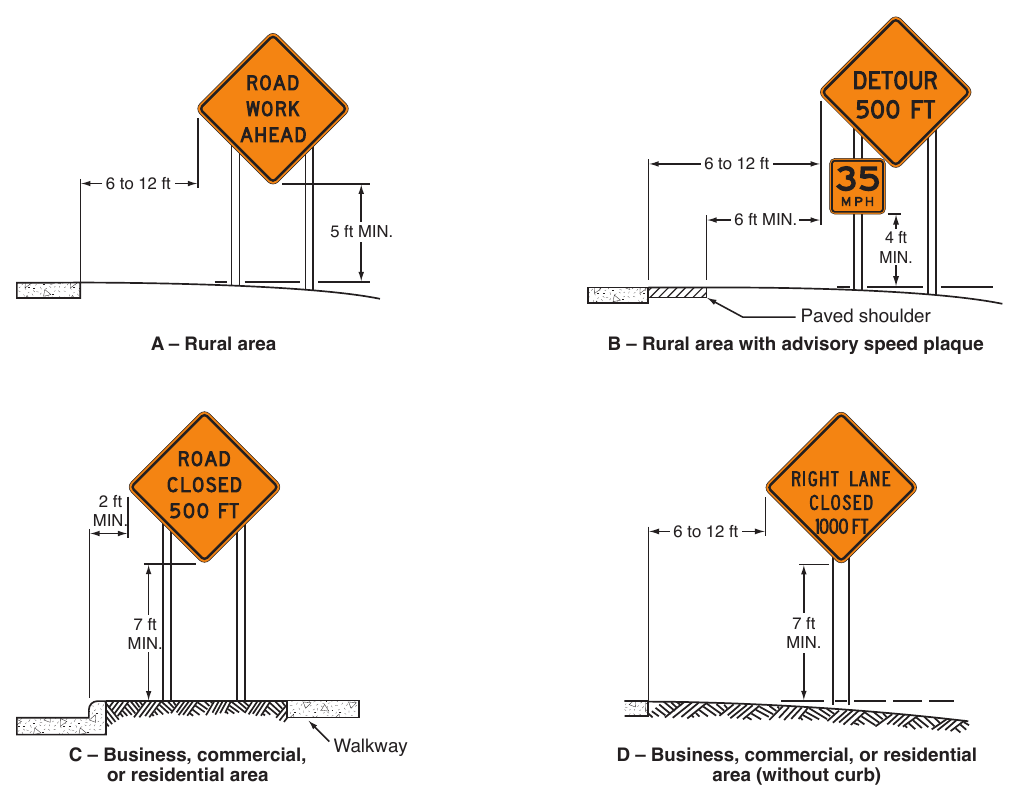
04. The minimum height, measured vertically from the bottom of the sign to the elevation of the near edge of the pavement, of signs installed at the side of the road in rural areas shall be 5 feet (see Figure 6F-1).
05. The minimum height, measured vertically from the bottom of the sign to the top of the curb, or in the absence of curb, measured vertically from the bottom of the sign to the elevation of the near edge of the traveled way, of signs installed at the side of the road in business, commercial, or residential areas where parking or pedestrian movements are likely to occur, or where the view of the sign might be obstructed, shall be 7 feet (see Figure 6F-1).
06. The minimum height, measured vertically from the bottom of the sign to the sidewalk, of signs installed above sidewalks shall be 7 feet.
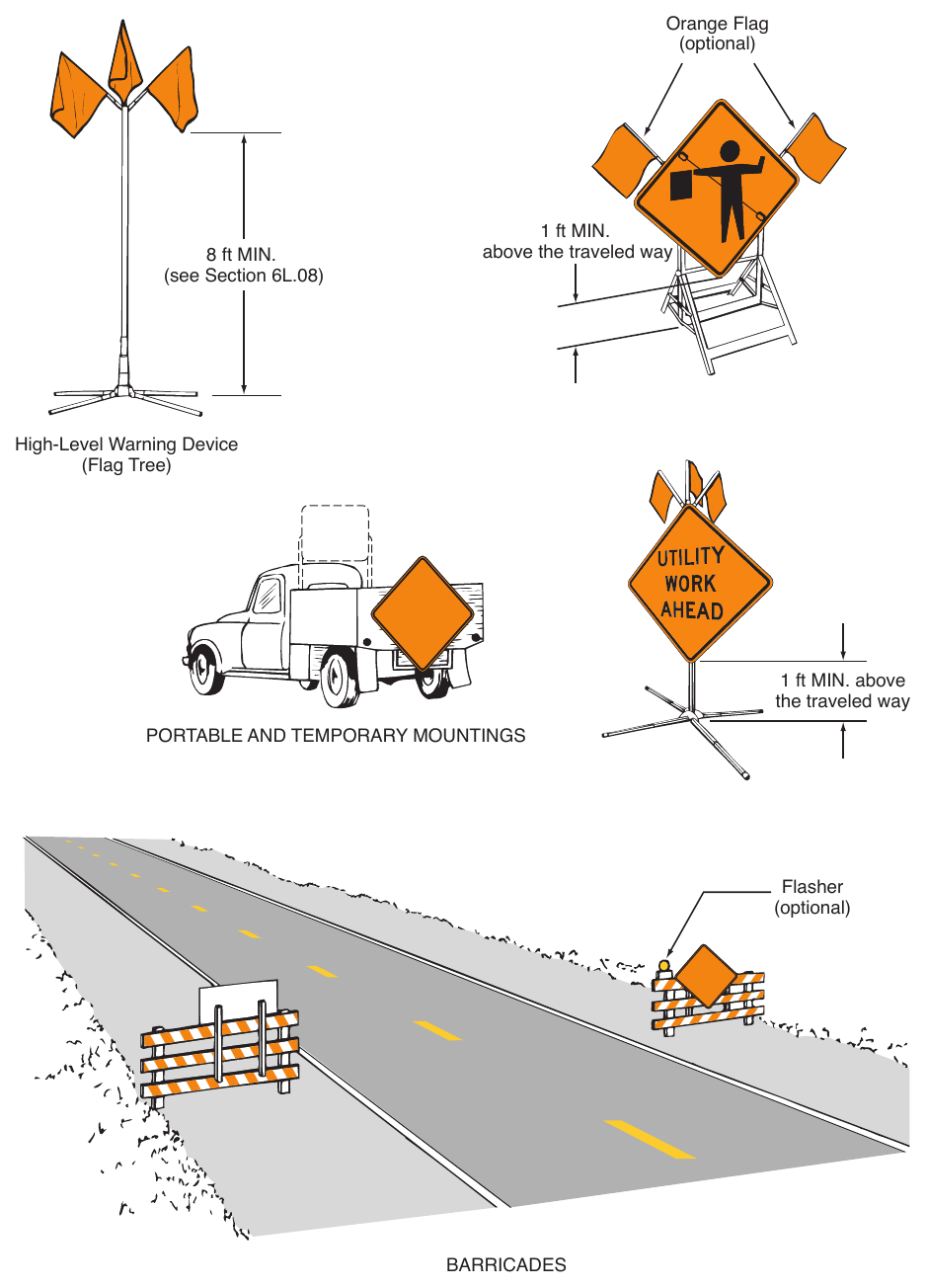
07. The bottom of a sign mounted on a barricade, or other portable support, shall be at least 1 foot above the traveled way.
Option
08. The height to the bottom of a secondary sign mounted below another sign may be 1 foot less than the height provided in Paragraphs 4 through 6 of this Section.
Guidance
09. Neither portable nor permanent sign supports should be located on sidewalks, bicycle facilities, or areas designated for pedestrians or bicyclists.
Standard
10. Signs shall be mounted and placed in accordance with Section 307 of the U.S. Department of Justice 2010 ADA Standards for Accessible Design, September 15, 2010, 28 CFR 35 and 36, Americans with Disabilities Act of 1990.
Guidance
11. Except as provided in Paragraph 12 of this Section, signs mounted on portable sign supports that do not meet the minimum mounting heights provided in Part 2 should not be used for a duration of more than 3 days.
Option
12. The R9-8 through R9-11a series, R11 series, W1-6 through W1-8 series, M4-10, E5-1, or other similar type signs (see Figures 6G-1, 6H-1, and 6I-1) may be used on portable sign supports that do not meet the minimum mounting heights provided in Part 2 for longer than 3 days.
Support
13. Methods of mounting signs other than on posts are illustrated in Figure 6F-2.
Guidance
14. Signs mounted on Type 3 Barricades should not cover more than 50 percent of the top two rails or 33 percent of the total area of the three rails.
Standard
15. Signs and sign supports used together shall be crashworthy (see Section 6A.04). Where large signs having an area exceeding 50 square feet are installed on multiple breakaway posts, the clearance from the ground to the bottom of the sign shall be at least 7 feet.
Option
16. For mobile operations, a sign may be mounted on a work vehicle, a shadow vehicle, or a trailer stationed in advance of the TTC zone or moving along with it.
§6F.03 Sign Maintenance¶
Guidance
01. Signs should be properly maintained for cleanliness, visibility, retroreflectivity, and correct positioning.
02. Signs that have lost significant legibility should be promptly replaced.
Support
03. Section 2A.21 contains information regarding the retroreflectivity of signs, including the signs that are used in TTC zones.