Chapter 6H. TTC Zone Warning Signs¶
§6H.01 Warning Sign Function, Design, and Application¶
Support
01. TTC zone warning signs (see Figure 6H-1) notify road users of specific situations or conditions on or adjacent to a roadway that might not otherwise be apparent.
Standard
02. TTC warning signs shall comply with the Standards for warning signs presented in Part 2 and in the FHWA’s “Standard Highway Signs” publication (see Section 1A.05).
03. The sizes for TTC warning signs shall be as shown in Table 6H-1.
04. Except as provided in Paragraphs 5-9 of this Section, TTC warning signs shall be diamond-shaped with a black legend and border on an orange background, except for the Grade Crossing Advance Warning (W10-1) sign, which shall have a black legend and border on a yellow background.
Option
05. Warning signs that are required or recommended in Parts 2 or 7 to have a fluorescent yellow-green background may have that color background in TTC zones.
06. Existing warning signs with a yellow background that are still applicable may remain in place.
07. Warning signs used for TTC incident management situations may have a black legend and border on a fluorescent pink background.
08. Mounting or space considerations may justify a change from the standard diamond shape to a rectangular shape.
09. In emergencies, available warning signs having yellow backgrounds may be used if signs with orange or fluorescent pink backgrounds are not at hand.
Guidance
10. Where roadway or road user conditions require greater emphasis, larger than standard size warning signs should be used, with the symbol or legend enlarged approximately in proportion to the outside dimensions.
11. Where any part of the roadway is obstructed or closed by work activities or incidents, advance warning signs should be installed to alert road users well in advance of these obstructions or restrictions.
12. Where road users include pedestrians, the provision of supplemental audible information or detectable barriers or barricades should be provided for people with vision disabilities.
Support
13. Detectable barriers or barricades communicate very clearly to pedestrians who have vision disabilities that they can no longer proceed in the direction that they are traveling.
Option
14. Advance warning signs may be used singly or in combination.
15. Where distances are not displayed on warning signs as part of the message, a supplemental plaque with the distance legend may be mounted immediately below the sign on the same support.
§6H.02 Position of Advance Warning Signs¶
Guidance
01. Where highway conditions permit, warning signs should be placed in advance of the transition and activity areas at varying distances depending on roadway type, condition, and posted speed. Table 6B-1 contains information regarding the spacing of advance warning signs. Where a series of two or more advance warning signs is used, the closest sign to the transition and activity areas should be placed approximately 100 feet for low-speed urban streets to 1,000 feet or more for freeways and expressways.
02. Where multiple advance warning signs are needed on the approach to a transition and activity area, the ROAD WORK AHEAD (W20-1) sign should be the first advance warning sign encountered by road users.
Support
03. Various conditions, such as limited sight distance or obstructions that might require a driver to reduce speed or stop, might require additional advance warning signs.
Option
04. As an alternative to a specific distance on advance warning signs, the word AHEAD may be used.
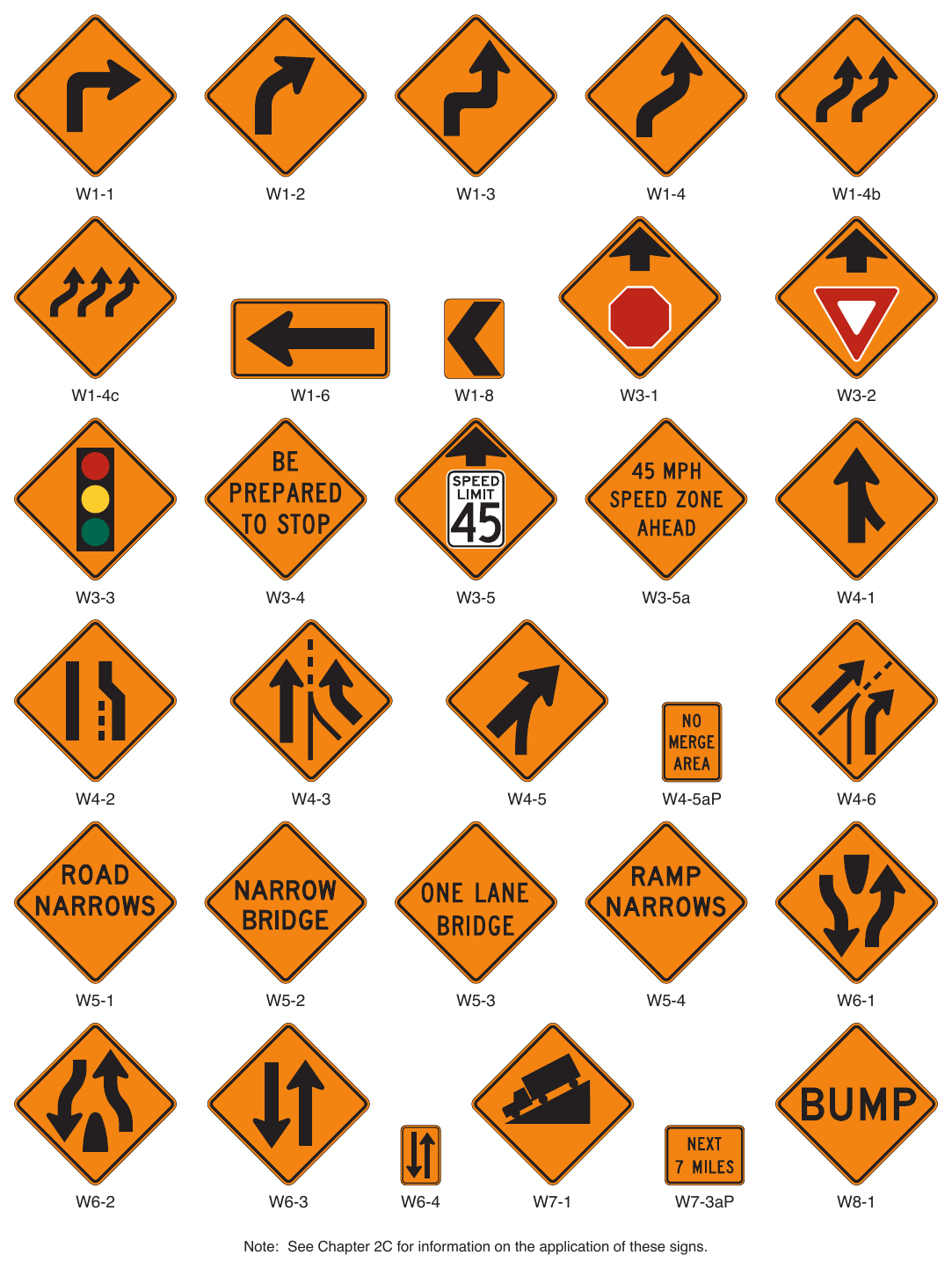
Signs shown: W1-1, W1-2, W1-3, W1-4, W1-4b, W1-4c, W1-6, W1-8, W3-1, W3-2, W3-3, W3-4, W3-5, W3-5a, W4-1, W4-2, W4-3, W4-5, W4-5aP, W4-6, W5-1, W5-2, W5-3, W5-4, W6-1, W6-2, W6-3, W6-4, W7-1, W7-3aP, W8-1
Note: See Chapter 2C for information on the application of these signs.
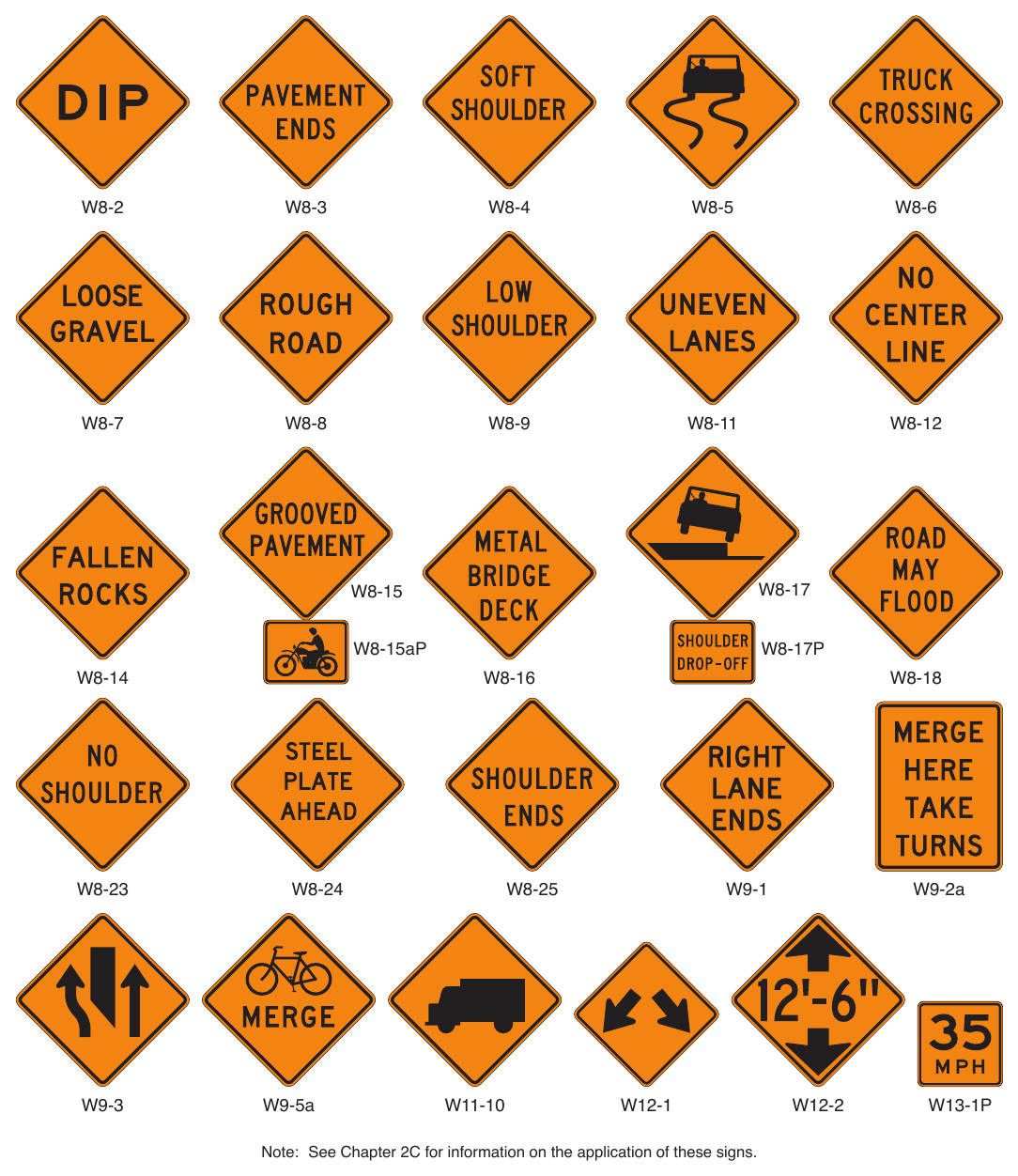
Signs shown: W8-2, W8-3, W8-4, W8-5, W8-6, W8-7, W8-8, W8-9, W8-11, W8-12, W8-15, W8-17, W8-15aP, W8-17P, W8-14, W8-16, W8-18, W8-23, W8-24, W8-25, W9-1, W9-2a, W9-3, W9-5a, W11-10, W12-1, W12-2, W13-1P
Note: See Chapter 2C for information on the application of these signs.
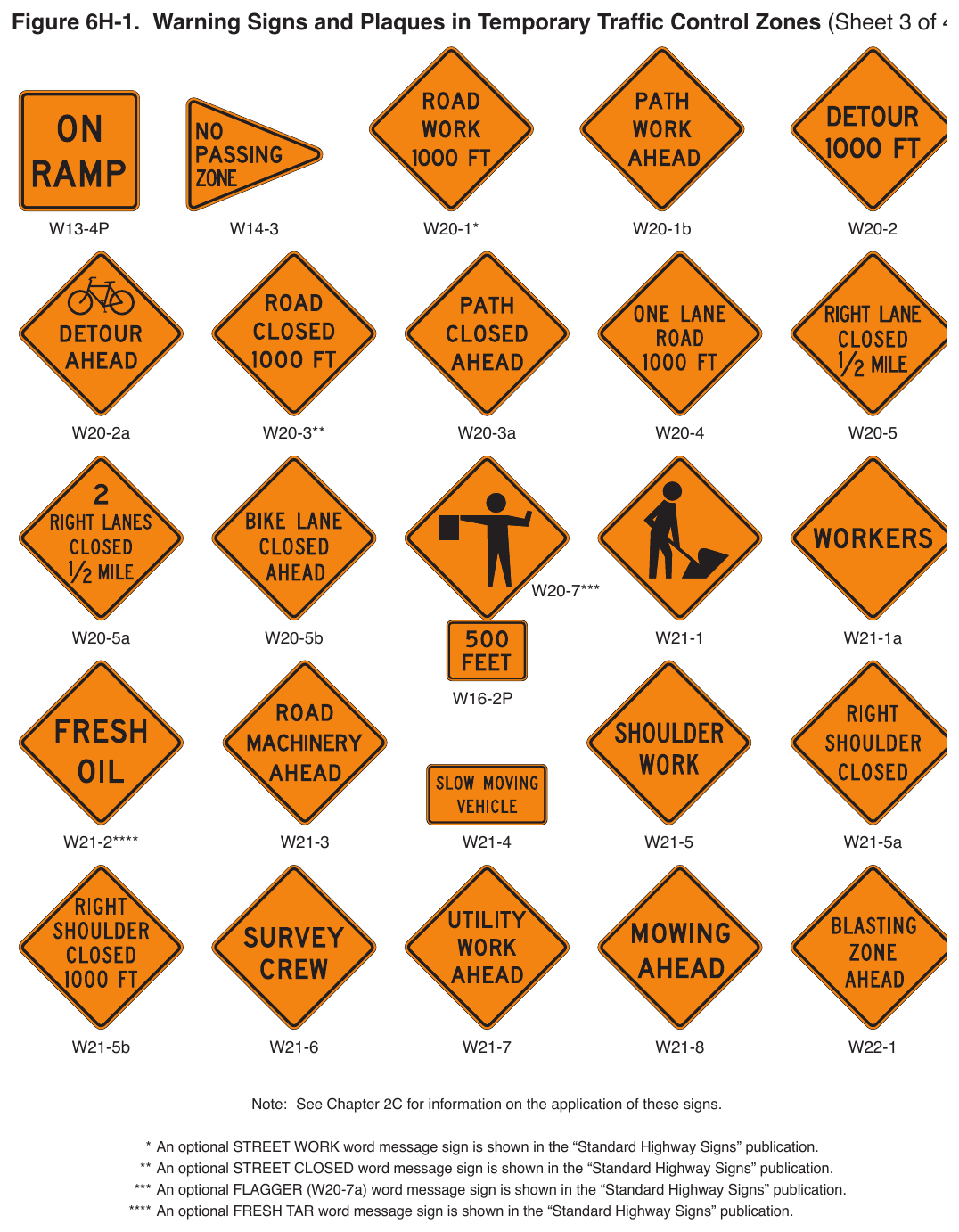
Signs shown: W13-4P, W14-3, W20-1, W20-1b, W20-2, W20-2a, W20-3, W20-3a, W20-4, W20-5, W20-7, W20-5a, W20-5b, W21-1, W21-1a, W16-2P, W21-2, W21-3, W21-4, W21-5, W21-5a, W21-5b, W21-6, W21-7, W21-8, W22-1, W20-7a
Note: See Chapter 2C for information on the application of these signs.
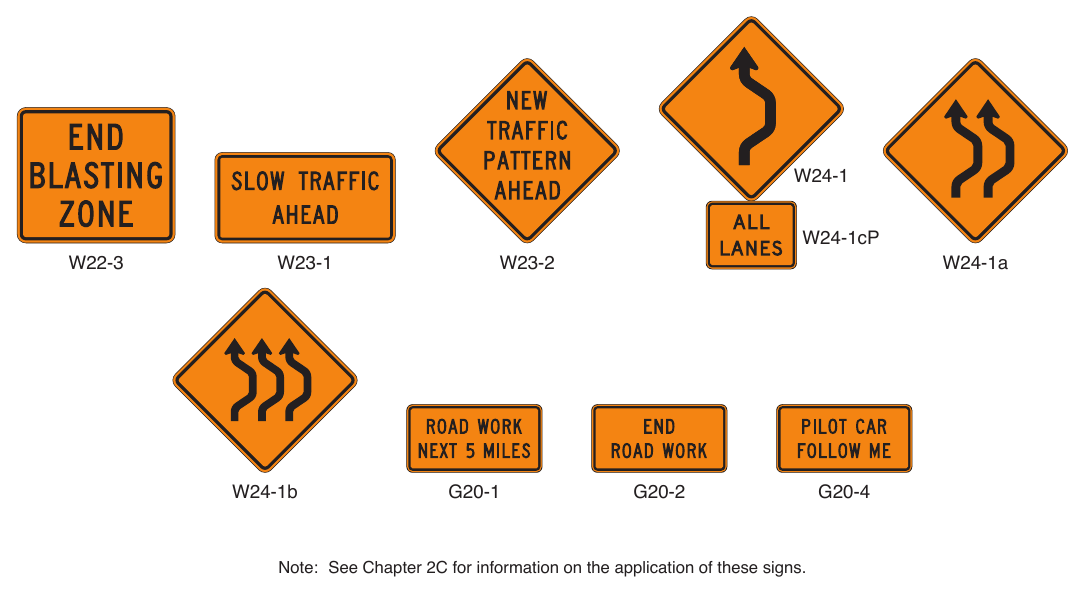
Signs shown: W24-1, W24-1cP, W22-3, W23-1, W23-2, W24-1a, W24-1b, G20-1, G20-2, G20-4
Note: See Chapter 2C for information on the application of these signs.
Support
At TTC zones on lightly-traveled roads, all of the advance warning signs prescribed for major construction might not be needed.
Option
06. Utility work, maintenance, or minor construction can occur within the TTC zone limits of a major construction project, and additional warning signs may be needed.
Guidance
07. Utility, maintenance, and minor construction signing and TTC should be coordinated with appropriate authorities so that road users are not confused or misled by the additional TTC devices.
§6H.03 ROAD (STREET) WORK Sign (W20-1)¶
Guidance
01. The ROAD (STREET) WORK (W20-1) sign (see Figure 6H-1), which serves as a general warning of obstructions or restrictions, should be located in advance of the work space or any detour, on the road where the work is taking place.
02. Where traffic can enter a TTC zone from a crossroad or a major (high-volume) driveway, an advance warning sign should be used on the crossroad or major driveway.
Option
03. The legend STREET may be substituted for ROAD and the distance legend may be either XX FEET, XX MILES, or AHEAD.
§6H.04 DETOUR Sign (W20-2)¶
Guidance
01. The DETOUR (W20-2) sign (see Figure 6H-1) should be used in advance of a road user detour over a different roadway or route.
Option
02. The distance legend may be either XX FEET, XX MILES, or AHEAD.
Table 6H-1. Temporary Traffic Control Zone Warning Sign and Plaque Sizes (Sheet 1 of 2)
| Sign or Plaque | Sign Designation | Section | Conventional Road | Freeway or Expressway | Minimum |
|---|---|---|---|---|---|
| Turn and Curve Signs | W1-1,2,3,4 | 6H.01 | 36 x 36 | 48 x 48 | 30 x 30 |
| Reverse Curve (2 or more lanes) | W1-4b,4c | 6H.30 | 36 x 36 | 48 x 48 | 30 x 30 |
| Large Arrow (1-direction) | W1-6 | 6H.01 | 48 x 24 | 60 x 30 | — |
| Chevron Alignment | W1-8 | 6H.01 | 18 x 24 | 30 x 36 | — |
| Stop Ahead | W3-1 | 6H.01 | 36 x 36 | 48 x 48 | 30 x 30 |
| Yield Ahead | W3-2 | 6H.01 | 36 x 36 | 48 x 48 | 30 x 30 |
| Signal Ahead | W3-3 | 6H.01 | 36 x 36 | 48 x 48 | 30 x 30 |
| Be Prepared to Stop | W3-4 | 6H.01 | 36 x 36 | 48 x 48 | 30 x 30 |
| Reduced Speed Limit Ahead | W3-5 | 6H.01 | 36 x 36 | 48 x 48 | 30 x 30 |
| XX MPH Speed Zone Ahead | W3-5a | 6H.01 | 36 x 36 | 48 x 48 | 30 x 30 |
| Merging Traffic | W4-1,5 | 6H.01 | 36 x 36 | 48 x 48 | 36 x 36 |
| Lane Ends | W4-2 | 6H.08 | 36 x 36 | 48 x 48 | 30 x 30 |
| Added Lane | W4-3,6 | 6H.01 | 36 x 36 | 48 x 48 | 30 x 30 |
| No Merge Area (plaque) | W4-5aP | 6H.01 | 18 x 24 | 24 x 30 | — |
| Road Narrows | W5-1 | 6H.01 | 36 x 36 | 48 x 48 | 30 x 30 |
| Narrow Bridge | W5-2 | 6H.01 | 36 x 36 | 48 x 48 | 30 x 30 |
| One Lane Bridge | W5-3 | 6H.01 | 36 x 36 | 48 x 48 | 30 x 30 |
| Ramp Narrows | W5-4 | 6H.10 | 36 x 36 | 48 x 48 | 30 x 30 |
| Divided Highway | W6-1 | 6H.01 | 36 x 36 | 48 x 48 | 30 x 30 |
| Divided Highway Ends | W6-2 | 6H.01 | 36 x 36 | 48 x 48 | 30 x 30 |
| Two-Way Traffic | W6-3 | 6H.16 | 36 x 36 | 48 x 48 | 30 x 30 |
| Narrow Two-Way Traffic | W6-4 | 6H.17 | 12 x 18 | 12 x 18 | — |
| Hill | W7-1 | 6H.01 | 36 x 36 | 48 x 48 | 30 x 30 |
| Next XX Miles (plaque) | W7-3aP | 6H.33 | 24 x 18 | 36 x 30 | — |
| Bump | W8-1 | 6H.01 | 36 x 36 | 48 x 48 | 24 x 24 |
| Dip | W8-2 | 6H.01 | 36 x 36 | 48 x 48 | 24 x 24 |
| Pavement Ends | W8-3 | 6H.01 | 36 x 36 | 48 x 48 | 30 x 30 |
| Soft Shoulder | W8-4 | 6H.26 | 36 x 36 | 48 x 48 | 30 x 30 |
| Slippery When Wet | W8-5 | 6H.01 | 36 x 36 | 48 x 48 | 30 x 30 |
| Truck Crossing | W8-6 | 6H.21 | 36 x 36 | 48 x 48 | 30 x 30 |
| Loose Gravel | W8-7 | 6H.01 | 36 x 36 | 48 x 48 | 30 x 30 |
| Rough Road | W8-8 | 6H.01 | 36 x 36 | 48 x 48 | 24 x 24 |
| Low Shoulder | W8-9 | 6H.26 | 36 x 36 | 48 x 48 | 24 x 24 |
| Uneven Lanes | W8-11 | 6H.27 | 36 x 36 | 48 x 48 | 30 x 30 |
| No Center Line | W8-12 | 6H.29 | 36 x 36 | 48 x 48 | 30 x 30 |
| Fallen Rocks | W8-14 | 6H.01 | 36 x 36 | 48 x 48 | 30 x 30 |
| Grooved Pavement | W8-15 | 6H.01 | 36 x 36 | 48 x 48 | 30 x 30 |
| Motorcycle (plaque) | W8-15aP | 6H.34 | 24 x 18 | 30 x 24 | — |
| Metal Bridge Deck | W8-16 | 6H.34 | 36 x 36 | 48 x 48 | 30 x 30 |
| Shoulder Drop-Off (symbol) | W8-17 | 6H.26 | 36 x 36 | 48 x 48 | 30 x 30 |
| Shoulder Drop-Off (plaque) | W8-17P | 6H.26 | 24 x 18 | 30 x 24 | — |
| Road May Flood | W8-18 | 6H.01 | 36 x 36 | 48 x 48 | 24 x 24 |
| No Shoulder | W8-23 | 6H.01 | 36 x 36 | 48 x 48 | 30 x 30 |
| Steel Plate Ahead | W8-24 | 6H.28 | 36 x 36 | 48 x 48 | 30 x 30 |
| Shoulder Ends | W8-25 | 6H.01 | 36 x 36 | 48 x 48 | 30 x 30 |
| Lane Ends | W9-1,2 | 6H.01 | 36 x 36 | 48 x 48 | 30 x 30 |
| Merge Here Take Turns | W9-2a | 6N.19 | 36 x 48 | 36 x 48 | — |
| Interior Lane Shift Ahead | W9-3 | 6H.07 | 36 x 36 | 48 x 48 | 30 x 30 |
Table 6H-1. Temporary Traffic Control Zone Warning Sign and Plaque Sizes (Sheet 2 of 2)
| Sign or Plaque | Sign Designation | Section | Conventional Road | Freeway or Expressway | Minimum |
|---|---|---|---|---|---|
| Bicycles Merging | W9-5a | 6P.01 | 30 x 30 | — | 18 x 18 |
| Grade Crossing Advance Warning | W10-1 | 6H.01 | 36 dia. | 48 Dia. | — |
| Truck | W11-10 | 6H.21 | 36 x 36 | 48 x 48 | 24 x 24 |
| Double Arrow | W12-1 | 6H.01 | 30 x 30 | 36 x 36 | — |
| Low Clearance | W12-2 | 6H.01 | 36 x 36 | 48 x 48 | 30 x 30 |
| Advisory Speed (plaque) | W13-1P | 6H.32 | 18 x 18 | 24 x 24 | 18 x 18 |
| On Ramp (plaque) | W13-4P | 6H.09 | 36 x 36 | 36 x 36 | — |
| No Passing Zone (pennant) | W14-3 | 6H.01 | 48 x 48 x 36 | 64 x 64 x 48 | 40 x 40 x 30 |
| XX Feet (2-line plaque) | W16-2P | 6H.01 | 24 x 18 | 30 x 24 | — |
| Road Work (with distance) | W20-1 | 6H.03 | 36 x 36 | 48 x 48 | 30 x 30 |
| Path Work (with distance) | W20-1b | 6P.01 | 36 x 36 | — | 30 x 30 |
| Detour (with distance) | W20-2 | 6H.04 | 36 x 36 | 48 x 48 | 30 x 30 |
| Bike Detour (with distance) | W20-2a | 6P.01 | 36 x 36 | — | 30 x 30 |
| Road Closed (with distance) | W20-3 | 6H.05 | 36 x 36 | 48 x 48 | 30 x 30 |
| Path Closed (with distance) | W20-3a | 6P.01 | 36 x 36 | — | 30 x 30 |
| One Lane Road (with distance) | W20-4 | 6H.06 | 36 x 36 | 48 x 48 | 30 x 30 |
| Lane(s) Closed (with distance) | W20-5,5a | 6H.07 | 36 x 36 | 48 x 48 | 30 x 30 |
| Bike Lane Closed (with distance) | W20-5b | 6P.01 | 36 x 36 | — | 30 x 30 |
| Flagger (symbol) | W20-7 | 6H.15 | 36 x 36 | 48 x 48 | 30 x 30 |
| Flagger | W20-7a | 6H.15 | 36 x 36 | 48 x 48 | 30 x 30 |
| Slow (on Stop/Slow Paddle) | W20-8 | 6D.02 | 18 x 18 | — | — |
| Workers | W21-1,1a | 6H.18 | 36 x 36 | 48 x 48 | 30 x 30 |
| Fresh Oil | W21-2 | 6H.19 | 36 x 36 | 48 x 48 | 30 x 30 |
| Road Machinery Ahead | W21-3 | 6H.20 | 36 x 36 | 48 x 48 | 30 x 30 |
| Slow Moving Vehicle | W21-4 | 6N.05 | 36 x 18 | — | — |
| Shoulder Work | W21-5 | 6H.22 | 36 x 36 | 48 x 48 | 30 x 30 |
| Shoulder Closed | W21-5a | 6H.22 | 36 x 36 | 48 x 48 | 30 x 30 |
| Shoulder Closed (with distance) | W21-5b | 6H.22 | 36 x 36 | 48 x 48 | 30 x 30 |
| Survey Crew | W21-6 | 6H.23 | 36 x 36 | 48 x 48 | 30 x 30 |
| Utility Work (with distance) | W21-7 | 6H.24 | 36 x 36 | 48 x 48 | 30 x 30 |
| Mowing Ahead | W21-8 | 6N.05 | 36 x 36 | 48 x 48 | 30 x 30 |
| Blasting Zone Ahead | W22-1 | 6H.25 | 36 x 36 | 48 x 48 | 30 x 30 |
| End Blasting Zone | W22-3 | 6H.25 | 42 x 36 | 42 x 36 | 36 x 30 |
| Slow Traffic Ahead | W23-1 | 6H.11 | 48 x 24 | 48 x 24 | — |
| New Traffic Pattern Ahead | W23-2 | 6H.14 | 36 x 36 | 48 x 48 | 30 x 30 |
| Double Reverse Curve (1 lane) | W24-1 | 6H.31 | 36 x 36 | 48 x 48 | 30 x 30 |
| Double Reverse Curve (2 lanes) | W24-1a | 6H.31 | 36 x 36 | 48 x 48 | 30 x 30 |
| Double Reverse Curve (3 lanes) | W24-1b | 6H.31 | 36 x 36 | 48 x 48 | 30 x 30 |
| All Lanes (plaque) | W24-1cP | 6H.31 | 24 x 18 | 30 x 24 | — |
| Road Work Next XX Miles | G20-1 | 6H.35 | 36 x 18 | 48 x 24 | — |
| End Road Work | G20-2 | 6H.36 | 36 x 18 | 48 x 24 | — |
| Pilot Car Follow Me | G20-4 | 6H.37 | 36 x 18 | — | — |
* See Table 2C-1 for minimum size required for signs facing traffic on multi-lane conventional roads Notes: 1. Larger signs may be used wherever necessary for greater legibility or emphasis 2. Dimensions are shown in inches and are shown as width x height
Notes:
- 1. Larger signs may be used wherever necessary for greater legibility or emphasis
- 2. Dimensions are shown in inches and are shown as width x height
§6H.05 ROAD (STREET) CLOSED Sign (W20-3)¶
Guidance
01. The ROAD (STREET) CLOSED (W20-3) sign (see Figure 6H-1) should be used in advance of the point where a highway is closed to all road users, or to all but local road users.
Option
02. The legend STREET may be substituted for ROAD and the distance legend may be either XX FEET, XX MILES, or AHEAD.
§6H.06 ONE LANE ROAD Sign (W20-4)¶
Standard
01. The ONE LANE ROAD (W20-4) sign (see Figure 6H-1) shall be used only in advance of that point where motor vehicle traffic in both directions must use a common single lane (see Section 6E.01).
Option
02. The distance legend may be either XX FEET, XX MILES, or AHEAD.
§6H.07 Lane(s) Closed Signs (W20-5, W20-5a, and W9-3)¶
Standard
01. The Lane(s) Closed sign (see Figure 6H-1) shall be used in advance of that point where one or more through lanes of a multi-lane roadway are closed.
02. For a single lane closure, the Lane Closed (W20-5) sign (see Figure 6H-1) shall use the legend RIGHT (LEFT) LANE CLOSED. Where two or more adjacent lanes are closed, the W20-5a sign (see Figure 6H-1) shall use the legend XX RIGHT (LEFT) LANES CLOSED.
Option
03. The distance legend may be either XX FEET, XX MILES, or AHEAD.
Guidance
04. The Interior Lane Shift (W9-3) sign (see Figure 6H-1) should be used in advance of that point where work occupies an interior lane(s) and approaching motor vehicle traffic is directed to the right or left of the work zone in the lane(s) by using a shifting taper to route traffic around the closed interior lane(s).
§6H.08 Lane Ends Signs (W4-2 and W9-2a)¶
Option
01. The Lane Ends (W4-2) sign (see Figure 6H-1) may be used to warn drivers of the reduction in the number of lanes for moving motor vehicle traffic in the direction of travel on a multi-lane roadway.
Guidance
02. The MERGE HERE TAKE TURNS (W9-2a) sign (see Figure 6H-1) should be used to identify the merge point at which vehicles from alternate lanes take turns merging during Late Merge applications (see Section 6N.19).
§6H.09 ON RAMP Plaque (W13-4P)¶
Guidance
When work is being done on a ramp, but the ramp remains open, the ON RAMP (W13-4P) plaque (see Figure 6H-1) should be used to supplement the advance ROAD WORK sign.
§6H.10 RAMP NARROWS Sign (W5-4)¶
Guidance
01. The RAMP NARROWS (W5-4) sign (see Figure 6H-1) should be used in advance of the point where work on a ramp reduces the normal width of the ramp along a part or all of the ramp.
§6H.11 SLOW TRAFFIC AHEAD Sign (W23-1)¶
Option
01. The SLOW TRAFFIC AHEAD (W23-1) sign (see Figure 6H-1) may be used on a shadow vehicle, usually mounted on the rear of the most upstream shadow vehicle, along with other appropriate signs for mobile operations to warn of slow moving work vehicles. A ROAD WORK (W20-1) sign may also be used with the SLOW TRAFFIC AHEAD sign.
§6H.12 EXIT OPEN and EXIT CLOSED Signs (E5-2 and E5-2a)¶
Option
An EXIT OPEN (E5-2) or EXIT CLOSED (E5-2a) sign (see Figure 6I-1) may be used to supplement other warning signs where work is being conducted in the vicinity of an exit ramp and where the exit maneuver for vehicular traffic using the ramp is different from the normal condition.
§6H.13 EXIT ONLY Sign (E5-3)¶
Option
An EXIT ONLY (E5-3) sign (see Figure 6I-1) may be used to supplement other warning signs where work is being conducted in the vicinity of an exit ramp and where the exit maneuver for vehicular traffic using the ramp is different from the normal condition.
§6H.14 NEW TRAFFIC PATTERN AHEAD Sign (W23-2)¶
Option
01. A NEW TRAFFIC PATTERN AHEAD (W23-2) sign (see Figure 6H-1) may be used on the approach to an intersection or along a section of roadway to provide advance warning of a change in traffic patterns, such as revised lane usage, roadway geometry, or signal phasing.
Guidance
02. To retain its effectiveness, the W23-2 sign should be displayed for up to 2 weeks, and then it should be covered or removed until it is needed again.
§6H.15 Flagger Signs (W20-7 and W20-7a)¶
Guidance
01. The Flagger (W20-7) sign (see Figure 6H-1) should be used in advance of any point where a flagger is stationed to control road users.
Option
02. A distance legend may be displayed on a supplemental plaque below the Flagger sign. The sign may be used with appropriate legends or in conjunction with other warning signs, such as the BE PREPARED TO STOP (W3-4) sign (see Figure 6H-1).
03. The FLAGGER (W20-7a) word message sign with a distance legend may be substituted for the Flagger (W20-7) sign.
§6H.16 Two-Way Traffic Sign (W6-3)¶
Guidance
01. When one roadway of a normally-divided highway is closed, with two-way vehicular traffic maintained on the other roadway, the Two-Way Traffic (W6-3) sign (see Figure 6H-1) should be used at the beginning of the two-way vehicular traffic section and at intervals to remind road users of opposing vehicular traffic.
§6H.17 Narrow Two-Way Traffic Sign (W6-4)¶
Standard
01. The Narrow Two-Way Traffic (W6-4) sign (see Figure 6H-1) shall be an upright, retroreflective orangecolored sign placed on a flexible support and sized at least 12 inches wide by 18 inches high.
Support
02. The Narrow Two-Way Traffic (W6-4) sign is intended for mounting only on a flexible support in a series along the center line to separate opposing vehicular traffic on a two-lane, two-way operation.
Standard
03. Narrow Two-Way Traffic signs shall not be placed within pedestrian crossings.
§6H.18 Workers Signs (W21-1 and W21-1a)¶
Option
01. A Workers (W21-1) sign (see Figure 6H-1) may be used to alert road users of workers in or near the roadway.
Guidance
02. In the absence of other warning devices, a Workers sign should be used when workers are in the roadway.
Option
03. The WORKERS (W21-1a) word message sign may be used as an alternate to the Workers (W21-1) symbol sign.
§6H.19 FRESH OIL (TAR) Sign (W21-2)¶
Guidance
01. The FRESH OIL (TAR) (W21-2) sign (see Figure 6H-1) should be used to warn road users of the surface treatment.
§6H.20 ROAD MACHINERY AHEAD Sign (W21-3)¶
Option
The ROAD MACHINERY AHEAD (W21-3) sign (see Figure 6H-1) may be used to warn of machinery operating in or adjacent to the roadway.
§6H.21 Motorized Traffic Signs (W8-6 and W11-10)¶
Option
01. Motorized Traffic (W8-6 and W11-10) signs may be used to alert road users to locations where unexpected travel on the roadway or entries into or departures from the roadway by construction vehicles might occur. The TRUCK CROSSING (W8-6) word message sign may be used as an alternate to the Truck (W11-10) symbol sign (see Figure 6H-1) where there is an established construction vehicle crossing of the roadway.
Support
02. These locations might be relatively confined or might occur randomly over a segment of roadway.
§6H.22 Shoulder Work Signs (W21-5, W21-5a, and W21-5b)¶
Support
01. Shoulder Work signs (see Figure 6H-1) warn of maintenance, reconstruction, or utility operations on the highway shoulder where the roadway is unobstructed.
Standard
02. The Shoulder Work sign shall have the legend SHOULDER WORK (W21-5), RIGHT (LEFT) SHOULDER CLOSED (W21-5a), or RIGHT (LEFT) SHOULDER CLOSED XX FT or AHEAD (W21-5b).
Option
03. The Shoulder Work sign may be used in advance of the point on a non-limited access highway where there is shoulder work. It may be used singly or in combination with a ROAD WORK NEXT XX MILES or ROAD WORK AHEAD sign.
Guidance
04. On freeways and expressways, the RIGHT (LEFT) SHOULDER CLOSED XX FT or AHEAD (W21-5b) sign followed by RIGHT (LEFT) SHOULDER CLOSED (W21-5a) sign should be used in advance of the point where the shoulder work occurs and should be preceded by a ROAD WORK AHEAD sign.
§6H.23 SURVEY CREW Sign (W21-6)¶
Guidance
The SURVEY CREW (W21-6) sign (see Figure 6H-1) should be used to warn of surveying crews working in or adjacent to the roadway.
§6H.24 UTILITY WORK Sign (W21-7)¶
Option
01. The UTILITY WORK (W21-7) sign (see Figure 6H-1) may be used as an alternate to the ROAD (STREET) WORK (W20-1) sign for utility operations on or adjacent to a highway.
Support
02. Typical examples of where the UTILITY WORK sign is used appear in Figures 6P-4, 6P-6, 6P-10, 6P-15, 6P-18, 6P-21, 6P-22, 6P-26, and 6P-33.
Option
03. The distance legend may be either XX FEET, XX MILES, or AHEAD.
§6H.25 Signs for Blasting Areas¶
Support
01. Radio-Frequency (RF) energy can cause the premature firing of electric detonators (blasting caps) used in TTC zones.
Standard
02. Road users shall be warned where blasting operations occur. A sequence of signs shall be prominently displayed to warn all road users of blasting operations and to direct operators of mobile radio equipment, including cellular telephones, to turn off transmitters in a blasting area. These signs shall be covered or removed when there are no explosives in the area or the area is otherwise secured.
03. The BLASTING ZONE AHEAD (W22-1) sign (see Figure 6H-1) shall be used in advance of any TTC zone where explosives are being used. The TURN OFF 2-WAY RADIO AND CELL PHONE (R22-2) and END BLASTING ZONE (W22-3) signs shall be used in sequence with this sign.
04. The TURN OFF 2-WAY RADIO AND CELL PHONE (R22-2) sign (see Section 6G.11 and Figure 6G-1) shall follow the BLASTING ZONE AHEAD (W22-1) sign and shall be placed at least 1,000 feet before the beginning of the blasting zone.
05. The END BLASTING ZONE (W22-3) sign (see Figure 6H-1) shall be placed a minimum of 1,000 feet past the blasting zone.
Option
06. The END BLASTING ZONE sign may be placed either with or preceding the END ROAD WORK sign.
§6H.26 Shoulder Signs and Plaque (W8-4, W8-9, W8-17, and W8-17P)¶
Option
01. The SOFT SHOULDER (W8-4) sign (see Figure 6H-1) may be used to warn of a soft shoulder condition.
02. The LOW SHOULDER (W8-9) sign (see Figure 6H-1) may be used to warn of a shoulder condition where there is an elevation difference of 3 inches or less between the shoulder and the travel lane.
Guidance
03. The Shoulder Drop-Off (W8-17) sign (see Figure 6H-1) should be used when an unprotected shoulder drop-off, adjacent to the travel lane, exceeds 3 inches in depth for a continuous length along the roadway, based on engineering judgment.
Option
04. A SHOULDER DROP-OFF (W8-17P) supplemental plaque (see Figure 6H-1) may be mounted below the W8-17 sign.
§6H.27 UNEVEN LANES Sign (W8-11)¶
Guidance
01. The UNEVEN LANES (W8-11) sign (see Figure 6H-1) should be used during operations that create a difference in elevation between adjacent lanes that are open to travel.
§6H.28 STEEL PLATE AHEAD Sign (W8-24)¶
Option
A STEEL PLATE AHEAD (W8-24) sign (see Figure 6H-1) may be used to warn road users that the presence of a temporary steel plate(s) might make the road surface uneven and might create slippery conditions during wet weather.
§6H.29 NO CENTER LINE Sign (W8-12)¶
Guidance
01. The NO CENTER LINE (W8-12) sign (see Figure 6H-1) should be used when the work obliterates the center line pavement markings. This sign should be placed at the beginning of the TTC zone and repeated at 2-mile intervals in long TTC zones.
Support
02. Section 6J.02 contains information regarding temporary markings.
§6H.30 Reverse Curve Signs (W1-4 Series)¶
Guidance
01. In order to give road users advance notice of a lane shift, a Reverse Curve (W1-4, W1-4b, or W1-4c) sign (see Figure 6H-1) should be used when a lane (or lanes) is being shifted to the left or right. If the design speed of the curves is 30 mph or less, a Reverse Turn (W1-3) sign should be used.
Standard
02. If a Reverse Curve (or Turn) sign is used, the direction of the reverse curve (or turn) shall be appropriately illustrated. Except as provided in Paragraph 3 of this Section, the number of lanes illustrated on the sign shall be the same as the number of through lanes available to road users.
Option
03. Where two or more lanes are being shifted, a W1-4 (or W1-3) sign with an ALL LANES (W24-1cP) plaque (see Figure 6H-1) may be used instead of a sign that illustrates the number of lanes.
04. Where more than three lanes are being shifted, the Reverse Curve (or Turn) sign may be rectangular.
§6H.31 Double Reverse Curve Signs (W24-1 Series)¶
Option
01. The Double Reverse Curve (W24-1, W24-1a, or W24-1b) sign (see Figure 6H-1) may be used where the tangent distance between two reverse curves is less than 600 feet, thus making it difficult for a second Reverse Curve (W1-4 series) sign to be placed between the curves. If the design speed of the curves is 30 mph or less, Double Reverse Turn signs may be used.
Standard
02. If a Double Reverse Curve (or Turn) sign is used, the direction of the double reverse curve (or turn) shall be appropriately illustrated. Except as provided in Paragraph 3 of this Section, the number of lanes illustrated on the sign shall be the same as the number of through lanes available to road users.
Option
03. Where two or more lanes are being shifted, a W24-1 (or Double Reverse Turn sign showing one lane) sign with an ALL LANES (W24-1cP) plaque (see Figure 6H-1) may be used instead of a sign that illustrates the number of lanes.
04. Where more than three lanes are being shifted, the Double Reverse Curve (or Turn) sign may be rectangular.
§6H.32 Advisory Speed Plaque (W13-1P)¶
Option
01. In combination with a warning sign, an Advisory Speed (W13-1P) plaque (see Figure 6H-1) may be used to indicate a recommended speed through the TTC zone.
Standard
02. The Advisory Speed plaque shall not be used in conjunction with any sign other than a warning sign, nor shall it be used alone. When used with orange TTC zone signs, this plaque shall have a black legend and border on an orange background. Except in emergencies, an Advisory Speed plaque shall not be mounted until the recommended speed is determined by the highway agency.
Support
03. Warning signs with advisory speed plaques (see Section 2C.59) inform drivers of the recommended operating speed based on temporary conditions within a TTC zone. Examples include narrow lanes, temporary diversion (reverse curves), lane shifts, sight distance restrictions, rough road surface, bumps, low/no shoulder, workers on foot, work vehicles or equipment close to the open travel lane, or other conditions that indicate the need for reduced speed.
04. AASHTO and ITE design documents contain established engineering practices for the determination of the recommended advisory speeds for horizontal curves or locations with limited sight distance.
§6H.33 Supplementary Distance Plaque (W7-3aP)¶
Option
01. In combination with a warning sign, a Supplementary Distance (W7-3aP) plaque (see Figure 6H-1) with the legend NEXT XX MILES may be used to indicate the length of highway over which a work activity is being conducted, or over which a condition exists in the TTC zone.
02. In long TTC zones, Supplementary Distance plaques with the legend NEXT XX MILES may be placed in combination with warning signs at regular intervals within the zone to indicate the remaining length of highway over which the TTC work activity or condition exists.
Standard
03. The Supplementary Distance plaque with the legend NEXT XX MILES shall not be used in conjunction with any sign other than a warning sign, nor shall it be used alone. When used with orange TTC zone signs, this plaque shall have a black legend and border on an orange background. The plaque shall be at least 30 x 24 inches in size when used with a sign that is 36 x 36 inches or larger.
Guidance
04. When used in TTC zones, the Supplementary Distance plaque with the legend NEXT XX MILES should be placed below the initial warning sign designating that, within the approaching zone, a temporary work activity or condition exists.
§6H.34 Motorcycle Plaque (W8-15aP)¶
Option
A Motorcycle (W8-15aP) plaque (see Figure 6H-1) may be mounted below a LOOSE GRAVEL (W8-7) sign, a GROOVED PAVEMENT (W8-15) sign, a METAL BRIDGE DECK (W8-16) sign, or a STEEL PLATE AHEAD (W8-24) sign if the warning is intended to be directed primarily to motorcyclists.
§6H.35 ROAD WORK NEXT XX MILES Sign (G20-1)¶
Guidance
01. The ROAD WORK NEXT XX MILES (G20-1) sign (see Figure 6H-1) should be installed in advance of TTC zones that are more than 2 miles in length.
Option
02. The ROAD WORK NEXT XX MILES sign may be mounted on a Type 3 Barricade. The sign may also be used for TTC zones of shorter length.
Standard
03. The distance displayed on the ROAD WORK NEXT XX MILES sign shall be stated to the nearest whole mile.
§6H.36 END ROAD WORK Sign (G20-2)¶
Guidance
01. When used, the END ROAD WORK (G20-2) sign (see Figure 6H-1) should be placed near the downstream end of the termination area, as determined by engineering judgment.
Option
02. The END ROAD WORK sign may be installed on the back of a warning sign facing the opposite direction of road users or on the back of a Type 3 Barricade.
§6H.37 PILOT CAR FOLLOW ME Sign (G20-4)¶
Standard
01. The PILOT CAR FOLLOW ME (G20-4) sign (see Figure 6H-1) shall be mounted in a conspicuous position on the top or on the rear of a vehicle used for guiding one-way vehicular traffic through or around a TTC zone (see Section 6E.04).
§6H.38 Other Warning Signs¶
Option
01. Advance warning signs may be used by themselves or with other advance warning signs.
02. Besides the warning signs specifically related to TTC zones, several other warning signs in Part 2 may apply in TTC zones.
03. Word message warning signs other than those classified and specified in this Manual and the “Standard Highway Signs” publication (see Section 1A.05) may be developed and used based on engineering judgment to warn of special conditions in TTC zones.
Standard
04. Except as provided in Sections 6F.01 and 6H.01, other warning signs that are used in TTC zones shall have black legends and borders on an orange background.
Guidance
05. Other warning signs should comply with the general requirements of color, shape, and alphabet size and series. The sign message should be brief, legible, and clear.