2G. Preferential & Managed Lane Signs¶
Chapter 2G. PREFERENTIAL AND MANAGED LANE SIGNS¶
§2G.01 Scope¶
Support
01. Preferential lanes are lanes designated for special traffic uses such as high-occupancy vehicles (HOVs), light rail, buses, or taxis. Preferential lane treatments might be as simple as restricting a turning lane to a certain class of vehicles during peak periods, or as sophisticated as providing a separate roadway system within a highway corridor for certain vehicles.
02. Preferential lanes might be barrier-separated (on a separate alignment or physically separated from the other travel lanes by a barrier or median), buffer-separated (separated from the adjacent general-purpose lanes only by a narrow buffer area created with longitudinal pavement markings), or contiguous (separated from the adjacent general-purpose lanes only by a lane line). Preferential lanes might allow continuous access with the adjacent general-purpose lanes or restrict access only to designated locations. Preferential lanes might be operated in a constant direction or operated as reversible lanes. Some reversible preferential lanes on a divided highway might be operated counter-flow to the direction of traffic on the immediately adjacent general-purpose lanes.
03. Preferential lanes might be operated on a 24-hour basis, for extended periods of the day, during peak travel periods only, during special events, or during other activities.
04. Open-road tolling lanes and toll plaza lanes that segregate traffic based on payment method are not considered preferential lanes. Chapter 2F contains information regarding signing of open-road tolling lanes and toll plaza lanes.
05. Managed lanes typically restrict access with the adjacent general-purpose lanes to designated locations only.
06. Under certain operational strategies, such as the occupancy requirement of an HOV lane changing in response to actual congestion levels, a managed lane is a special type of preferential lane (see Sections 2G.03 through 2G.07).
07. A managed lane operated on a real-time basis in response to changing conditions might be operated as an HOV lane for a period of time as needed to manage congestion levels.
08. Sections 2G.17 through 2G.19 contain additional information regarding signs for managed lanes that use tolling or pricing as a management strategy.
09. Section 9B.04 contains information regarding Preferential Lane signs for bicycle lanes.
Standard
10. Unless otherwise provided, the provisions of this Chapter shall not apply to bicycle lanes.
§2G.02 Sizes of Preferential and Managed Lane Signs¶
Standard
01. Except as provided in Section 2A.07, the minimum sizes of preferential and managed lane signs that have standardized designs shall be as shown in Table 2G-1.
Support
02. Section 2A.07 contains information regarding the applicability of the various columns in Table 2G-1.
Option
03. Signs larger than those shown in Table 2G-1 may be used (see Section 2A.07).
Table 2G-1. Managed and Preferential Lanes Sign and Plaque Minimum Sizes (Sheet 1 of 2)
| Sign or Plaque | Sign Designation | Section | Conventional Road | Expressway | Freeway | Oversized | |
|---|---|---|---|---|---|---|---|
| Single Lane | Multi-Lane | ||||||
| Preferential Lane Vehicle Occupancy Definition (post-mounted) | R3-10,10a | 2G.04 | 30 x 42 | 30 x 42 | 36 x 60 | 78 x 96 | 78 x 96 |
| Preferential Lane Operation - High-Occupancy Vehicles (post-mounted) | R3-11 series | 2G.05 | 30 x 42 | 30 x 42 | 36 x 60 | 78 x 96 | 78 x 96 |
| Motorcycles Allowed (plaque) | R3-11hP | 2G.05 | 30 x 15 | 30 x 15 | 36 x 18 | 78 x 36 | 78 x 36 |
| Preferential Lane Ahead or Ends - High-Occupancy Vehicles (post-mounted) | R3-12, 12a, 12b, 12c, 12d, 12e | 2G.06 2G.07 | 30 x 42 | 30 x 42 | 36 x 60 | 48 x 84 | 48 x 84 |
| Preferential Lane Ahead or Ends (post-mounted) | R3-12f, 12g | 2G.06 2G.07 | 30 x 36 | 30 x 36 | 36 x 48 | 48 x 60 | 48 x 60 |
| Preferential Lane Ends (post-mounted) | R3-12h | 2G.07 | 36 x 48 | 36 x 48 | 48 x 66 | 60 x 84 | 60 x 84 |
| Preferential Lane Vehicle Occupancy Definition (overhead) | R3-13,13a | 2G.04 | 66 x 36 | 66 x 36 | 84 x 48 | 144 x 78 | 144 x 78 |
| HOV Lane Operation (overhead) | R3-14,14a | 2G.05 | 72 x 60 | 72 x 60 | 96 x 72 | 144 x 108 | 144 x 108 |
| HOV Lane Operation (overhead) | R3-14b | 2G.05 | 72 x 60 | 72 x 60 | 96 x 72 | 120 x 96 | 120 x 96 |
| Preferential Lane Operation (overhead) | R3-14c | 2G.05 | 90 x 60 | 90 x 60 | 108 x 72 | 156 x 102 | 156 x 102 |
| HOV Lane Ahead (overhead) | R3-15 | 2G.06 | 66 x 36 | 66 x 36 | 84 x 48 | 102 x 60 | 102 x 60 |
| HOV Lane Begins XX Miles (overhead) | R3-15a | 2G.06 | 78 x 48 | 114 x 72 | 144 x 84 | 150 x 108 | 150 x 108 |
| HOV Lane Ends (overhead) | R3-15b,15c | 2G.07 | 66 x 36 | 66 x 36 | 84 x 48 | 102 x 60 | 102 x 60 |
| Preferential Lane Ahead or Ends (overhead) | R3-15d,15e | 2G.06 2G.07 | 42 x 36 | 42 x 36 | 54 x 48 | 72 x 60 | 72 x 60 |
| Priced Managed Lane Vehicle Occupancy Definition (post-mounted) | R3-40 | 2G.18 | — | — | 54 x 66 | 54 x 66 | 66 x 78 |
| Priced Managed Lane Ends (post-mounted) | R3-42 | 2G.18 | — | — | 48 x 60 | 48 x 60 | 60 x 78 |
| Priced Managed Lane Ends Advance (post-mounted) | R3-42a | 2G.18 | — | — | 48 x 66 | 48 x 66 | 60 x 84 |
| Priced Managed Lane Restriction Ends (post-mounted) | R3-42b | 2G.18 | — | — | 48 x 60 | 48 x 60 | 60 x 78 |
| Priced Managed Lane Restriction Ends Advance (post-mounted) | R3-42c | 2G.18 | — | — | 48 x 66 | 48 x 66 | 60 x 84 |
| Priced Managed Lane Vehicle Occupancy Definition | R3-43 | 2G.18 | — | — | 138 x 66 | 138 x 66 | — |
| Priced Managed Lane Operation (overhead) | R3-44 | 2G.18 | — | — | 90 x 84 | 90 x 84 | — |
| Priced Managed Lane Operation (overhead) | R3-44a | 2G.18 | — | — | 132 x 84 | 132 x 84 | — |
| Priced Managed Lane Operation (overhead) | R3-44b | 2G.18 | — | — | 90 x 72 | 90 x 72 | — |
| Priced Managed Lane Ends (overhead) | R3-45 | 2G.18 | — | — | 90 x 66 | 90 x 66 | — |
| Priced Managed Lane Restriction Ends (overhead) | R3-45a | 2G.18 | — | — | 114 x 66 | 114 x 66 | — |
| Priced Managed Lane Toll Rate | R3-48 | 2G.18 | — | — | Varies | Varies | — |
| Priced Managed Lane Toll Rate | R3-48a | 2G.18 | — | — | Varies | Varies | — |
| Part-Time Travel on Shoulder Operation | R3-51 | 2G.21 | — | — | 66 x 78 | 66 x 78 | — |
| No Trucks (plaque) | R3-51aP | 2G.21 | — | — | 66 x 12 | 66 x 12 | — |
| No Trucks or Buses (plaque) | R3-51bP | 2G.21 | — | — | 66 x 24 | 66 x 24 | — |
| Emergency Stopping Only Other Times (plaque) | R3-51cP | 2G.21 | — | — | 54 x 42 | 54 x 42 | — |
Table 2G-1. Managed and Preferential Lanes Sign and Plaque Minimum Sizes (Sheet 2 of 2)
| Sign or Plaque | Sign Designation | Section | Conventional Road | Expressway | Freeway | Oversized | |
|---|---|---|---|---|---|---|---|
| Single Lane | Multi-Lane | ||||||
| Part-Time Travel on Shoulder Variable Operation | R3-51d | 2G.21 | — | — | 66 x 84 | 66 x 84 | — |
| Part-Time Travel on Shoulder on Green Arrow | R3-51e | 2G.24 | — | — | 66 x 84 | 66 x 84 | — |
| Part-Time Travel on Shoulder Ends | R3-52 | 2G.21 | — | — | 66 x 72 | 66 x 72 | — |
| Part-Time Travel on Shoulder Ends Advance | R3-52a | 2G.21 | — | — | 66 x 72 | 66 x 72 | — |
| Shoulder Must Exit Advance | R3-52b | 2G.21 | — | — | 66 x 72 | 66 x 72 | — |
| Part-Time Travel on Shoulder Begins Advance | R3-52c | 2G.21 | — | — | 66 x 72 | 66 x 72 | — |
| Begin Exit Lane | R3-56 | 2G.21 | — | — | 48 x 72 | 48 x 72 | — |
| To Traffic on Shoulder (plaque) | R3-57P | 2G.21 | — | — | 36 x 18 | 36 x 18 | — |
| Traffic Using Shoulder | W3-9 | 2G.22 | — | — | 36 x 48 | 48 x 60 | — |
| High-Occupancy Vehicles (plaque) | W16-11P | 2G.09 | 24 x 12 | 24 x 12 | 30 x 18 | 30 x 18 | 30 x 18 |
| Preferential Lane Entrance Gore | E8-1 | 2G.10 | — | — | 48 x 96 | 48 x 96 | — |
| Preferential Lane Intermediate Entrance Gore | E8-1a | 2G.10 | — | — | 48 x 84 | 48 x 84 | — |
| Preferential Lane Entrance Direction (overhead) | E8-2 | 2G.10 | — | — | 228 x 72 | 228 x 72 | — |
| Preferential Lane Entrance Direction (post-mounted) | E8-2a | 2G.10 | — | — | 186 x 108 | 186 x 108 | — |
| Preferential Lane Entrance Advance | E8-3 | 2G.10 | — | — | 186 x 96 | 186 x 96 | — |
| Preferential Lane Direct Exit Gore | E8-4 | 2G.15 | — | — | 60 x 78 | 60 x 78 | — |
| Preferential Lane Intermediate Egress Direction | E8-5 | 2G.13 | — | — | Varies x 90 | Varies x 90 | — |
| Preferential Lane Intermediate Egress Advance | E8-6 | 2G.13 | — | — | Varies x 84 | Varies x 84 | — |
Notes: 1. Larger signs may be used when appropriate 2. Dimensions are shown as width x height, in inches
Notes: 1. Larger signs may be used when appropriate
- 2. Dimensions are shown as width x height, in inches
REGULATORY SIGNS¶
§2G.03 Regulatory Signs for Preferential Lanes – General¶
Standard
01. When a preferential lane is established, the Preferential Lane regulatory signs (see Figure 2G-1) and pavement markings (see Chapter 3E) for these lanes shall be used to advise road users.
Support
02. Preferential Lane (R3-10 series through R3-15 series) regulatory signs (see Figure 2G-1) consist of several different general types of regulatory signs as follows:
- A. Vehicle Occupancy Definition signs define the vehicle occupancy requirements applicable to an HOV lane (such as “2 OR MORE PERSONS PER VEHICLE”) or types of vehicles not meeting the minimum occupancy requirement (such as motorcycles or Inherently Low Emission Vehicles (ILEVs)) that are allowed to use an HOV lane (see Section 2G.04).
- B. Preferential Lane Operation signs notify road users of the days and hours during which the preferential restrictions are in effect (see Section 2G.05).
- C. Preferential Lane Advance signs notify road users that a preferential lane restriction begins ahead (see Section 2G.06).
- D. Preferential Lane Ends signs notify users of the termination point of the preferential lane restrictions (see Section 2G.07).
Standard
03. Regulatory signs applicable only to a preferential lane shall be distinguished from regulatory signs applicable to general-purpose lanes by the inclusion of the applicable symbol(s) and/or word(s) (see Figure 2G-1).
Support
04. The symbol and word message displayed on a particular Preferential Lane regulatory sign will vary based on the specific type of allowed traffic and on other related operational constraints that have been established for a particular lane, such as an HOV lane, a bus lane, or a taxi lane.
Option
05. Changeable message signs may supplement, substitute for, or be incorporated into static Preferential Lane regulatory signs where travel conditions change or where multiple types of operational strategies (such as variable occupancy requirements or vehicle types) are used and varied throughout the day or week, or on a real-time basis, to manage the use of, control of, or access to preferential lanes.
Support
06. Figure 2G-1 illustrates examples of changeable messages incorporated into static Preferential Lane regulatory signs displaying open and closed status using lane-use control signal indications (see Chapter 4T).
Standard
07. When changeable message signs (see Chapter 2L) are used as regulatory signs for preferential lanes, they shall be the required sign size and shall display the required letter height and legend format that corresponds to the type of roadway facility and design speed.
Guidance
08. When Preferential Lane regulatory signs are used on conventional roads, the decision regarding whether to use a post-mounted or overhead version of a particular type of sign should be based on an engineering study that considers the available space, the existing signs for the adjacent general-purpose traffic lanes, roadway and traffic characteristics, the proximity to existing overhead signs, the ability to install overhead signs, and any other unique local factors.
09. If overhead regulatory signs applicable only to a preferential lane are located in approximately the same longitudinal position along the highway as overhead signs applicable only to the general-purpose lanes, the signs for the preferential lane should be separated laterally from the signs for the general-purpose lanes to the maximum extent practicable to minimize conflicting information, while maintaining their visual relationship to the lanes below necessitated by specific legend or arrows indicating lane assignment.
Standard
10. If used, overhead Preferential Lane (R3-13 series, R3-14 series, and R3-15 series) regulatory signs shall be installed on the side of the roadway where the entrance to the preferential lane is located and any appropriate adjustments shall be made to the sign message.
Option
11. Where a median of sufficient width is available, the R3-13 series and R3-15 series signs may be post-mounted.
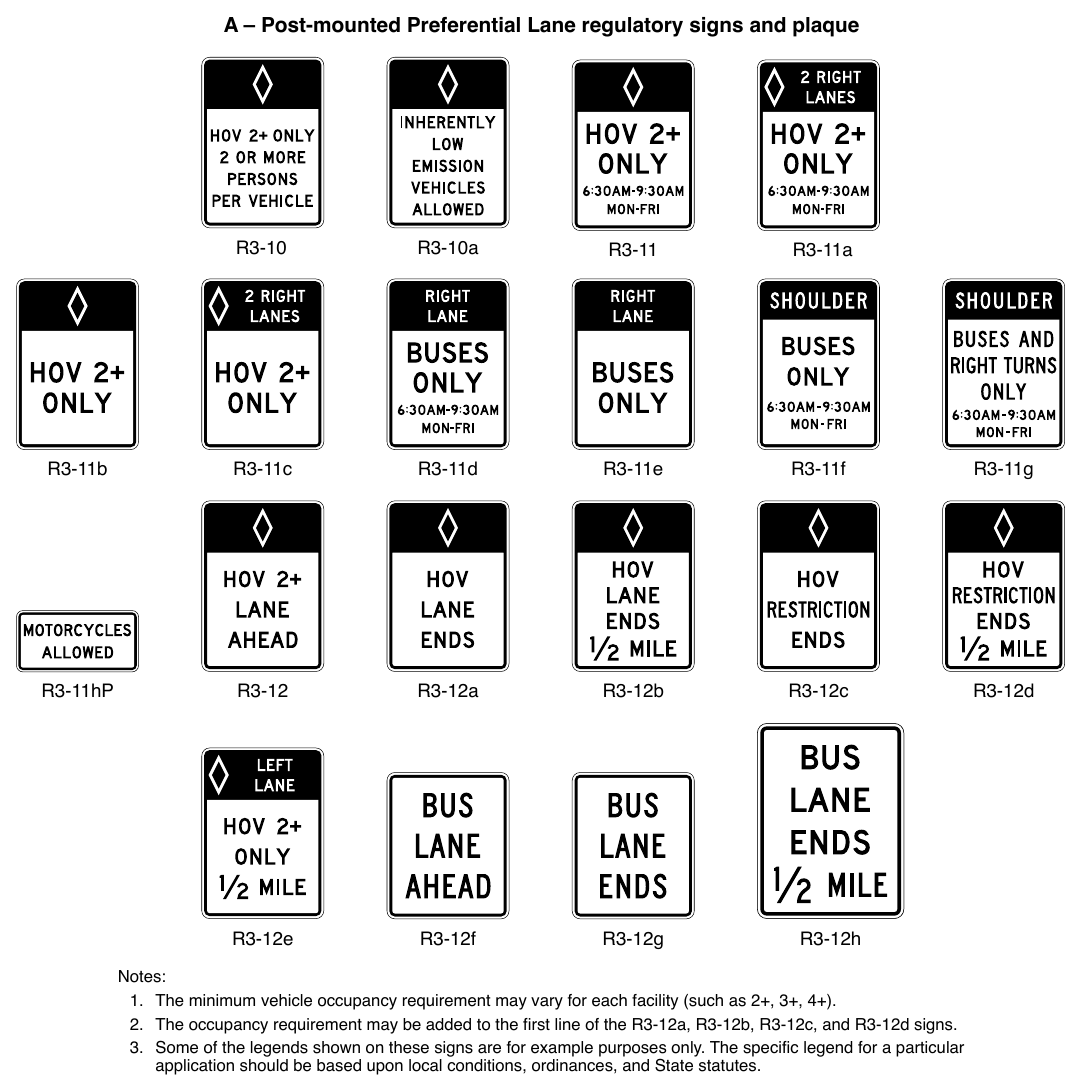
Signs shown: R3-10, R3-10a, R3-11, R3-11a, R3-11b, R3-11c, R3-11d, R3-11e, R3-11f, R3-11g, R3-11hP, R3-12, R3-12a, R3-12b, R3-12c, R3-12d, R3-12e, R3-12f, R3-12g, R3-12h
- 1. The minimum vehicle occupancy requirement may vary for each facility (such as 2+, 3+, 4+).
- 2. The occupancy requirement may be added to the first line of the R3-12a, R3-12b, R3-12c, and R3-12d signs.
- 3. Some of the legends shown on these signs are for example purposes only. The specific legend for a particular application should be based upon local conditions, ordinances, and State statutes.
Support
12. The sizes for Preferential Lane regulatory signs will differ to reflect the design speeds for each type of roadway facility. Table 2G-1 provides sizes for each type of roadway facility.
Guidance
13. The edges of Preferential Lane regulatory signs that are post-mounted on a median barrier should not project beyond the outer edges of the barrier, including in areas where lateral clearance is limited.
Option
14. Where lateral clearance is limited, Preferential Lane regulatory signs that are post-mounted on a median barrier and that are 72 inches or less in width may be skewed up to 45 degrees in order to fit within the barrier width or may be mounted higher, such that the vertical clearance to the bottom of the sign, light fixture, or structural support, whichever is lowest, is not less than 17 feet above any portion of the pavement and shoulders.
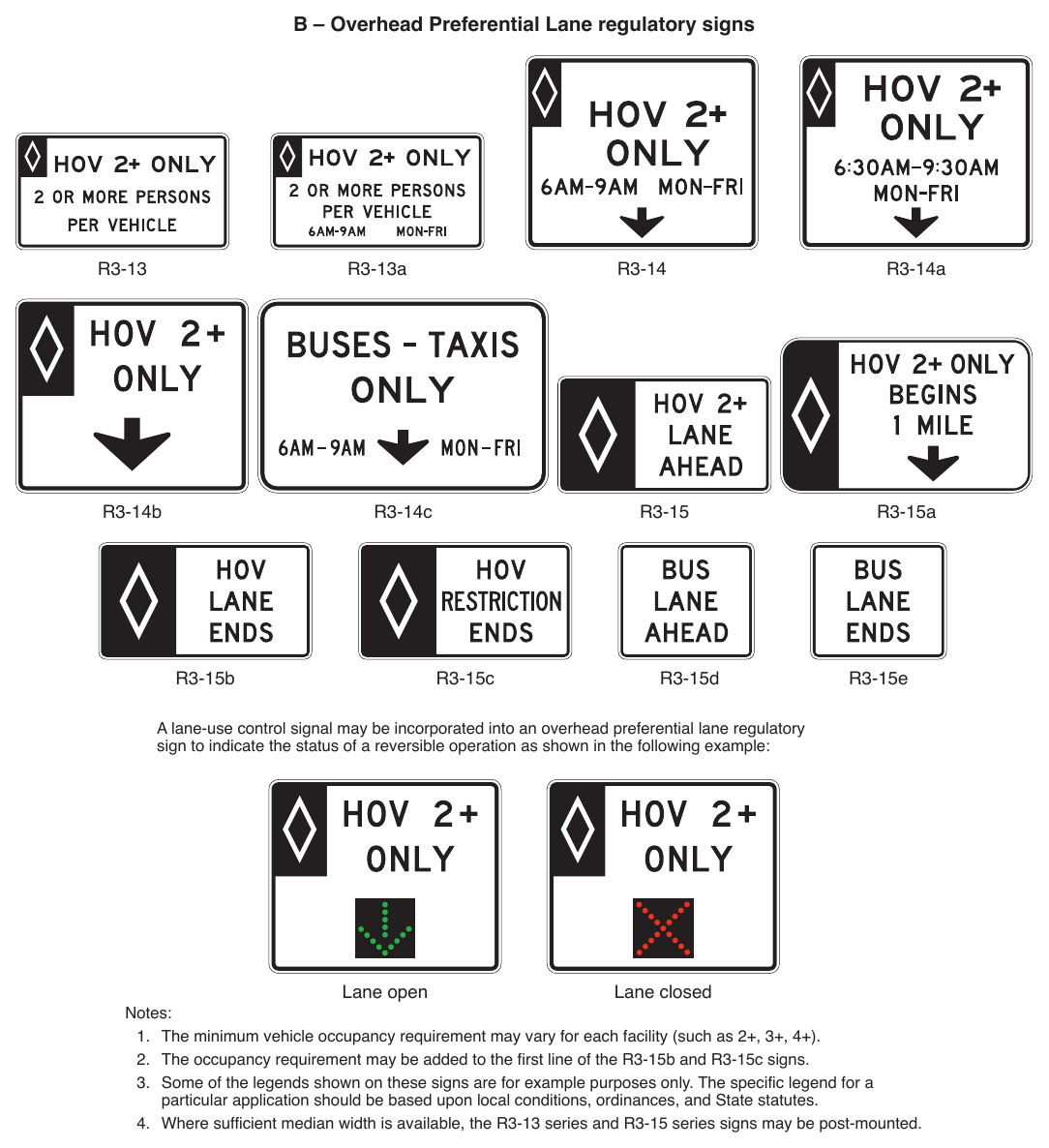
Signs shown: R3-13, R3-13a, R3-14, R3-14a, R3-14b, R3-14c, R3-15, R3-15a, R3-15b, R3-15c, R3-15d, R3-15e
- 1. The minimum vehicle occupancy requirement may vary for each facility (such as 2+, 3+, 4+).
- 2. The occupancy requirement may be added to the first line of the R3-15b and R3-15c signs.
- 3. Some of the legends shown on these signs are for example purposes only. The specific legend for a particular application should be based upon local conditions, ordinances, and State statutes.
- 4. Where sufficient median width is available, the R3-13 series and R3-15 series signs may be post-mounted.
Standard
15. Where lateral clearance is limited, Preferential Lane regulatory signs that are post-mounted on a median barrier and that are wider than 72 inches shall be mounted with a vertical clearance that complies with the provisions of Section 2A.15 for overhead mounting if any portion of the sign extends over the roadway or shoulder.
Guidance
16. On conventional roadways, Preferential Lane regulatory sign spacing should be determined by engineering judgment based on speed, block length, distances from adjacent intersections, and other site-specific considerations.
Support
17. Sections 2G.04 and 2G.05 contain provisions regarding the placement of Preferential Lane regulatory signs on freeways and expressways.
Standard
18. The signs illustrated in Figure 2G-1 that incorporate the diamond symbol shall be used exclusively with preferential lanes for high-occupancy vehicles to indicate the particular occupancy requirement and time restrictions applying to that lane. The signs illustrated in Figure 2G-1 that do not have a diamond symbol shall be used with preferential lanes that are not HOV lanes, but are designated for use by other types of vehicles (such as bus and/or taxi use).
19. The diamond symbol shall not be used on the bus, taxi, or bicycle Preferential Lane signs.
20. Vehicle Occupancy Definition, Preferential Lane Operation, and Preferential Lane Advance regulatory signs for HOV lanes shall display the minimum allowable vehicle occupancy requirement established for each HOV lane, displayed immediately after the word message HOV.
Support
21. The agencies that own and operate HOV lanes have the authority and responsibility to determine how they are operated and the minimum occupancy requirements. Information about federal requirements for certain types of vehicles not meeting the minimum occupancy requirement to be eligible to use HOV lanes that receive Federalaid program funding and about requirements associated with proposed significant changes to the operation of an existing HOV lane and certain vehicles are contained in the “Federal-Aid Highway Program Guidance on High Occupancy Vehicle (HOV) Lanes.”
22. Figures 2G-2 and 2G-3 illustrate the use of regulatory signs for the beginning, along the length, and at the end of contiguous or buffer-separated preferential lanes that provide continuous access with the adjacent general-purpose lanes.
§2G.04 Vehicle Occupancy Definition Signs (R3-10 Series and R3-13 Series)¶
Standard
01. The R3-10, R3-13, and R3-13a Vehicle Occupancy Definition signs (see Figure 2G-1) shall be used where agencies determine that it is appropriate to provide a sign that defines the minimum occupancy of vehicles that are allowed to use an HOV lane.
Guidance
02. The Inherently Low Emission Vehicle (ILEV) (R3-10a) sign (see Figure 2G-1) should be used when it is permissible for a properly labeled and certified ILEV, regardless of the number of occupants, to use an HOV lane. When used, the ILEV signs should be post-mounted in advance of and at intervals along the HOV lane based upon engineering judgment and the placement of other Preferential Lane regulatory signs. The R3-10a sign is only applicable to HOV lanes and should not be used with other preferential lane applications.
Support
03. ILEVs are defined by the Environmental Protection Agency (EPA) as vehicles having no fuel vapor (hydrocarbon) emissions and are certified by the EPA as meeting the emissions standards and requirements specified in 40 CFR §88.311-93 and 40 CFR §88.312-93(c).
04. Section 2G.18 contains information regarding the legends of Vehicle Occupancy Definition signs for a priced managed lane that has an occupancy requirement for non-toll travel.
Standard
05. For barrier-separated, buffer-separated, or contiguous preferential lanes where access between the preferential and general-purpose lanes is restricted to designated locations on freeways and expressways, an overhead Vehicle Occupancy Definition (R3-13 or R3-13a) sign shall be installed at least ½ mile in advance of the beginning of or initial entry point to an HOV lane. These signs shall only be displayed in advance of the beginning of or initial or intermediate entry point to HOV lanes.
06. For buffer-separated or contiguous HOV lanes where access is restricted to designated locations on freeways and expressways, the sequence of a post-mounted Preferential Lane Operation (R3-11a) sign (see Section 2G.05) followed by a post-mounted Vehicle Occupancy Definition (R3-10) sign shall be located at intervals not greater than ½ mile along the length of designated gaps where vehicles are allowed to legally access the HOV lane, and within designated enforcement areas as defined by the operating agency.
Option
07. For buffer-separated or contiguous HOV lanes where access is restricted to designated locations on freeways and expressways, the sequence of a post-mounted Preferential Lane Operation (R3-11a) sign (see Section 2G.05) followed by a post-mounted Vehicle Occupancy Definition (R3-10) sign may be located at intervals of approximately ½ mile along the length of the HOV lane.
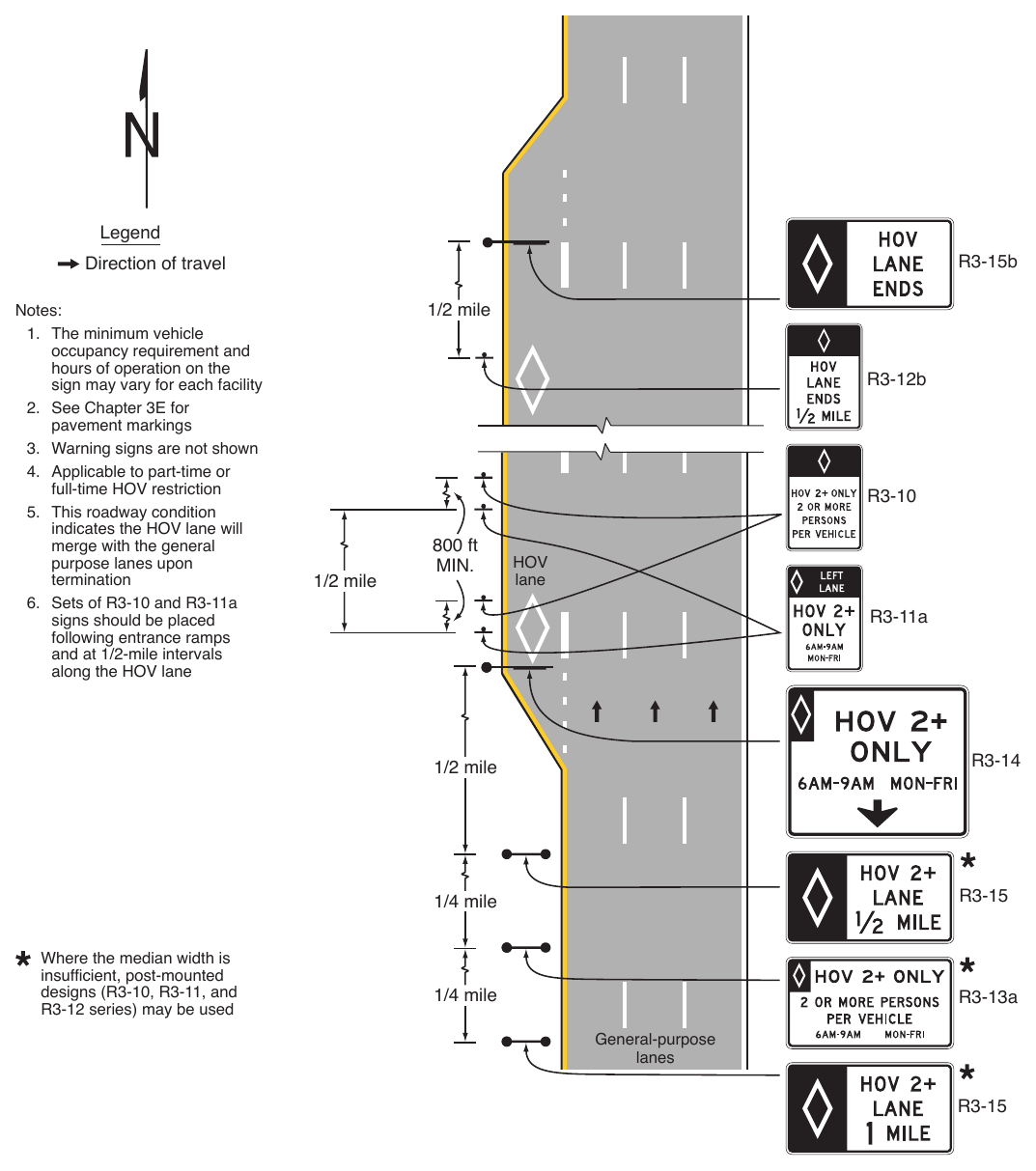
- 1. The minimum vehicle occupancy requirement and hours of operation on the sign may vary for each facility
- 2. See Chapter 3E for pavement markings
- 3. Warning signs are not shown
- 4. Applicable to part-time or full-time HOV restriction
- 5. This roadway condition indicates the HOV lane will merge with the general purpose lanes upon termination
- 6. Sets of R3-10 and R3-11a signs should be placed following entrance ramps and at 1/2-mile intervals along the HOV lane Where the median width is insufficient, post-mounted designs (R3-10, R3-11, and R3-12 series) may be used 1/2 mile R3-12b R3-10 1/2 mile 800 ft MIN. HOV lane R3-11a 1/2 mile R3-14 1/4 mile R3-15 1/4 mile R3-13a General-purpose lanes R3-15
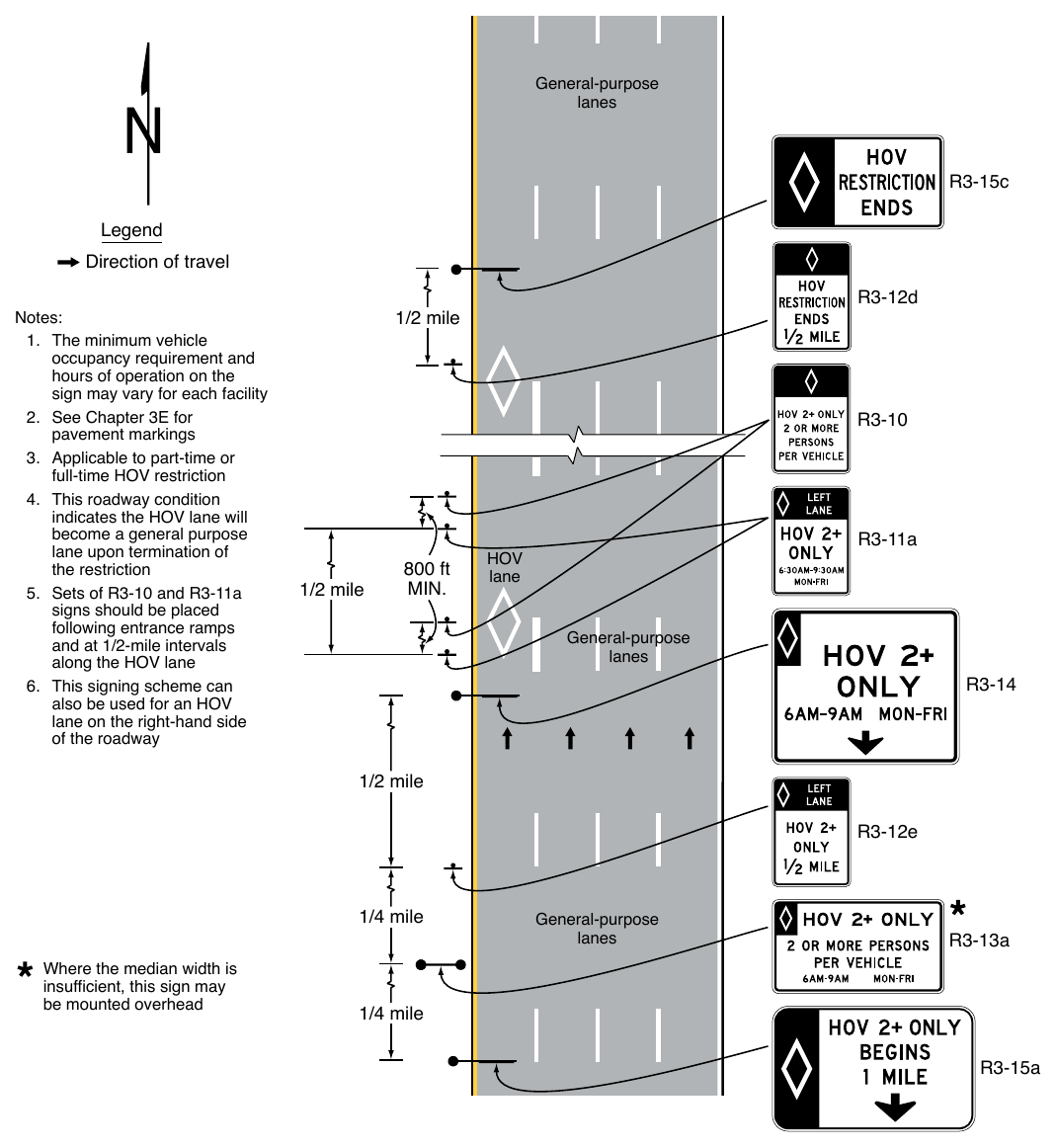
- 1. The minimum vehicle occupancy requirement and hours of operation on the sign may vary for each facility
- 2. See Chapter 3E for pavement markings
- 3. Applicable to part-time or full-time HOV restriction
- 4. This roadway condition indicates the HOV lane will become a general purpose lane upon termination of the restriction
- 5. Sets of R3-10 and R3-11a signs should be placed following entrance ramps and at 1/2-mile intervals along the HOV lane
- 6. This signing scheme can also be used for an HOV lane on the right-hand side of the roadway R3-12d 1/2 mile R3-10 1/2 mile 800 ft MIN. R3-11a HOV lane General-purpose lanes R3-14 1/2 mile R3-12e 1/4 mile Where the median width is insufficient, this sign may be mounted overhead General-purpose lanes R3-13a 1/4 mile R3-15a For barrier-separated HOV lanes on freeways and expressways, the sequence of a post-mounted Preferential Lane Operation (R3-11a) sign (see Section 2G.05) followed by a post-mounted Vehicle Occupancy Definition (R3-10) sign may be located at intervals of approximately ½ mile along the length of the HOV lane, at intermediate entry points, and at designated enforcement areas as defined by the operating agency.
Standard
09. For buffer-separated or contiguous HOV lanes where continuous access with the adjacent general-purpose lanes is provided on freeways and expressways, the sequence of a post-mounted Preferential Lane Operation (R3-11a) sign (see Section 2G.05) followed by a post-mounted Vehicle Occupancy Definition (R3-10) sign, and ILEV (R3-10a) signs, if appropriate, shall be located at intervals not greater than ½ mile along the length of the HOV lane.
Guidance
10. On freeways and expressways, the signs within each Preferential Lane regulatory sign sequence should be separated by a minimum distance of 800 feet and a maximum distance of 1,000 feet.
11. On conventional roads, the distance between Preferential Lane regulatory signs within each sequence should be determined by engineering judgment based on speed, block length, distances from adjacent intersections, and other site-specific considerations.
Standard
12. For all types of direct access ramps that provide access to or lead to HOV lanes, a post-mounted Vehicle Occupancy Definition (R3-10) sign, and an ILEV (R3-10a) sign, if appropriate, shall be used at the beginning or initial entry point for the direct access ramp.
§2G.05 Preferential Lane Operation Signs (R3-11 Series and R3-14 Series)¶
Support
01. The standardized sizes of post-mounted Preferential Lane Operation (R3-11 series) signs are consistent to accommodate any future addition or removal of a single line of legend for each sign. Each size accommodates two lines of legend for the times of day and days of week that the regulation is in effect. Consistent sign sizes are beneficial for agencies when ordering sign materials, as well as when making legend changes to existing signs if changes occur to operating times or occupancy restrictions in the future.
Guidance
02. Where the regulation is in effect during more than one time period of the day, such as during the morning and afternoon peak periods, the height of the R3-11 and R3-14 series signs should be suitably increased to accommodate the additional line(s) of legend.
Standard
03. When used, the post-mounted Preferential Lane Operation (R3-11 series) signs shall be located adjacent to the preferential lane, and the overhead Preferential Lane Operation (R3-14 series) signs shall be mounted directly over the lane.
04. The legend format of the post-mounted Preferential Lane Operation (R3-11 series) signs shall have the following sequence:
- A. Top Lines: Lanes applicable, such as “RIGHT LANE” or “2 RIGHT LANES”
- B. Middle Lines: Eligible uses, such as “HOV 2+ ONLY” (or 3+ or 4+, if appropriate) or “BUSES ONLY” or other applicable uses or eligible turning movements
- C. Bottom Lines: Applicable times and days, such as “7 AM – 9 AM” or “6:30 AM – 9:30 AM, MON-FRI”
05. The legend format of the overhead Preferential Lane Operation (R3-14 series) signs shall have the following sequence:
- A. Top Lines: Eligible uses, such as “HOV 2+ ONLY” (or 3+ or 4+, if appropriate) or “BUSES ONLY” or other applicable uses or eligible turning movements
- B. Bottom Lines: Applicable times and days, with the time and day placed above the down arrow, such as “7 AM – 9 AM” or “6:30 AM – 9:30 AM, MON-FRI.” When the operating periods exceed the available line width, the hours and days of the week shall be stacked as shown for the R3-14a sign in Figure 2G-1.
06. For preferential lane restrictions that are in effect on a full-time (24 hours per day, seven days per week) basis, the Preferential Lane Operation (R3-11b, R3-11c, R3-11e, and R3-14b) signs that include a period of operation legend shall be modified to display no legend relative to the period of operation except as provided in Paragraph 7 of this Section.
Option
07. In lieu of removing the period of operation text from the Preferential Lane Operation signs for full-time operation, the legend 24 HOURS may be substituted for the times and days of the week on the Preferential Lane Operation (R3-11, R3-11a, R3-11d, R3-11f, R3-11g, R3-14, R3-14a, and R3-14c) signs for preferential lane restrictions that are in effect on a full-time basis.
Support
08. The 24 HOURS legend displayed on the Preferential Lane Operation (R3-11 and R3-14 series) signs reinforces the full-time operation where several facilities in the same area have different hours of operation—some part time, others full time, or where the same lane changes from part-time to full-time operation somewhere along its length.
Standard
09. The full-time Preferential Lane Operation (R3-11b, R3-11c, R3-11e, and R3-14b) signs that do not display a period of operation legend, as described in Paragraph 6 of this Section, shall not be used where the preferential lane restriction is in effect only on a part-time basis.
Option
10. Where additional movements are allowed from a preferential lane on an approach to an intersection by vehicles not meeting the preferential lane regulation, the format and words used in the legend in the middle lines on the post-mounted Preferential Lane Operation (R3-11 series) signs and on the top line of the overhead Preferential Lane Operation (R3-14 series) signs may be modified to accommodate the allowable movements (such as “HOV 2+ AND RIGHT TURNS ONLY”).
11. The MOTORCYCLES ALLOWED (R3-11hP) plaque (see Figure 2G-1) may be used where motorcycles, regardless of the number of occupants, are allowed to use an HOV lane.
Standard
12. If used, the MOTORCYCLES ALLOWED plaque shall be mounted below a post-mounted Preferential Lane Operation (R3-11, R3-11a, or R3-11b) sign.
13. For all barrier-separated or buffer-separated or contiguous preferential lanes where access is restricted to designated locations, an overhead Preferential Lane Operation (R3-14 series) sign shall be used at the beginning or initial entry point on freeways, expressways, and at locations on conventional roadways where the preferential lane is not the outermost (far right or far left) lane of the roadway, and at any intermediate entry points or gaps in the barrier or buffer where vehicles are allowed to legally enter the access-restricted preferential lanes. For all barrier-separated and buffer-separated preferential lanes, post-mounted Preferential Lane Operation (R3-11 series) signs shall be used only as a supplement to the overhead signs on freeways, expressways, and at locations on conventional roadways where the preferential lane is not the outermost lane of the roadway at the beginning or initial entry point, or at any intermediate entry points or gaps in the barrier or buffer.
14. For buffer-separated or contiguous preferential lanes where continuous access with the adjacent general-purpose lanes is provided, including those where a preferential lane is added to the roadway (see Figure 2G-2 for HOV lanes) and those where a general-purpose lane transitions into a preferential lane (see Figure 2G-3 for HOV lanes), an overhead Preferential Lane Operation (R3-14 series) sign shall be used at the beginning or initial entry point of the preferential lane on freeways and expressways.
Option
15. On conventional roads where preferential lane operations exist, R3-11 series post-mounted signs may be used in lieu of or in addition to overhead R3-14 series signs, except where overhead signs are required as provided in Paragraph 13 of this Section.
16. Additional overhead (R3-14 series) or post-mounted (R3-11 series) Preferential Lane Operation signs may be provided along the length of any type of preferential lane.
Standard
17. For all types of direct access ramps that provide access to or lead to preferential lanes, a post-mounted Preferential Lane Operation (R3-11 series) sign shall be used at the beginning or initial entry point of the direct access ramp.
Option
18. For direct access ramps to preferential lanes, an overhead Preferential Lane Operation (R3-14 series) sign may be used at the beginning or initial entry point to supplement the required post-mounted signs.
19. Lane-use control signals (see Chapter 4T) may be used at access points to preferential lanes to indicate that a ramp or access roadway leading to the preferential lane or facility, or one or more specific lanes of the facility, are open or closed (see Figure 2G-1).
§2G.06 Preferential Lane Advance Signs (R3-12, R3-12e, R3-12f, R3-15, R3-15a, and R3-15d)¶
Guidance
01. The Preferential Lane Advance (R3-12, R3-12f, R3-15, and R3-15d) signs (see Figure 2G-1) should be used for advance notification of a barrier-separated, buffer-separated, or contiguous preferential lane that is added to the general-purpose lanes (see Figure 2G-2).
02. The Preferential Lane Advance (R3-12e and R3-15a) signs (see Figure 2G-1) should be used for advance notification of a general-purpose lane that becomes a preferential lane (see Figure 2G-3).
Option
03. The legends on the R3-12f and R3-15d signs may be modified to suit the type of preferential lane.
Guidance
04. On conventional roads, for general-purpose lanes that become preferential lanes, a post-mounted (R3-12e) or overhead (R3-15a) Preferential Lane Advance sign should be installed in advance of the beginning of or initial entry point to the preferential lane at a distance determined by engineering judgment based on speed, traffic characteristics, and other site-specific considerations. The distance selected should provide adequate opportunity for ineligible vehicles to vacate the lane prior to the beginning of the restriction.
05. On freeways and expressways, for general-purpose lanes that become preferential lanes, an overhead Preferential Lane Advance (R3-15a) sign should be installed at least 1 mile in advance of the beginning of the preferential lane restriction.
Option
06. Additional post-mounted or overhead Preferential Lane Advance signs may be placed farther in advance of or closer to the beginning or initial entry points to a preferential lane.
§2G.07 Preferential Lane Ends Signs (R3-12a, R3-12b, R3-12c, R3-12d, R3-12g, R3-12h, R3-15b, R3-15c, and R3-15e)¶
Standard
01. A post-mounted Preferential Lane Ends (R3-12b or R3-12h) sign (see Figure 2G-1) shall be installed at least ½ mile in advance of the termination of a preferential lane on freeways and expressways.
02. Except as provided in Paragraph 7 of this Section, a post-mounted Preferential Lane Ends (R3-12a or R3-12g) sign shall be installed at the point where a preferential lane and restriction end and traffic must merge into the general-purpose lanes.
03. A post-mounted Preferential Lane Ends (R3-12d) sign (see Figure 2G-1) shall be installed at least ½ mile in advance of the point where a preferential lane restriction ends and the lane becomes a general-purpose lane on freeways and expressways.
04. Except as provided in Paragraph 8 of this Section, a post-mounted Preferential Lane Ends (R3-12c) sign shall be installed at the point where a preferential lane restriction ends and the lane becomes a general-purpose lane.
Guidance
05. On conventional roads, the distance at which Preferential Lane Ends signs are installed in advance of the termination of a preferential lane and/or restriction should be determined by engineering judgment.
Option
06. The legends on the R3-12g and R3-15e signs may be modified to suit the type of preferential lane.
07. An overhead Preferential Lane Ends (R3-15b or R3-15e) sign may be installed instead of or in addition to a post-mounted R3-12a or R3-12g sign at the point where a preferential lane and restriction ends and traffic must merge into the general-purpose lanes.
08. An overhead Preferential Lane Ends (R3-15c) sign may be installed instead of or in addition to a post-mounted R3-12c sign at the point where the preferential lane restriction ends and the lane becomes a general-purpose lane.
WARNING SIGNS AND PLAQUE¶
§2G.08 Warning Signs on Median Barriers for Preferential Lanes¶
Option
01. When a warning sign applicable only to a preferential lane is installed on a median barrier with limited lateral clearance to the adjacent travel lanes or shoulders, the warning sign may have a vertically-oriented rectangular shape. For a high-occupancy vehicle lane, such signs may be used instead of using the HOV (W16-11P) plaque (see Section 2G.09) with a standard diamond-shaped warning sign.
Standard
02. When a vertically-oriented rectangular-shaped warning sign applicable only to a preferential lane is installed on a median barrier, the top portion of the sign shall be comprised of a white symbol or legend denoting the type of preferential lane (such as the diamond symbol for HOV or the legend BUS LANE) on a black background with a white border, and the bottom portion of the sign shall be comprised of the standard word message or symbol of the standard warning sign as a black legend on a yellow background with a black border (see Figure 2G-4).
Guidance
03. Where lateral clearance is limited, such as when a post-mounted warning sign applicable only to a preferential lane is installed on a median barrier, the edges of the sign should not project beyond the outer edges of the barrier.
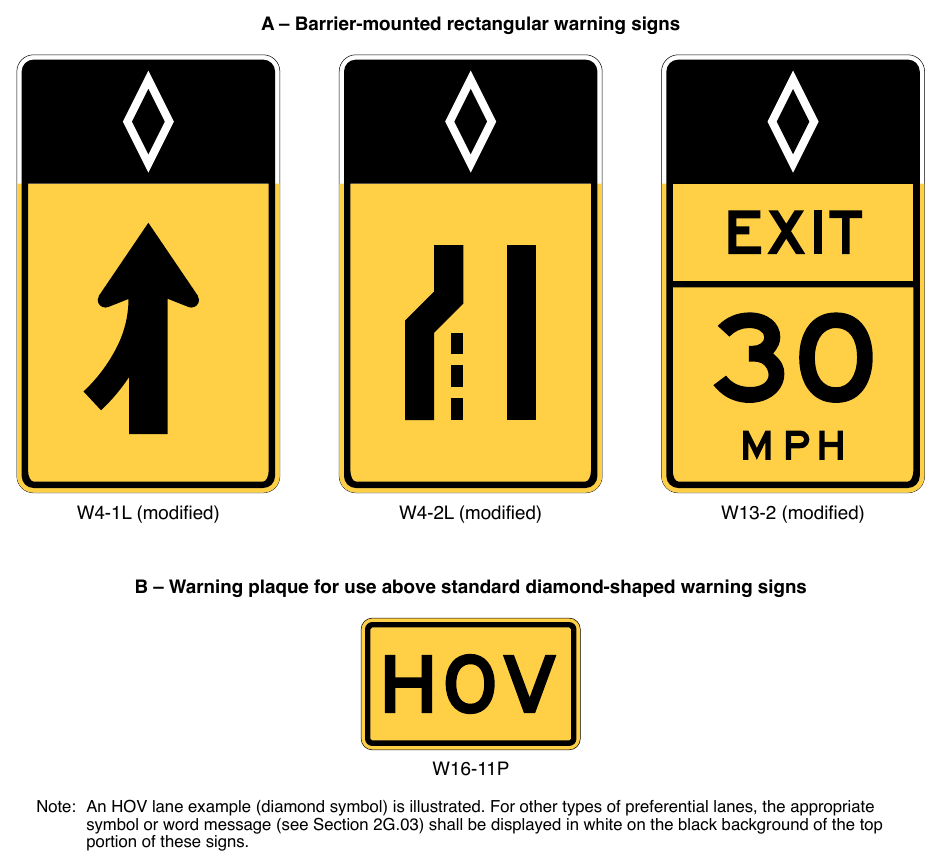
W4-1L (modified) W4-2L (modified) W13-2 (modified) B – Warning plaque for use above standard diamond-shaped warning signs Note: An HOV lane example (diamond symbol) is illustrated. For other types of preferential lanes, the appropriate symbol or word message (see Section 2G.03) shall be displayed in white on the black background of the top portion of these signs.
Option
04. Where lateral clearance is limited, warning signs applicable only to a preferential lane that are post-mounted on a median barrier and that are 72 inches or less in width may be skewed up to 45 degrees in order to fit within the barrier width or may be mounted higher, such that the vertical clearance to bottom of the sign, light fixture, or its structural support, whichever is lowest, is not less than 17 feet above any portion of the pavement and shoulders.
Standard
05. Where lateral clearance is limited, Preferential Lane warning signs that are post-mounted on a median barrier and that are wider than 72 inches shall be mounted with a vertical clearance that complies with the provisions of Section 2A.15 for overhead mounting.
§2G.09 High-Occupancy Vehicle (HOV) Plaque (W16-11P)¶
Option
01. In situations where there is a need to warn drivers in an HOV lane of a specific condition, the HOV (W16-11P) plaque (see Figure 2G-4) may be used above a warning sign. The HOV plaque may be used to differentiate a warning sign applicable to the HOV lanes when the sign is also visible to traffic on the adjacent general-purpose roadway. Among the warning signs that may be possible applications of the HOV plaque are the Advisory Exit Speed, Added Lane, and Merge signs.
02. The diamond symbol may be used instead of the word message HOV on the W16-11P plaque. When appropriate, the words LANE or ONLY may be used on this plaque.
Support
03. Section 2G.08 contains information regarding warning signs that can be mounted on barriers for HOV or other types of preferential lanes.
GUIDE SIGNS¶
§2G.10 Preferential Lane Guide Signs – General¶
Support
01. Preferential lanes are used on freeways, expressways, and conventional roads. Except as otherwise provided, Sections 2G.10 through 2G.15 apply only to guide signs for preferential lanes on freeways and expressways.
Guidance
02. On conventional roads, guide signs applicable only to preferential lanes are ordinarily not needed, but if used, they should comply with the provisions for guide signs in Chapter 2D and any principles for Preferential Lane guide signs in Sections 2G.10 through 2G.15 that engineering judgment finds to be appropriate for the conditions.
Support
03. Additional guidance and standards related to the designation, operational considerations, signs, pavement markings, and other considerations for preferential lanes are provided in Sections 2G.03 through 2G.07, 2G.09, and Chapter 3E.
Guidance
04. The appropriate combinations of pavement markings and standard overhead and post-mounted regulatory, warning, and guide signs for a specific preferential lane application should be selected based on an engineering study.
05. If overhead signs applicable only to a preferential lane are located in approximately the same longitudinal position along the highway as overhead signs applicable only to the general-purpose lanes, the signs for the preferential lane should be separated laterally from the signs for the general-purpose lanes to the maximum extent practicable to minimize conflicting information.
06. The Preferential Lane signs should be designed and located to avoid overloading the road user. The order of priority of guide signs should be Advance Guide, Preferential Lane Entrance Direction, and finally Preferential Lane Exit Destination Supplemental guide signs.
Standard
07. Signs applicable only to a preferential lane shall be distinguished from signs applicable to general-purpose lanes by the inclusion of the applicable symbol(s) and/or word(s).
Support
08. The symbol and/or word message that appears on a particular guide sign applicable only to a preferential lane will vary based on the specific type of traffic allowed and on other related operational constraints that have been established for a particular lane, such as an HOV lane, a bus lane, or a taxi lane.
Standard
09. For HOV lanes, the diamond symbol shall appear on each Advance Guide (E8-3) sign (see Figure 2G-5), Preferential Lane Entrance Direction (E8-2 or E8-2a) sign (see Figure 2G-6), and Preferential Lane Entrance Gore (E8-1 or E8-1a) sign (see Figure 2G-7) for the designated entry and exit points for barrier-separated and buffer-separated geometric configurations and direct access ramps to or from such lanes. The diamond symbol shall not be used with preferential lanes for other types of traffic, such as bus lanes or taxi lanes.
10. Signing for an HOV lane that is managed by means of varying the occupancy requirement in response to changing conditions shall also comply with these provisions.
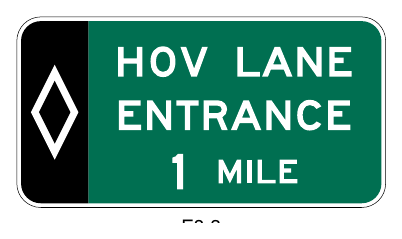
Signs shown: E8-3
Note: An example of an HOV lane (diamond symbol) sign is illustrated. For other types of preferential lanes, the appropriate symbol or word message (see Section 2G.03) is displayed in white on the black background of the left-hand portion of this sign.
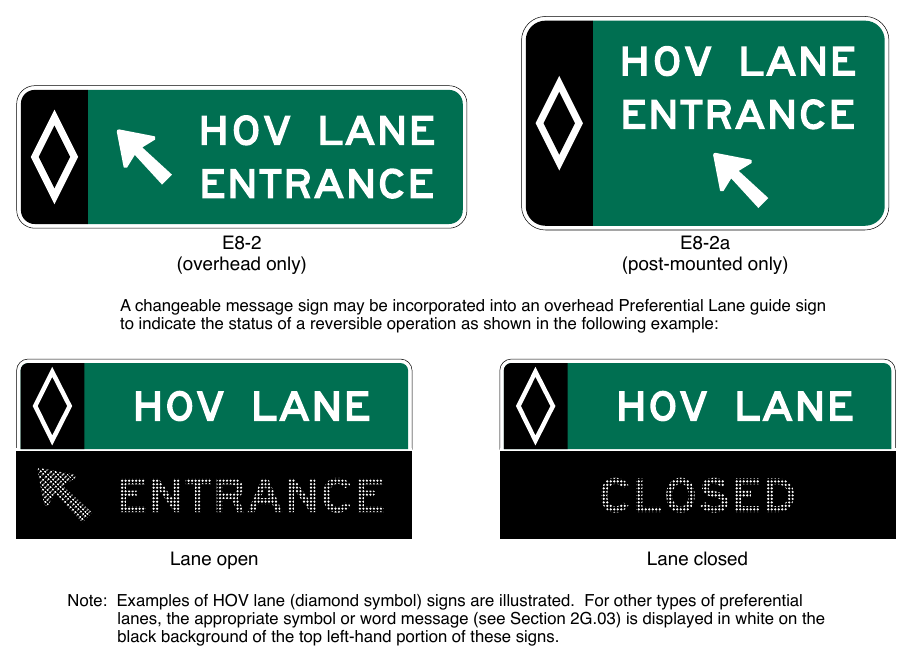
(overhead only) E8-2a (post-mounted only) A changeable message sign may be incorporated into an overhead Preferential Lane guide sign to indicate the status of a reversible operation as shown in the following example: Lane open Lane closed Note: Examples of HOV lane (diamond symbol) signs are illustrated. For other types of preferential lanes, the appropriate symbol or word message (see Section 2G.03) is displayed in white on the black background of the top left-hand portion of these signs.
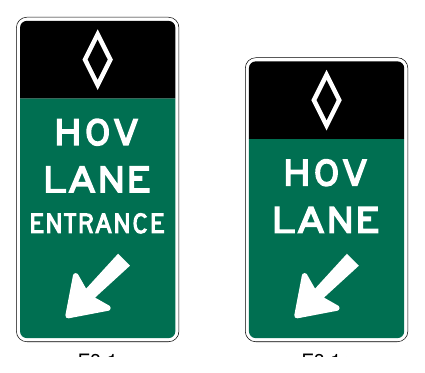
Note: Examples of HOV lane (diamond symbol) signs are illustrated. For other types of preferential lanes, the appropriate symbol or word message (see Section 2G.03) is displayed in white on the black background of the top portion of these signs. E8-1a
11. The diamond symbol shall be displayed in the legend of each Preferential Lane guide sign at the designated entry and exit points for all types of HOV lanes (including barrier-separated, buffer-separated, contiguous, and direct access ramps) in order to alert motorists that there is a minimum allowable vehicle occupancy requirement for vehicles to use the HOV lanes. Guide signs shall not display the occupancy requirement for the preferential lane.
12. A combination of guide and regulatory signs shall be used in advance of and at the initial entry point and all intermediate entry points from general-purpose lanes or facilities to contiguous, barrier-separated, and buffer-separated preferential lanes where access between the preferential and general-purpose lanes is restricted to designated locations. The regulatory signs shall comply with the provisions of Sections 2G.03 through 2G.07.
13. Regulatory signs alone shall be used in advance of, at the beginning of, and at periodic intervals along contiguous or buffer-separated preferential lanes that provide continuous access between the adjacent general-purpose lanes and the preferential lane (see Figures 2G-2 and 2G-3). The design and placement of the regulatory signs shall comply with the provisions of Sections 2G.03 through 2G.07.
14. Except as otherwise provided in Sections 2G.10 through 2G.13, guide signs applicable to a preferential lane with a vehicle occupancy requirement shall be distinguished from those applicable to general-purpose lanes by displaying the white diamond symbol on a black background at the left-hand edge of these signs.
Option
15. When post-mounted guide signs applicable only to a preferential lane are installed on a median barrier with limited lateral clearance to the adjacent travel lanes or shoulders, the guide signs may have a vertically-oriented rectangular shape.
Standard
16. When vertically-oriented rectangular-shaped guide signs applicable only to a preferential lane are installed on a median barrier, the top portion of the signs shall be comprised of the applicable white symbol or white word message that identifies the type of preferential lane (such as the diamond symbol for an HOV lane) on a black background with a white border, and the bottom portion of the sign shall be comprised of the appropriate guide sign legend on a green background with a white border (see Figures 2G-7 through 2G-9).
Guidance
17. Where lateral clearance is limited, such as when a post-mounted Preferential Lane guide sign is installed on a median barrier, the edges of the sign should not project beyond the outer edges of the barrier.
Option
18. Where lateral clearance is limited, Preferential Lane guide signs that are 72 inches or less in width may be skewed up to 45 degrees in order to fit within the barrier width or may be mounted higher, such that the vertical clearance to the bottom of the sign, light fixture, or its structural support, whichever is lowest, is not less than 17 feet above any portion of the pavement and shoulders.
Standard
19. Where lateral clearance is limited, Preferential Lane guide signs that are post-mounted on a median barrier and that are wider than 72 inches shall be mounted with a vertical clearance that complies with the provisions of Section 2A.15 for overhead mounting.
Option
20. Lane-use control signals (see Chapter 4T) may be used at access points to preferential lanes to indicate that a ramp or access roadway leading to or from the preferential lane or facility, or one or more specific lanes of the facility, are open or closed.
21. Changeable message signs may supplement, substitute for, or be incorporated into static guide signs (see Figure 2G-6) where travel conditions change or where multiple types of operational strategies (such as variable occupancy requirements, vehicle types, or pricing policies) are used and varied throughout the day or week to manage the use of, control of, or access to preferential lanes.
Standard
22. When changeable message signs (see Chapter 2L) are used as guide signs for preferential lanes, they shall be the required sign size and shall display the required letter height and legend format that correspond to the type of roadway facility and design speed.
23. Advance Guide signs, Preferential Lane Entrance Direction signs, and Preferential Lane Entrance Gore signs for the initial entry point and intermediate entry points into a preferential lane from the general-purpose lanes on the same designated route shall not identify the entry point as an exit by using the word “EXIT” on the sign or on a plaque.
Guidance
24. Advance Guide signs and Preferential Lane Entrance Direction signs for initial and intermediate entry points into a preferential lane should use the word “ENTRANCE,” such as “HOV LANE ENTRANCE” (see Figures 2G-5 and 2G-6), to convey the fact that vehicles are not leaving the designated route.
25. Preferential Lane Entrance Gore signs (see Figure 2G-7) at the initial entry point to a preferential lane should use the word “ENTRANCE.” Preferential Lane Entrance Gore signs at intermediate entry points to a barrier-separated preferential lane where the sign would be located immediately adjacent to and directly viewed by traffic in the preferential lane should not use the word “ENTRANCE.”
Standard
26. When the entry point is on the left-hand side of the general-purpose lanes, a LEFT (E1-5mP) plaque (see Figure 2E-9) shall be added to the top left edge of the Advance Guide and Preferential Lane Entrance Direction signs. The LEFT plaque shall not be used on a preferential lane regulatory sign.
§2G.11 Signing for Initial Entry Points to Preferential Lanes¶
Standard
01. Except where a buffer-separated or contiguous preferential lane is added or where a general-purpose lane becomes a buffer-separated or contiguous preferential lane, and provides continuous access with the adjacent general-purpose lanes as illustrated in Figures 2G-2 and 2G-3, an Advance Guide sign shall be provided at least ½ mile prior to the initial entry point to all types of preferential lanes in any type of geometric configuration on freeways and expressways. A Preferential Lane Entrance Direction sign shall also be provided at the initial entry point. Advance Guide and Preferential Lane Entrance Direction signs for such entry points shall not include the word “EXIT” (see Section 2G.10).
02. Where a general-purpose lane becomes a preferential lane that does not provide continuous access with the adjacent general-purpose lanes, an Advance Guide sign shall also be provided at approximately 1 mile in advance of the initial entry point. The Advance Guide and Entrance Direction signs in this sequence shall include a panel at the bottom of the sign with a black legend and border on a yellow background displaying a down arrow and the word ONLY as illustrated in Figure 2G-8.
Guidance
03. Unless an Advance Guide Sign is already required in Paragraph 2 of this Section, an Advance Guide sign should also be installed and located approximately 1 mile in advance of the initial entry point to a preferential lane on freeways and expressways that restricts access to the adjacent general-purpose lanes.
Option
04. An Advance Guide sign may also be installed and located approximately 2 miles in advance of the initial entry point to a preferential lane that restricts access with the adjacent general-purpose lanes to designated locations.
Standard
05. For barrier-separated, buffer-separated, or contiguous preferential lanes where entry is restricted to only designated points on freeways and expressways, the Advance Guide and Preferential Lane Entrance Direction signs shall be mounted overhead.
Guidance
06. Preferential Lane Exit Destination guide signs, identifying final destination and downstream exit locations accessible from the preferential lane (see Figures 2G-8, 2G-9, 2G-14, 2G-16, and 2G-17), should be installed in advance of the initial entry points to access-restricted preferential lanes (such as barrier-separated and bufferseparated). These signs should be located based on the priority of the message, the available space, the existing signs on adjacent general-purpose traffic lanes, roadway and traffic characteristics, the proximity to existing overhead signs, the ability to install overhead signs, and other unique local factors.
Standard
07. Advance destination guide signs for preferential lanes shall include an upper section displaying a black legend that includes the type of preferential lane and the word “EXITS,” such as “HOV EXITS,” on a white background. For preferential lanes that incorporate a vehicle occupancy requirement, the white diamond symbol on a black background shall be displayed at the left-hand edge of this upper section (see Figure 2G-9).
Support
08. Figure 2G-8 shows an example of signing for a general-purpose lane that becomes a preferential lane that does not provide continuous access with the adjacent general-purpose lanes.
09. Figure 2G-9 shows an example of signs for the initial entry point to a preferential lane.
§2G.12 Signing for Intermediate Entry Points to Preferential Lanes¶
Standard
01. For barrier-separated, buffer-separated, and contiguous preferential lanes where entry is restricted only to designated points, an overhead Preferential Lane Entrance Direction sign shall be provided at intermediate entry points to the preferential lane from the general-purpose lanes.
Guidance
02. For barrier-separated and buffer-separated preferential lanes where intermediate entry from the general-purpose lanes is provided via a separate lane or ramp (see Figure 2G-10), at least one Advance Guide sign should be provided in addition to the Preferential Lane Entrance Direction sign.
03. For access-restricted preferential lanes where intermediate entrance and egress are at the same designated access location, the Preferential Lane Entrance Direction sign should be located between ½ and ¼ of the length of the designated entry area, as measured from the downstream end of the entry area (see Figure 2G-11).
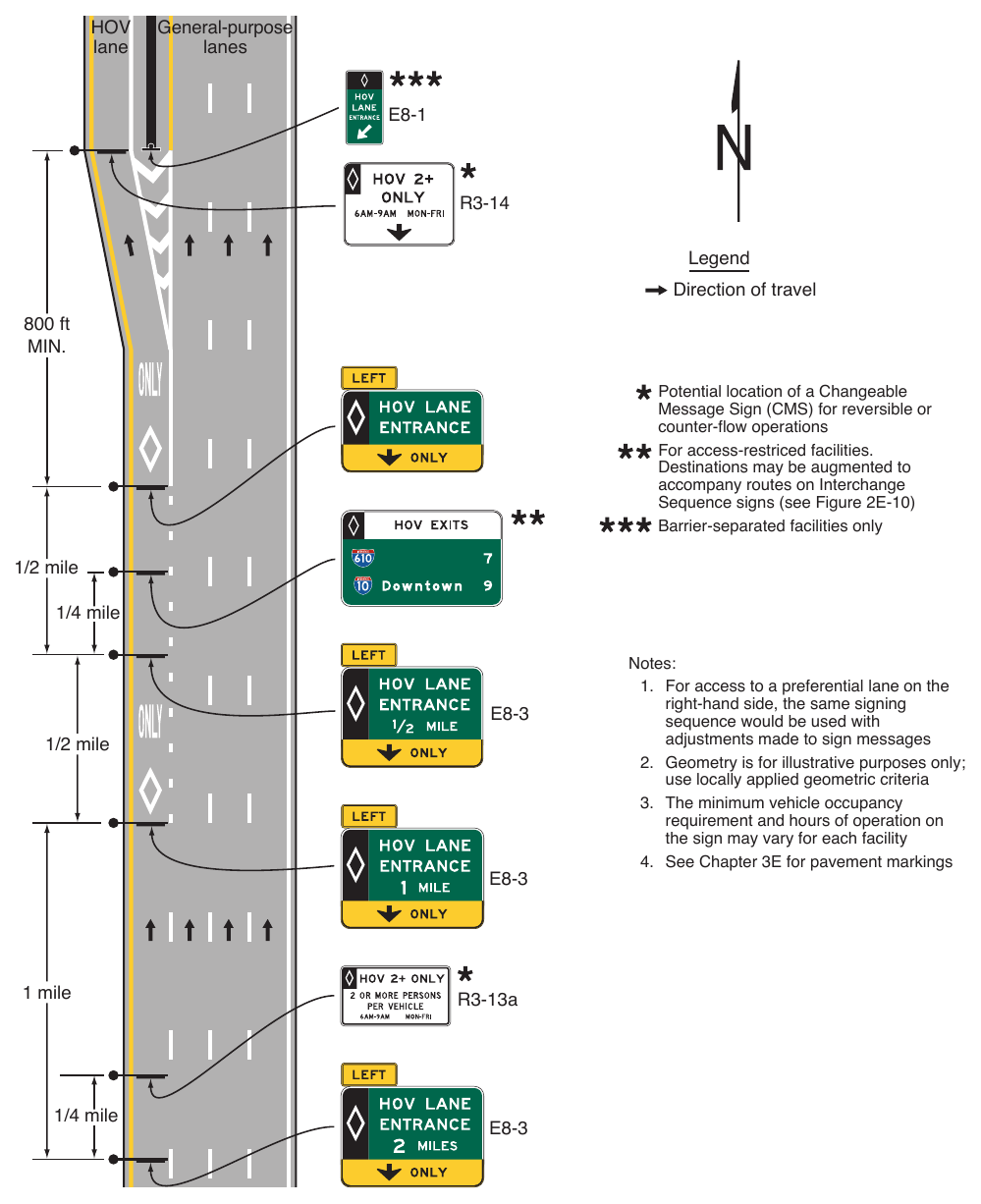
Message Sign (CMS) for reversible or counter-flow operations For access-restriced facilities. Destinations may be augmented to accompany routes on Interchange Sequence signs (see Figure 2E-10) Barrier-separated facilities only 1/2 mile 1/4 mile 1/2 mile 1 mile 1/4 mile Notes:
- 1. For access to a preferential lane on the right-hand side, the same signing sequence would be used with adjustments made to sign messages
- 2. Geometry is for illustrative purposes only; use locally applied geometric criteria
- 3. The minimum vehicle occupancy requirement and hours of operation on the sign may vary for each facility
- 4. See Chapter 3E for pavement markings R3-13a E8-3
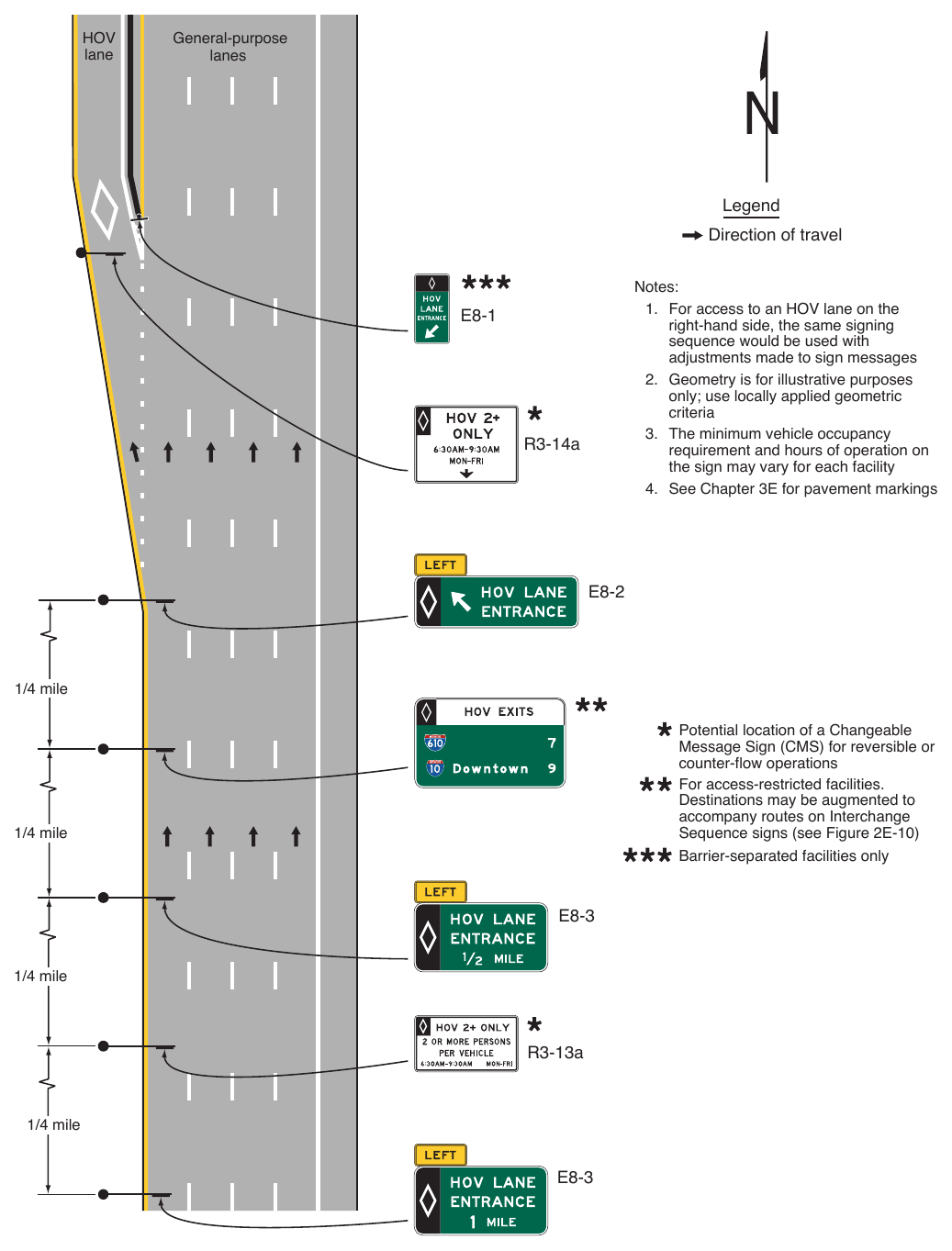
- 1. For access to an HOV lane on the right-hand side, the same signing sequence would be used with adjustments made to sign messages
- 2. Geometry is for illustrative purposes only; use locally applied geometric criteria
- 3. The minimum vehicle occupancy requirement and hours of operation on the sign may vary for each facility
- 4. See Chapter 3E for pavement markings E8-1 R3-14a E8-2 1/4 mile Potential location of a Changeable Message Sign (CMS) for reversible or counter-flow operations For access-restricted facilities. Destinations may be augmented to accompany routes on Interchange Sequence signs (see Figure 2E-10) 1/4 mile Barrier-separated facilities only E8-3 1/4 mile R3-13a 1/4 mile E8-3
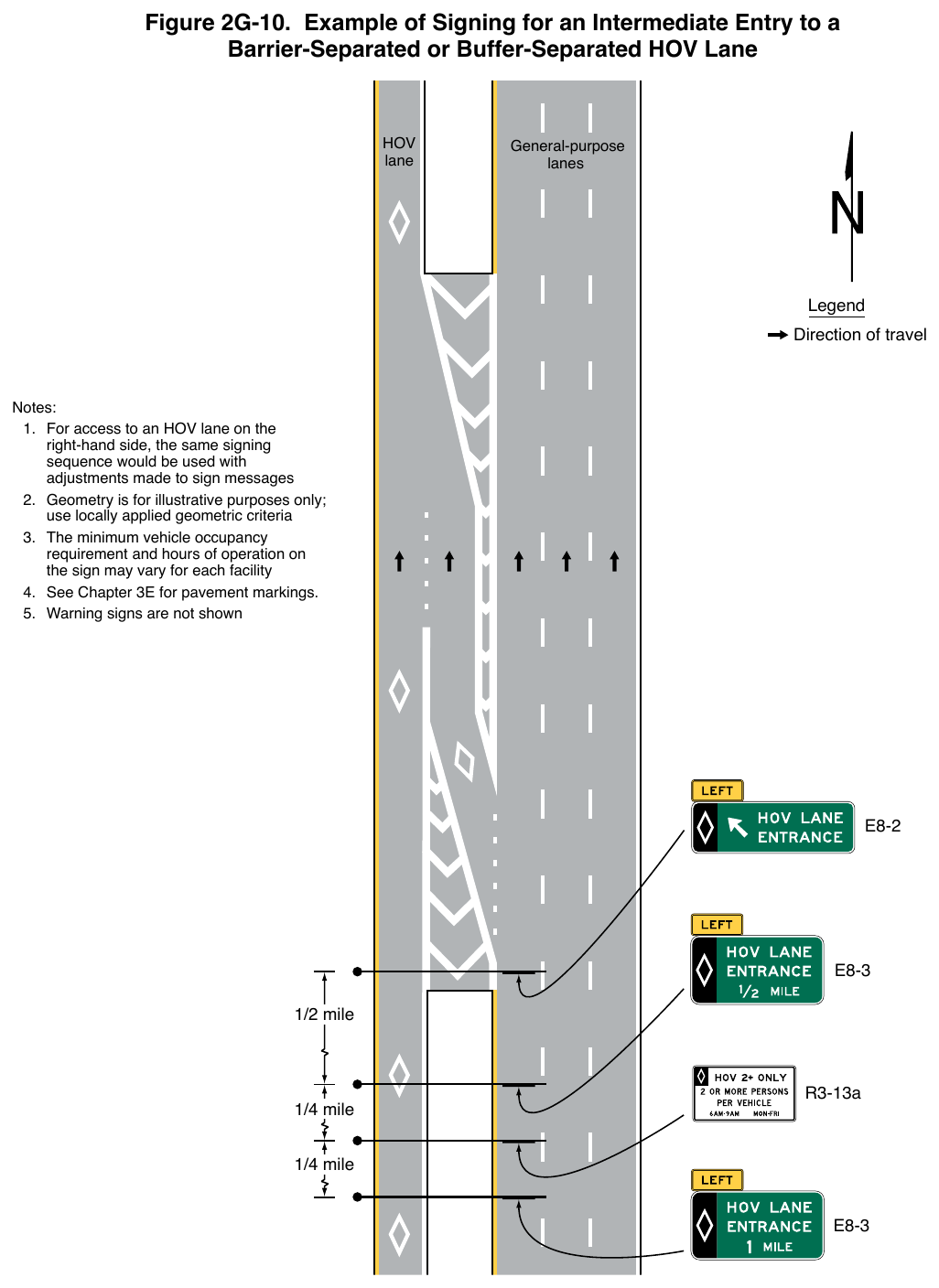
- 1. For access to an HOV lane on the right-hand side, the same signing sequence would be used with adjustments made to sign messages
- 2. Geometry is for illustrative purposes only; use locally applied geometric criteria
- 3. The minimum vehicle occupancy requirement and hours of operation on the sign may vary for each facility
- 4. See Chapter 3E for pavement markings.
- 5. Warning signs are not shown E8-2 E8-3 1/2 mile 1/4 mile R3-13a 1/4 mile E8-3
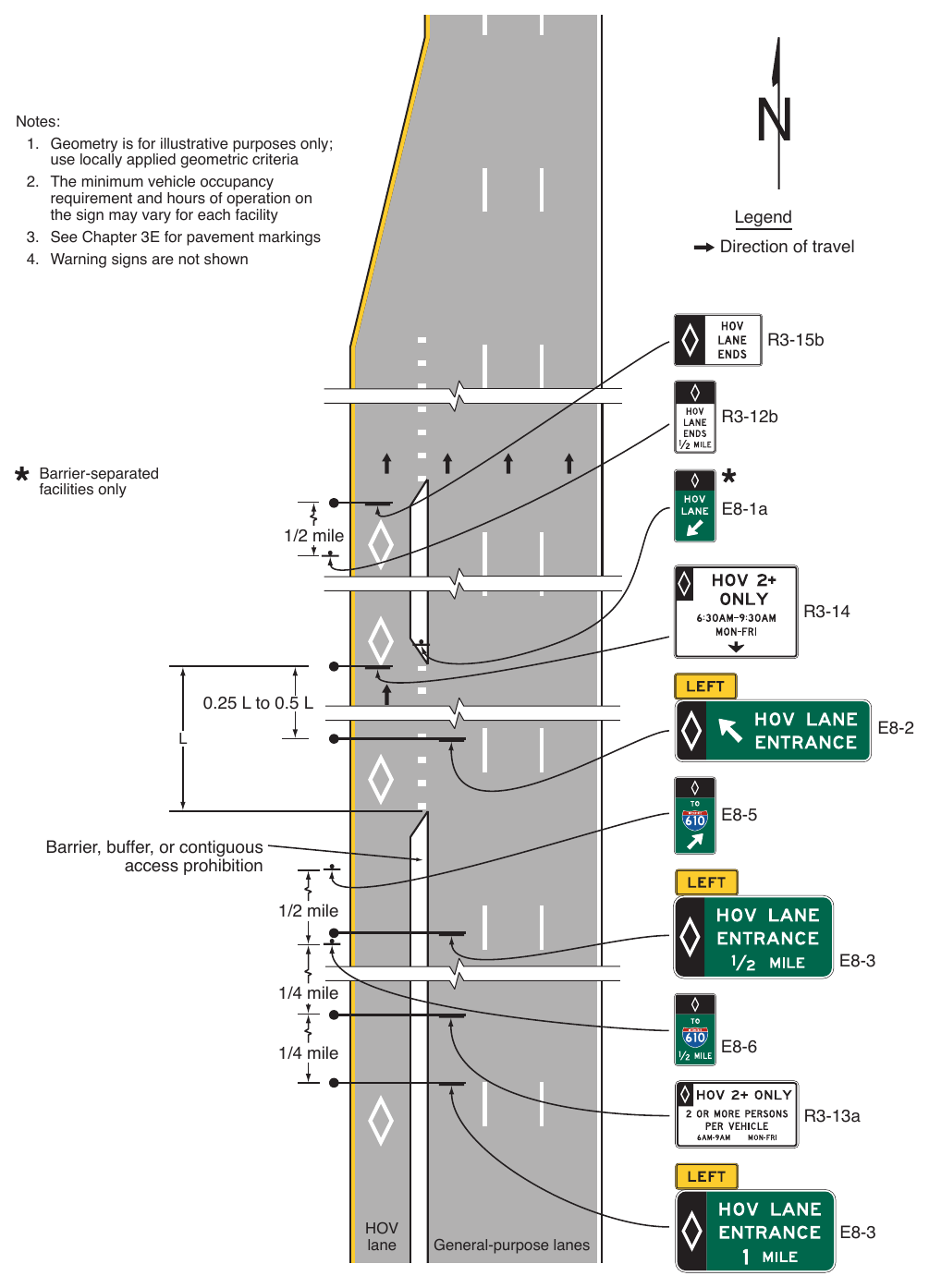
Signs shown: R3-15b, R3-12b, E8-1a, R3-14, E8-2, E8-5, E8-3, E8-6, R3-13a
- 1. Geometry is for illustrative purposes only; use locally applied geometric criteria
- 2. The minimum vehicle occupancy requirement and hours of operation on the sign may vary for each facility
- 3. See Chapter 3E for pavement markings
- 4. Warning signs are not shown Legend Direction of travel R3-15b R3-12b Barrier-separated facilities only E8-1a 1/2 mile R3-14 0.25 L to 0.5 L E8-2 L E8-5 Barrier, buffer, or contiguous access prohibition 1/2 mile E8-3 1/4 mile E8-6 1/4 mile R3-13a HOV lane General-purpose lanes E8-3
Standard
The Advance Guide signs, if used for intermediate entry points to a preferential lane from the general-purpose lanes, shall be overhead.
Option
05. Advance Guide signs may be provided at approximately ½ mile, 1 mile, and 2 miles in advance of intermediate entry points from the general-purpose lanes to a preferential lane.
Standard
06. Advance Guide and Preferential Lane Entrance Direction signs for intermediate entry points shall not include the word “EXIT” (see Section 2G.10).
Guidance
07. Exit Destination guide signs, identifying the final destination and downstream exit locations accessible from the preferential lane, should be installed in advance of intermediate entry points from the general-purpose lanes to access-restricted preferential lanes.
Support
08. Section 2G.11 contains information on the design and placement of Preferential Lane Exit Destination guide signs.
09. Figures 2G-10 and 2G-11 show examples of signs for various geometric configurations of intermediate entry to a barrier-separated or buffer-separated preferential lane where access is restricted to designated locations.
§2G.13 Signing for Egress from Preferential Lanes to General-Purpose Lanes¶
Standard
01. Except as provided in Paragraphs 4 and 5 of this Section, for barrier-separated, buffer-separated, and contiguous preferential lanes where egress is restricted only to designated points, post-mounted Advance Guide (E8-6) and post-mounted Intermediate Egress Direction (E8-5) signs (see Figure 2G-12) shall be installed in the median or on median barriers that separate two directions of traffic prior to and at the intermediate exit points from the preferential lanes to the general-purpose lanes (see Figure 2G-11).
02. The legends of these signs shall refer to the next exit or exits from the general-purpose lanes by displaying the appropriate destination information, exit number(s), or both. The Intermediate Egress Direction signs for egress from the preferential lanes to the general-purpose lanes shall not refer to the egress as an exit.
Support
03. Section 2G.10 contains information on the design of post-mounted guide signs applicable to a preferential lane when installed on a median barrier. Figures 2G-11 and 2G-13 show examples of signs for various geometric configurations of intermediate egress from a barrier-separated or buffer-separated preferential lane where access is restricted to designated locations.
Guidance
04. Where two or more adjacent preferential lanes are present in a single direction, consideration should be given to the use of overhead guide signs to display the information related to egress from the preferential lanes.
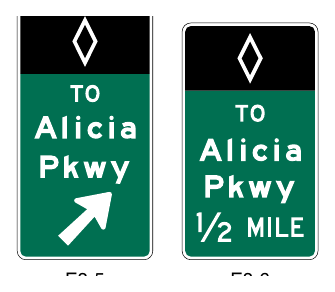
05. Note: Examples of HOV lane (diamond symbol) signs are illustrated. For other types of preferential lanes, the appropriate symbol or word message (see Section 2G.03) is displayed in white on the black background of the top portion of these signs. For barrier-separated and buffer-separated preferential lanes where egress from a preferential lane to the general-purpose lanes is restricted only to designated points via a separate lane or ramp, the Advance Guide and Intermediate Egress Direction signs for the egress should be mounted overhead and a Pull-Through sign should be mounted with the Intermediate Egress Direction sign (see Figure 2G-13).
Standard
06. For preferential lanes that incorporate a vehicle occupancy requirement, the design of the overhead Advance Guide and Egress Direction signs for intermediate egress from the preferential lanes to the general-purpose lanes shall display a white diamond symbol on a black background at the left-hand edge of the signs.
07. The design of Pull-Through signs when used in conjunction with an Egress Direction sign at an intermediate egress from the preferential lanes to the general-purpose lanes shall be distinguished from those applicable to general-purpose lanes by inclusion of an upper section with the applicable black legend on a white background, such as HOV LANE. For preferential lanes that incorporate a vehicle occupancy requirement, the white diamond symbol on a black background shall be displayed at the left-hand edge of this upper section.
§2G.14 Signing for Direct Entrances to Preferential Lanes from Another Highway¶
Standard
01. For direct access ramps to preferential lanes from a transit facility (such as a park-and-ride lot or a transit station or terminal) that is accessible from surface streets, advance guide signs shall be provided along the adjoining surface streets to direct traffic into and through the transit facility to the preferential lane (see Figure 2G-14).
Support
02. Figure 2G-14 provides examples of recommended uses and layouts of signs for HOV lanes for direct access ramps, park-and-ride lots, and access from surface streets.
§2G.15 Signing for Direct Exits from Preferential Lanes to Another Highway¶
Standard
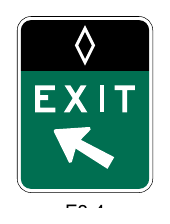
01. For contiguous preferential lanes on the left-hand side of the roadway, Advance Guide signs, Exit Direction signs, and Exit Gore (E8-4) signs (see Figure 2G-15) specifically applicable to the preferential lanes shall be used for exits to direct access ramps, such as HOV lane ramps (see Figure 2G-16) or ramps to park-and-ride facilities.
02. The design of Advance Guide, Exit Direction, and Pull-Through signs for direct exits from preferential lanes shall be distinguished from those applicable to general-purpose lanes by inclusion of an upper section with the applicable black legend on a white background, such as HOV LANE (for Pull-Through signs) or HOV EXIT (for Advance Guide and Exit Direction signs). For preferential lanes that incorporate a vehicle occupancy requirement, the white diamond symbol on a black background shall be displayed at the left-hand edge of this upper section (see Figures 2G-16 and 2G-17).
Guidance
03. Advance Guide and Exit Direction signs for exits to direct access ramps from a preferential lane should be mounted overhead. A Pull-Through sign over the preferential lane should be used with the Exit Direction sign at exits to direct access ramps.
Standard
04. Post-mounted guide signs in a vertically-oriented rectangular shape installed on a median barrier shall not be used for the Advance Guide and Exit Direction signs for exits to direct access ramps.
05. Because direct access ramps for preferential lanes at interchanges connecting two freeways are typically left-hand side exits and typically have design speeds similar to the preferential lane, overhead Advance Guide signs and overhead Exit Direction signs shall be provided in advance of and at the entry point to each freeway-to-freeway preferential lane ramp (see Figure 2G-17).
Guidance
06. The use of guide signs for preferential lanes at freeway interchanges should comply with the provisions for guide signs established in Chapter 2E of this Manual.
Support
07. Guide signs for direct access ramps for preferential lanes at interchanges connecting two freeways are similar to those for a connecting ramp between two freeway facilities.
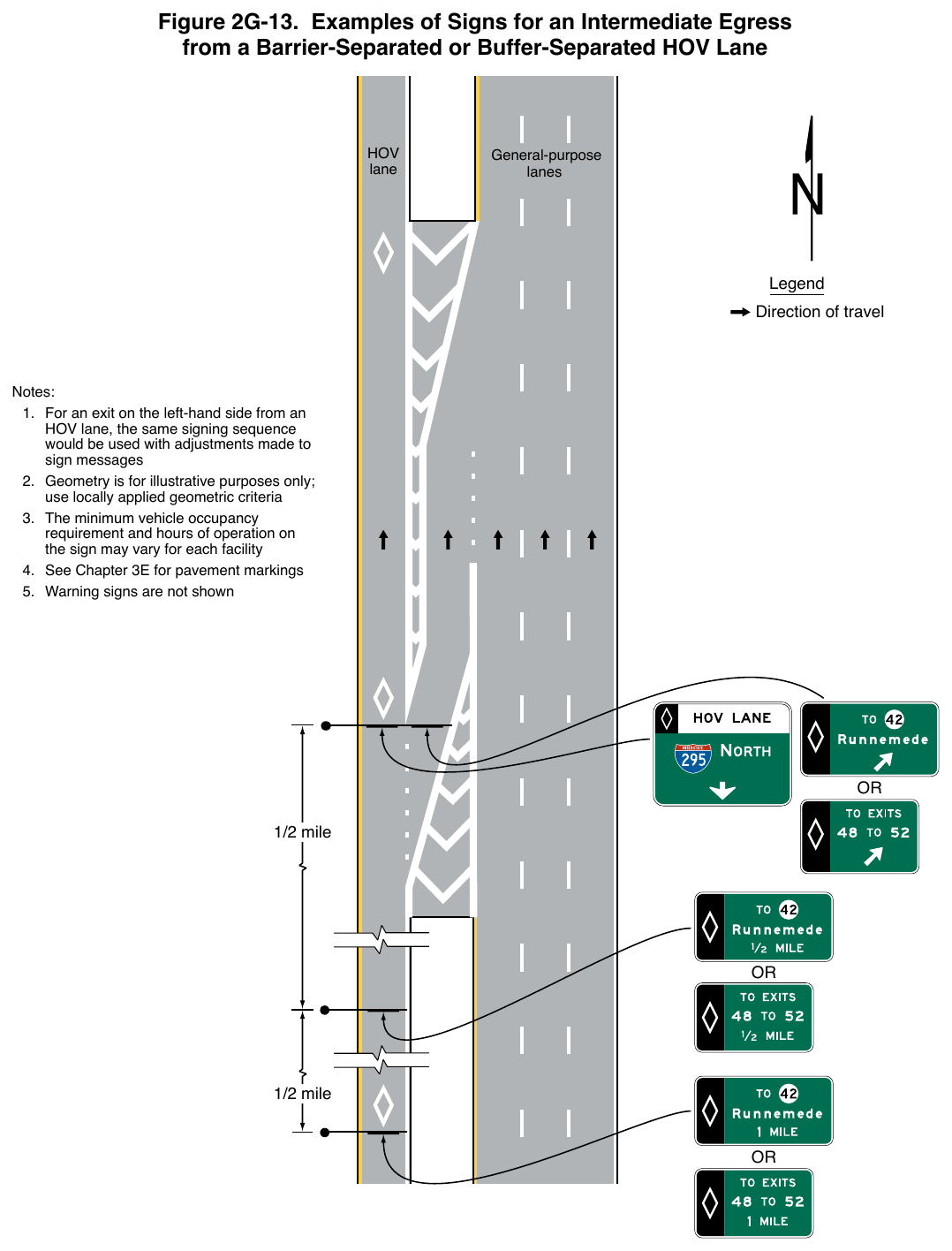
- 1. For an exit on the left-hand side from an HOV lane, the same signing sequence would be used with adjustments made to sign messages
- 2. Geometry is for illustrative purposes only; use locally applied geometric criteria
- 3. The minimum vehicle occupancy requirement and hours of operation on the sign may vary for each facility
- 4. See Chapter 3E for pavement markings
- 5. Warning signs are not shown OR 1/2 mile OR 1/2 mile OR
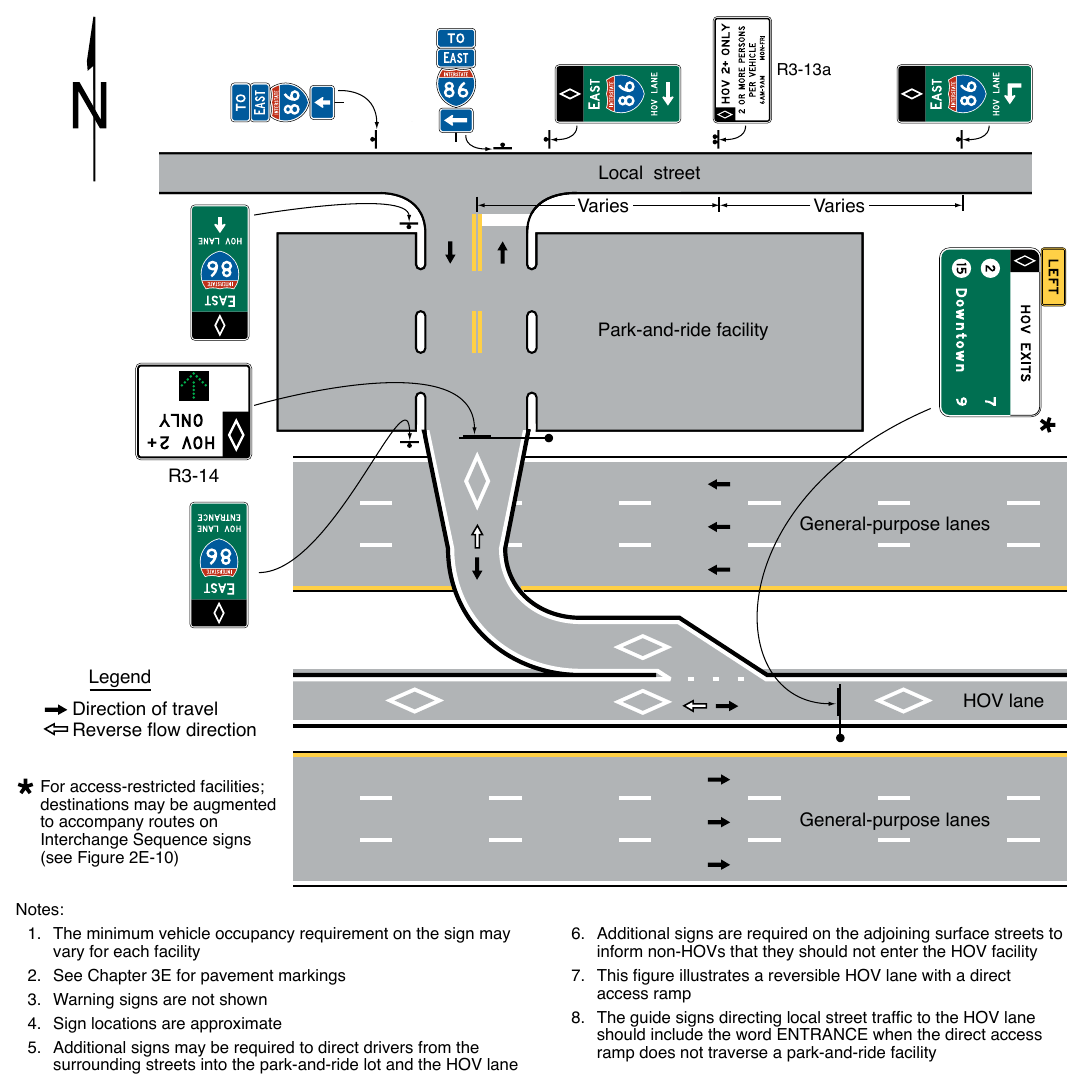
For access-restricted facilities; destinations may be augmented to accompany routes on Interchange Sequence signs (see Figure 2E-10) General-purpose lanes Notes:
- 1. The minimum vehicle occupancy requirement on the sign may vary for each facility
- 2. See Chapter 3E for pavement markings
- 3. Warning signs are not shown
- 4. Sign locations are approximate
- 5. Additional signs may be required to direct drivers from the surrounding streets into the park-and-ride lot and the HOV lane
- 6. Additional signs are required on the adjoining surface streets to inform non-HOVs that they should not enter the HOV facility
- 7. This figure illustrates a reversible HOV lane with a direct access ramp
- 8. The guide signs directing local street traffic to the HOV lane should include the word ENTRANCE when the direct access ramp does not traverse a park-and-ride facility
Signs shown: E8-4
Note: An example of an HOV lane (diamond symbol) sign is illustrated. For other types of preferential lanes, the appropriate symbol or word message (see Section 2G.03) is displayed in white on the black background of the top portion of this sign.
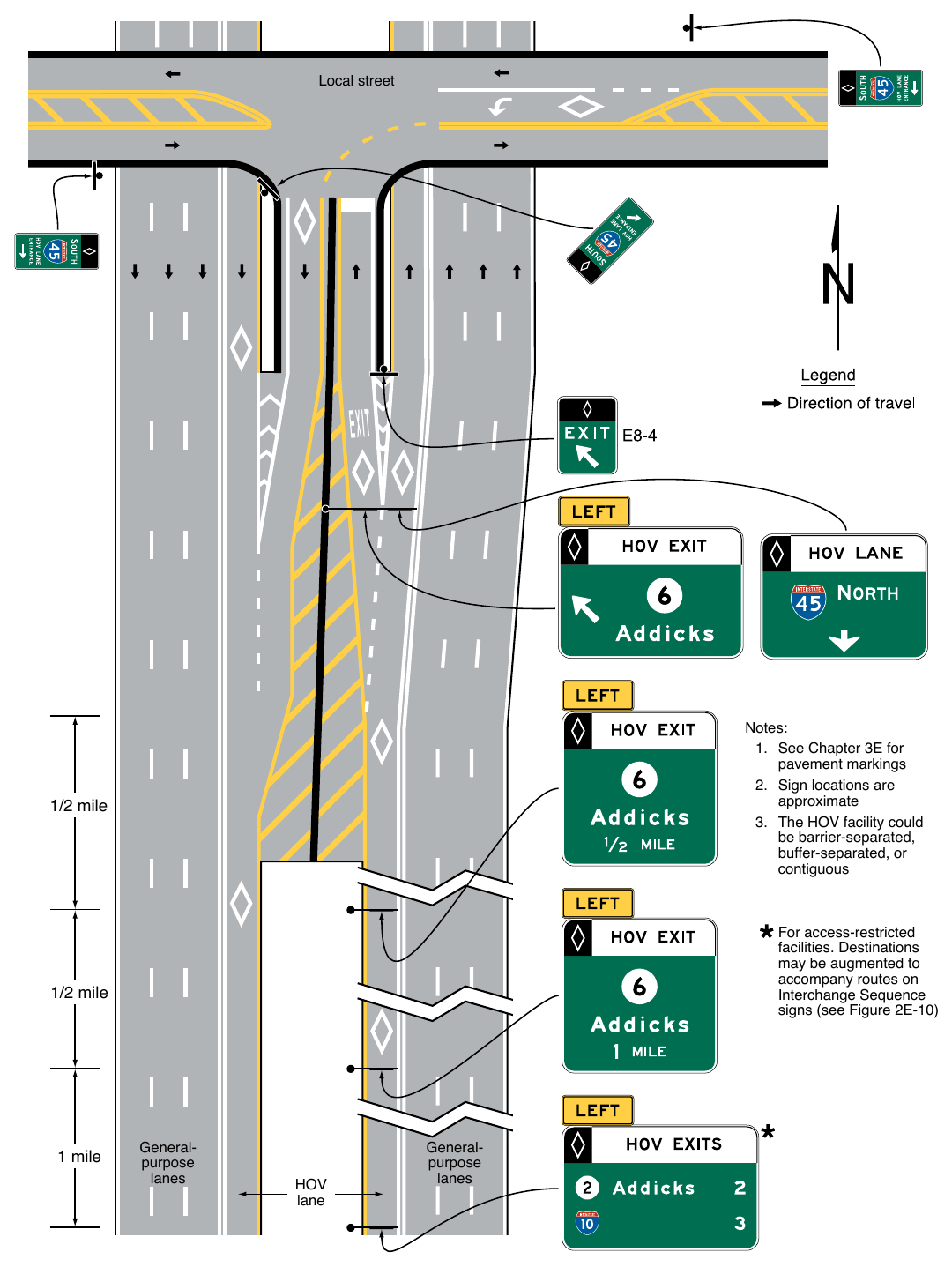
- 2. Sign locations are approximate
- 3. The HOV facility could be barrier-separated, buffer-separated, or contiguous 1/2 mile For access-restricted facilities. Destinations may be augmented to accompany routes on Interchange Sequence signs (see Figure 2E-10) 1/2 mile 1 mile General-purpose lanes HOV lane General-purpose lanes
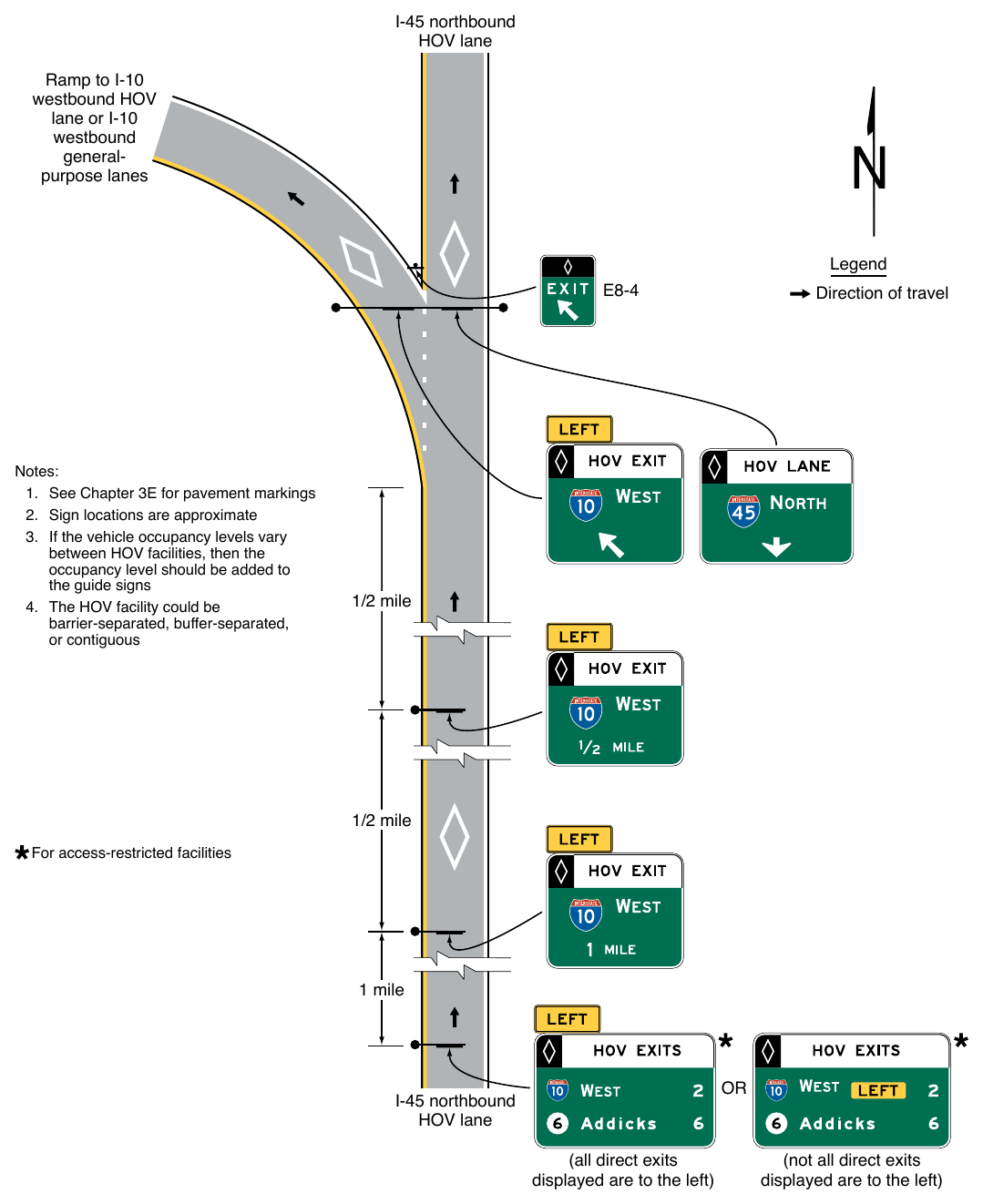
Signs shown: E8-4
- 2. Sign locations are approximate
- 3. If the vehicle occupancy levels vary between HOV facilities, then the occupancy level should be added to the guide signs
- 4. The HOV facility could be barrier-separated, buffer-separated, or contiguous Direction of travel 1/2 mile 1/2 mile For access-restricted facilities 1 mile OR I-45 northbound HOV lane (all direct exits displayed are to the left) (not all direct exits displayed are to the left)
MANAGED LANE SIGNS, PLAQUES, AND LANE-USE CONTROL SIGNALS¶
§2G.16 Signs for Managed Lanes – General¶
Standard
01. The provisions of Sections 2G.03 through 2G.07 regarding regulatory signs for preferential lanes shall apply to managed lanes operated at all times or at certain times by varying vehicle occupancy requirements (HOV) or by using vehicle type restrictions as a congestion management strategy. Such managed lanes shall use changeable message signs or changeable message elements within static signs to display the appropriate regulatory sign messages only when they are in effect.
02. When certain types of vehicles (such as trucks) are prohibited from using a managed lane or when a managed lane is restricted to use by only certain types of vehicles during certain operational strategies, regulatory signs or regulatory panels within the appropriate guide signs that include changeable message elements shall be used to display the open/closed status of the managed lane for such vehicle types.
03. When the vehicle occupancy required for use of an HOV lane is varied as a part of a managed lane operational strategy, regulatory signs that include changeable message elements shall be used to display the required minimum vehicle occupancy in effect.
Support
04. Section 2G.18 contains information about regulatory signs for managed lanes that use tolling or pricing as a congestion management strategy, either exclusively or with other management strategies.
§2G.17 Signs for Priced Managed Lanes – General¶
Support
01. A priced managed lane is a managed lane that employs tolling or pricing, typically through electronic toll collection, to manage congestion levels and maintain a certain level of service for users of the facility. A priced managed facility typically provides a less-congested alternative to adjacent lanes along the same designated route, or to a nearby facility, that experience recurring congestion during peak periods. A priced managed lane might allow non-toll travel by certain vehicles based on occupancy or other criteria. A variety of operational management strategies might be used in conjunction with tolling or pricing.
02. The number and combination of operational strategies that are applied to a managed lane to manage congestion or improve efficiency might be practically limited by the amount of information that can be legibly displayed on signs or in signing sequences and still be readily comprehended by road users. Such factors to consider when evaluating alternatives for managed lanes are locations of signs for general-purpose interchanges and for other roadway conditions, the number of intermediate access points between the managed and general-purpose lanes and the need to repeat the operational information, and the distance over which a signing sequence that displays all of the eligibility requirements can be displayed.
03. Because managed lanes have the capability to employ a variety of operational strategies on a changing basis, it is not practical to assign a naming convention to such lanes for the purpose of signing based on the specific operational management strategies, as is more readily accomplished with other types of preferential lanes, such as HOV, bus, or bicycle lanes. Instead, the various requirements, restrictions, and eligibility criteria are more appropriately conveyed through a sequence of regulatory and guide signs with a more encompassing designation for the purpose of providing directional information.
04. As priced managed lanes have become prevalent as an operational strategy, it is important to maintain a uniform naming convention to distinguish those lanes that are an alternative to travel on adjacent general-purpose lanes on the same designated route to effectively communicate to motorists the range of basic requirements for similar facilities in different regions.
Standard
05. Priced managed lanes that are adjacent to general-purpose lanes along the same designated route shall be signed using the legend EXPRESS or EXPRESS LANE(S) as provided in this Chapter. This provision shall apply when any of the following operational strategies is used for a managed lane:
- A. All users of the managed lane are charged a fixed or variable toll;
- B. General-purpose traffic using the managed lane is charged a fixed or variable toll, but HOV traffic is allowed to travel without being charged a toll on either a full-time or part-time basis;
- C. General-purpose traffic using the managed lane is charged a fixed or variable toll, but HOV traffic is offered a discounted toll on either a full-time or part-time basis; or
- D. General-purpose traffic using the managed lane is charged a fixed or variable toll, but HOV traffic registered with a local program travels at a discounted toll or without being charged a toll on either a full-time or part-time basis (a transponder or other identifier is typically required of HOVs to indicate registration in conjunction with electronic or visual enforcement and verification of vehicle occupancy).
06. The legends EXPRESS and EXPRESS LANE(S) shall not be used on signs for entrances to highways on which all lanes are managed and there are no adjacent general-purpose lanes on the same designated route. The legends EXPRESS and EXPRESS LANE(S) shall not be used on signs for a managed ramp connection that provides an alternative to a general-purpose ramp connection (see Figure 2F-13), except where the ramp leads directly to a managed lane as described in Section 2G.14. The legends EXPRESS and EXPRESS LANE(S) shall not be used on signs for open-road tolling lanes that bypass a conventional toll plaza (see Chapter 2F).
§2G.18 Regulatory Signs for Priced Managed Lanes¶
Standard
01. Except as otherwise provided in this Section, the provisions of Sections 2G.03 through 2G.07 regarding regulatory signs for Preferential lanes shall apply to priced managed lanes operated at all times or at certain times with a toll payment requirement of some or all vehicles to use the lane(s). Such managed lanes shall use changeable message signs or changeable message elements within static signs to display the appropriate regulatory sign messages only when they are in effect.
02. Regulatory signs for preferential lanes shall be appropriately modified for adaptation to a priced managed lane, where applicable, as shown in Figure 2G-18.
03. Regulatory signs shall be used to indicate the toll charged. If the toll varies the R3-48 and R3-48a signs that are shown in Figure 2G-18 shall be used to display the actual toll amount in effect at any given time.
04. When only vehicles with a registered ETC account are allowed to use a managed lane where some or all vehicles are charged a toll, regulatory signs to indicate such a restriction shall be provided and shall incorporate the pictograph adopted by the toll facility’s ETC payment system and the word ONLY (see Section 2G.19 for the incorporation of such regulatory legends into the guide signs for the entrances to such facilities). The display of the ETC system pictograph shall comply with the provisions of Sections 2F.02 and 2F.03 as shown in Figures 2G-18 and 2G-19.
05. When HOV traffic is allowed to use a priced managed lane without paying a toll and registration in a local program is not required to receive the toll exemption, the Vehicle Occupancy Definition (R3-10 or R3-13) signs (see Section 2G.04) shall be modified to delete the diamond symbol to create priced managed lane Vehicle Occupancy Definition (R3-40 and R3-43) signs to indicate the minimum occupancy related to the management strategy (see Figure 2G-18).
06. A Priced Managed Lane Operation (R3-44, R3-44a, or R3-44b) sign (see Figure 2G-18) shall be installed at the beginning or initial entry point, and at any intermediate entry points where vehicles are allowed to legally enter an access-restricted priced managed lane.
07. When the vehicle occupancy required for non-toll use of a managed lane is varied as a part of a priced managed lane operational strategy, regulatory signs that include changeable message elements shall be used to display the required vehicle occupancy in effect for non-toll travel.
Option
08. Where registration in a local program or ETC account is required for HOV traffic to travel in a priced managed lane without being charged a toll or by being charged a discounted toll, such information may be displayed on a separate sign within the sequence of the required regulatory and guide signs.
Standard
09. R3-42 series and R3-45 series signs (see Figure 2G-18) shall be installed in accordance with the provisions of Section 2G.07 to indicate the termination of a priced managed lane or restriction. The R3-42, R3-42a, and R3-45 signs shall be used only where the managed lane and restriction end and traffic must merge into the general-purpose lanes. The R3-42b, R3-42c, and R3-45a signs shall be used only where the managed lane restriction ends and the lane becomes a general-purpose lane.
§2G.19 Guide Signs for Priced Managed Lanes¶
Standard
01. Except as otherwise provided in this Section, guide signs for barrier-separated, buffer-separated, and contiguous managed lanes shall follow the specific provisions for Preferential Lane guide signs contained in Sections 2G.10 through 2G.15. Except as otherwise provided in this Section, guide signs for highways on which all lanes are managed shall follow the general provisions for freeway and expressway guide signs as contained in Chapter 2E as a whole. Guide signs for highways on which all lanes are managed and tolling or pricing is used as a management strategy shall follow the applicable provisions for toll road guide signs as contained in Chapter 2F, in addition to the general provisions of Chapter 2E.
02. If fixed or variable tolls are used as an operational strategy for a managed lane, the guide signs shall comply with the provisions of Sections 2F.02, 2F.03, and 2F.17 regarding the use, size, and placement of ETC-account pictographs.
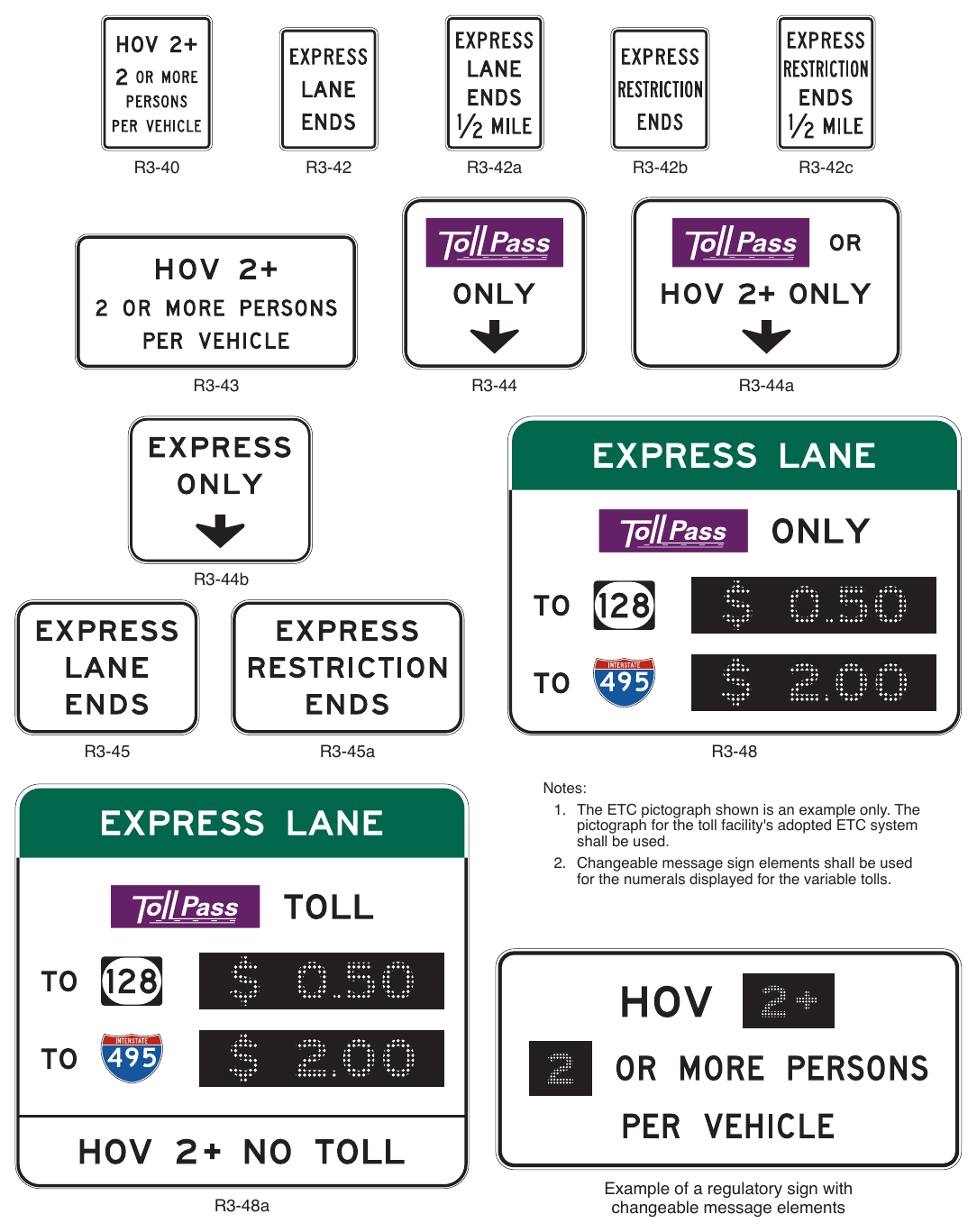
Signs shown: R3-40, R3-42, R3-42a, R3-42b, R3-42c, R3-43, R3-44, R3-44a, R3-44b, R3-45, R3-45a, R3-48, R3-48a
- 1. The ETC pictograph shown is an example only. The pictograph for the toll facility's adopted ETC system shall be used.
- 2. Changeable message sign elements shall be used for the numerals displayed for the variable tolls. R3-48a Example of a regulatory sign with changeable message elements Guide signs at the initial and intermediate entry points to a priced managed lane in which all general-purpose passenger vehicles are allowed shall include the legend EXPRESS LANE(S). Except as provided in Paragraph 5 of this Section, the guide signs shall incorporate the pictograph of the ETC account system into a header panel within the guide sign in accordance with Sections 2F.02, 2F.03, and 2F.17. For a priced managed lane that allows non-toll travel by HOV traffic without registration in a local program, the header panel shall be modified to a regulatory format to display both the pictograph of the ETC account system and the minimum occupancy requirement for non-toll travel with a black legend on a white background (see Figure 2G-19).
04. Guide signs at the initial and intermediate entry points to a managed lane that allows only HOV traffic with either a fixed or variable occupancy requirement shall follow the provisions of Sections 2G.10 through 2G.12 and 2G.14.
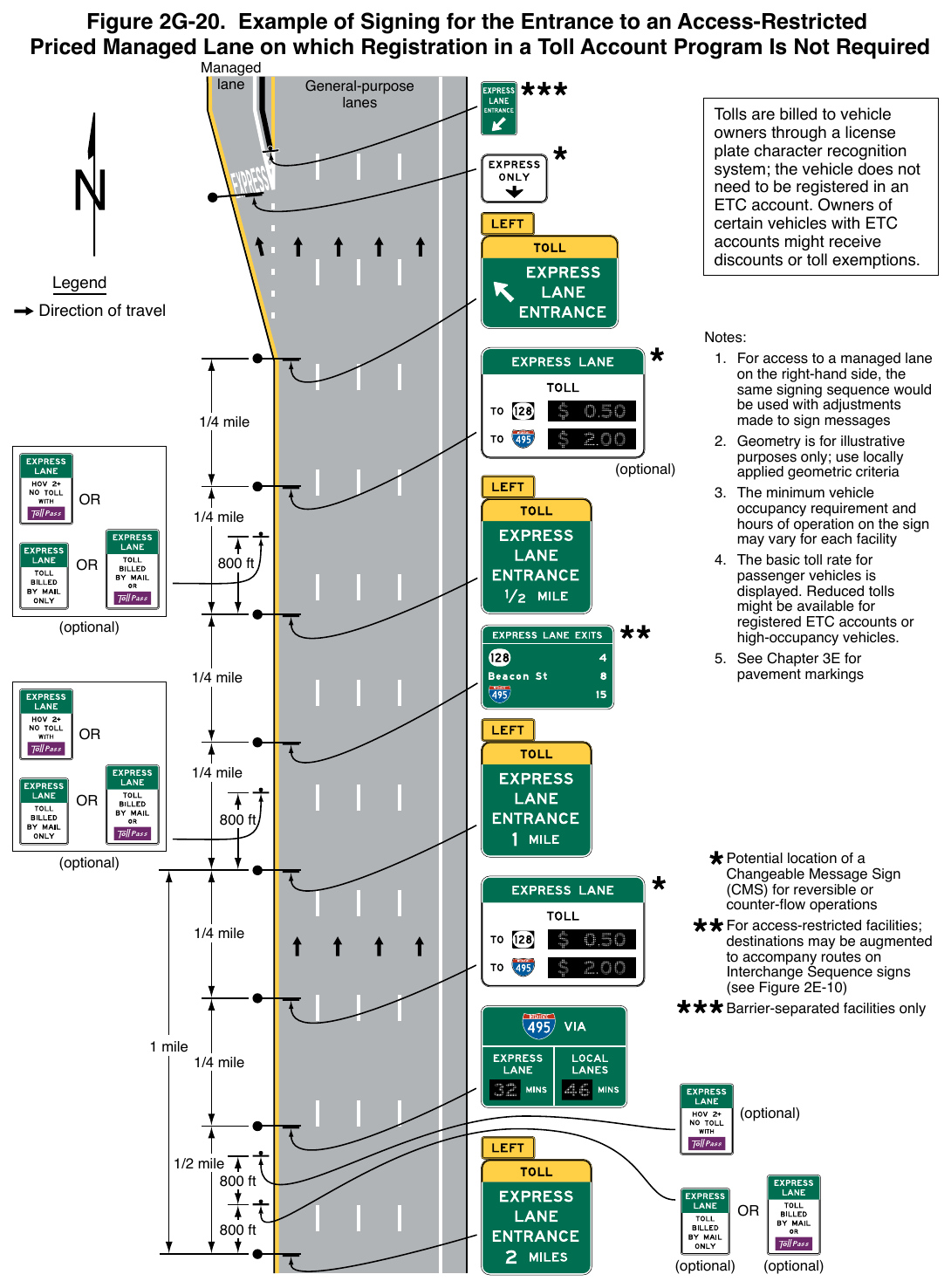
05. If registration in a toll-account program is not required for travel in a managed lane in which tolls are charged, then the ETC-account pictographs shall not be displayed on primary guide signs directing traffic to the managed lane. In such cases, the purple header panel shall be replaced with a warning header panel with a black legend and border on a yellow background displaying the word TOLL as illustrated in Figure 2G-20.
Option
06. If the managed lane does not accept toll payments from an ETC account system and collects tolls only by posttravel billing of registered vehicle owners, then the legend TOLL BILLED BY MAIL ONLY may be displayed on a separate information sign within the sequence of primary guide signs in advance of the entrance to the managed lane.
07. If the managed lane accepts payments from registered ETC accounts, but does not require registration to use the lane, then the pictographs of the accepted ETC account programs may be displayed on a separate information sign within the sequence of primary guide signs in advance of the entrance to the managed lane. The information sign may also display the legend TOLL BILLED BY MAIL OR in addition to the pictograph of the accepted ETC account program.
Support
08. Figure 2G-19 shows examples of Guide signs for entrances to priced managed lanes and other ETC account-only toll facilities that incorporate header panels with ETC account pictographs and regulatory legends.
09. Figures 2G-21 through 2G-24 show examples of guide signs for various configurations of initial and intermediate entrances to a priced managed lane.
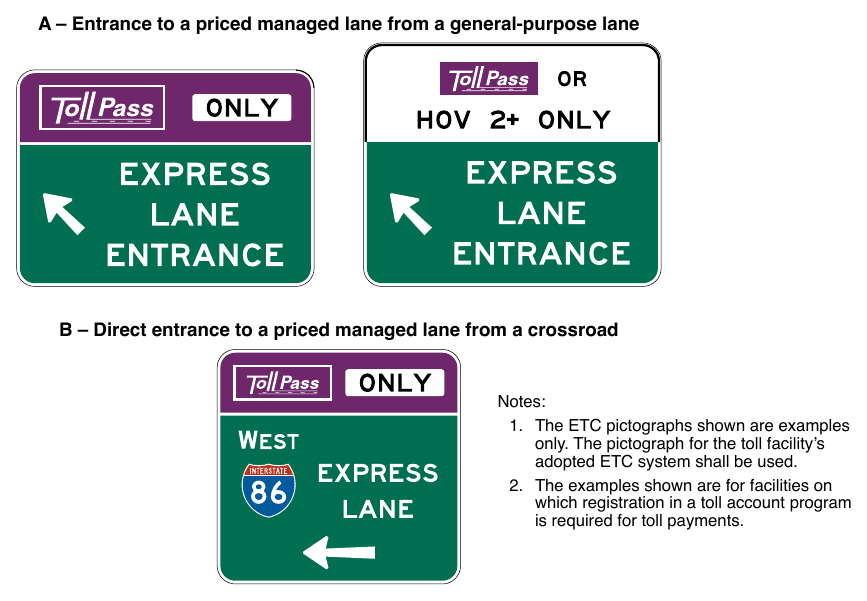
- 1. The ETC pictographs shown are examples only. The pictograph for the toll facility’s adopted ETC system shall be used.
- 2. The examples shown are for facilities on which registration in a toll account program is required for toll payments.
on the right-hand side, the same signing sequence would be used with adjustments made to sign messages
- 2. Geometry is for illustrative purposes only; use locally applied geometric criteria
- 3. The minimum vehicle occupancy requirement and hours of operation on the sign may vary for each facility
- 4. The basic toll rate for passenger vehicles is displayed. Reduced tolls might be available for registered ETC accounts or high-occupancy vehicles.
- 5. See Chapter 3E for pavement markings OR 1/4 mile OR 800 ft (optional) 1/4 mile 1 mile Potential location of a Changeable Message Sign (CMS) for reversible or counter-flow operations For access-restricted facilities; destinations may be augmented to accompany routes on Interchange Sequence signs (see Figure 2E-10) Barrier-separated facilities only 1/4 mile (optional) 1/2 mile 800 ft OR 800 ft (optional) (optional)
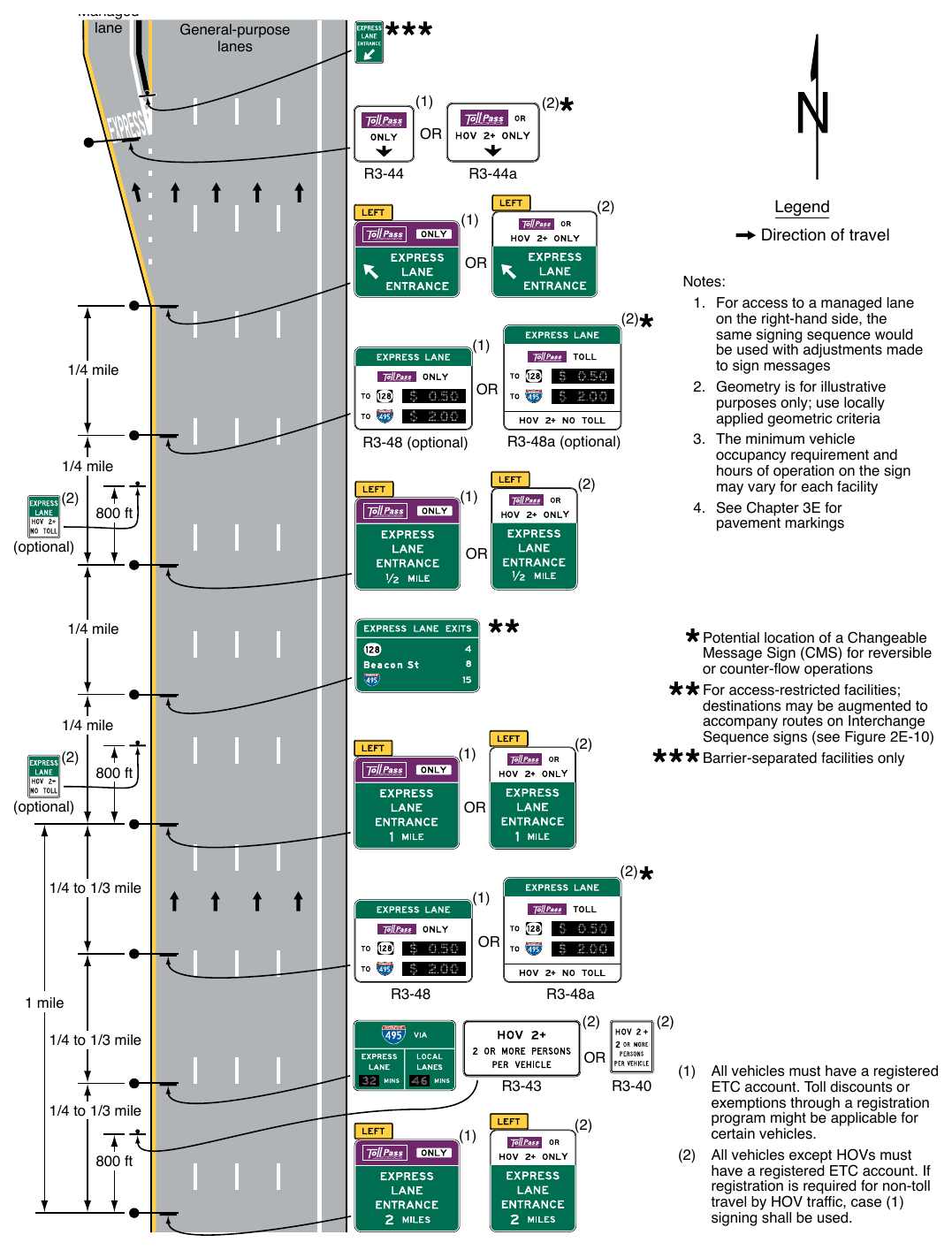
on the right-hand side, the same signing sequence would be used with adjustments made to sign messages
- 2. Geometry is for illustrative purposes only; use locally applied geometric criteria
- 3. The minimum vehicle occupancy requirement and hours of operation on the sign may vary for each facility
- 4. See Chapter 3E for pavement markings (2) (1) 1/4 mile OR R3-48a (optional) R3-48 (optional) 1/4 mile (2) (2) (1) 800 ft (optional) OR 1/4 mile 1/4 mile (2) (2) (1) 800 ft (optional) Potential location of a Changeable Message Sign (CMS) for reversible or counter-flow operations For access-restricted facilities; destinations may be augmented to accompany routes on Interchange Sequence signs (see Figure 2E-10) Barrier-separated facilities only OR (2) 1/4 to 1/3 mile (1) OR R3-48a R3-48 1 mile OR R3-43 1/4 to 1/3 mile (1) 800 ft (2) (2) 1/4 to 1/3 mile R3-40 (1) (2) (2) All vehicles must have a registered ETC account. Toll discounts or exemptions through a registration program might be applicable for certain vehicles. All vehicles except HOVs must have a registered ETC account. If registration is required for non-toll travel by HOV traffic, case (1) signing shall be used.
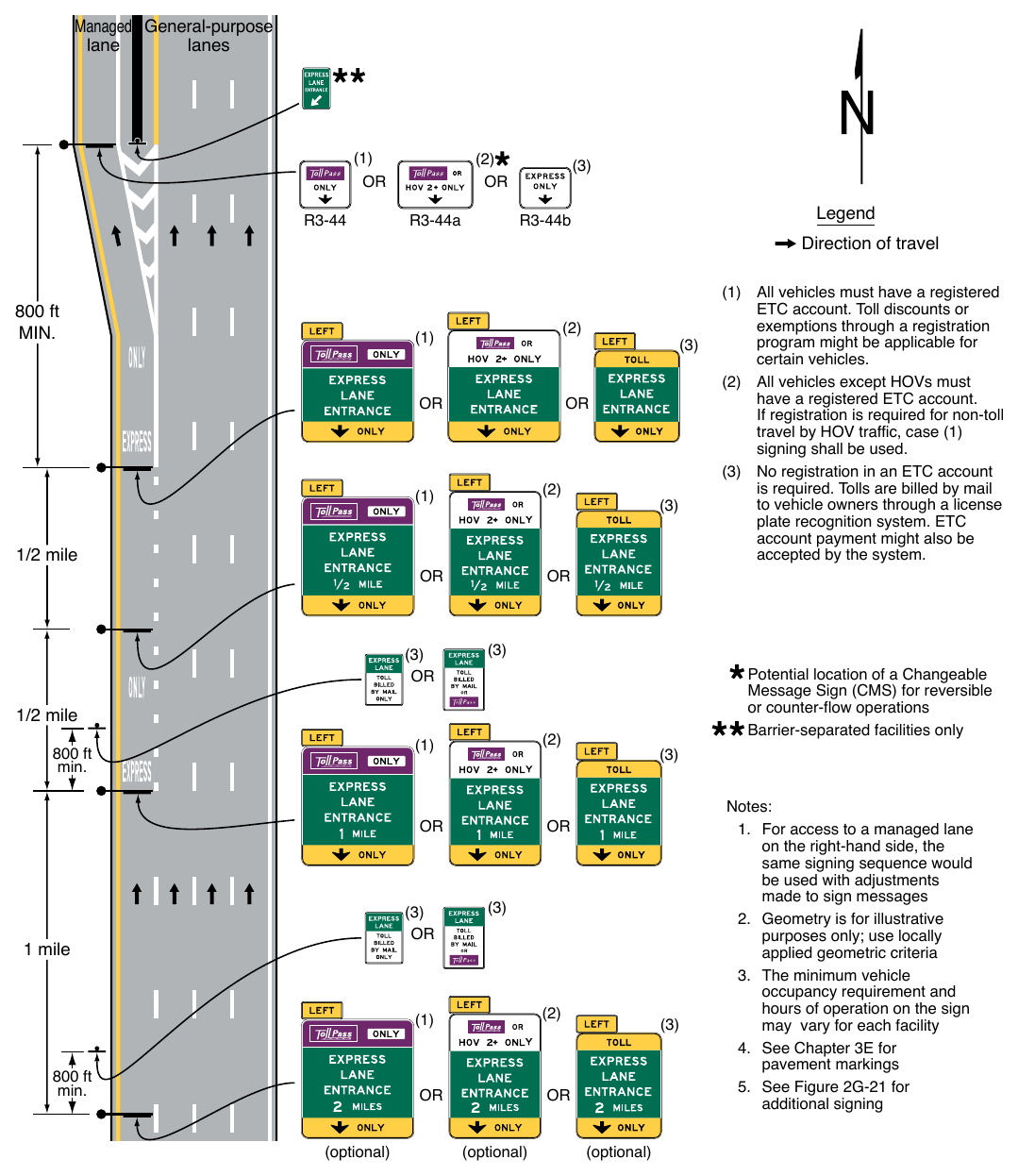
exemptions through a registration program might be applicable for certain vehicles. (2) All vehicles except HOVs must have a registered ETC account. If registration is required for non-toll travel by HOV traffic, case (1) signing shall be used. (3) No registration in an ETC account is required. Tolls are billed by mail to vehicle owners through a license plate recognition system. ETC account payment might also be accepted by the system. Potential location of a Changeable Message Sign (CMS) for reversible or counter-flow operations Barrier-separated facilities only Notes:
- 1. For access to a managed lane on the right-hand side, the same signing sequence would be used with adjustments made to sign messages
- 2. Geometry is for illustrative purposes only; use locally applied geometric criteria
- 3. The minimum vehicle occupancy requirement and hours of operation on the sign may vary for each facility
- 4. See Chapter 3E for pavement markings
- 5. See Figure 2G-21 for additional signing (optional)
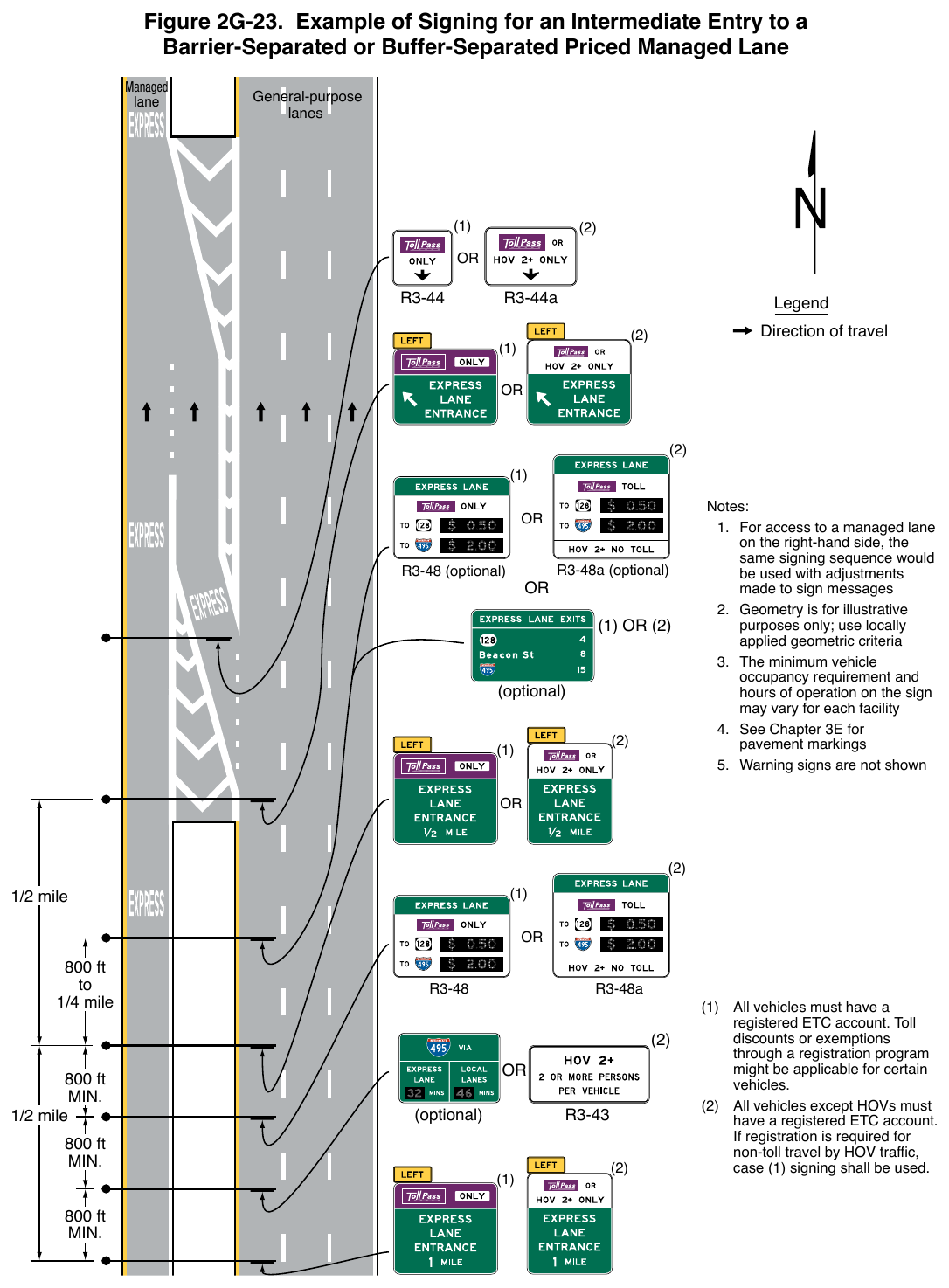
R3-48 (optional) R3-48a (optional) (optional) Notes:
- 1. For access to a managed lane on the right-hand side, the same signing sequence would be used with adjustments made to sign messages
- 2. Geometry is for illustrative purposes only; use locally applied geometric criteria
- 3. The minimum vehicle occupancy requirement and hours of operation on the sign may vary for each facility
- 4. See Chapter 3E for pavement markings
- 5. Warning signs are not shown OR (2) (1) 1/2 mile OR 800 ft to 1/4 mile R3-48 R3-48a (2) 800 ft MIN. 1/2 mile 800 ft MIN. OR R3-43 (optional) (1) (2) (1) All vehicles must have a registered ETC account. Toll discounts or exemptions through a registration program might be applicable for certain vehicles. (2) All vehicles except HOVs must have a registered ETC account. If registration is required for non-toll travel by HOV traffic, case (1) signing shall be used. 800 ft MIN.
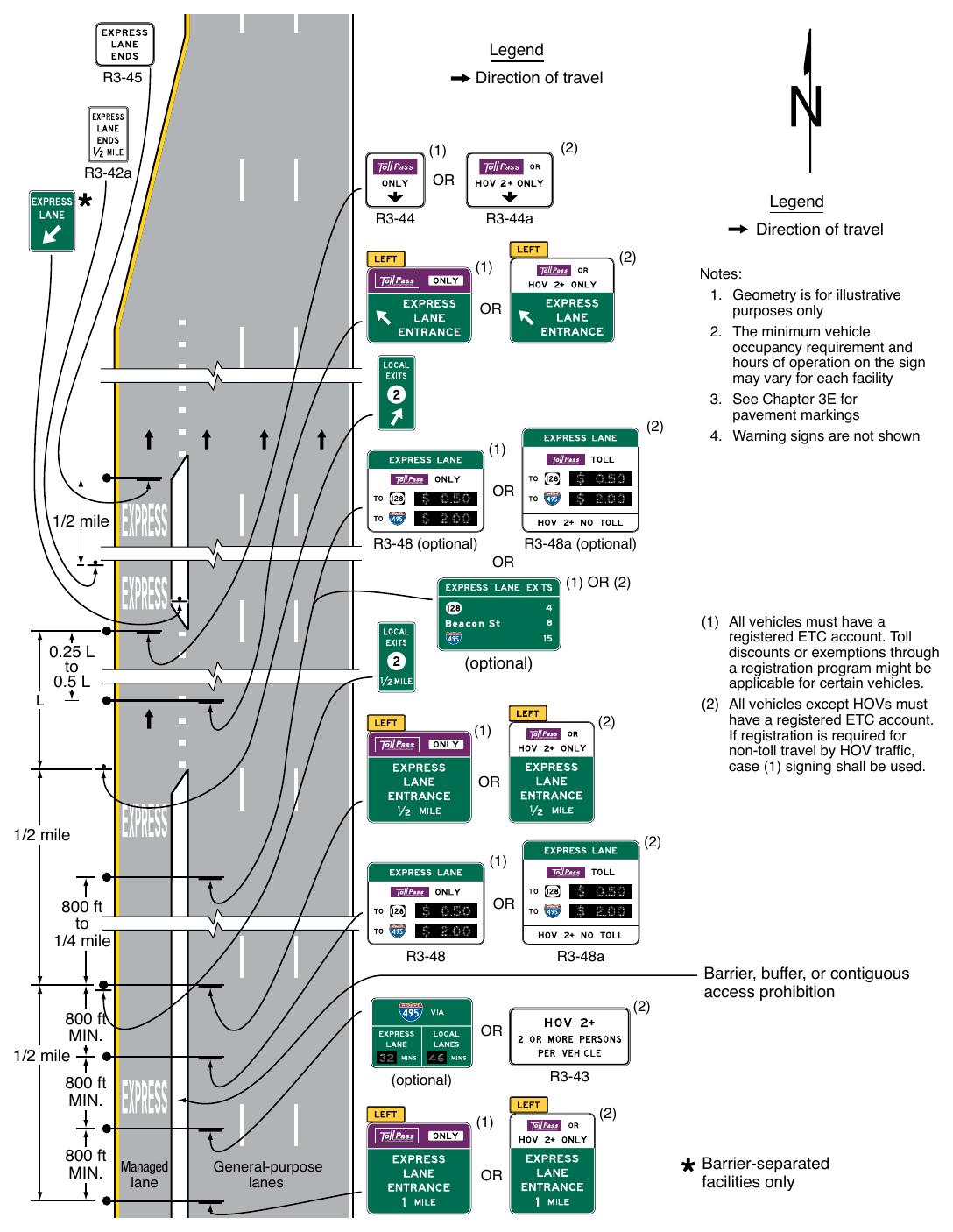
- 1. Geometry is for illustrative purposes only
- 2. The minimum vehicle occupancy requirement and hours of operation on the sign may vary for each facility
- 3. See Chapter 3E for pavement markings
- 4. Warning signs are not shown OR 1/2 mile L R3-48 (optional) 0.25 L to 0.5 L OR R3-48a (optional) (1) OR (2) (1) All vehicles must have a registered ETC account. Toll discounts or exemptions through a registration program might be applicable for certain vehicles. (2) All vehicles except HOVs must have a registered ETC account. If registration is required for non-toll travel by HOV traffic, case (1) signing shall be used. (optional) (2) (1) OR 1/2 mile (2) (1) OR 800 ft to 1/4 mile R3-48 (2) 800 ft MIN. 1/2 mile Barrier, buffer, or contiguous access prohibition OR R3-43 (optional) 800 ft MIN. (1) 800 ft MIN. Managed lane R3-48a General-purpose lanes OR (2) Barrier-separated facilities only
Guidance
10. Exit Destination supplemental guide signs, identifying final destination and downstream exit locations accessible from the managed lane (see Figure 2G-25), should be installed in advance of the initial entry points to priced managed lanes. These signs should be located in accordance with the provisions of Paragraph 6 of Section 2G.11.
11. For managed lanes that are available as an alternative to travel on adjacent general-purpose lanes on the same designated route, changeable message signs indicating the comparative travel times or congestion levels using the managed lanes versus the general-purpose lanes (see Figure 2G-26) should be installed in advance of the initial and intermediate entry points to the managed lanes.
Option
12. Changeable message signs may also be used on non-managed highways to display comparative travel times or congestion levels for a nearby managed highway.
Standard
13. The use and locations of guide signs for intermediate egress locations and direct exits from a priced managed lane (see Figures 2G-24 and 2G-27 through 2G-29) shall comply with the provisions of Sections 2G.13 and 2G.15. The signs shall be suitably modified to display header messages of white legend on a green background that relate the guide sign legends to the managed lane(s) as appropriate in accordance with the following:
- A. Post-mounted or overhead-mounted Advance Guide signs for intermediate egress to the general-purpose lanes shall include the legend LOCAL EXITS in a header panel within the guide signs, destination information or the exit number(s) for the next exit(s) accessible from the general-purpose lanes, and the appropriate distance information to the location of the egress (see Figure 2G-27).
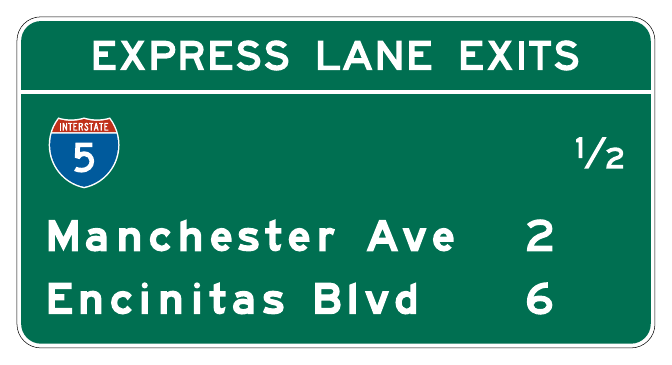
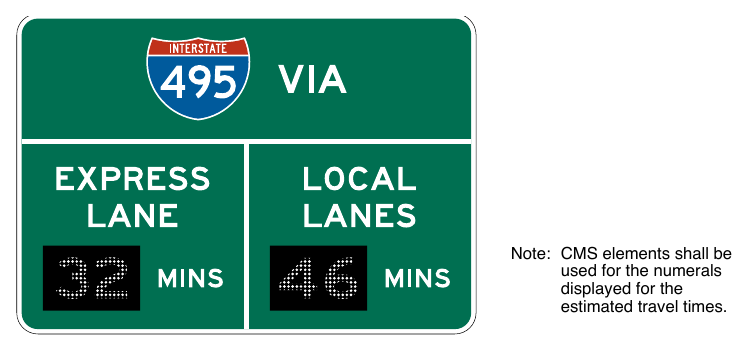
Note: CMS elements shall be used for the numerals displayed for the estimated travel times.
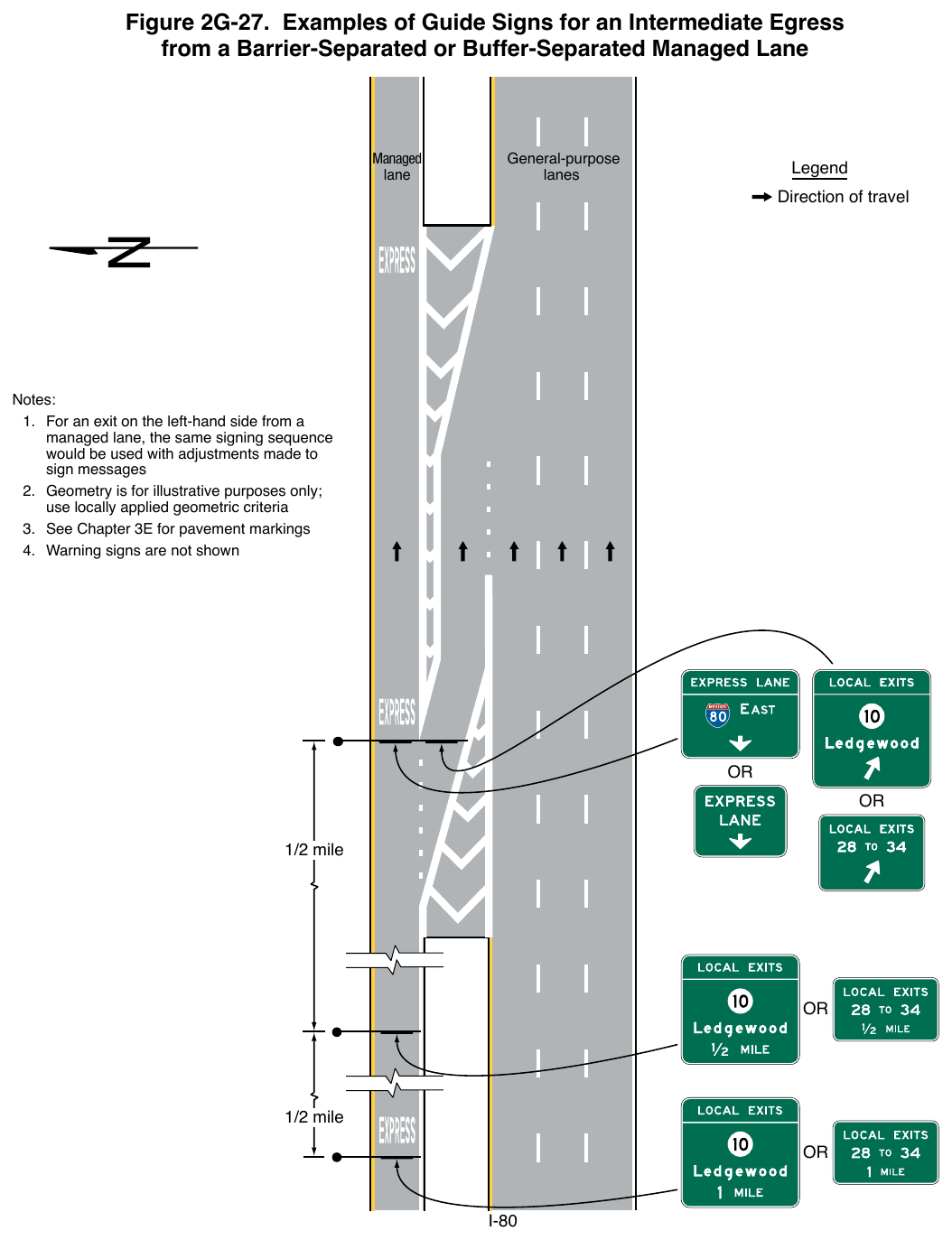
- 1. For an exit on the left-hand side from a managed lane, the same signing sequence would be used with adjustments made to sign messages
- 2. Geometry is for illustrative purposes only; use locally applied geometric criteria
- 3. See Chapter 3E for pavement markings
- 4. Warning signs are not shown OR OR 1/2 mile OR 1/2 mile OR I-80
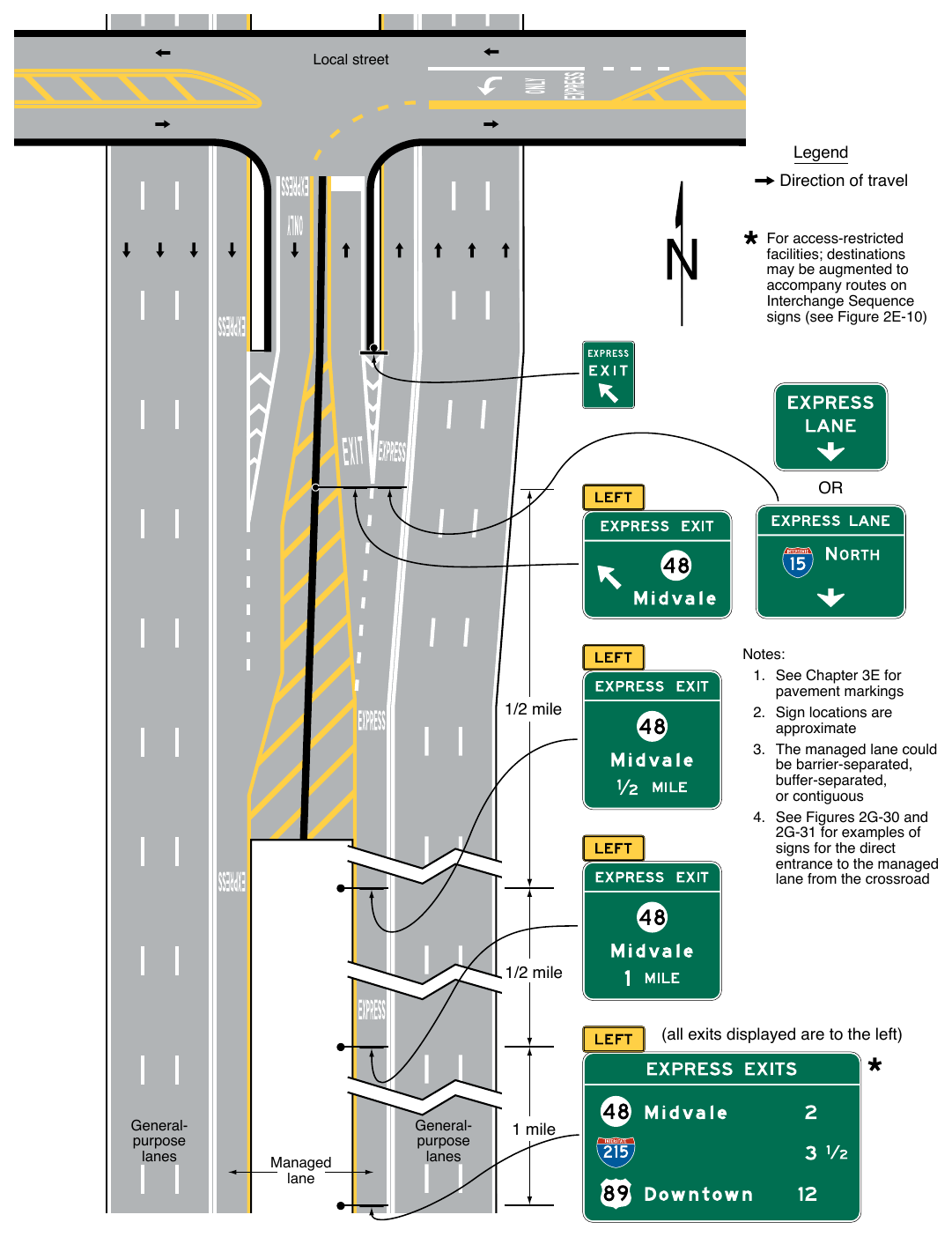
facilities; destinations may be augmented to accompany routes on Interchange Sequence signs (see Figure 2E-10) 1/2 mile Notes:
- 1. See Chapter 3E for pavement markings
- 2. Sign locations are approximate
- 3. The managed lane could be barrier-separated, buffer-separated, or contiguous
- 4. See Figures 2G-30 and 2G-31 for examples of signs for the direct entrance to the managed lane from the crossroad 1/2 mile (all exits displayed are to the left) General-purpose lanes Managed lane General-purpose lanes 1 mile
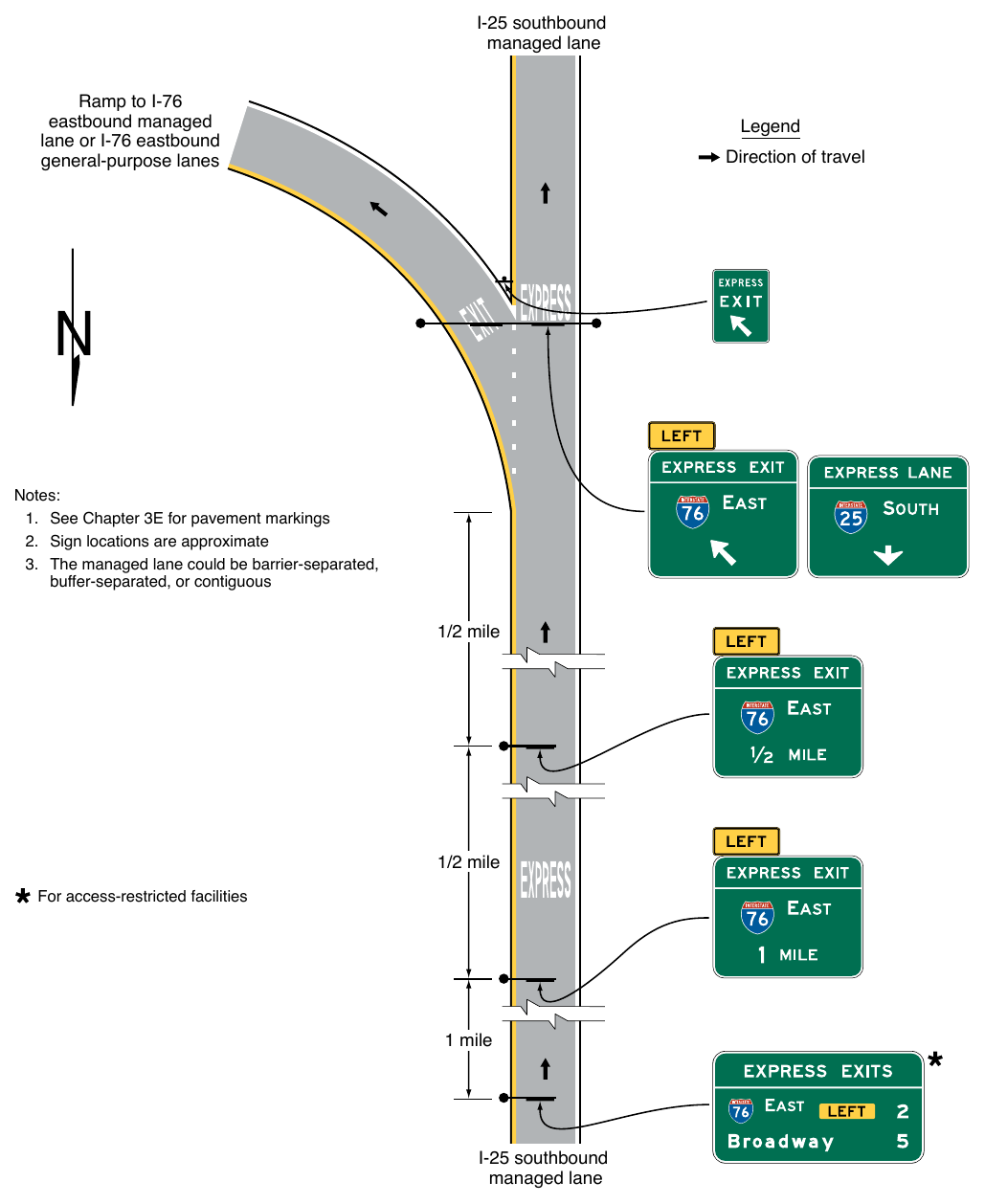
- 2. Sign locations are approximate
- 3. The managed lane could be barrier-separated, buffer-separated, or contiguous 1/2 mile 1/2 mile For access-restricted facilities 1 mile I-25 southbound managed lane
- B. Post-mounted or overhead-mounted Intermediate Egress Direction signs shall include the legend LOCAL EXITS in a header panel within the signs, the destination information or the exit number(s) of the next exit(s) accessible from the general-purpose lanes, and a diagonally upward-pointing directional arrow (see Figure 2G-27).
- C. For direct exits to another roadway, the legend EXPRESS EXIT shall be used on the Advance Guide and Exit Direction signs (see Figure 2G-28).
- D. For Pull-Through signs, the legend EXPRESS LANE(S) shall be used, either as a header panel within the Pull-Through sign or as the principal legend of the sign without a header panel (see Figures 2G-27 through 2G-29).
Support
14. Section 2G.13 contains information on the use of overhead-mounted guide signs for intermediate egress to the general-purpose lanes.
15. Figures 2G-30 and 2G-31 show examples of guide signing for direct entrances to a priced managed lane from a crossroad or surface street.
§2G.20 Signs for Part-Time Travel on a Shoulder – General¶
Support
01. In some cases, paved shoulders are allowed to be used for driving use during peak periods to manage congestion. Configurations might be on freeways and expressways, as well as on conventional roads. Travel on the shoulder during these periods might be restricted to certain classes of vehicles, such as buses or HOV, or might be open to general traffic. When the part-time travel on a shoulder is limited to certain classes of vehicles, the signing is similar to that for preferential lanes. Additional signing is typically used to advise road users that the shoulder is not available for emergency use during these periods. Part-time travel on a shoulder might also employ lane-use control signals and/or blank-out signs to inform traffic of the allowable use of the shoulder. Depending on the design of exit ramp terminals and auxiliary lanes, guide signs must account for exit maneuvers during both shoulder use conditions and might necessitate changeable legend elements. However, additional guide signs are not normally necessary specifically for the condition when the shoulder is used for travel. The pavement markings might also be modified where travel allowed on the shoulder begins and ends.
02. Figure 2G-32 shows an example of signing for part-time travel on a shoulder.
Standard
03. A shoulder that has been opened to travel on a permanent, full-time basis shall be considered a travel lane and shall be signed and marked in accordance with other provisions of this Manual.
Support
04. Section 3E.04 contains provisions regarding the placement of markings on paved shoulders that are open for part-time travel.
§2G.21 Regulatory Signs and Plaques for Part-Time Travel on a Shoulder¶
Standard
01. Regulatory signs shall be used to notify road users of the periods of operation that travel is allowed on a paved shoulder. The Part-Time Travel on Shoulder Operation (R3-51) sign (see Figure 2G-32) shall be used where traffic is allowed to travel on the shoulder during certain fixed periods of operation. The Part-Time Travel on Shoulder Variable Operation (R3-51d) sign (see Figure 2G-32) with two flashing beacons (see Chapter 4S) mounted above it shall be used when the period of operation is variable.
02. If certain classes of vehicles are not allowed to use the shoulder during these periods, then a Selective Exclusion (R3-51aP or R3-51bP) plaque shall be mounted below the R3-51 or R3-51d sign. If the travel on the shoulder is restricted to certain classes of vehicles, then the regulatory signs shall display that information.
Option
03. The EMERGENCY STOPPING ONLY OTHER TIMES (R3-51cP) plaque may be mounted below the R3-51 sign if the R3-51aP or R3-51bP plaque is not used.
Guidance
04. The Part-Time Travel on Shoulder Begins Advance (R3-52c) sign should be used in advance of the location where part-time travel on shoulder first begins and followed by the DO NOT DRIVE ON SHOULDER (R4-17) sign appropriately spaced downstream.
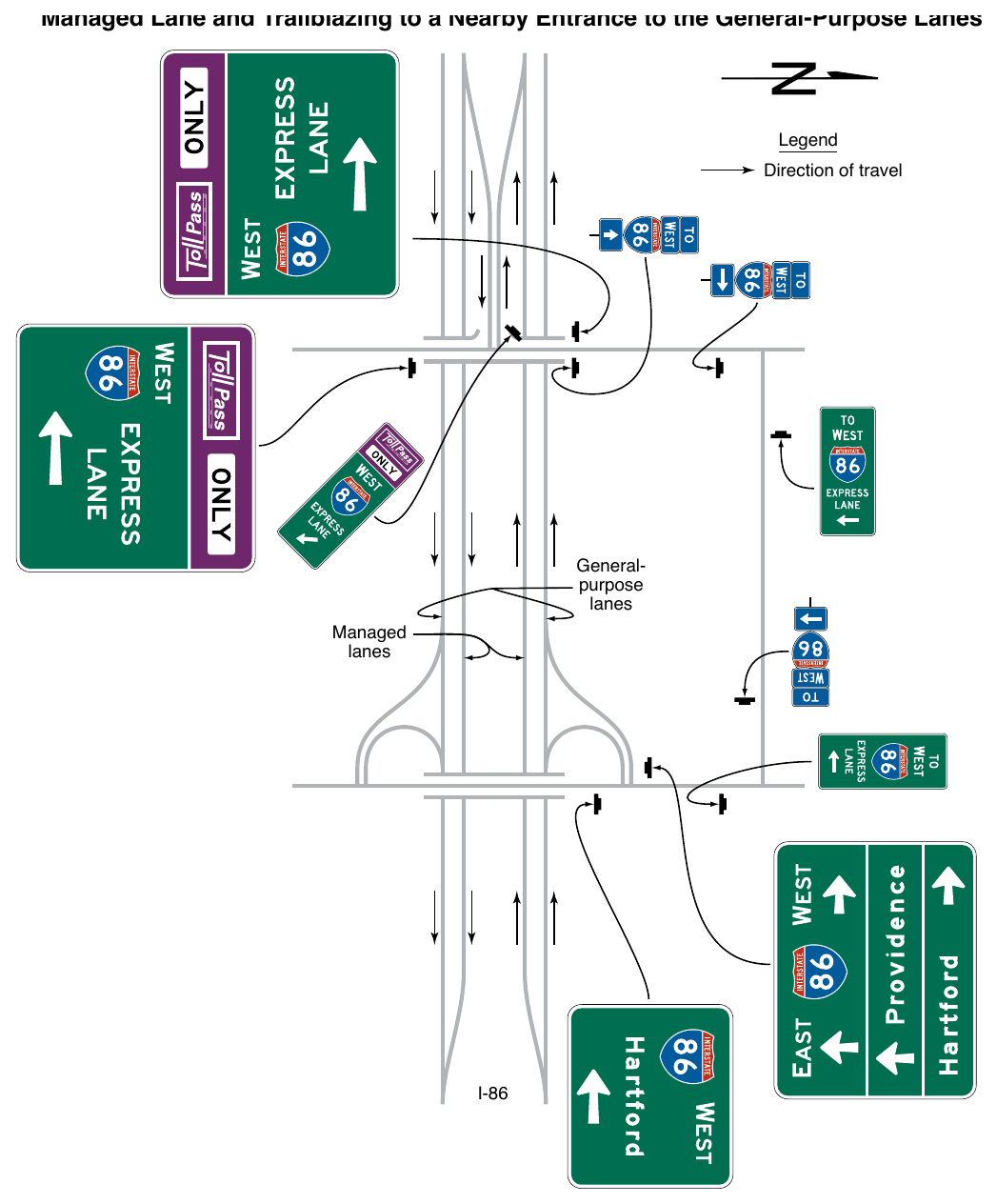
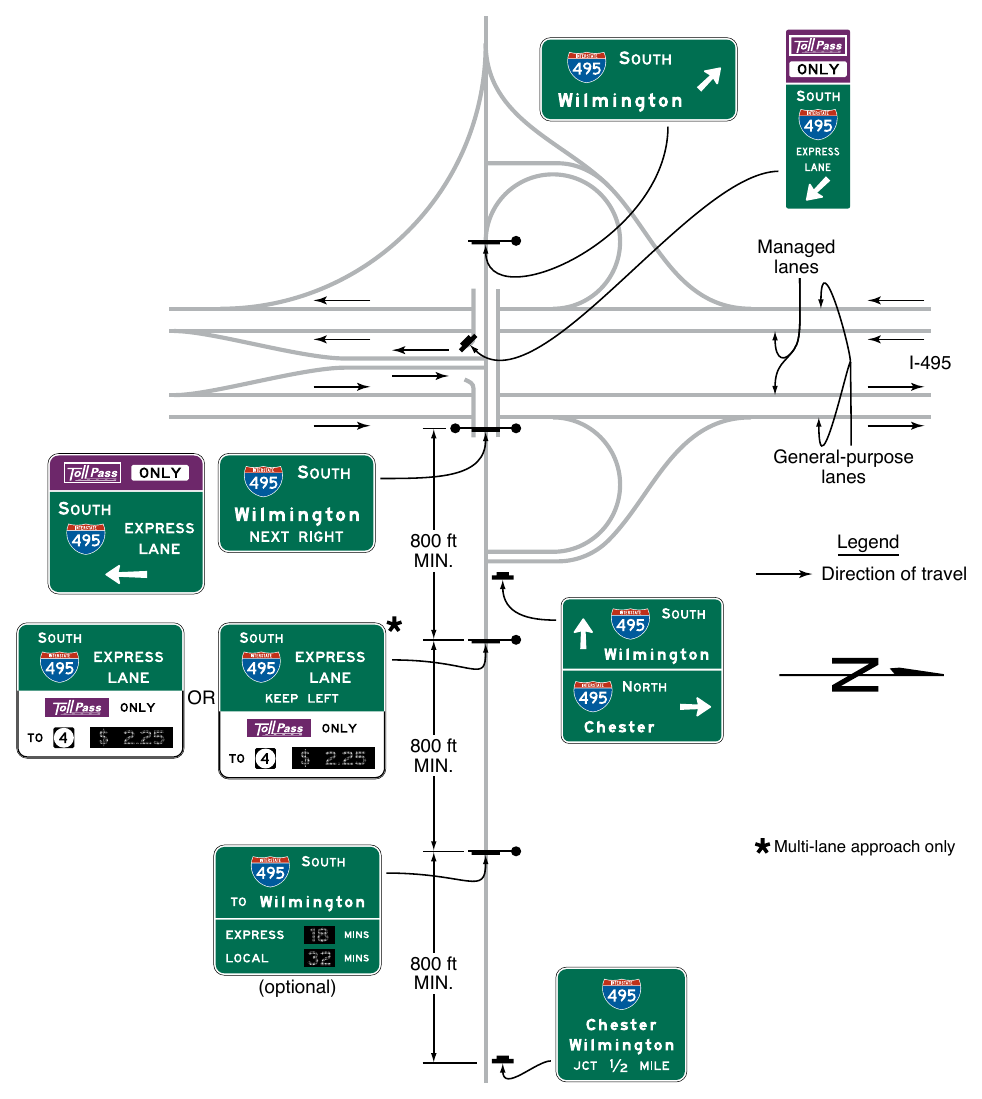
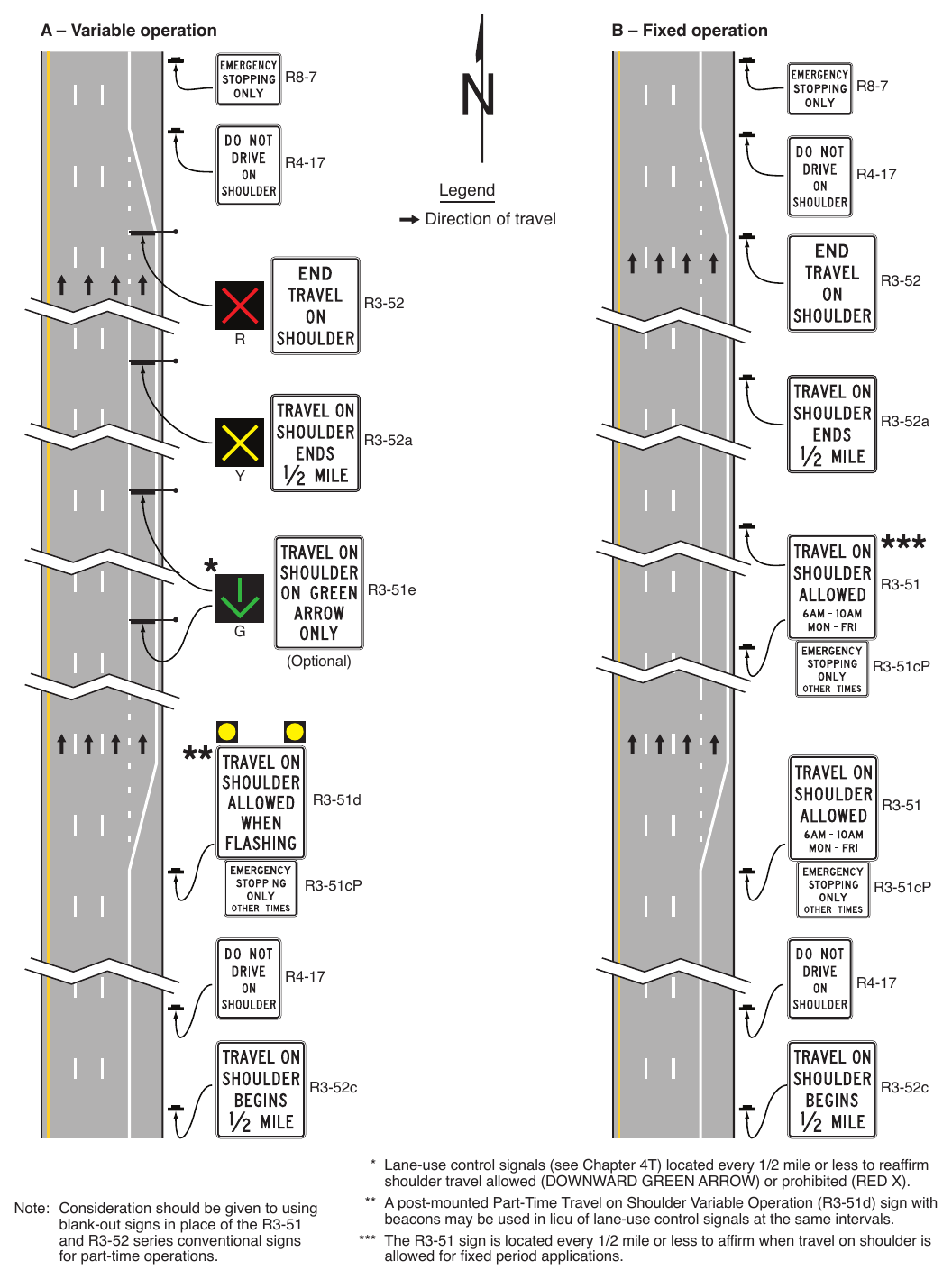
Signs shown: R8-7, R4-17, R3-52, R3-52a, R3-51, R3-51e, R3-51cP, R3-51d, R3-52c
Note: Consideration should be given to using blank-out signs in place of the R3-51 and R3-52 series conventional signs for part-time operations. R3-52c shoulder travel allowed (DOWNWARD GREEN ARROW) or prohibited (RED X). beacons may be used in lieu of lane-use control signals at the same intervals. allowed for fixed period applications.
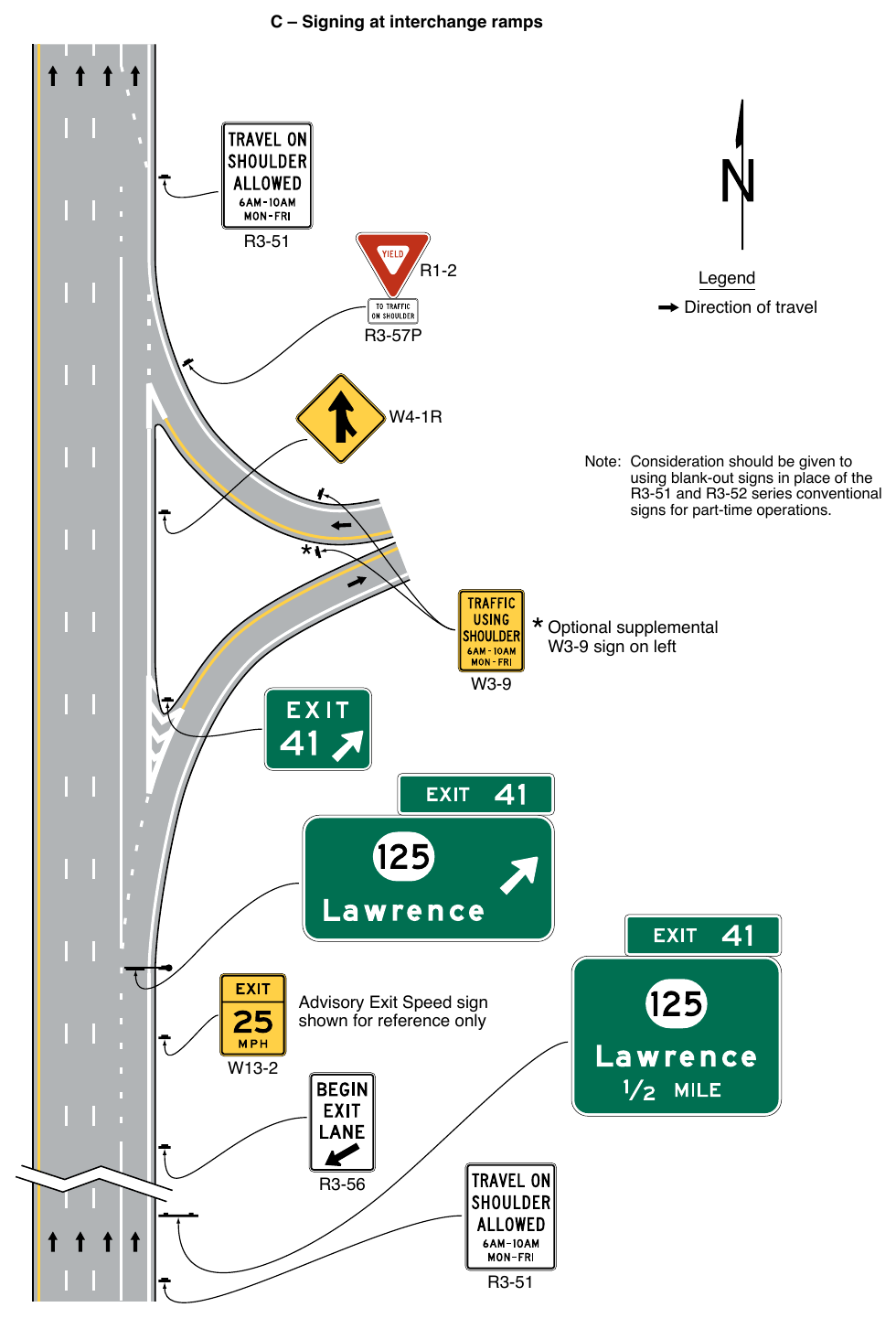
Signs shown: R3-51, R1-2, R3-57P, W4-1R, R3-52, W3-9, W13-2, R3-56
Note: Consideration should be given to using blank-out signs in place of the R3-51 and R3-52 series conventional signs for part-time operations.
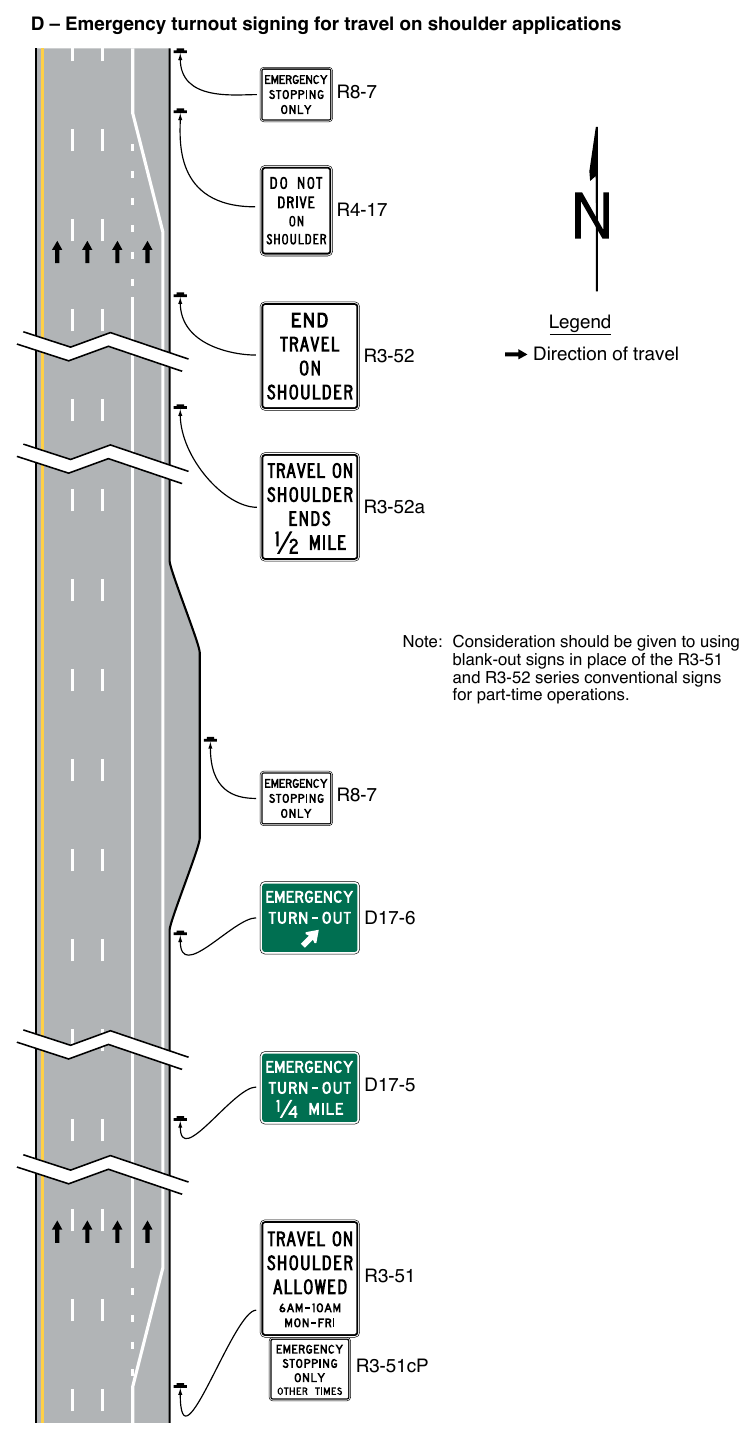
Signs shown: R8-7, R4-17, R3-52, R3-52a, R3-51, D17-6, D17-5, R3-51cP
Note: Consideration should be given to using blank-out signs in place of the R3-51 and R3-52 series conventional signs for part-time operations. R3-51cP
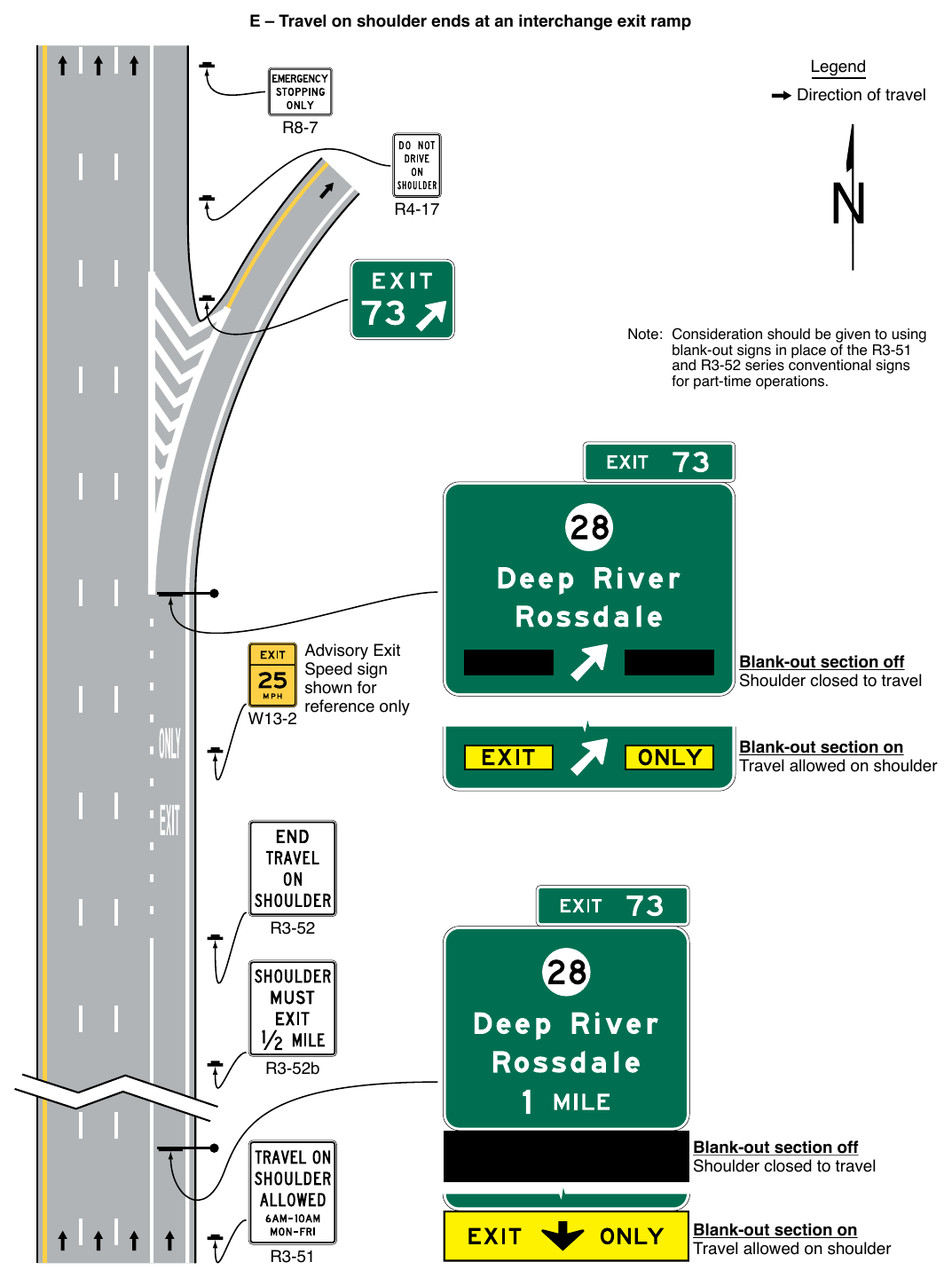
Note: Consideration should be given to using blank-out signs in place of the R3-51 and R3-52 series conventional signs for part-time operations. Advisory Exit Speed sign shown for reference only Blank-out section off Shoulder closed to travel Blank-out section on Travel allowed on shoulder R3-52b Blank-out section off Shoulder closed to travel Blank-out section on Travel allowed on shoulder
Standard
05. Approximately ½ mile from where part-time travel on shoulder ends, the Part-Time Travel on Shoulder Ends Advance (R3-52a) sign shall be used. At the location provided for traffic to transition from shoulder travel back to permanent highway lane travel, a Part-Time Travel on Shoulder Ends (R3-52) sign shall be used. After this transition location a DO NOT DRIVE ON SHOULDER (R4-17) sign shall be used.
Guidance
06. Where a shoulder that allows part-time travel is interrupted by a deceleration lane for an exit, the BEGIN EXIT LANE (R3-56) sign should be used at the beginning of the deceleration lane where traffic is allowed to enter during the periods that travel is prohibited on the shoulder.
07. On a conventional road where a shoulder that is open to part-time travel becomes a mandatory turn lane, the BEGIN RIGHT TURN LANE (R3-20R) sign should be post-mounted on the right-hand side of the roadway at the upstream end of the turn lane taper of a mandatory right-turn lane. Where the shoulder is on the left-hand side of the roadway, the BEGIN LEFT TURN LANE (R3-20L) sign may be post-mounted on a median (or on the left-hand side of the roadway for a one-way street) at the upstream end of the turn lane taper of a mandatory left-turn lane.
08. Where turn-outs are provided for emergency stopping during periods when travel is allowed on the shoulder, the EMERGENCY STOPPING ONLY (R8-7) sign (see Section 2B.52) should be used adjacent to the turn-out (see Drawing D in Figure 2G-32).
09. Where traffic on an entrance ramp is required to yield to traffic using the shoulder of the freeway or expressway mainline during the periods when travel is allowed on the shoulder, the TO TRAFFIC ON SHOULDER (R3-57P) plaque should be mounted below the YIELD (R1-2) sign (see Section 2B.05 and Drawing C in Figure 2G-32).
§2G.22 Warning Signs for Part-Time Travel on a Shoulder¶
Guidance
01. The Traffic Using Shoulder (W3-9) sign should be used on a ramp that enters a freeway or expressway on which part-time travel is allowed on the shoulder. When used, the W3-9 sign should be located on the right-hand side of the ramp from which the shoulder traffic approaches (see Drawing C in Figure 2G-32).
Option
02. A second W3-9 sign may be used on the left-hand side of the ramp opposite the W3-9 sign on the right-hand side of the ramp to provide greater visibility to oncoming traffic.
03. The W3-9 sign may be used on a conventional road that is required to stop for or yield to the through street or highway on which part-time travel is allowed on the shoulder.
§2G.23 Guide Signs for Part-Time Travel on a Shoulder¶
Support
01. Guide signs for part-time travel on a freeway or expressway shoulder generally consist of the typical interchange guide sign sequence (see Chapter 2E). While specialized guide signs are not normally necessary, modifications to the typical guide signs might be necessary, especially where an interchange lane drop is created only during the periods when the shoulder is open to travel.
Standard
02. Where an interchange lane drop is created only during the periods when a shoulder is open to travel, the Advance and Exit Direction guide signs (see Sections 2E.23 and 2E.25) shall be overhead-mounted and shall be modified to include a blank-out or changeable EXIT ONLY message that complies with the provisions of Section 2E.28 and is displayed only during the periods that the shoulder is open to travel (see Drawing E in Figure 2G-32).
03. Guide signs located in conjunction with part-time travel on a shoulder shall otherwise comply with the provisions of Chapters 2D and 2E.
Guidance
04. Where turn-outs are provided for emergency stopping during periods when travel is allowed on the shoulder, the Advance Emergency Turn-Out (D17-5) sign and Emergency Turn-Out Directional (D17-6) sign (see Drawing D in Figure 2G-32) should be used as provided in Section 2D.54.
§2G.24 Lane-Use Control Signals for Part-Time Travel on a Shoulder¶
Support
01. Lane-use control signals (see Chapter 4T) are sometimes used for part-time travel on a paved shoulder (see Drawing A in Figure 2G-32), in addition to signs, to indicate the allowable use of the shoulder.
Option
02. Overhead lane-use control signals may be used above a shoulder on which part-time travel is allowed.
Standard
03. Except as otherwise provided in this Section, lane-use control signals that are used for part-time travel on a shoulder shall comply with the provisions of Chapter 4T. When used for part-time travel on a shoulder, lane-use control signals shall not be required above the lanes adjacent to the shoulder. When used for part-time travel on a shoulder, a steady RED X signal indication shall be displayed when the shoulder is available for emergency stopping only and travel on the shoulder is otherwise prohibited.
04. When part-time travel on shoulder is allowed for variable periods of operation, lane-use control signals (see Chapter 4T) shall be used and evenly spaced approximately every ½ mile or less and centered over the shoulder to indicate when the shoulder is open or closed to vehicle travel. The lane-use control signals shall display a steady DOWNWARD GREEN ARROW signal indication during times when travel is allowed on the shoulder, followed by a steady YELLOW X signal indication just before the shoulder is to be closed to travel, and a steady RED X signal indication when shoulder travel is discontinued. Additionally, during the period when travel is allowed on the shoulder, a lane-use control signal that continuously displays a steady YELLOW X signal indication shall be used approximately ½ mile in advance of the location where part-time travel on the shoulder ends, and then displays a steady RED X signal indication when the travel on shoulder ends. A lane-use control signal with a steady RED X signal indication shall be displayed at all times at the location where part-time travel on the shoulder ends.
Option
05. For part-time travel on shoulder with variable periods of operation, post-mounted Part-Time Travel on Shoulder Variable Operation (R3-51d) signs (see Drawing A in Figure 2G-32) with flashing beacons may be used in lieu of the lane-use control signals at the same intervals.
06. The Part-Time Travel on Shoulder on Green Arrow (R3-51e) sign (see Drawing A in Figure 2G-32) may be used with a lane-use control signal and may be mounted adjacent to the signal head, elsewhere on the signal support, or post-mounted next to, or in advance of, the signal.
§2G.25 Lane-Use Control Signals for Active Lane Management on Freeways and Expressways¶
Support
01. Active lane management is a component of active traffic management in which the use of travel lanes and speed limits might be varied in real time in response to traffic conditions to manage congestion. Active lane management might employ lane-use control signals (see Chapter 4T) and/or changeable message signs (see Chapter 2L). Figure 2G-33 shows an example of lane-use control signals and variable Speed Limit signs for active lane management during an incident
Standard
02. Except as otherwise provided in this Section, lane-use control signals that are used for active lane management shall comply with the provisions of Chapter 4T. When used for active lane management on a freeway or expressway, a steady YELLOW X signal indication shall be displayed to warn road users to vacate the lane when the next downstream lane-use control signal over the same lane is displaying a steady RED X signal indication.
Option
03. A steady YELLOW X signal indication may be displayed on one or more lane-use control signals in advance of the steady YELLOW X signal indication required by Paragraph 2 of this Section as conditions warrant to warn road users to vacate the lane.
Support
04. Using too many steady YELLOW X signal indications could diminish the effectiveness of the steady YELLOW X signal indication in conveying the lane is closed a short distance ahead and the road user needs to vacate the lane soon.
Standard
05. When operated in conjunction with a temporary planned lane closure, lane-use control signals shall only supplement the temporary traffic control devices as provided in Part 6 of this Manual.
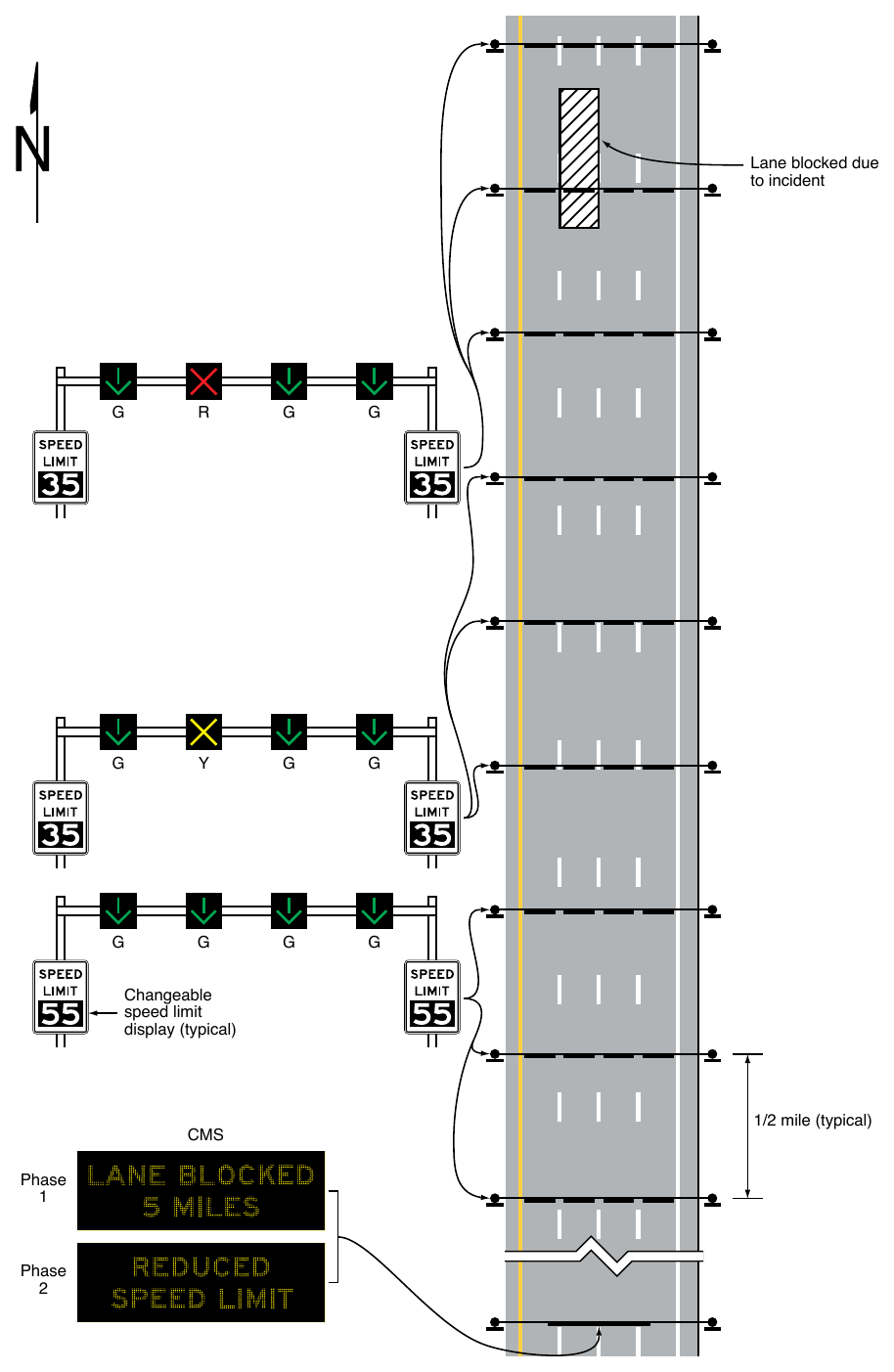
Guidance
06. Spacing of lane-use control signals for active lane management on freeways and expressways should be at ½-mile intervals. Closer spacing should be used where the viewing distance is limited by the roadway geometry, overcrossings or other sight obstructions, or where traffic entering from intervening interchange ramps is not adequately served by the ½-mile spacing.
07. Combining lane-use control signals with overhead sign support structures should be minimized to avoid overloading road users with too much information or conflicting or incorrect messages, such as exclusive lane use or lane drop implied by the display of a steady DOWNWARD GREEN ARROW signal indication below a guide sign.
§2G.26 Variable Speed Limits for Active Traffic Management on Freeways and Expressways¶
Support
01. Active traffic management on freeways and expressways might employ variable speed limits as an element of an overall congestion management plan using variable Speed Limit (R2-1) sign (see Section 2B.21).
02. Careful consideration is needed in locating variable Speed Limit signs along the roadway and potential positioning adjacent to guide signs or lane-use control signals so that the speed displayed is clearly associated with the lane or lanes intended to be regulated and not other adjacent lanes, ramps, or roadways. This might result in the need to place variable Speed Limit signs on separate supports away from guide and other signs or lane-use control signals.
Standard
03. The regulatory speed displayed on a variable Speed Limit sign shall comply with Paragraph 13 of Section 2B.21 and the “Standard Highway Signs” publication (see Section 1A.05).
Guidance
04. The location and positioning of variable Speed Limit signs should clearly associate the speed displayed to the lane or lanes intended to be regulated such that it would not present a conflict or confusion with other posted speed limits or advisory speeds for adjacent lanes, ramps, or roadways. Variable Speed Limit signs should not be located on overhead guide sign installations (see Section 2E.43).
05. In addition to the post-interchange Speed Limit sign (see Paragraph 17 of Section 2E.47), the spacing of variable Speed Limit signs on freeways and expressways should be based on an engineering study that considers such factors as recurring congestion, high-volume interchanges, weaving sections, and other location-specific factors that are known to affect travel speeds. The variable Speed Limit signs should be placed far enough in advance of known congestion points to adequately adjust the operating speed to minimize the extent of vehicle queuing.