Chapter 6K. TTC Zone Channelizing Devices¶
§6K.01 Channelizing Devices – General¶
Standard
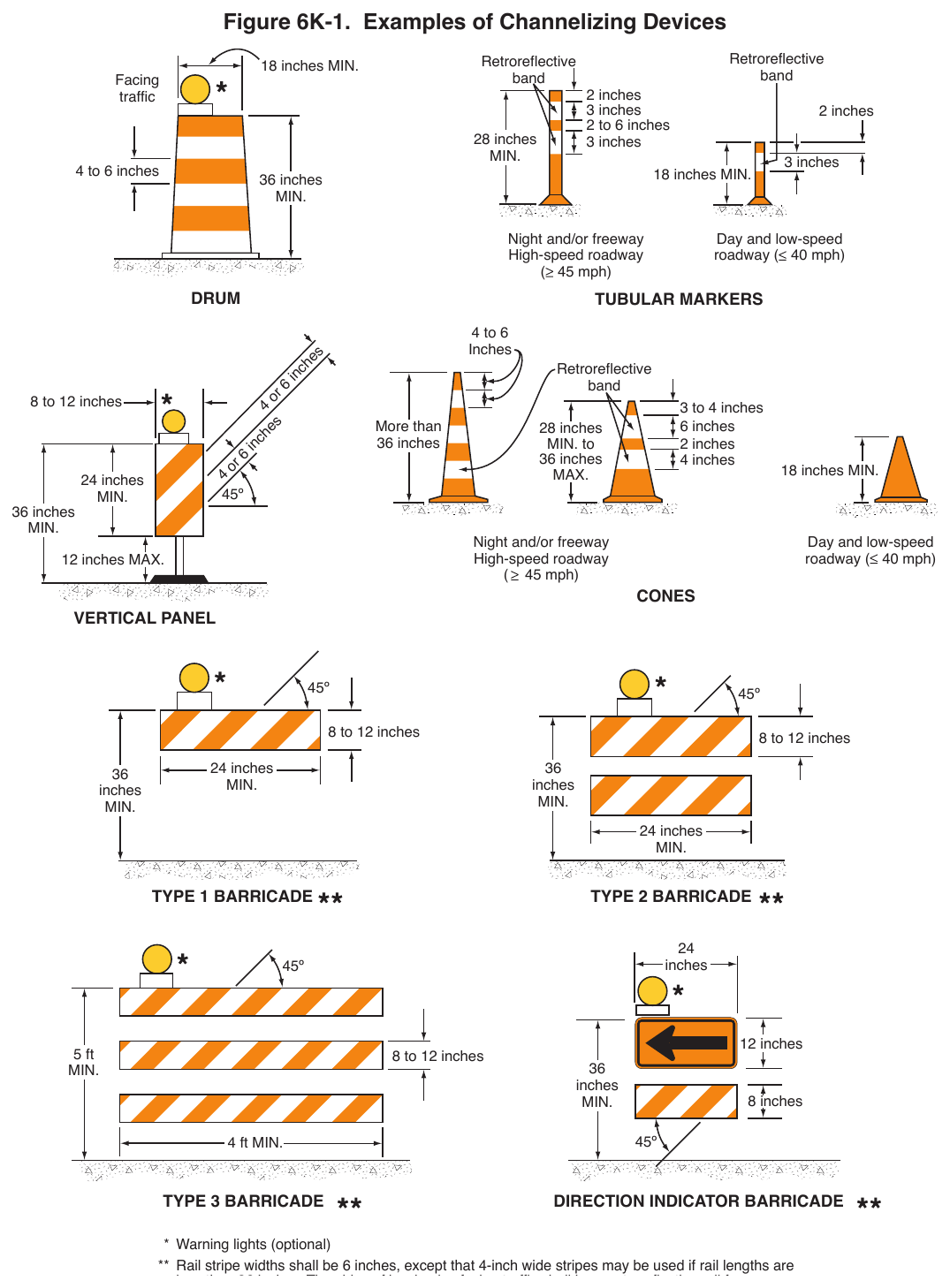
01. Designs of various channelizing devices shall be as shown in Figure 6K-1. All channelizing devices shall be crashworthy (see definition in Section 1C.02).
Support
02. The function of channelizing devices is to warn road users of conditions created by work activities in or near the roadway and to guide road users. Channelizing devices include cones, tubular markers, vertical panels, drums, barricades, and longitudinal channelizing devices.
03. Channelizing devices provide for smooth and gradual vehicular traffic flow from one lane to another, onto a bypass or detour, or into a narrower traveled way. They are also used to channelize traffic away from the work space, pavement drop-offs, pedestrian or shared-use paths, bicycle facilities, or opposing directions of vehicular traffic.
Guidance
04. The spacing between cones, tubular markers, vertical panels, drums, and barricades should not exceed a distance in feet equal to 1 times the speed limit in mph when used for taper channelization, and should not exceed a distance in feet equal to 2 times the speed limit in mph when used for tangent channelization.
05. When channelizing devices have the potential of leading vehicular traffic out of the intended vehicular traffic space as shown in Figure 6P-39, the channelizing devices should be extended a distance in feet of 2 times the speed limit in mph beyond the downstream end of the transition area.
Option
06. A gap not exceeding 2 inches between the bottom rail and the ground surface may be used to facilitate drainage.
07. Warning lights (see Section 6L.07) may be added to channelizing devices in areas with frequent fog, snow, or severe roadway curvature, or where visual distractions are present.
08. A series of sequential flashing warning lights may be placed on channelizing devices that form a merging taper in order to increase driver detection and recognition of the merging taper.
Support
09. The flashing rates and patterns for warning lights used on channelizing devices are specified in Section 6L.07.
Standard
10. The retroreflective material used on channelizing devices shall display a similar color day or night.
11. Except as provided in Paragraph 12 of this Section, information identifying the owner or manufacturer of the channelizing device shall not be displayed on any portion of the device that can be seen by road users approaching the device.
Option
12. The name and telephone number of the highway agency, contractor, or supplier may be displayed on the nonretroreflective surface of all types of channelizing devices.
Standard
13. The area containing the name and telephone number shall be non-retroreflective and not over 2 inches in height.
Guidance
14. Particular attention should be given to maintaining the channelizing devices to keep them clean, visible, and properly positioned at all times.
Standard
15. Channelizing devices that are no longer serviceable (see definition in Section 1C.02) shall be replaced.
§6K.02 Pedestrian Channelizing Devices¶
Support
01. Pedestrian channelizing devices indicate a suitable path of pedestrian travel around or through the work zone.
Guidance
02. Pedestrian channelizing devices should be provided when work activities impact sidewalks or other pedestrian facilities or when the design of the temporary pedestrian facility does not otherwise include accessibility features consistent with the features in the existing pedestrian facility.
03. The pedestrian channelizing devices should be used both to close sidewalks and to delineate an alternate route.
Support
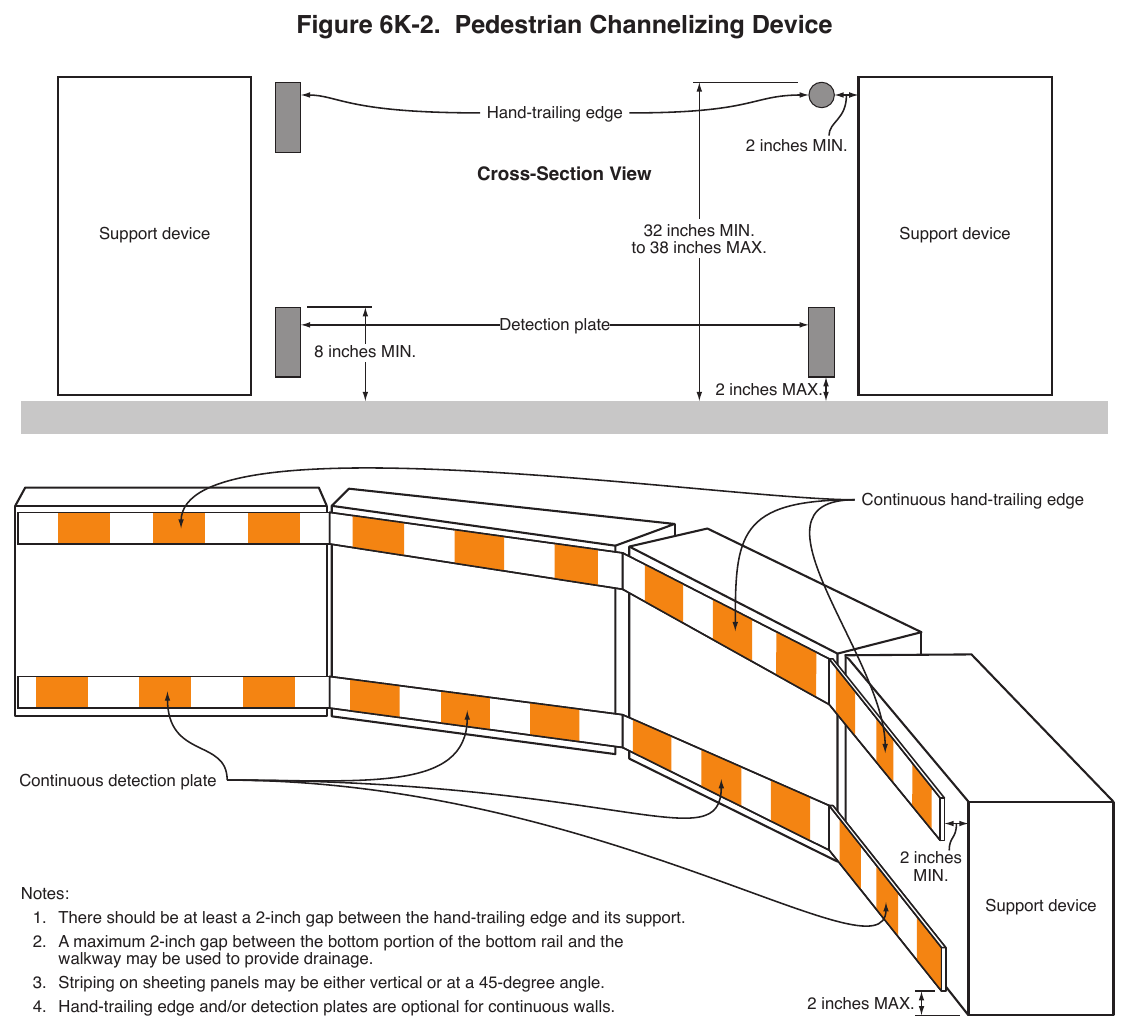
04. An example of a pedestrian channelizing device is depicted in Figure 6K-2.
Standard
05. Pedestrian channelizing devices shall be crashworthy (see definition in Section 1C.02) when exposed to vehicular traffic.
06. Devices used to channelize pedestrians shall be detectable to users of long canes and visible to pedestrians with vision disabilities.
07. When used as a sidewalk closure, the device shall cover the entire width of the sidewalk.
2 inches MIN. Cross-Section View 32 inches MIN. to 38 inches MAX. Support device Support device Detection plate 8 inches MIN. 2 inches MAX. Continuous hand-trailing edge Continuous detection plate Notes:
- 1. There should be at least a 2-inch gap between the hand-trailing edge and its support.
- 2. A maximum 2-inch gap between the bottom portion of the bottom rail and the walkway may be used to provide drainage.
- 3. Striping on sheeting panels may be either vertical or at a 45-degree angle.
- 4. Hand-trailing edge and/or detection plates are optional for continuous walls. 2 inches MIN. Support device 2 inches MAX. Pedestrian channelizing devices shall have continuous detection plates and hand-trailing edges. The bottom of the detection plate shall be no higher than 2 inches above the walkway. The top edge of the detection plate shall be at least 8 inches above the walkway. The top of the hand-trailing edge shall be no lower than 32 inches and no higher than 38 inches above the walkway. The top surface of the hand-trailing edge shall be smooth to optimize hand trailing. Both the detection plate and the hand-trailing edge shall share a common vertical plane.
Guidance
09. When pedestrian channelizing devices are combined in a series, the gap between devices should not exceed 1 inch.
Support
10. The hand-trailing edge is the upper rail on a pedestrian channelizing device, as shown in Figure 6K-2. It is provided to allow pedestrians with vision disabilities to follow the pedestrian channelizing device with their hand. The hand-trailing edge is not a weight-bearing railing.
Guidance
11. There should be at least a 2-inch gap between the hand-trailing edge and its support.
Standard
12. When visible to vehicular traffic the detection plate and the hand-trailing edge of the pedestrian channelizing device shall have retroreflective sheeting complying with Paragraph 10 of Section 6K.01.
Guidance
13. When not visible to vehicular traffic, the pedestrian channelizing device should have a contrasting pattern in alternating light and dark colors to provide visual contrast on the upper surface consisting of a minimum of 6 inches of sheeting or other contrasting materials.
Option
14. Non-retroreflective materials may be used on the pedestrian side of the pedestrian channelizing device.
15. The sheeting on the pedestrian side of the pedestrian channelizing device may have stripes that are oriented either vertically or at a 45-degree angle.
Support
16. The contrast of the light and dark stripes on the barricade sheeting assists pedestrians with vision disabilities in following the designated detour.
17. Section 6M.04 also contains information regarding detectable edging for pedestrian channelization.
Option
18. A continuous wall may be used as a pedestrian channelizing device.
Guidance
19. When used, a continuous wall should have a lower edge no more than 2 inches above the walkway, should extend a minimum of 32 inches above the walkway, should have a common vertical face, and should have alternating, contrasting sheeting positioned 32 inches above the walkway.
Option
20. The continuous wall may extend to any height above the 32-inch minimum.
§6K.03 Cones¶
Standard
01. Cones (see Figure 6K-1) shall be predominantly orange and shall be made of a material that can be struck without causing damage to the impacting vehicle. For daytime and low-speed roadways, cones shall be not less than 18 inches in height. When cones are used on freeways and other high-speed highways or at night on all highways, or when more conspicuous guidance is needed, cones shall be a minimum of 28 inches in height.
02. For nighttime use, cones shall be retroreflectorized or equipped with lighting devices for maximum visibility. Retroreflectorization of cones that are 28 to 36 inches in height shall be provided by a 6-inch wide white band located 3 to 4 inches from the top of the cone and an additional 4-inch wide white band located approximately 2 inches below the 6-inch band.
03. Retroreflectorization of cones that are more than 36 inches in height shall be provided by horizontal, circumferential, alternating orange and white retroreflective stripes that are 4 to 6 inches wide. Each cone shall have a minimum of two orange and two white stripes with the top stripe being orange. Any nonretroreflective spaces between the retroreflective stripes shall not exceed 3 inches in width.
Option
04. Traffic cones may be used to channelize road users, divide opposing vehicular traffic lanes, divide lanes when two or more lanes are kept open in the same direction, and delineate short-duration maintenance and utility work.
Guidance
05. Steps should be taken to minimize the possibility of cones being blown over or displaced by wind or moving vehicular traffic.
Option
06. Cones may be doubled up to increase their weight.
Support
07. Some cones are constructed with bases that can be filled with ballast. Others have specially weighted bases, or weight such as sandbag rings, that can be dropped over the cones and onto the base to provide added stability.
Guidance
08. Ballast should be kept to the minimum amount needed.
§6K.04 Tubular Markers¶
Standard
01. Tubular markers (see Figure 6K-1) shall be predominantly orange for TTC zone applications and shall be not less than 18 inches high and 2 inches wide facing road users. They shall be made of a material that can be struck without causing damage to the impacting vehicle.
02. Tubular markers shall be a minimum of 28 inches in height when they are used on freeways and other high-speed highways, on all highways during nighttime, or whenever more conspicuous guidance is needed.
03. For nighttime use, tubular markers shall be retroreflectorized. Retroreflectorization of tubular markers that have a height of less than 42 inches shall be provided by two 3-inch wide white bands placed a maximum of 2 inches from the top with a maximum of 6 inches between the bands. Retroreflectorization of tubular markers that have a height of 42 inches or more shall be provided by four 4-inch to 6-inch wide alternating orange and white stripes with the top stripe being orange.
Guidance
04. Tubular markers have less visible area than other devices and should be used only where space restrictions do not allow for the use of other more visible devices.
05. Tubular markers should be stabilized by affixing them to the pavement, by using weighted bases, or by using weights such as sandbag rings that can be dropped over the tubular markers and onto the base to provide added stability. Ballast should be kept to the minimum amount needed.
Option
06. Tubular markers may be used effectively to divide opposing lanes of road users, divide vehicular traffic lanes when two or more lanes of moving vehicular traffic are kept open in the same direction, and to delineate the edge of a pavement drop off where space limitations do not allow the use of larger devices.
Standard
07. A tubular marker shall be attached to the pavement to display the minimum 2-inch width to the approaching road users.
§6K.05 Vertical Panels¶
Standard
01. Vertical panels (see Figure 6K-1) shall have retroreflective striped material that is 8 to 12 inches in width and at least 24 inches in height. They shall have alternating diagonal orange and white retroreflective stripes sloping downward at an angle of 45 degrees in the direction vehicular traffic is to pass.
02. Where the height of the retroreflective material on the vertical panel is 36 inches or more, a stripe width of 6 inches shall be used.
Option
03. Where the height of the retroreflective material on the vertical panel is less than 36 inches, a stripe width of 4 inches may be used.
04. Where space is limited, vertical panels may be used to channelize vehicular traffic, divide opposing lanes, or replace barricades.
§6K.06 Drums¶
Standard
01. Drums (see Figure 6K-1) used for road user warning or channelization shall be constructed of lightweight, deformable materials. They shall be a minimum of 36 inches in height and have at least an 18-inch minimum width regardless of orientation. Metal drums shall not be used. The markings on drums shall be horizontal, circumferential, alternating orange and white retroreflective stripes 4 to 6 inches wide. Each drum shall have a minimum of two orange and two white stripes with the top stripe being orange. Any non-retroreflectorized spaces between the horizontal orange and white stripes shall not exceed 3 inches wide. Drums shall have closed tops that will not allow collection of construction debris or other debris.
Support
02. Drums are highly visible, have good target value, give the appearance of being formidable obstacles and, therefore, command the respect of road users. They are portable enough to be shifted from place to place within a TTC zone in order to accommodate changing conditions, but are generally used in situations where they will remain in place for a prolonged period of time.
Option
03. Although drums are most commonly used to channelize or delineate road user flow, they may also be used alone or in groups to mark specific locations.
Guidance
04. Drums should not be weighted with sand, water, or any material to the extent that would make them hazardous to road users or workers when struck. Drums used in regions susceptible to freezing should have drain holes in the bottom so that water will not accumulate and freeze causing a hazard if struck by a road user.
Standard
05. Ballast shall not be placed on the top of a drum.
§6K.07 Type 1, 2, or 3 Barricades¶
Support
01. A barricade is a portable or fixed device having from one to three rails with appropriate markings and is used to control road users by closing, restricting, or delineating all or a portion of the right-of-way.
02. As shown in Figure 6K-1, barricades are classified as Type 1, Type 2, or Type 3.
Standard
03. Stripes on barricade rails shall be alternating orange and white retroreflective stripes sloping downward at an angle of 45 degrees in the direction road users are to pass. Except as provided in Paragraph 4 of this Section, the stripes shall be 6 inches wide.
Option
04. When rail lengths are less than 36 inches, 4-inch wide stripes may be used.
Standard
05. The minimum length for Type 1 and Type 2 Barricades shall be 24 inches, and the minimum length for Type 3 Barricades shall be 48 inches. Each barricade rail shall be 8 to 12 inches wide. Barricades used on freeways, expressways, and other high-speed roadways shall have a minimum of 270 square inches of retroreflective area facing road users.
Guidance
06. Where barricades extend entirely across a roadway, the stripes should slope downward in the direction toward which road users must turn.
07. Where both right and left turns are provided, the barricade stripes should slope downward in both directions from the center of the barricade or barricades.
08. Where no turns are intended, the stripes should be positioned to slope downward toward the center of the barricade or barricades.
09. Barricade rails should be supported in a manner that will allow them to be seen by the road user, and in a manner that provides a stable support that is not easily blown over or displaced.
10. The width of the existing pedestrian facility should be provided for the temporary facility if practical. Traffic control devices and other construction materials and features should not intrude into the usable width of the sidewalk, temporary pathway, or other pedestrian facility. When it is not possible to maintain a minimum width of 60 inches throughout the entire length of the pedestrian pathway, a 60 x 60-inch passing space should be provided at least every 200 feet to allow individuals in wheelchairs to pass.
11. Barricade rail supports should not project into pedestrian circulation routes more than 4 inches from the support between 27 and 80 inches from the surface as described in Section 307 of the U.S. Department of Justice 2010 ADA Standards for Accessible Design, September 15, 2010, 28 CFR 35 and 36, Americans with Disabilities Act of 1990.
Option
12. For Type 1 Barricades, the support may include other unstriped horizontal rails necessary to provide stability.
Guidance
13. On high-speed expressways or in other situations where barricades might be susceptible to overturning in the wind, ballasting should be used.
Option
14. Sandbags may be placed on the lower parts of the frame or the stays of barricades to provide the required ballast.
Support
15. Type 1 or Type 2 Barricades are intended for use in situations where road user flow is maintained through the TTC zone.
Option
16. Barricades may be used alone or in groups to mark a specific condition or they may be used in a series for channelizing road users.
17. Type 1 Barricades may be used on conventional roads or urban streets.
Guidance
18. Type 2 or Type 3 Barricades should be used on freeways and expressways or other high-speed roadways. Type 3 Barricades should be used to close or partially close a road.
Option
19. Type 3 Barricades used at a road closure may be placed completely across a roadway or from curb to curb.
Guidance
20. Where provision is made for access of authorized equipment and vehicles, the responsibility for Type 3 Barricades should be assigned to a person who will provide proper closure at the end of each work day.
Support
21. When a highway is legally closed but access must still be allowed for local road users, barricades usually are not extended completely across the roadway.
Standard
22. A sign shall be installed with the appropriate legend concerning permissible use by local road users (see Section 6G.05).
Guidance
23. Adequate visibility of the barricades from both directions should be provided.
Option
24. Signs may be installed on barricades (see Section 6F.02).
§6K.08 Direction Indicator Barricades¶
Standard
01. The Direction Indicator Barricade (see Figure 6K-1) shall consist of a One-Direction Large Arrow (W1-6) sign mounted above a diagonal striped, horizontally-aligned, retroreflective rail.
02. The One-Direction Large Arrow (W1-6) sign shall have a black legend and border on an orange background. The stripes on the bottom rail shall be alternating orange and white retroreflective stripes sloping downward at an angle of 45 degrees in the direction road users are to pass. The stripes shall be 4 inches wide. The One-Direction Large Arrow (W1-6) sign shall be 24 x 12 inches. The bottom rail shall have a length of 24 inches and a height of 8 inches.
Option
03. The Direction Indicator Barricade may be used in tapers, transitions, and other areas where specific directional guidance to drivers is necessary.
Guidance
04. If used, Direction Indicator Barricades should be used in a series to direct the driver through the transition and into the intended travel lane.
§6K.09 Temporary Traffic Barriers as Channelizing Devices¶
Support
01. Temporary traffic barriers (see Section 6M.02) are not TTC devices in themselves; however, when placed in a position identical to a line of channelizing devices and marked and/or equipped with appropriate channelization features to provide guidance and warning both day and night, they serve as TTC devices.
Standard
02. Temporary traffic barriers serving as TTC devices shall comply with requirements for such devices as set forth throughout Part 6.
03. Temporary traffic barriers (see Section 6M.02) shall not be used solely to channelize road users, but also to protect the work space. If used to channelize vehicular traffic, the temporary traffic barrier shall be supplemented with delineation, pavement markings, or channelizing devices for improved daytime and nighttime visibility.
Guidance
04. Temporary traffic barriers should not be used for a merging taper except in low-speed urban areas.
05. When it is necessary to use a temporary traffic barrier for a merging taper in low-speed urban areas or for a constricted/restricted TTC zone, the taper length should be designed to optimize road user operations considering the available geometric conditions.
Standard
06. When it is necessary to use a temporary traffic barrier for a merging taper in low-speed urban areas or for a constricted/restricted TTC zone, the taper shall be delineated using channelizing devices, and/or an edge line, and/or delineators on the barrier.
Guidance
07. When used for channelization, temporary traffic barriers should be of a light color for increased visibility.
§6K.10 Longitudinal Channelizing Devices¶
Support
01. Longitudinal channelizing devices are lightweight, deformable devices that are highly visible, have good target value, and can be connected together.
Standard
02. If used singly as Type 1, 2, or 3 barricades, longitudinal channelizing devices shall comply with the general size, color, stripe pattern, retroreflectivity, and placement characteristics established for the devices described in this Chapter.
Guidance
03. If used to channelize vehicular traffic at night, longitudinal channelizing devices should be supplemented with retroreflective material or delineation for improved nighttime visibility.
Option
04. Longitudinal channelizing devices may be used instead of a line of cones, drums, or barricades.
05. Longitudinal channelizing devices may be hollow and filled with water as a ballast.
06. Longitudinal channelizing devices may be used for pedestrian traffic control.
Standard
07. If used for pedestrian traffic control, longitudinal channelizing devices shall be interlocked to delineate or channelize flow. The interlocking devices shall not have gaps that allow pedestrians to stray from the channelizing path.
Guidance
08. Longitudinal channelizing devices have not met the crashworthy requirements for temporary traffic barriers and should not be used to shield obstacles or provide positive protection for pedestrians or workers.
§6K.11 Temporary Lane Separators¶
Option
01. Temporary lane separators may be used to channelize road users, to divide opposing vehicular traffic lanes, and to divide lanes when two or more lanes are open in the same direction.
Standard
02. Temporary lane separators shall consist of a longitudinal base component with a maximum height of 4 inches and a maximum width of 1 foot. The longitudinal base shall have sloping sides in order to facilitate crossover by emergency vehicles. One or more types of channelizing devices, such as tubular markers, vertical panels, or a Narrow Two-Way Traffic (W6-4) sign (see Section 6H.17) mounted on flexible supports, shall be affixed to the longitudinal base.
03. Channelizing devices affixed to the longitudinal base of a temporary lane separator shall be retroreflectorized to provide nighttime visibility.
Guidance
04. A temporary lane separator should be stabilized by affixing it to the pavement in a manner suitable to its design, while allowing the unit to be intentionally moved from place to place within the TTC zone in order to accommodate changing conditions.
05. Temporary Lane Separators should not be used to shield obstacles or provide positive protection for pedestrians or workers because these devices have not met the crashworthy requirements for temporary traffic barriers.
Standard
06. At pedestrian crossing locations, temporary lane separators shall have an opening or be shortened to provide a pathway that is at least 60 inches wide for crossing pedestrians.
§6K.12 Other Channelizing Devices¶
Option
01. Channelizing devices other than those described in this Chapter may be used in special situations based on an engineering study.
Guidance
02. Other channelizing devices should comply with the general size, color, stripe pattern, retroreflection, and placement characteristics established for the devices described in this Chapter.