Chapter 9C. Warning Signs and Object Markers¶
§9C.01 Turn or Curve Warning Signs (W1 Series)¶
Guidance
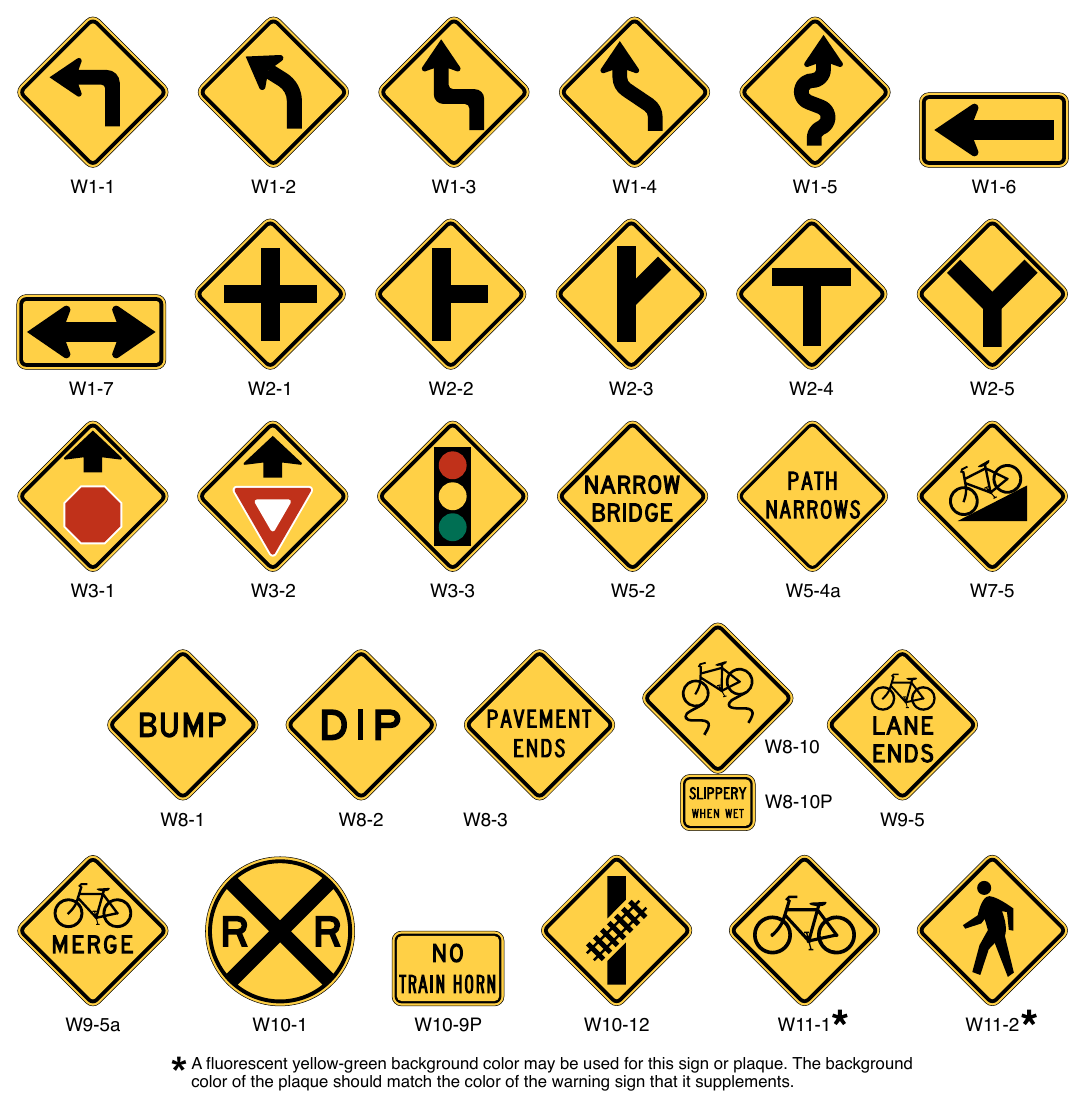
01. To warn bicyclists of unexpected changes in shared-use path direction, appropriate Turn, Curve, or Large Arrow (W1-1 through W1-7) signs (see Figure 9C-1) should be used.
02. The W1-1 through W1-5 signs should be installed at least 50 feet in advance of the beginning of the change of alignment.
Signs shown: W1-1, W1-2, W1-3, W1-4, W1-5, W1-6, W1-7, W2-1, W2-2, W2-3, W2-4, W2-5, W3-1, W3-2, W3-3, W5-2, W5-4a, W7-5, W8-10, W8-10P, W8-1, W8-2, W8-3, W9-5, W9-5a, W10-1, W10-9P, W10-12, W11-1, W11-2
for Bicycle Facilities (Sheet 1 of 2) W5-4a W9-5a
Signs shown: W11-15, W12-2, W15-1, W16-1P, W16-1aP, W16-2P, W16-2aP, W11-15P, W16-7P, W16-9P, W16-20P, W16-21P, W2-1, W2-5
for Bicycle Facilities (Sheet 2 of 2) W16-1aP W16-2aP
§9C.02 Intersection Warning Signs (W2 Series)¶
Option
01. Intersection Warning (W2-1 through W2-5) signs (see Figure 9C-1) may be used on a roadway, street, or shared-use path in advance of an intersection to indicate the presence of an intersection and the possibility of turning or entering traffic.
Guidance
02. When engineering judgment determines that the visibility of the intersection is limited on the shared-use path approach, Intersection Warning signs should be used.
03. Intersection Warning signs should not be used where the shared-use path approach to the intersection is controlled by a STOP sign, a YIELD sign, or a traffic control signal.
§9C.03 Bicycle Surface Condition Warning Sign (W8-10)¶
Option
01. The Bicycle Surface Condition Warning (W8-10) sign (see Figure 9C-1) may be installed where roadway or shared-use path conditions could cause a bicyclist to lose control of the bicycle.
02. Signs warning of other conditions that might be of concern to bicyclists, including BUMP (W8-1), DIP (W8-2), PAVEMENT ENDS (W8-3), and any other word message that describes conditions that are of concern to bicyclists, may also be used (see Figure 9C-1).
03. A supplemental plaque may be used to clarify the specific type of surface condition.
§9C.04 Bicycle Warning and Trail Crossing Signs (W11-1 and W11-15)¶
Support
01. The Bicycle Warning (W11-1) sign (see Figure 9C-1) alerts the road user to unexpected entries into the roadway by bicyclists, and other crossing activities that might cause conflicts. These conflicts might be relatively confined, or might occur randomly over a segment of roadway.
02. Section 9C.06 contains information for Bicycle Cross Traffic Warning plaques that can be used below STOP signs on crossroads or driveways that intersect with bicycle facilities.
Option
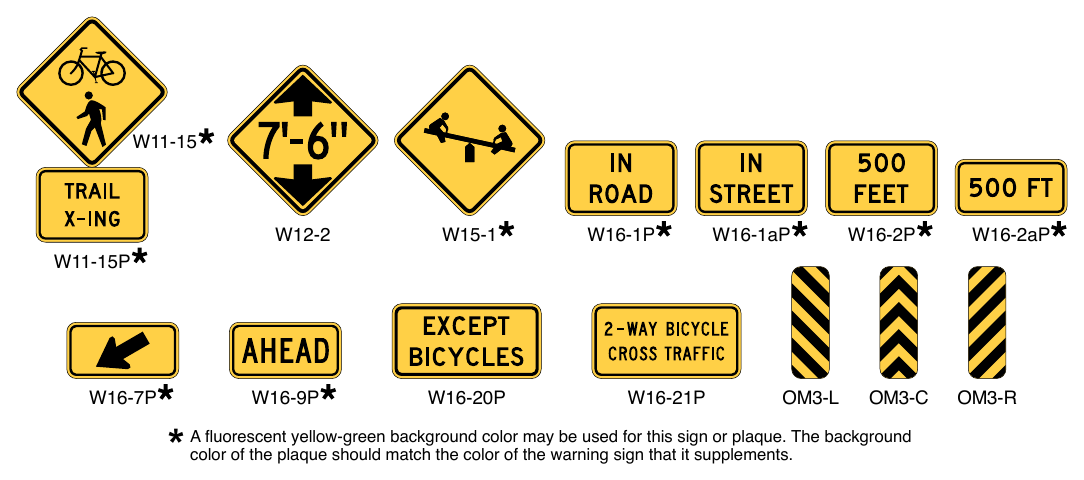
03. The Trail Crossing (W11-15) sign (see Figure 9C-1) may be used where both bicyclists and pedestrians might be crossing the roadway, such as at an intersection with a shared-use path. A TRAIL X-ING (W11-15P) supplemental plaque may be mounted below the W11-15 sign.
Guidance
04. If used in advance of a trail crossing, a W11-15 or W11-15a sign should be supplemented with an AHEAD (W16-9P) or XX FEET (W16-2P or W16-2aP) plaque to inform road users that they are approaching a point where crossing activity might occur.
05. If used in advance of a specific crossing point, the Bicycle Warning or Trail Crossing sign should be placed at a distance in advance of the crossing location that complies with Table 2C-3.
Standard
06. Bicycle Warning and Trail Crossing signs, when used at the location of the crossing, shall be supplemented with a diagonal downward-pointing arrow (W16-7P) plaque to show the location of the crossing.
Option
07. A fluorescent yellow-green background color with a black legend and border may be used for Bicycle Warning and Trail Crossing signs and supplemental plaques.
Guidance
08. When the fluorescent yellow-green background color is used, a systematic approach featuring one background color within a zone or area should be used. The mixing of standard yellow and fluorescent yellowgreen backgrounds within a zone or area should be avoided.
§9C.05 EXCEPT BICYCLES Warning Plaque (W16-20P)¶
Option
01. Where it might be advantageous to notify bicyclists that the conditions or hazards depicted by a warning sign are not applicable to bicycles, the EXCEPT BICYCLES (W16-20P) warning plaque (see Figure 9C-1) may be used.
Support
02. Examples of warning signs where an EXCEPT BICYCLES warning plaque can be mounted include DEAD END (W14-1) and NO OUTLET (W14-2) signs (see Section 2C.24).
03. Sections 2C.57 and 2C.58 contain information on the design of supplemental warning plaques.
§9C.06 Two-Way Bicycle Cross Traffic Warning Plaque (W16-21P)¶
Standard
01. When used, the Two-Way Bicycle Cross Traffic (W16-21P) warning plaque (see Figure 9C-1) shall be installed below a STOP or YIELD sign.
Option
02. The Two-Way Bicycle Cross Traffic warning plaque may be used below STOP or YIELD signs on crossroads and driveways to alert road users of an unexpected bicycle movement.
Support
03. The Two-Way Bicycle Cross Traffic warning plaque can help minimize overuse or misapplication of other warning signs such as the Bicycle Warning (W11-1) sign.
Guidance
04. The Two-Way Bicycle Cross Traffic warning plaque should be used in combination with a STOP or YIELD sign when a counter-flow or two-way bicycle facility has an approach that is counter to the customary scanning behavior of a motorist at that location.
§9C.07 Bicycle Lane Ends Warning Sign (W9-5) and Bicycles Merging Sign (W9-5a)¶
Support
01. Where a warning sign is appropriate, the Bicycle Lane Ends (W9-5) warning sign (see Figure 9C-1) is intended to alert road users that a bicycle lane is ending and that bicycles will share or occupy the travel lane after merging.
Option
02. The Bicycle Lane Ends warning sign may be used in advance of the end of a bicycle lane to warn that a bicycle lane will be ending.
03. The Bicycles Merging (W9-5a) sign (see Figure 9C-1) may be used where a bicycle merging maneuver might occur. The Bicycles Merging sign may be used in addition to the Bicycle Lane Ends (W9-5) warning sign.
Guidance
04. To avoid excessive use of signs, the Bicycle Lane Ends warning sign should not be used where a bicycle lane is dropped on the approach to an intersection and resumes immediately after the intersection.
Option
05. A Bicycles Allowed Use of Full Lane (R9-20) sign (see Section 9B.14) and/or shared-lane markings (see Section 9E.09) may be installed downstream of the merge area.
06. A W16-2aP supplemental warning plaque may be used to inform road users of the distance to the end of the bicycle lane and/or to the bicycle merge.
§9C.08 Other Bicycle Warning Signs¶
Option
01. Other bicycle warning signs (see Figure 9C-1) such as PATH NARROWS (W5-4a) and Hill (W7-5) may be installed on shared-use paths to warn bicyclists of conditions not readily apparent.
02. In situations where there is a need to warn road users to watch for bicycles traveling along the highway, the Bicycle Warning (W11-1) sign may be used with the IN ROAD (W16-1P) plaque or the IN STREET (W16-1aP) plaque (see Figure 9C-1).
Guidance
03. If used, other advance bicycle warning signs should be installed at least 50 feet in advance of the beginning of the condition.
04. Where temporary traffic control zones are present on bikeways, appropriate signs from Part 6 should be used.
Option
05. Other warning signs described in Chapters 2C and 8C may be installed on bicycle facilities as appropriate.
§9C.09 Object Markers¶
Standard
01. Obstructions in a shared-use path shall be marked with retroreflective material or appropriate object markers as described in Section 2C.70.
Option
02. Fixed objects adjacent to shared-use paths may be marked with Type 1, Type 2, or Type 3 object markers. If the object marker is not also intended to be seen by motorists, a smaller version of the Type 3 object marker may be used (see Table 9A-1).