Chapter 9A. General¶
§9A.01 General¶
Support
01. Part 9 covers signs and pavement markings specifically related to bicycle operation on roadways, separated bikeways, and shared-use paths. In jurisdictions where small, low-speed, human or electric-powered transportation devices (often referred to as a micromobility devices) are allowed to use bicycle facilities, they can be regulated by signs, pavement markings, and other traffic control devices related to bicycle operations. Part 4 contains information on highway traffic signals and bicycle signal faces. Part 6 contains information on work zones for bicycle facilities and the mitigation of impacts to bicycle travel through work zones.
02. Definitions and acronyms pertaining to Part 9 are provided in Sections 1C.02 and 1C.03.
03. When operating on a roadway, bicycles are typically defined as vehicles and the operator of a bicycle is given the same rights and duties as an operator of a motor vehicle. Bicyclists are also vulnerable road users who have little to no protection from crash forces.
04. Designing bicycle facilities and the traffic control devices on those facilities in a manner that encourages predictable behavior and compliance with traffic laws from all roadway users can improve safety and increase public acceptance of bicyclists from other road users. The misuse of traffic control devices for improperly designed bicycle facilities or non-uniform applications can produce ineffective or counterproductive results. Section 1D.01 provides more information on the importance of uniformity of traffic control devices.
05. The “Bikeway Selection Guide” (FHWA-SA-18-077), FHWA, provides information on the designs and configuration of bicycle facilities.
06. The operation of bicycles is generally allowed on rights-of-way open to motor vehicles, even if the bicyclespecific traffic control devices outlined in Part 9 are not present.
Guidance
07. All signs, signals, and markings, including those on bicycle facilities, should be properly maintained to command respect from all road users. When installing signs and markings on bicycle facilities, an agency should be designated to maintain these devices.
§9A.02 Standardization of Application for Signing¶
Support
01. The installation of nonstandard signing on bikeways or modifying standard signing in a manner inconsistent with Chapter 2A of this Manual to draw special attention, educate users or the community, or brand a bicycle facility can contribute to problems with public acceptance and enforcement.
Standard
02. Bicycle signs shall comply with the provisions of this Manual for standard shape, legend, and color.
03. All signs installed on bikeways shall be retroreflective, including those on shared-use paths and bicycle lane facilities.
04. Where signs serve both bicyclists and other road users, vertical mounting height and lateral placement shall be as provided in Sections 2A.15 and 2A.16 of this manual.
Guidance
05. Where used on a shared-use path, no portion of a sign or its support should be placed less than 2 feet laterally from the near edge of the path, or less than 8 feet vertically over the entire width of the shared-use path (see Figure 9A-1).
06. Mounting height for post-mounted signs on shared-use paths should be a minimum of 4 feet, measured vertically from the bottom of the sign to the elevation of the near edge of the path surface (see Figure 9A-1).
07. Signs for the exclusive use of bicyclists should be located so that other road users are not confused by them.
08. The clearance for overhead signs on shared-use paths should be adjusted when appropriate to accommodate path users requiring more clearance, such as equestrians, or typical maintenance or emergency vehicles.
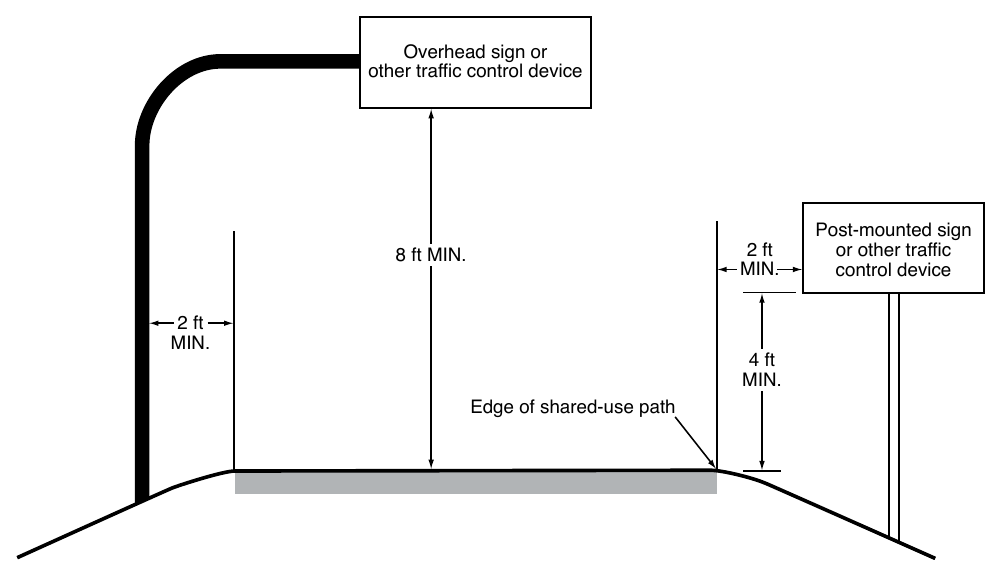
8 ft MIN. 2 ft Edge of shared-use path Post-mounted sign or other traffic control device 4 ft
Standard
09. If the sign or plaque applies to motorists and bicyclists, then the size shall be as shown for conventional roads in Tables 2B-1, 2C-1, 2D-1, and 8B-1, as applicable.
10. The minimum sign and plaque sizes for signs specific to bicycle-only facilities and shared-use paths shall be those shown in Table 9A-1. These sizes shall be used only for signs and plaques installed specifically for bicyclist applications.
Option
11. Larger sizes of signs and plaques may be used on bicycle facilities when appropriate (see Section 2A.07).
12. Any diamond-shaped warning sign that is placed such that it is applicable only to bicyclists or pedestrians on shared-use paths or separated bicycle lanes may be 18” x 18”.
Guidance
13. Except for size, the design of signs and plaques for bicycle facilities should be identical to that provided in this Manual for signs and plaques for streets and highways.
Support
14. Uniformity in design of bicycle signs and plaques includes shape, color, symbols, arrows, wording, lettering, and illumination or retroreflectivity.
§9A.03 Standardization of Application for Markings¶
Support
01. Markings indicate the separation of the lanes for road users, assist the bicyclist by indicating assigned travel paths, indicate correct position for traffic control signal actuation, and provide advance information for turning and crossing maneuvers.
Guidance
02. Pavement marking word messages, symbols, and/or arrows should be used in bikeways where appropriate.
03. Consideration should be given to selecting pavement marking materials that will minimize loss of traction for bicycles under wet conditions.
Table 9A-1. Bicycle Facility Sign and Plaque Minimum Sizes (Sheet 1 of 3)
| Sign or Plaque | Sign Designation | Section | Off Roadway1,5 | Roadway2,5 |
|---|---|---|---|---|
| Stop | R1-1 | 9B.01 | 18 x 18 | — |
| Yield | R1-2 | 9B.01 | 18 x 18 x 18 | — |
| Bike Lane (plaque) | R3-5hP | 9B.04 | — | 30 x 12 |
| Except Bicycles (plaque) | R3-7bP | 9B.02 | — | 24 x 12 |
| Advance Intersection Lane Control with Bike Lane | R3-8x Series | 9B.03 | — | Varies x 36 |
| Bike Lane | R3-17 | 9B.04 | — | 24 x 18 |
| Ahead, Ends (plaques) | R3-17aP, R3-17bP | 9B.04 | — | 24 x 9 |
| Movement Restriction | R4-1,2,3,7,16 | 9B.24 | 12 x 18 | — |
| Begin Right Turn Lane Yield to Bikes | R4-4 | 9B.05 | — | 36 x 30 |
| Bicycle Passing Clearance | R4-19 | 9B.15 | — | 30 x 30 |
| Bicycle Wrong Way | R5-1b | 9B.06 | 12 x 18 | 12 x 18 |
| No Motor Vehicles | R5-3 | 9B.07 | 24 x 24 | 24 x 24 |
| No Bicycles | R5-6 | 9B.08 | 18 x 18 | — |
| On Freeway (plaque) | R5-10dP | 9B.17 | — | 24 x 6 |
| No Parking Bike Lane | R7-9,9a | 9B.09 | — | 12 x 18 |
| Back-In Parking | R7-10 | 9B.10 | — | 12 x 18 |
| No Pedestrian Crossing | R9-3 | 9B.08 | 18 x 18 | — |
| Ride With Traffic (plaque) | R9-3cP | 9B.06 | 12 x 12 | 12 x 12 |
| Bicycles Use Pedestrian Signal | R9-5 | 9B.11 | 12 x 18 | 12 x 18 |
| Bicycles Yield to Pedestrians | R9-6 | 9B.12 | 12 x 18 | 12 x 18 |
| Shared-Use Path Restriction | R9-7 | 9B.13 | 12 x 18* | — |
| No Skaters | R9-13 | 9B.08 | 18 x 18 | 18 x 18 |
| No Equestrians | R9-14 | 9B.08 | 18 x 18 | 18 x 18 |
| No Snowmobiles | R9-15 | 9B.08 | 18 x 18 | 18 x 18 |
| No All-Terrain Vehicles | R9-16 | 9B.08 | 18 x 18 | 18 x 18 |
| Bicycles Allowed Use of Full Lane | R9-20 | 9B.14 | — | 30 x 30 |
| Bicycles Use Shoulder Only | R9-21 | 9B.16 | — | 24 x 30 |
| Bicycles Must Exit | R9-22 | 9B.17 | — | 24 x 30 |
| Bicycle All Turns from Bike Lane | R9-23 | 9B.18 | — | 12 x 18 |
| Bicycle Left Turn from Bike Lane | R9-23a | 9B.18 | — | 12 x 18 |
| Bicycle Left Turn Must Use Turn Box | R9-23b, R9-23c | 9B.18 | — | 12 x 18 |
| Bicycle All Turns | R9-24,24a | 9B.19 | — | 24 x 6 |
| Bicycle U and Left Turns | R9-25,25a,25b | 9B.19 | — | 24 x 9 |
| Bicycle U Turn | R9-26,26a,26b | 9B.19 | — | 24 x 6 |
| Bicycle Left Turn | R9-27,27a,27b | 9B.19 | — | 24 x 6 |
| Push Button for Green | R10-4 | 9B.20 | 9 x 12 | 9 x 12 |
| Left Turn Yield to Bicycle | R10-12b | 9B.21 | — | 30 x 36 |
| Bicycle Detector | R10-22 | 9B.20 | 12 x 18 | 12 x 18 |
| Bike Push Button for Green Light | R10-24 | 9B.20 | 9 x 15 | 9 x 15 |
| Push Button for Warning Lights - Wait for Gap | R10-25 | 9B.20 | 9 x 12 | 9 x 12 |
| Bike Push Button for Green Light (arrow) | R10-26 | 9B.20 | 9 x 15 | 9 x 15 |
| Bicycle Signal | R10-40, R10-40a, R10-41, R10-41a, R10-41b, R10-41c | 9B.22 | 12 x 21 | 12 x 21 |
| Overhead Bicycle Signal | R10-40, R10-40a, R10-41, R10-41a, R10-41b, R10-41c | 9B.22 | — | 24 x 36 |
| Grade Crossing (Crossbuck) | R15-1 | 9B.23 | 24 x 4.5 | 48 x 9 |
| Number of Tracks (plaque) | R15-2P | 9B.23 | 13.5 x 9 | 27 x 18 |
| Look | R15-8 | 9B.23 | 18 x 9 | 36 x 18 |
| Horizontal Alignment | W1-1,2,3,4,5 | 9C.01 | 18 x 18 | — |
| Large Arrow | W1-6,7 | 9C.01 | 24 x 12 | — |
| Intersection Warning | W2-1,2,3,4,5 | 9C.02 | 18 x 18 | — |
Table 9A-1. Bicycle Facility Sign and Plaque Minimum Sizes (Sheet 2 of 3)
| Sign or Plaque | Sign Designation | Section | Off Roadway1,5 | Roadway2,5 |
|---|---|---|---|---|
| Stop Ahead, Yield Ahead, Signal Ahead | W3-1,2,3 | 9C.08 | 18 x 18 | — |
| Narrow Bridge | W5-2 | 9C.08 | 18 x 18 | — |
| Path Narrows | W5-4a | 9C.08 | 18 x 18 | — |
| Hill | W7-5 | 9C.08 | 18 x 18 | 30 x 30 |
| Bump, Dip | W8-1,2 | 9C.03 | 18 x 18 | — |
| Pavement Ends | W8-3 | 9C.03 | 18 x 18 | — |
| Bicycle Surface Condition | W8-10 | 9C.03 | 18 x 18 | 30 x 30 |
| Slippery When Wet (plaque) | W8-10P | 9C.03 | 12 x 9 | 12 x 9 |
| Bicycle Lane Ends | W9-5 | 9C.07 | — | 30 x 30 |
| Bicycles Merging | W9-5a | 9C.07 | 18 x 18 | 30 x 30 |
| Grade Crossing Advance Warning | W10-1 | 9C.08 | 24 Dia. | 36 Dia. |
| No Train Horn (plaque) | W10-9P | 9C.08 | 18 x 12 | 30 x 24 |
| Skewed Crossing | W10-12 | 9C.08 | 18 x 18 | 36 x 36 |
| Bicycle | W11-1 | 9C.04, 9C.08 | 18 x 18 | — |
| Pedestrian | W11-2 | 9C.08 | 18 x 18 | — |
| Trail Crossing | W11-15 | 9C.04 | 18 x 18 | — |
| Trail Crossing (plaque) | W11-15P | 9C.04 | 18 x 12 | — |
| Low Clearance | W12-2 | 9C.08 | 18 x 18 | — |
| Playground | W15-1 | 9C.08 | 18 x 18 | — |
| In Road (plaque) | W16-1P | 9C.08 | — | 18 x 12 |
| In Street (plaque) | W16-1aP | 9C.08 | — | 18 x 12 |
| XX Feet (2-line plaque) | W16-2P | 9C.04 | 18 x 12 | — |
| XX Ft (1-line plaque) | W16-2aP | 9C.04 | 12 x 9 | — |
| Downward Diagonal Arrow (plaque) | W16-7P | 9C.04 | 12 x 9 | — |
| Ahead (plaque) | W16-9P | 9C.04 | — | 24 x 12 |
| Except Bicycles (plaque) | W16-20P | 9C.05 | — | 24 x 12 |
| 2-Way Bicycle Cross Traffic (plaque) | W16-21P | 9C.06 | — | 24 x 12 |
| Object Marker Type 3 | OM3-L,C,R | 9C.09 | 6 x 18 | 12 x 36 |
| Destination (1 line) | D1-1, D1-1a | 9D.01 | Varies x 6 | — |
| Bicycle Destination (1 line) | D1-1b, D1-1c | 9D.01 | Varies x 6 | Varies x 6 |
| Destination (2 lines) | D1-2, D1-2a | 9D.01 | Varies x 12 | — |
| Bicycle Destination (2 lines) | D1-2b, D1-2c | 9D.01 | Varies x 12 | Varies x 12 |
| Destination (3 lines) | D1-3, D1-3a | 9D.01 | Varies x 18 | — |
| Bicycle Destination (3 lines) | D1-3b, D1-3c | 9D.01 | Varies x 18 | Varies x 18 |
| Distance (1 line) | D2-1 | 9D.01 | Varies x 6 | — |
| Bike Route Destination and Distance (1 Line) | D2-1a | 9D.01 | Varies x 12 | Varies x 12 |
| Distance (2 line) | D2-2 | 9D.01 | Varies x 9 | — |
| Bike Route Destination and Distance (2 Lines) | D2-2a | 9D.01 | Varies x 15 | Varies x 15 |
| Distance (3 line) | D2-3 | 9D.01 | Varies x 12 | — |
| Bike Route Destination and Distance (3 Lines) | D2-3a | 9D.01 | Varies x 18 | Varies x 18 |
| Street Name (1 line) | D3-1 | 9D.01 | Varies x 6 | Varies x 6 |
| Street Name (2 lines) | D3-1 | 9D.01 | Varies x 12 | Varies x 12 |
| Bicycle Parking Area Directional | D4-3 | 9D.09 | 18 x 12 | 18 x 12 |
| Bicycle-Sharing Station Directional | D4-4 | 9D.09 | 12 x 18 | 12 x 18 |
| Bicycle Lockers Directional | D4-4a | 9D.09 | 12 x 18 | 12 x 18 |
| Reference Location (1-digit) | D10-1 | 9D.10 | 6 x 9 | — |
| Intermediate Reference Location (2-digits) | D10-1a | 9D.10 | 6 x 15 | — |
| Reference Location (2-digits) | D10-2 | 9D.10 | 6 x 15 | — |
| Intermediate Reference Location (3-digits) | D10-2a | 9D.10 | 6 x 21 | — |
Table 9A-1. Bicycle Facility Sign and Plaque Minimum Sizes (Sheet 3 of 3)
| Sign or Plaque | Sign Designation | Section | Off Roadway1,5 | Roadway2,5 |
|---|---|---|---|---|
| Reference Location (3-digits) | D10-3 | 9D.10 | 6 x 21 | — |
| Intermediate Reference Location (4-digits) | D10-3a | 9D.10 | 6 x 24 | — |
| Bike Route | D11-1 | 9D.02 | 24 x 18 | 24 x 18 |
| Bike Route (plaque) | D11-1bP | 9D.03 | 18 x 6 | 18 x 6 |
| Bike Route with Destination | D11-1c | 9D.02 | 24 x 18 | 24 x 18 |
| Shared-Use Path Destination (1 line) | D11-10a | 9D.12 | Varies x 6* | — |
| Shared-Use Path Destination (2 lines) | D11-10b | 9D.12 | Varies x 12* | — |
| Shared-Use Path Destination (3 lines) | D11-10c | 9D.12 | Varies x 18* | — |
| Shared-Use Path Destination and Distance (1 line) | D11-10d | 9D.12 | Varies x 6* | — |
| Shared-Use Path Destination and Distance (2 lines) | D11-10e | 9D.12 | Varies x 12* | — |
| Shared-Use Path Destination and Distance (3 lines) | D11-10f | 9D.12 | Varies x 18* | — |
| Bicycles Directional | D11-11 | 9D.11 | 18 x 18 | — |
| Pedestrians Directional | D11-12 | 9D.11 | 18 x 18 | — |
| Skaters Directional | D11-13 | 9D.11 | 18 x 18 | — |
| Equestrians Directional | D11-14 | 9D.11 | 18 x 18 | — |
| Bicycle Turn Box Guide Signs | D11-20, D11-20a | 9D.13 | — | 12 x 18 |
| State or Local Bicycle Route | M1-8, M1-8a | 9D.05 | 12 x 18 | 18 x 24 |
| Non-Numbered Bicycle Route | M1-8b, M1-8c | 9D.06 | 12 x 12 | 18 x 18 |
| U.S. Bicycle Route | M1-9 | 9D.07 | 12 x 18 | 18 x 24 |
| Bicycle Route Auxiliary Signs (plaque) | M2-1P, M3-1P,2P,3P,4P, M4-1P,1aP,2P,3P,5P,6P,7P, 7aP,8P,14P | 9D.08 | 12 x 6 | 12 x 6 |
| Bicycle Route Arrow Signs (plaque) | M5-1P, 2P, M6-1P, 2P, 3P, 4P, 5P, 6P, 7P | 9D.08 | 12 x 9 | 12 x 9 |
* For use on shared-use paths only. Notes: 1. Includes shared-use paths and bicycle-only facilities outside of the roadway. 2. If the sign or plaque applies to motorists and bicyclists, then the size shall be as shown for conventional roads in Tables 2B-1, 2C-1, 2D-1, or 8B-1. 3. Larger signs may be used when appropriate. 4. Dimensions are shown in inches and are shown as width x height. 5. Separated bicycle lanes (see definition in Section 1C.02) can be located within the roadway or outside the roadway, and the minimum sign sizes for these facilities are shown in the off roadway and roadway columns respectively.
Notes: 1. Includes shared-use paths and bicycle-only facilities outside of the roadway.
- 2. If the sign or plaque applies to motorists and bicyclists, then the size shall be as shown for conventional roads in Tables 2B-1, 2C-1, 2D-1, or 8B-1.
- 3. Larger signs may be used when appropriate.
- 4. Dimensions are shown in inches and are shown as width x height.
- 5. Separated bicycle lanes (see definition in Section 1C.02) can be located within the roadway or outside the roadway, and the minimum sign sizes for these facilities are shown in the off roadway and roadway columns respectively.
Standard
04. Pavement markings on bicycle facilities that must be visible at night or in low-light conditions shall be retroreflective unless the markings are adequately visible under provided lighting.
05. The colors, width of lines, patterns of lines, symbols, and arrows used for marking bicycle facilities shall be as defined in Part 3.
Support
06. Section 3H.06 contains information on green-colored pavement for use with certain traffic control devices for bicycles and bicycle facilities.
07. Section 9E.17 contains information on the use of channelizing devices to emphasize the pavement markings for bicycle facilities.
Guidance
08. Raised pavement markers should not be used on bicycle lanes or shared-use paths.
09. If used around bicycle facilities, raised pavement markers should not be placed immediately adjacent to the travel path of bicyclists in a bicycle lane or on a shared-use path.
Support
10. Using raised pavement markers creates a collision potential for bicyclists by placing fixed objects immediately adjacent to the travel path of the bicyclist. Raised pavement markers can cause a bicyclist to lose balance and fall, and might not be visible to a bicyclist who is following another bicyclist.